 Menu
Menu
Achieving a SOC 2 report is a critical milestone for B2B companies, often a non-negotiable requirement for closing enterprise deals. However, the path to compliance is notoriously complex. Manually managing evidence collection, mapping hundreds of controls, and coordinating with auditors using spreadsheets and shared drives is a slow, error-prone process that simply doesn’t scale. This is precisely the problem that SOC 2 software is designed to solve. These platforms automate the tedious, repetitive tasks that bog down engineering and compliance teams.
To truly understand how SOC 2 automation software streamlines compliance, it’s beneficial to first grasp what workflow automation entails. These tools apply those principles directly to the audit process, connecting to your cloud infrastructure, HR systems, and developer tools to continuously monitor controls and collect proof of compliance automatically. This frees up valuable resources and provides a centralized, real-time view of your security posture.
This guide cuts through the marketing noise to deliver a detailed comparison of the top 12 SOC 2 software platforms available today. We dive deep into each solution, analyzing its specific strengths, ideal customer profile, and practical limitations. You’ll find direct links and screenshots to help you evaluate which tool is the best fit, whether you’re a startup racing towards your first Type 1 report or an enterprise building a robust, continuous monitoring program. Our goal is to equip you with the insights needed to select the right automation partner, a decision just as crucial as choosing your auditor.
1. Vanta
Vanta is a leading trust management platform that streamlines the path to SOC 2 compliance through deep automation and a comprehensive, integrated ecosystem. It’s designed for tech companies, from startups to enterprises, that need an efficient and scalable way to achieve and maintain security certifications. The platform connects to hundreds of your business systems-like AWS, Google Cloud, GitHub, and Slack-to continuously collect evidence and monitor security controls in real-time.
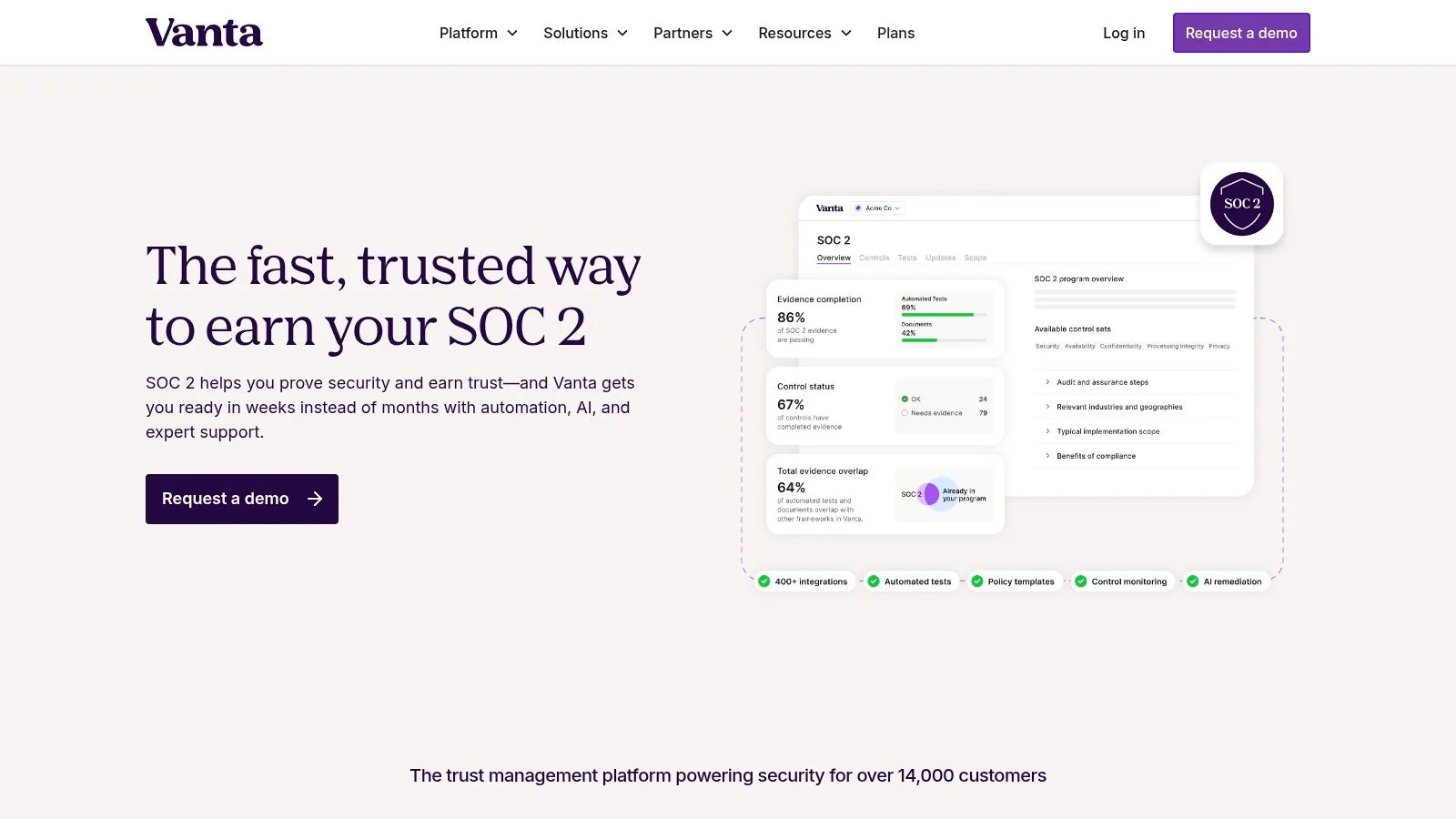
The core value proposition of this SOC 2 software is its ability to reduce the manual effort typically associated with audit preparation. Vanta’s AI-powered tools help generate security policies, manage access reviews, and automate evidence collection across more than 1,200 predefined tests. For businesses seeking a streamlined audit experience, Vanta’s auditor marketplace connects you directly with vetted audit firms, allowing for seamless collaboration and evidence sharing entirely within the platform. You can find more details in this in-depth review of Vanta.
Key Features & Considerations
- Continuous Monitoring: With over 200 integrations, Vanta automatically pulls evidence for controls, significantly reducing manual work and providing a live view of your compliance status.
- Auditor Marketplace: The platform includes a network of audit partners, simplifying the process of finding and engaging a qualified auditor who is already familiar with the Vanta ecosystem.
- Scalability: While excellent for a first SOC 2, Vanta supports growth by expanding into other frameworks like ISO 27001, HIPAA, and GDPR, managing them from a single dashboard.
Pricing is quote-based and tailored to company size, integration needs, and desired frameworks. While its extensive feature set might feel complex for very small teams, its broad automation and integrated auditor experience make it a top choice for organizations prioritizing speed and scalability.
Website: https://www.vanta.com/products/soc-2
2. Drata
Drata is a security and compliance automation platform that positions itself as the smartest way to achieve continuous SOC 2 compliance. Built on a foundation of automation and deep integration, Drata is designed for fast-growing tech companies that need to build a scalable and auditable security program. The platform connects to hundreds of SaaS applications, cloud providers, and infrastructure tools to continuously monitor security controls and collect evidence, simplifying audit readiness.
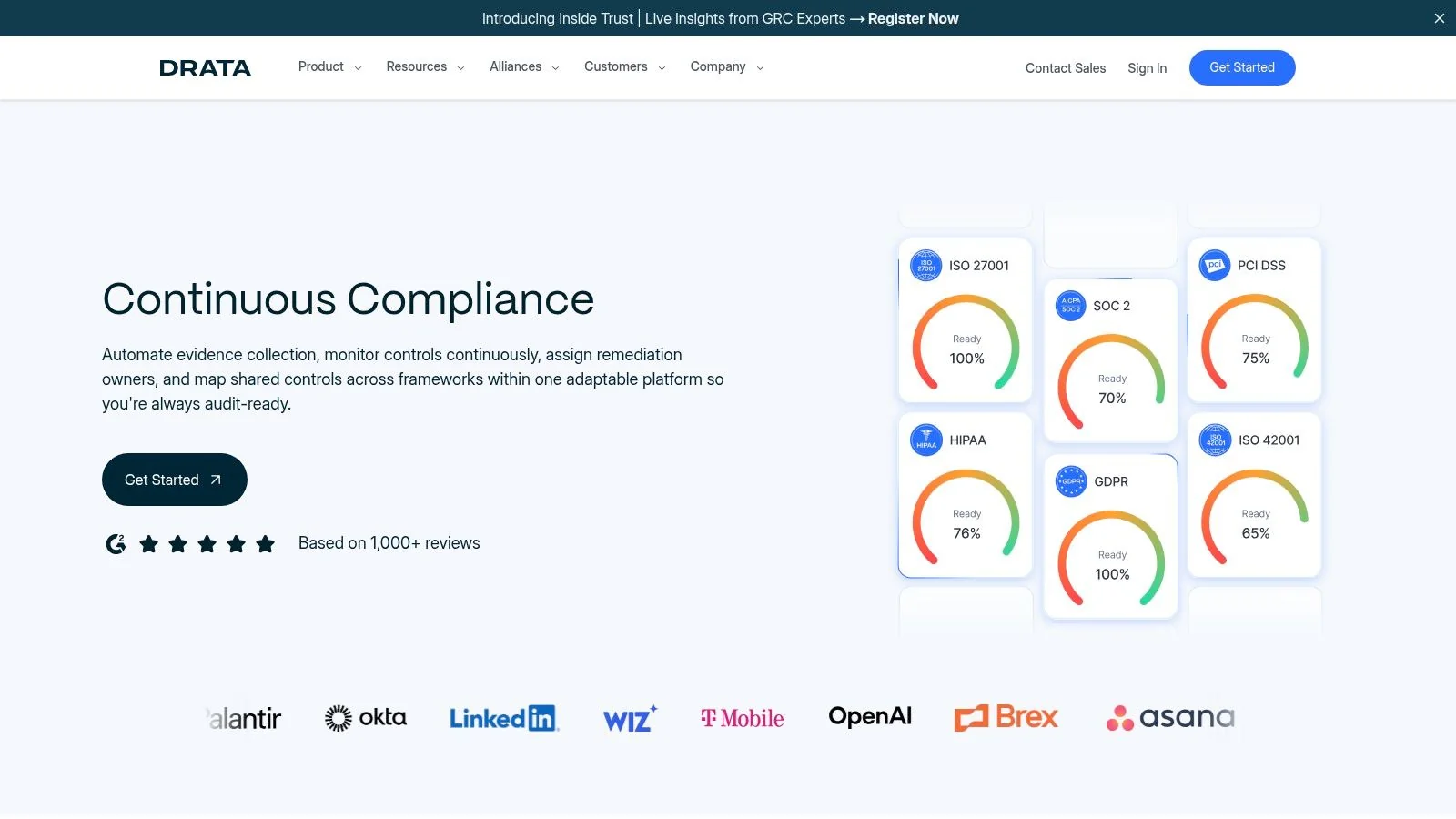
The platform’s core strength lies in its “trust-on-demand” approach, offering real-time visibility into your compliance posture through intuitive dashboards. Drata’s automated evidence collection and testing across more than 300 integrations significantly reduce the manual burden of preparing for an audit. The platform’s well-documented scaling patterns and strong market adoption provide a clear path for companies expanding into multiple frameworks. While auditor fees are separate, you can learn more about the complete SOC 2 cost and timeline considerations when budgeting.
Key Features & Considerations
- Extensive Integrations: With over 300 integrations, Drata automates evidence collection across your entire tech stack, providing continuous control monitoring and automated testing.
- Multi-Framework Support: Drata excels at mapping controls across more than 26 frameworks, allowing businesses to reuse evidence and streamline compliance for SOC 2, ISO 27001, HIPAA, and more.
- Real-Time Readiness Dashboards: The platform provides clear, actionable insights into your compliance status, highlighting gaps and assigning tasks to ensure your team stays on track for a successful audit.
Drata uses a quote-based pricing model and offers robust onboarding support for advanced configurations. Its comprehensive automation and ability to manage multiple frameworks make it an ideal SOC 2 software choice for growth-stage companies planning for long-term, scalable compliance.
Website: https://drata.com/compliance
3. Secureframe
Secureframe offers an all-in-one compliance automation platform that is particularly well-suited for companies tackling their first SOC 2 audit. The platform blends powerful automation with dedicated support from compliance experts, many of whom are former auditors. It connects with your cloud infrastructure, HR systems, and developer tools to continuously gather evidence, monitor controls, and flag compliance gaps in real time.
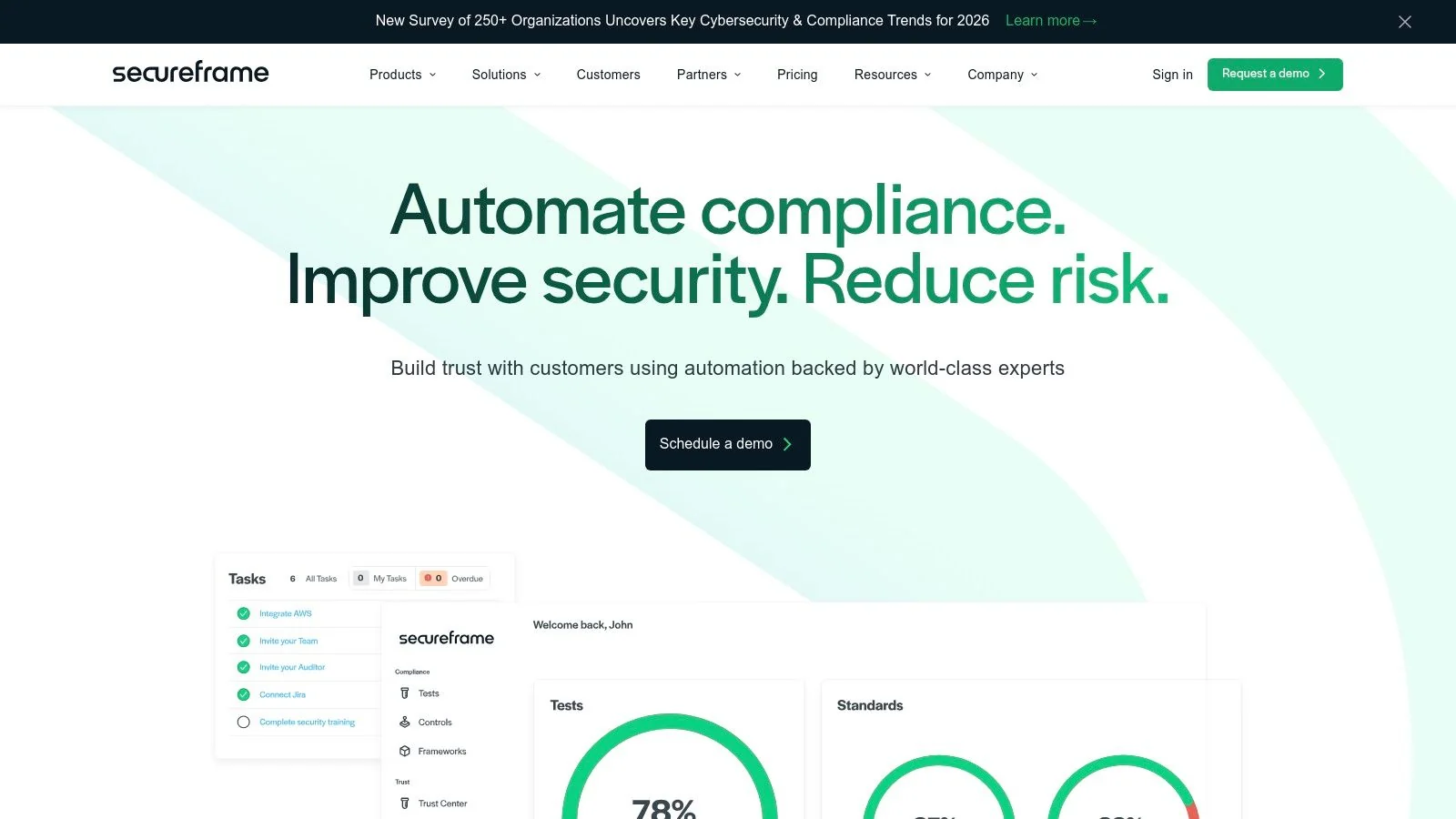
The core strength of this SOC 2 software is its guided approach, which simplifies the complex process for teams without deep security expertise. Secureframe provides a library of auditor-approved policy templates, integrated security awareness training, and automated workflows for vendor management and risk assessments. For auditor selection, Secureframe partners with a network of reputable firms, though you are not locked into their ecosystem. You can find more information about how this compares to other SOC 2 audit firms and their software preferences.
Key Features & Considerations
- Expert-Guided Compliance: Secureframe assigns dedicated compliance experts to each customer, providing hands-on support for control implementation, policy customization, and audit readiness.
- Integrated Training & Policies: The platform includes built-in security awareness training for employees and over 100 customizable policy templates, streamlining two critical components of SOC 2.
- Broad Framework Support: While strong for SOC 2, Secureframe scales to manage other major frameworks like ISO 27001, PCI DSS, HIPAA, and GDPR from one centralized platform.
Pricing is quote-based and depends on factors like company size, the number of employees, and the specific compliance frameworks required. Its combination of robust automation and expert human guidance makes it an excellent choice for organizations that want to build a solid compliance foundation from the start.
Website: https://secureframe.com/
4. Sprinto
Sprinto positions itself as an intelligent compliance automation platform designed for cloud-native companies. It focuses on a prescriptive, guided approach to SOC 2, making it an excellent choice for businesses that want a clear, step-by-step path to audit readiness. The platform helps engineering-led teams translate complex security requirements into concrete tasks, integrating directly with their existing tech stack to automate evidence collection and ensure continuous control monitoring.
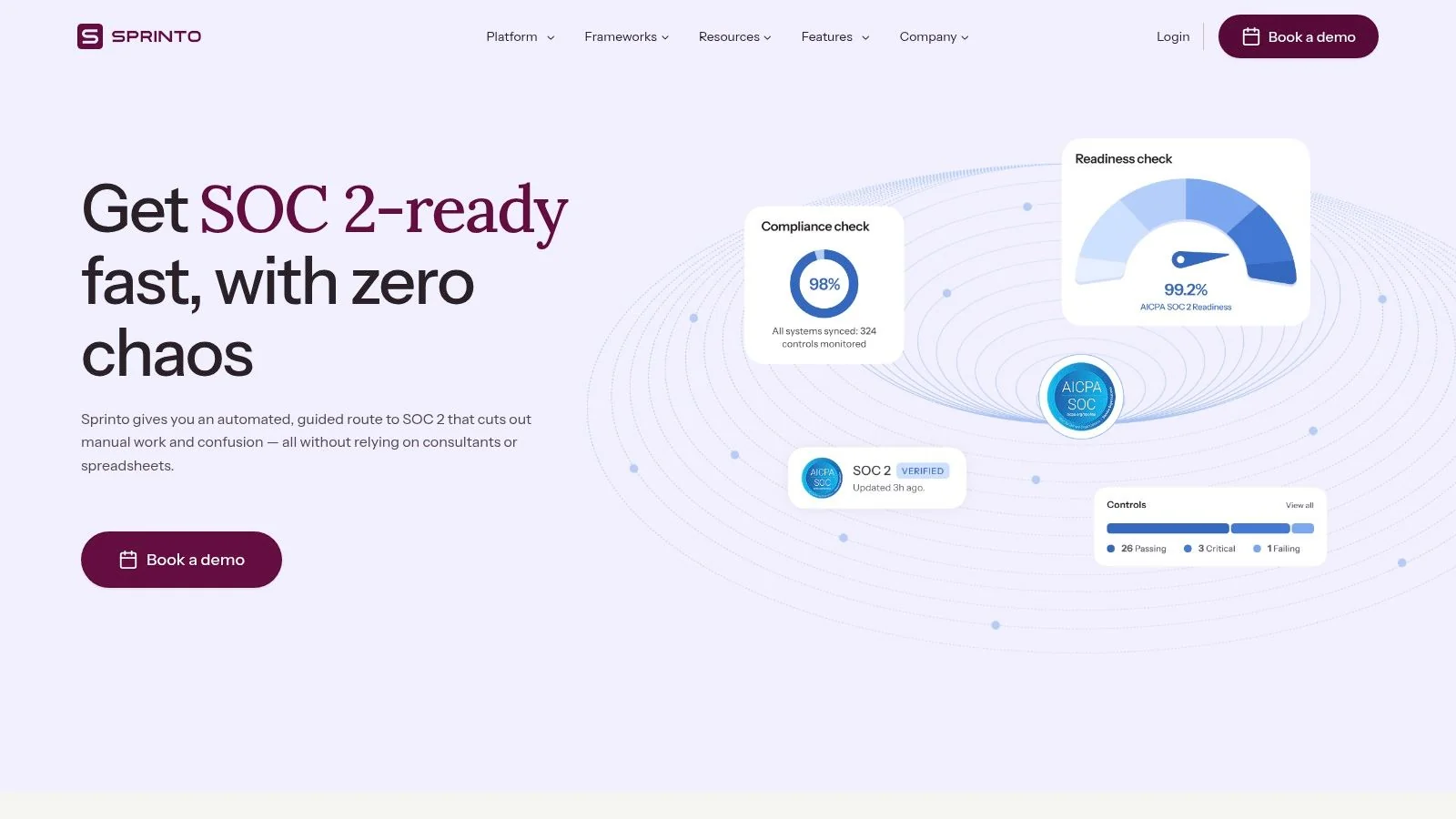
What sets Sprinto apart is its emphasis on speed and clarity from the outset. Its automated onboarding and pre-built SOC 2 program eliminate ambiguity, guiding teams through each required control and policy. By connecting to over 300 business systems via API, Sprinto provides real-time visibility into compliance posture and alerts teams to gaps before they become audit issues. The platform’s helpful public calculators for estimating SOC 2 timelines and costs are also a unique resource for organizations in the planning phase.
Key Features & Considerations
- Guided Onboarding: Sprinto provides a prescriptive, task-based workflow that simplifies the initial setup and helps teams achieve audit readiness quickly.
- Continuous Monitoring: The platform offers automated, entity-level checks across your cloud environment, ensuring that controls remain effective long after the audit is complete.
- Integrated Trust Center: Users can create a public-facing trust center with a single click, providing customers and prospects with real-time assurance of their security posture.
Sprinto’s pricing is quote-based and requires a sales consultation. While its calculators offer valuable planning insights, they present variable scenarios. The platform’s prescriptive nature is ideal for achieving a fast time-to-readiness, but it requires disciplined internal ownership to maintain momentum and stay on track with the automated checks.
Website: https://sprinto.com/get-soc-2/
5. Thoropass
Thoropass (formerly Laika) presents a unique, all-in-one approach to compliance by combining its automation software with an in-house audit and advisory team. This integrated model is designed for organizations that want to simplify procurement and management by working with a single partner for both the preparation platform and the final attestation. The software automates evidence collection and control monitoring, while the in-house audit team provides continuous guidance and performs the audit, creating a deeply connected experience from start to finish.
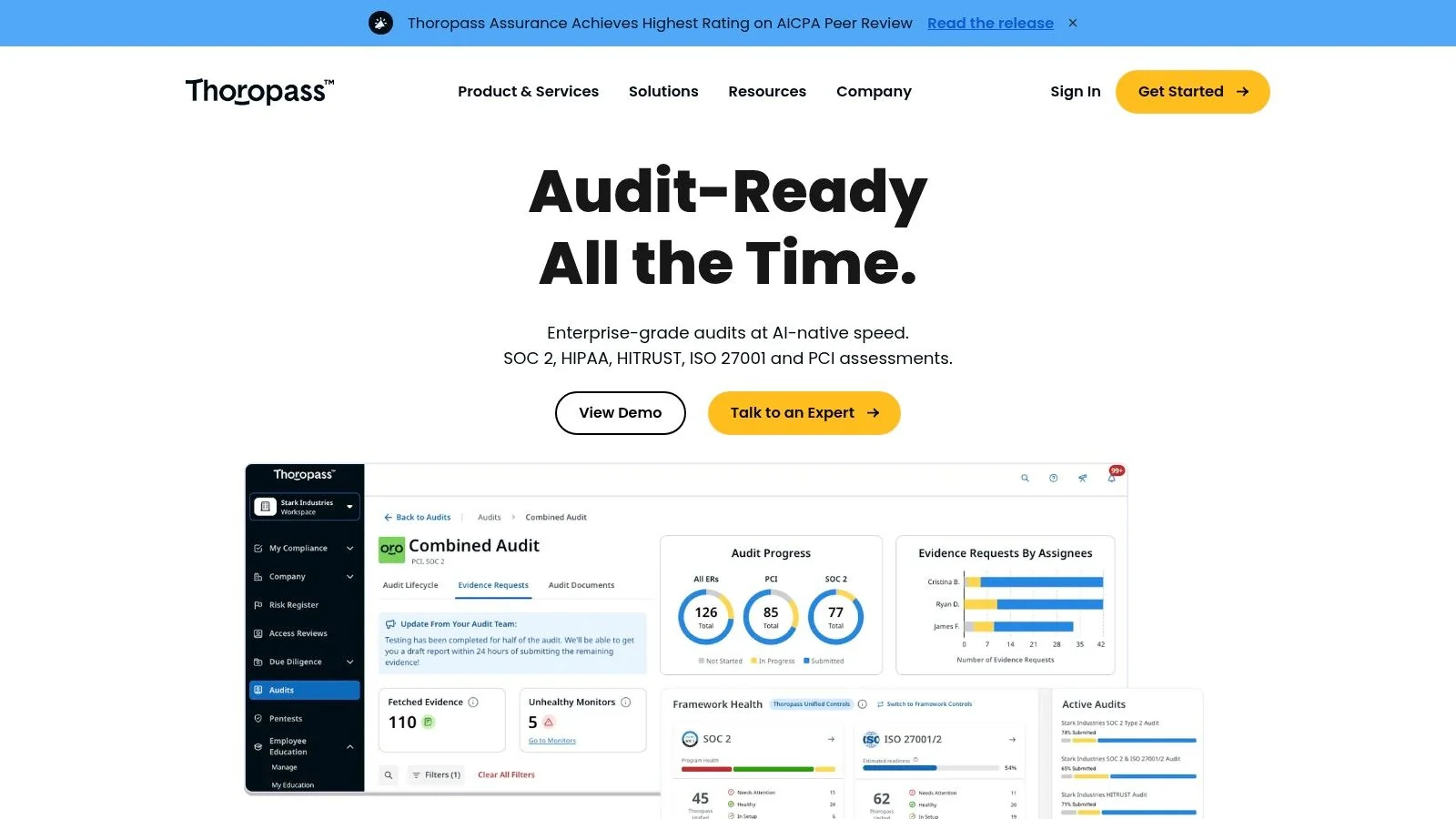
The primary benefit of this SOC 2 software is the elimination of friction between the technology platform and the audit firm. Because the auditors are part of Thoropass, they are experts on the platform, which can accelerate evidence review and reduce back-and-forth communication. The platform’s AI-supported workflows further streamline the process, helping map controls and evidence across multiple frameworks like ISO 27001, HIPAA, and PCI DSS, which is ideal for companies needing to stack compliance certifications efficiently.
Key Features & Considerations
- Integrated Software and Audit: The core offering combines a compliance automation platform with audit services from Thoropass’s own CPA firm, creating a seamless, single-vendor workflow.
- Multi-Framework Support: Thoropass is built to handle complex compliance needs, allowing you to manage and audit SOC 2, ISO 27001, HIPAA, and others from one unified system, minimizing duplicate work.
- Collaborative Audit Process: The platform provides a transparent view into the audit process, allowing teams to collaborate directly with the audit team within the software for real-time feedback and issue resolution.
Pricing is provided on a custom-quote basis. While the integrated model significantly reduces coordination overhead, it also limits your choice of third-party auditors. This makes Thoropass a great fit for businesses that value a streamlined, single-vendor relationship over the flexibility of selecting their own audit firm.
Website: https://thoropass.com/
6. Strike Graph
Strike Graph stands out in the SOC 2 software market by offering transparent, published pricing tiers, which removes the ambiguity often found in vendor quoting processes. The platform is built around a “Right-Sized” compliance approach, allowing businesses to choose a plan that matches their immediate needs and budget. Strike Graph combines a user-friendly compliance SaaS platform with optional, integrated audit and assessment services, providing a potential one-stop-shop experience.
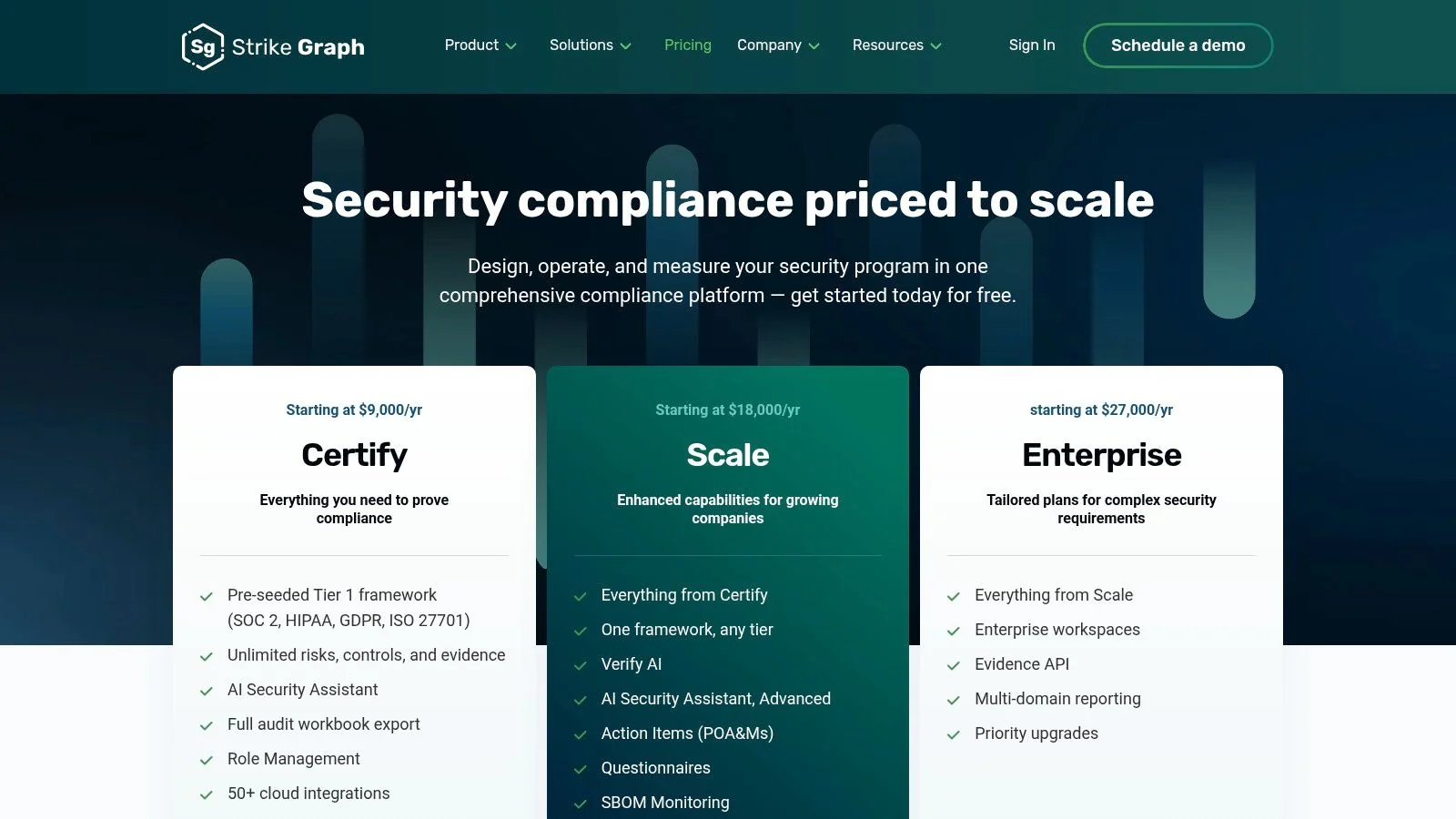
The platform’s core strength lies in its clear cost structure and flexible service model. It guides users through scoping their security program, generating policies, and collecting evidence with the help of an AI Security Assistant. For companies that want a streamlined process, Strike Graph can bundle SOC 2 readiness assessments and even the audit itself through its affiliated CPA firm, making it an attractive option for teams seeking efficiency and predictable costs from a single vendor.
Key Features & Considerations
- Transparent Pricing: Strike Graph publishes its pricing, including a free “Launch” tier for initial setup and paid plans starting at $9,000 per year, which simplifies budgeting for startups and SMBs.
- Integrated Audit Services: The ability to bundle the compliance platform with optional assessment and audit services from a single provider can significantly streamline the end-to-end compliance journey.
- Right-Sized Frameworks: The platform focuses on helping you build a security program that fits your company’s size and risk profile, avoiding the complexity of enterprise-grade tools.
While its clear pricing is a major advantage, the number of native integrations is more limited compared to larger competitors. Advanced features and support for additional frameworks like ISO 27001 often require add-on purchases, so costs can scale as compliance needs grow.
Website: https://www.strikegraph.com/pricing
7. TrustCloud
TrustCloud (formerly Kintent) is an assurance platform that uniquely connects SOC 2 compliance with revenue acceleration. It is designed for businesses that not only need to achieve and maintain compliance but also want to leverage their security posture as a sales tool. The platform uses a control graph and API-based evidence collection to streamline audit preparation while offering powerful tools for managing security questionnaires and demonstrating trust to customers.
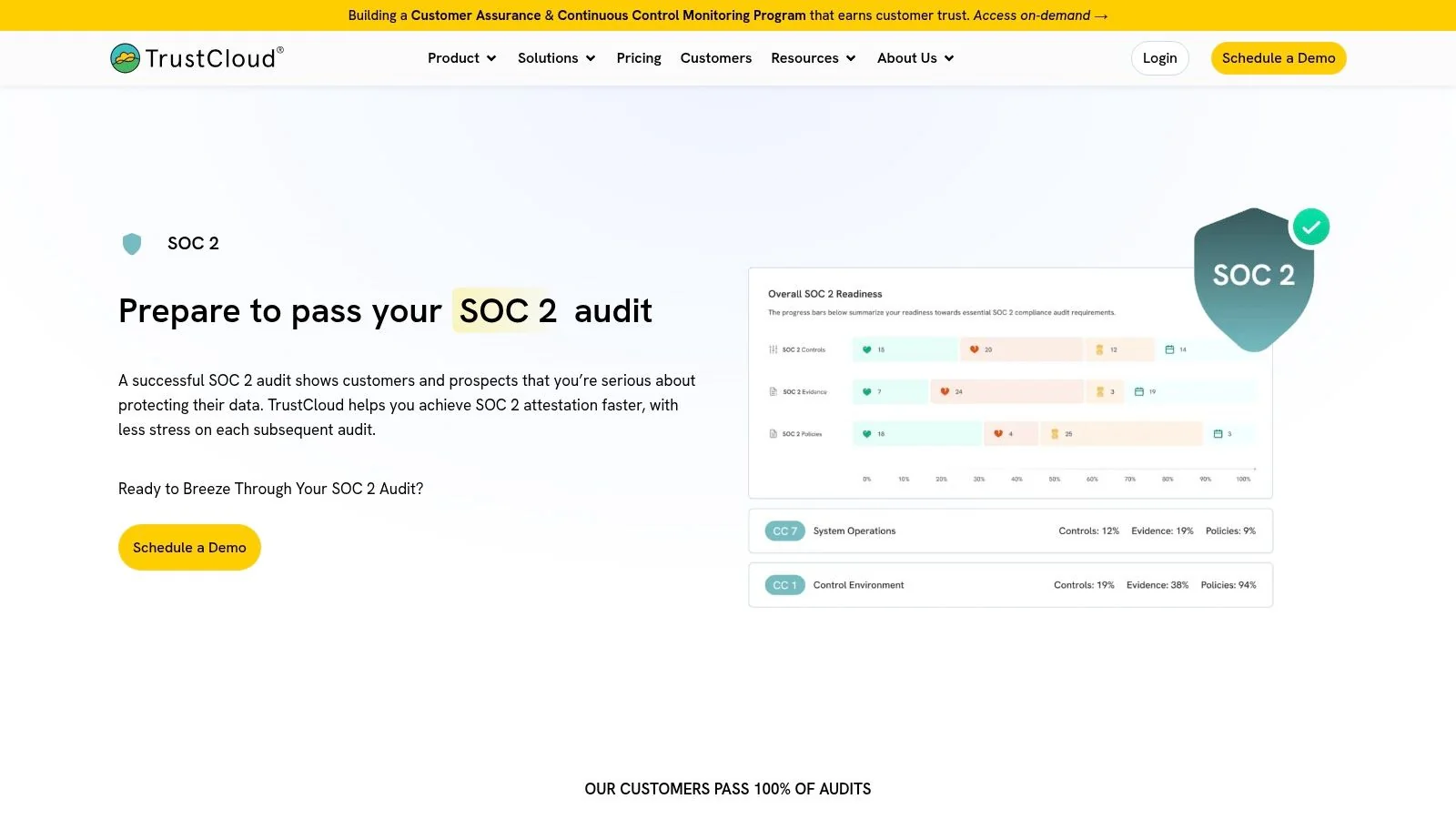
The core differentiator of this SOC 2 software is its focus on turning compliance efforts into tangible business outcomes. TrustCloud helps teams manage incoming security questionnaires from prospects by automating responses based on their verified controls. This approach reduces the burden on security and sales teams, speeds up sales cycles, and provides a clear ROI on compliance investments. Its trust portals allow you to proactively share your security and compliance documentation with customers, building confidence from the first interaction.
Key Features & Considerations
- Trust Assurance for Revenue: Directly links your compliance activities to sales enablement through automated security questionnaire responses and customer-facing trust portals.
- Continuous Control Monitoring: Leverages a control graph and API integrations to automate evidence collection and provide real-time visibility into your compliance status.
- Cross-Framework Mapping: Efficiently maps controls and evidence across multiple frameworks like SOC 2, ISO 27001, and HIPAA, reducing redundant work for multi-certified organizations.
Pricing for TrustCloud is available upon request. While its integration catalog is smaller than some of the largest platforms in the market, its unique focus on connecting assurance to sales makes it an excellent choice for organizations looking to weaponize their compliance posture for a competitive advantage.
Website: https://www.trustcloud.ai/soc2/
8. OneTrust (Certification Automation / Tugboat Logic)
OneTrust offers its Certification Automation module, built upon the foundation of its Tugboat Logic acquisition, to streamline compliance across numerous frameworks. This platform is ideal for enterprises that already use or plan to use OneTrust’s broader suite for privacy, GRC, and ethics programs. It aims to unify SOC 2 compliance with other risk management functions, providing a single source of truth for an organization’s entire compliance posture. The platform automates evidence collection, generates security policies, and maps controls across more than 50 frameworks.
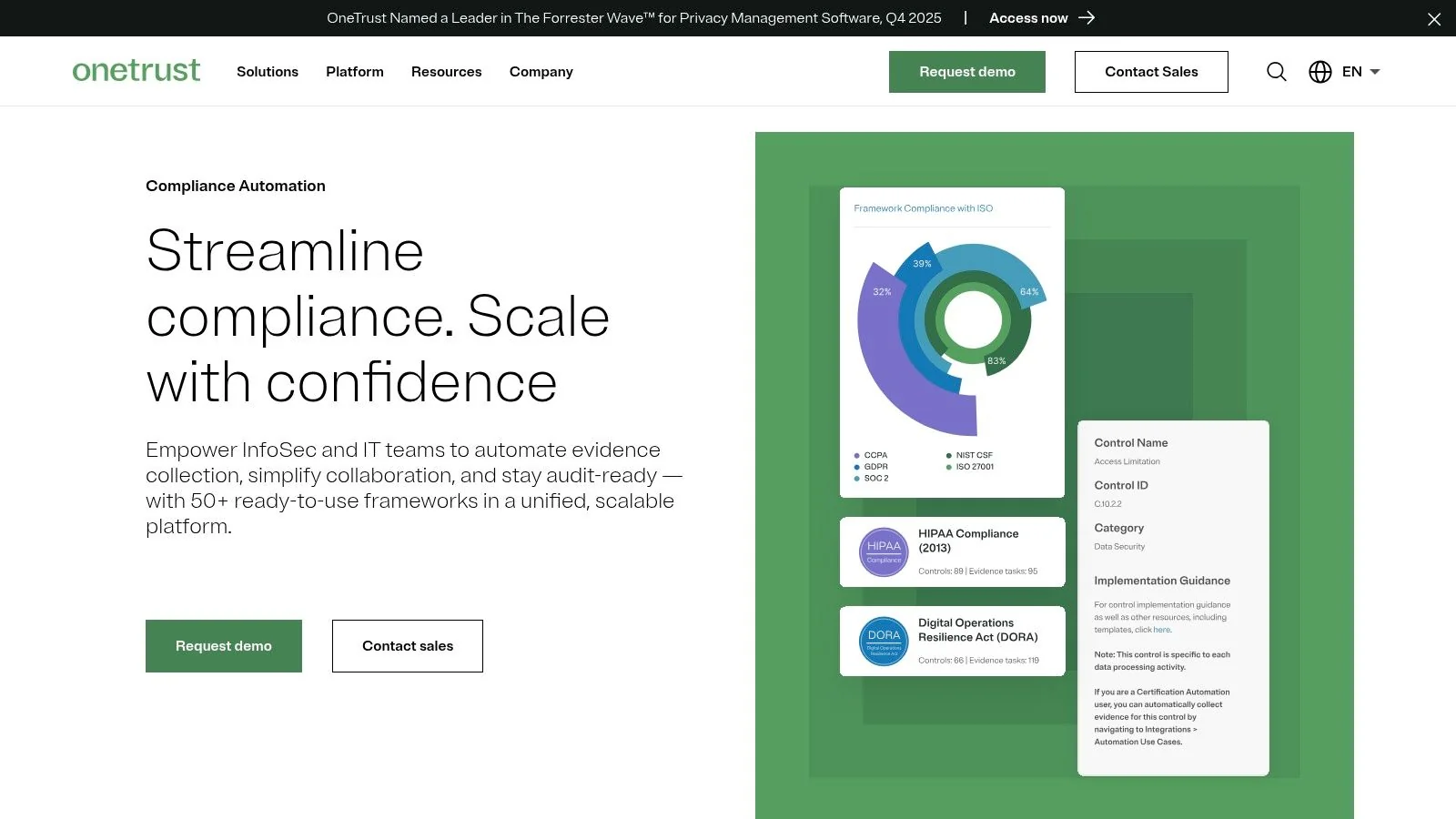
The primary differentiator of this SOC 2 software is its deep integration into a comprehensive GRC ecosystem. A “test once, comply many” approach allows you to map a single piece of evidence to multiple controls across SOC 2, ISO 27001, and others, saving significant time for teams managing multiple certifications. A scoping wizard helps tailor requirements from the start, ensuring you focus only on relevant controls. While its extensive capabilities are powerful, the platform’s breadth can feel complex for smaller teams solely focused on their first SOC 2.
Key Features & Considerations
- Broad Enterprise GRC Ecosystem: The platform’s strength is its ability to grow with you, connecting SOC 2 efforts directly to privacy, IT risk management, and data governance modules.
- Cross-Framework Mapping: Its evidence mapping feature is highly efficient for organizations that must adhere to multiple compliance standards, reducing redundant audit preparation work.
- Integrated Policy Engine: OneTrust helps auto-generate security policies based on your scoped frameworks, providing a solid foundation for your information security program.
Pricing is quote-based, reflecting the platform’s enterprise focus and the varying scope of implementation. While a free trial path is sometimes noted, OneTrust is best suited for established companies seeking to consolidate compliance into a single, powerful system rather than a standalone SOC 2 tool.
Website: https://www.onetrust.com/products/certification-automation/
9. Hyperproof
Hyperproof is a governance, risk, and compliance (GRC) platform built to scale complex security programs, making it a strong contender for companies managing multiple frameworks beyond just SOC 2. It positions itself as an enterprise-grade solution that centralizes control management and evidence collection, allowing teams to reuse work across audits like ISO 27001, PCI DSS, and HIPAA. The platform’s strength lies in its ability to create a single source of truth for compliance activities.
This SOC 2 software is particularly effective for organizations that need to map controls and evidence across different standards. Instead of duplicating efforts for each audit, Hyperproof’s “controls-as-a-service” model lets you link a single piece of evidence to multiple requirements. It also features a robust partner ecosystem, enabling businesses to connect with advisory and audit firms that can assist with implementation and ongoing management, which is ideal for complex rollouts.
Key Features & Considerations
- Evidence Reuse: Its standout feature is the ability to collect evidence once and reuse it across numerous frameworks, which dramatically reduces redundant work for teams pursuing multiple certifications.
- Centralized Control Library: Hyperproof allows you to build and manage a central library of controls that are mapped to various standards, providing a unified view of your compliance posture.
- Partner Ecosystem: The platform integrates with a network of service and advisory partners, offering expert support for implementation, which is beneficial for enterprises without large in-house GRC teams.
Pricing is quote-based and tailored to enterprise needs, so it may be more than what a small startup requires for a first-time audit. While its comprehensive feature set is powerful, smaller teams might find that implementation requires more strategic planning, potentially with the help of a partner.
Website: https://hyperproof.io/soc2/
10. AuditBoard
AuditBoard is an AI-first connected risk and GRC platform built for large enterprises that need to manage SOC 2 compliance within a broader governance framework. Unlike tools focused solely on initial certification, AuditBoard provides a centralized hub to oversee multiple compliance standards, automate control mapping, and generate sophisticated reports for leadership and board-level visibility. It is designed for mature organizations that require a robust, enterprise-grade solution for managing complex risk and compliance landscapes.
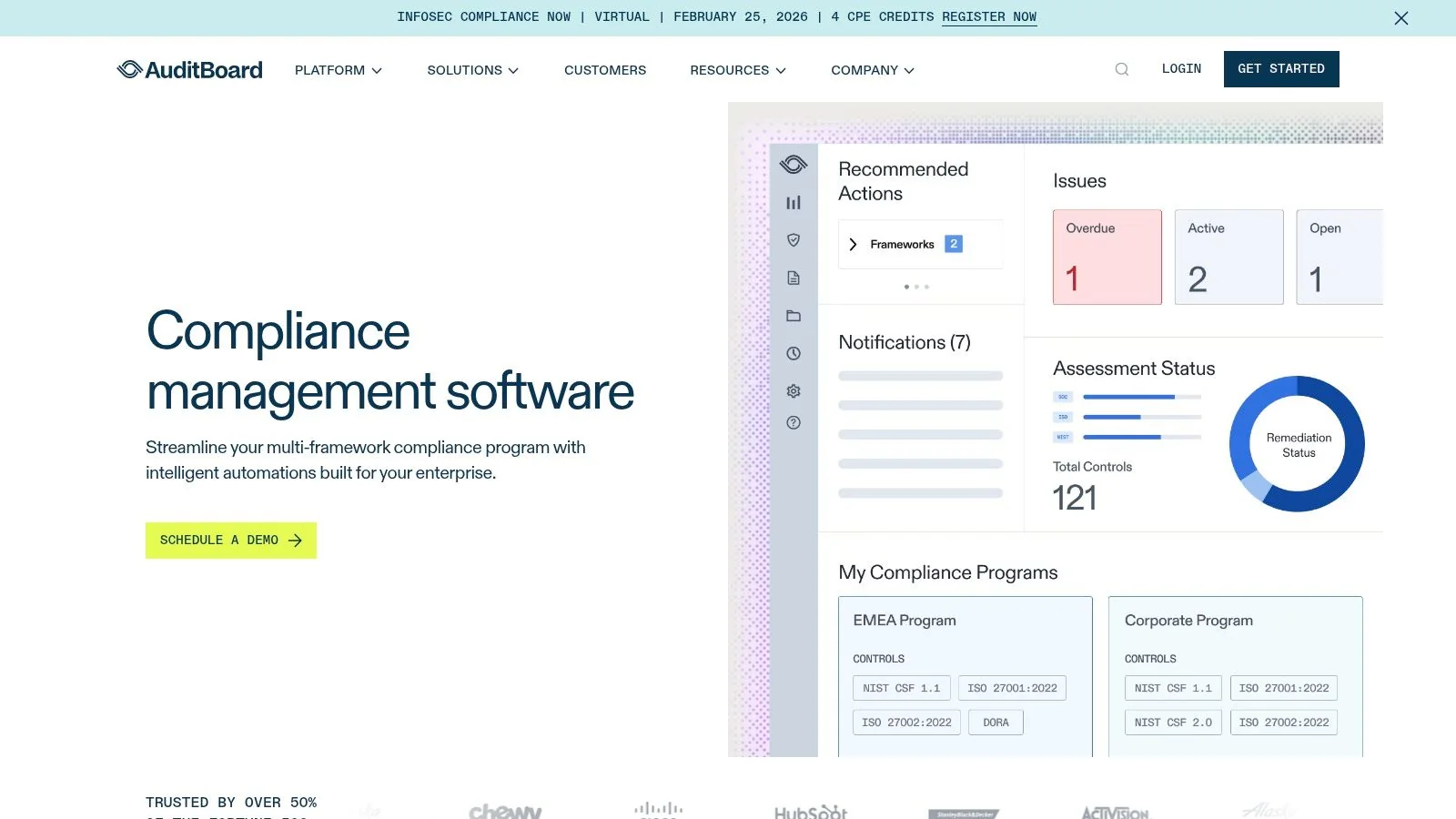
The platform excels at connecting risks across the business, offering a unified view of controls and their effectiveness. AuditBoard’s AI capabilities assist with tasks like gap assessments and evidence automation, streamlining the internal audit process. For businesses needing more than just a SOC 2 software solution, AuditBoard provides an integrated suite for SOX, internal audit, ESG, and third-party risk management, making it a comprehensive choice for holistic GRC strategies.
Key Features & Considerations
- Centralized Multi-Framework Compliance: AuditBoard allows you to map controls across multiple frameworks (SOC 2, ISO 27001, SOX, etc.), avoiding redundant work and creating a single source of truth for compliance.
- Advanced Reporting and Analytics: The platform offers powerful, customizable dashboards and reporting tools designed to provide deep insights into risk posture and compliance status for executive stakeholders.
- Enterprise-Grade Scalability: Built for complexity, it integrates with a wide range of enterprise systems and is proven to scale with large, global organizations managing extensive control environments.
Pricing is quote-based, reflecting its enterprise focus and the need for a tailored implementation. While its comprehensive feature set may be overkill and too complex for startups or small businesses, AuditBoard is a top-tier option for mid-market and enterprise companies seeking a powerful, integrated risk management platform.
Website: https://www.auditboard.com/product/compliance-control
11. A-LIGN A-SCEND
A-SCEND by A-LIGN is an audit and compliance management platform that uniquely integrates software with audit services. Developed by a leading CPA firm, it’s designed for businesses that want a unified experience where their compliance software is directly connected to their auditor. The platform streamlines evidence collection, manages controls, and facilitates direct collaboration between your team and A-LIGN’s audit professionals, aiming to eliminate the friction that often occurs between a company and its external assessor.
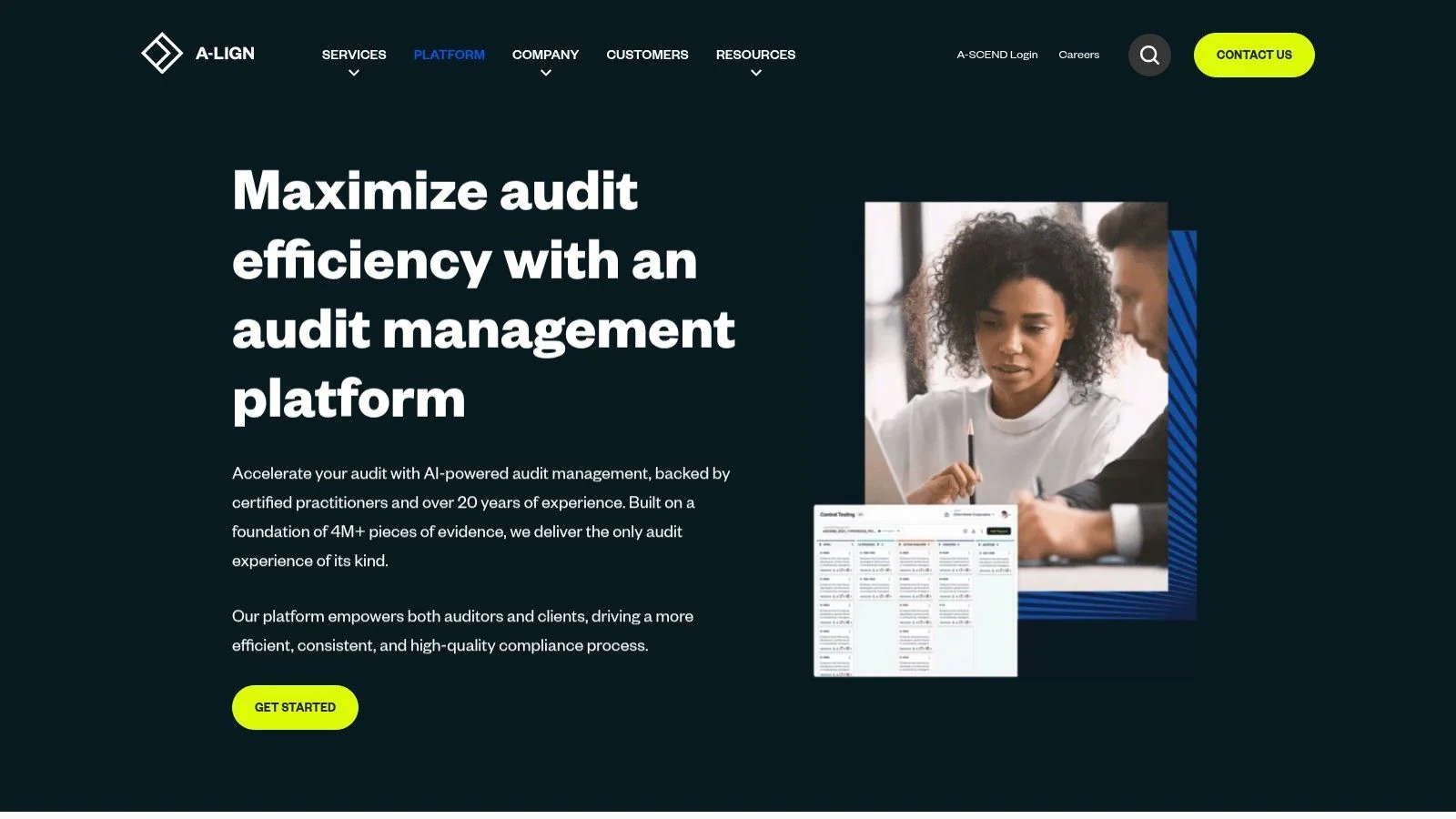
The primary value of this SOC 2 software is its auditor-centric workflow. Unlike standalone tools, A-SCEND is purpose-built to accelerate the audit process specifically with A-LIGN. Its AI-assisted features help with evidence reuse and mapping controls across multiple frameworks, which is a significant advantage for companies pursuing SOC 2 alongside frameworks like ISO 27001 or HIPAA. This approach reduces redundant work and keeps audit activities centralized in one place.
Key Features & Considerations
- Integrated Auditor Collaboration: The platform serves as a direct communication and evidence-sharing portal with your A-LIGN audit team, creating a more transparent and efficient audit cycle.
- Evidence Deduplication: A-SCEND’s AI capabilities help identify and reuse evidence across multiple controls and frameworks, saving significant time and effort during audit preparation.
- Auditor-Backed Platform: Since the software is developed by auditors, its workflows are inherently aligned with what is required for a successful attestation, potentially reducing back-and-forth.
Pricing for A-SCEND is quote-based, as it’s typically bundled with A-LIGN’s audit services. This model is ideal for organizations that have already decided to use A-LIGN as their auditor. However, for companies wanting to keep their software and audit firm separate, the platform’s tight integration with A-LIGN might be a limiting factor.
Website: https://www.a-lign.com/a-scend
12. Aptible
Aptible offers a unique approach to SOC 2 compliance by providing a managed infrastructure platform that already implements many required technical controls. Instead of solely automating evidence collection, Aptible allows development teams to build and deploy on a foundation where controls for logging, access, patching, and encryption are inherited. This model is designed for teams that want to offload a significant portion of their infrastructure-level security operations to a SOC 2-ready environment.
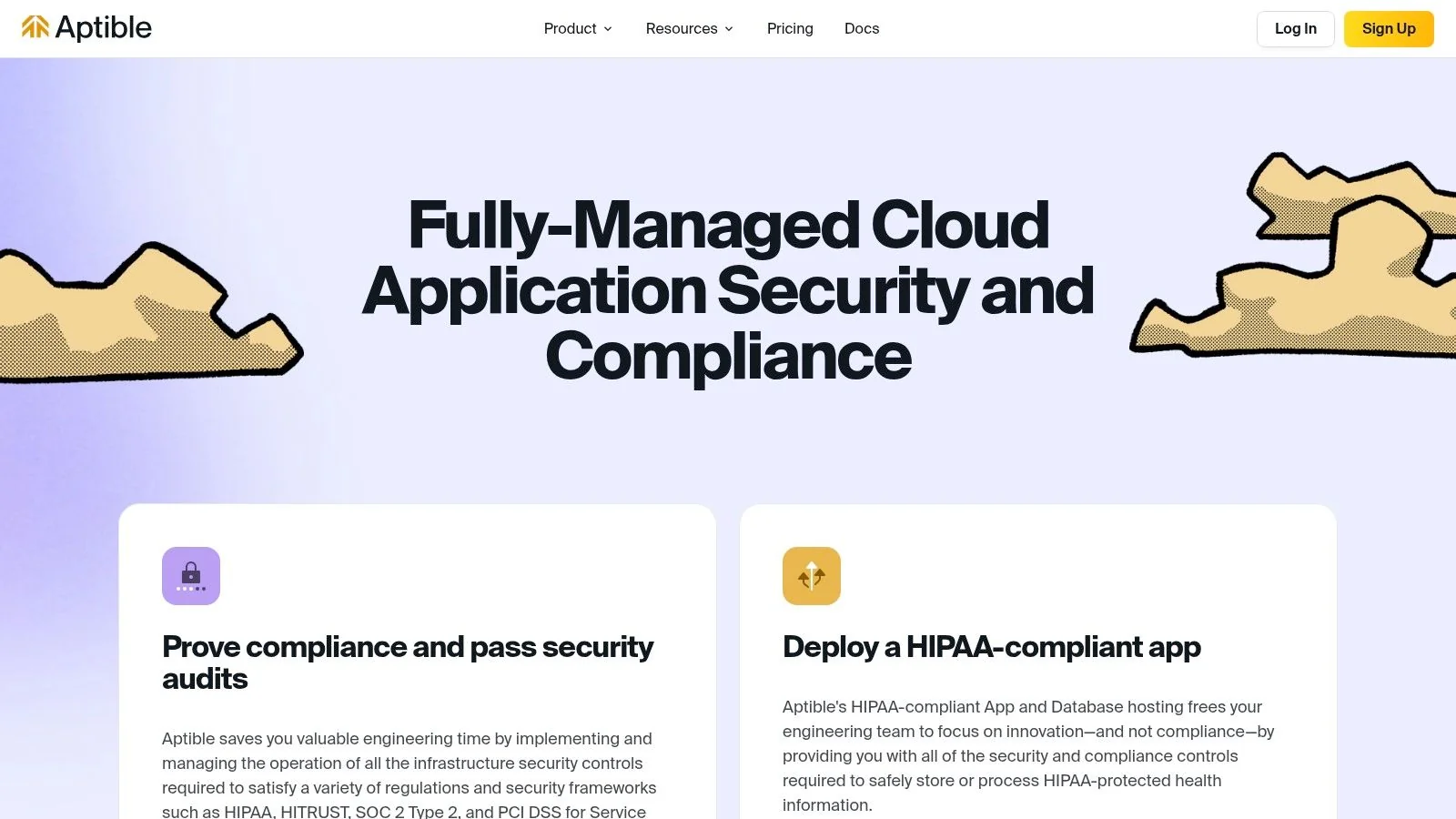
The primary value of this SOC 2 software is its ability to accelerate readiness by providing a compliant-by-design PaaS (Platform as a Service). By hosting on Aptible, companies can satisfy a large number of technical audit requirements out of the box, reducing the scope of internal work. Aptible provides its own SOC 2 attestation and detailed documentation to help customers and their auditors understand how its inherited controls map to the Trust Services Criteria, simplifying the evidence-gathering process for infrastructure security.
Key Features & Considerations
- Inherited Technical Controls: Automatically satisfies numerous SOC 2 requirements related to infrastructure security, including encryption, logging, vulnerability scanning, and disaster recovery.
- Compliance-Focused Infrastructure: Built specifically for regulated industries, with support not only for SOC 2 but also for HIPAA, HITRUST, and PCI DSS, making it ideal for HealthTech and FinTech.
- Audit Support: Provides customers with access to its own compliance reports and a trust portal, which can be shared with auditors to prove the underlying infrastructure is secure.
Pricing is based on resource consumption within the platform. While Aptible dramatically reduces the burden of infrastructure compliance, it is not a traditional GRC tool for managing policies or company-wide controls. Organizations often use it alongside a separate compliance platform to manage the administrative side of their SOC 2 program.
Website: https://www.aptible.com/security-compliance
Top 12 SOC 2 Compliance Tools Comparison
| Vendor | Key features | Ideal for | Strengths | Limitations | Pricing & timeline |
|---|---|---|---|---|---|
| Vanta | 1,200+ automated tests; 200+ integrations; policy generation; in-platform auditor workflows | Teams wanting broad automation + auditor marketplace; scaling to multi-framework | Large integration ecosystem; reduces auditor coordination; continuous monitoring | Quote-based pricing; can feel heavyweight for very small teams | Pricing: quote-based. Continuous monitoring; timelines vary by scope |
| Drata | Automated evidence/testing; 300+ integrations; control mapping across 26+ frameworks; real-time dashboards | Teams prioritizing continuous monitoring and framework reuse | Well-documented automation and scaling patterns; strong market adoption | Quote-based pricing; auditor fees usually separate; advanced setup may need support | Pricing: quote-based; readiness dashboards provide real-time timelines |
| Secureframe | Automated tests; training & policy templates; readiness reporting; 300+ integrations | First-time SOC 2 programs wanting automation + expert guidance | Mixes automation with former-auditor expertise; strong onboarding support | Pricing requires sales contact; may rely on vendor ecosystem for some audits | Pricing: contact sales; timelines dependent on program size |
| Sprinto | Pre-built SOC 2 program; API evidence collection; continuous monitoring; planning calculators | Teams needing fast, prescriptive path to readiness | Fast time-to-readiness; public calculators for budgeting | Sales-led pricing; requires disciplined internal ownership | Pricing: sales-led/variable; emphasizes quick readiness (tooling for planning) |
| Thoropass | Software + in-house CPA audit service; AI workflows; multi-framework support | Organizations wanting single-vendor platform + attestation | Single-vendor reduces coordination; designed to minimize duplicate evidence | Fewer independent auditor choices; pricing not public | Pricing: not public; built for collaborative, faster attestations |
| Strike Graph | Published pricing (free Launch + paid tiers); AI Security Assistant; add-ons; optional audit services | Buyers wanting transparent entry pricing and clearer cost expectations | Clear published tiers; can bundle assessments and some audit workbooks | Add-ons raise cost; fewer integrations vs largest incumbents | Pricing: Free tier + paid from ~$9K/year; timelines depend on chosen tier/services |
| TrustCloud | Control graph; API evidence collection; trust portals; questionnaire automation | Teams tying assurance to sales enablement and customer questionnaires | Strong focus on revenue-facing trust workflows; questionnaire automation | Pricing not public; smaller integration catalog than largest players | Pricing: not public; offers promotional terms sometimes |
| OneTrust (Certification Automation) | Scoping wizard; policy auto-generation; cross-framework mapping (50+ frameworks); integrates with OneTrust stack | Enterprises needing unified GRC, privacy and SOC 2 in one ecosystem | Broad enterprise GRC ecosystem; good fit if using OneTrust modules | Complex interface for small teams; quote-based pricing; implementation scope varies | Pricing: quote-based; free trial path available on product pages |
| Hyperproof | SOC 2 templates; evidence reuse; centralized control library; partner ecosystem | Enterprise compliance ops and partner-supported rollouts | Strong multi-framework library and partner integrations; clear documentation | Pricing not public; enterprise-leaning implementation often requires partners | Pricing: not public; designed for scaled programs |
| AuditBoard | Centralized multi-framework compliance; AI gap assessments; advanced reporting & analytics | Mid-market and enterprise needing governance, reporting and board visibility | Proven at scale; deep analytics and reporting for leadership | Overkill for small startups; quote-based pricing; implementation effort needed | Pricing: quote-based; enterprise rollout timelines vary |
| A-LIGN A-SCEND | AI-assisted audit management; direct collaboration with A-LIGN auditors; evidence reuse | Companies that plan to use A-LIGN as their auditor and want auditor-backed software | Backed by a CPA firm; purpose-built to accelerate external attestations | Works best if you choose A-LIGN; pricing and timelines client-scoped | Pricing: client-scoped (not public); timelines vary by engagement |
| Aptible | Inherited SOC 2-aligned controls (logging, access, patching); compliance dashboard; customer trust portal | Startups wanting to offload infrastructure-level control operations | Offloads large portion of technical controls; helpful for teams without deep infra/sec staff | Not a full GRC tool; must host on Aptible to maximize benefits | Pricing: not public; reduces internal prep by inheriting controls and attestations |
Making Your Final Decision: Software, Auditors, and Your Path Forward
Navigating the landscape of SOC 2 compliance can feel overwhelming, but as we’ve explored, the right technology can transform this complex challenge into a manageable, strategic initiative. We’ve dissected a dozen leading platforms, from comprehensive GRC suites like AuditBoard and OneTrust to startup-focused automation engines like Vanta, Drata, and Secureframe. Each tool offers a unique blend of features, integrations, and pricing models designed for different stages of organizational maturity.
The central takeaway is that there is no single “best” SOC 2 software. The ideal choice for your company hinges on a clear understanding of your specific needs, your existing tech stack, your team’s capacity, and your long-term compliance roadmap. A high-growth startup aiming for a quick Type 1 report has vastly different requirements than a mature enterprise managing multiple frameworks and continuous monitoring for a Type 2.
Synthesizing Your Options: Key Decision Factors
Before making a final commitment, revisit the core evaluation criteria we’ve discussed. Your decision-making process should be a deliberate one, moving from a broad list to a shortlist of two or three highly relevant contenders.
- Audit Readiness vs. Continuous Compliance: Are you focused solely on passing an audit as quickly as possible, or are you building a sustainable, long-term security program? Tools like Sprinto and Thoropass excel at guided, rapid readiness, while platforms like Hyperproof and TrustCloud are built for a more holistic, continuous compliance posture.
- Platform vs. Point Solution: Do you need a dedicated SOC 2 tool, or a broader GRC platform that can grow with you to include ISO 27001, HIPAA, and GDPR? Consider your three-to-five-year plan. Investing in a more robust platform now might save significant migration headaches later.
- Integration Depth and Breadth: A platform’s true power lies in its ability to connect to your ecosystem. Don’t just look at the logo list; ask for specifics during demos. How deep does the integration go? Does it just check for a setting, or can it pull detailed evidence, like pull request approvals from GitHub or user access logs from AWS? The quality of these connections directly impacts the level of automation you will achieve.
- Cost and Total Cost of Ownership (TCO): Look beyond the initial subscription fee. Factor in the cost of your audit, the internal time required from your engineering and management teams, and any potential add-on modules you may need in the future. A cheaper tool that requires more manual work can quickly become more expensive in terms of personnel hours.
The Critical Link: Your Auditor Relationship
Choosing the right SOC 2 software is a foundational step, but it is only one half of the equation. Your success ultimately depends on the partnership between your team, your chosen technology, and your audit firm. Even the most advanced automation platform cannot compensate for a poor auditor relationship defined by slow communication, surprise findings, or a fundamental misunderstanding of your business model.
Many of the platforms we’ve reviewed offer their own audit services or have preferred partners. While this can streamline the process, it’s crucial to perform your own due diligence. Your auditor should be an independent partner who not only tests your controls but also provides valuable context and guidance.
Once you have your software shortlist, the next critical task is to find an auditor who complements your choice. By pairing the right automation platform with a responsive, expert audit partner, you can transform SOC 2 from a daunting compliance hurdle into a powerful strategic asset. This dual approach doesn’t just get you a report; it builds a scalable security program that accelerates sales cycles, unlocks enterprise deals, and establishes a foundation of lasting customer trust.
Ready to find the other half of your compliance equation? The most powerful soc 2 software can’t guarantee a smooth audit without the right partner. At SOC2Auditors, we help you de-risk the selection process by providing transparent pricing, timelines, and verified reviews for top-tier audit firms, ensuring you find the perfect fit for your new platform. Find your ideal SOC 2 auditor today.