 Menu
Menu
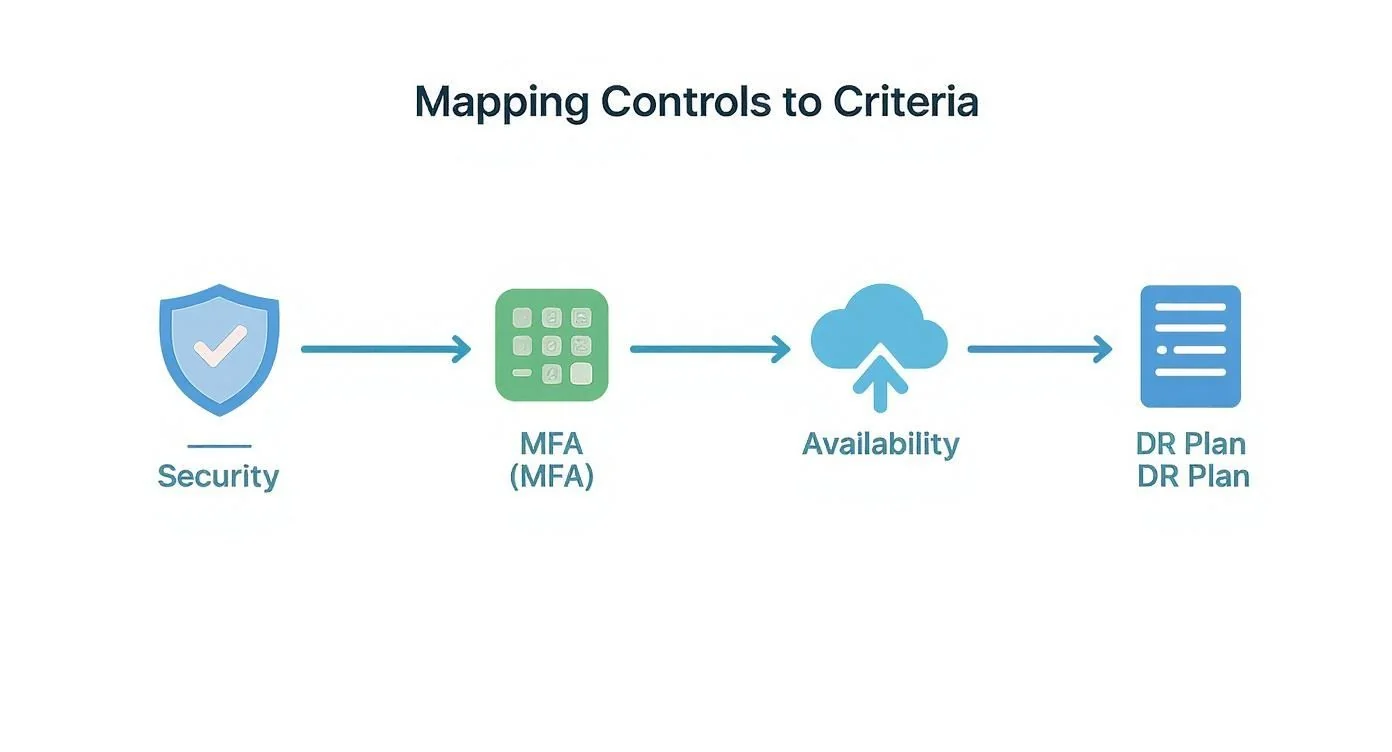
The SOC 2 controls list is not a fixed AICPA catalog. SOC 2 defines criteria you must meet, and you design the controls that satisfy them. The criteria come from the AICPA’s 2017 Trust Services Criteria (with revised points of focus, 2022): 33 Common Criteria under Security (CC1–CC9), plus supplemental criteria for Availability (A1.1–A1.3), Processing Integrity (PI1.1–PI1.5), Confidentiality (C1.1–C1.2), and Privacy (P1–P8). A control is the specific, auditable action — MFA enforcement, quarterly access reviews, a tested disaster-recovery plan — that maps to one or more of those criteria and produces evidence an auditor tests.
This page maps every criteria family to the controls that satisfy it and the exact evidence auditors in our network request — including the gaps that draw the most exceptions in 2026. For how controls fit the wider picture, see our SOC 2 compliance guide and the SOC 2 Trust Services Criteria reference. To match with a firm that audits companies like yours, browse the SOC 2 auditor directory.
SOC 2 Criteria at a Glance
| Criteria family | Designation | Count | Scope |
|---|---|---|---|
| Security (Common Criteria) | CC1–CC9 | 33 | Mandatory for every SOC 2 report |
| Availability | A1.1–A1.3 | 3 | Uptime, capacity, recovery |
| Processing Integrity | PI1.1–PI1.5 | 5 | Complete, accurate, timely processing |
| Confidentiality | C1.1–C1.2 | 2 | Protecting designated confidential data |
| Privacy | P1–P8 series | ~18 | Lifecycle of personal information |
Source: AICPA, 2017 Trust Services Criteria (with revised points of focus, 2022). Security is required; you scope in the other four based on the commitments you make to customers.
What Are SOC 2 Controls?
SOC 2 controls are the specific policies, procedures, and technologies that demonstrate an organization meets the AICPA’s Trust Services Criteria. They are the auditable, operational actions — MFA enforcement, quarterly access reviews, vulnerability scanning — that turn a written security policy into verifiable proof.
SOC 2 is principles-based: the AICPA gives you criteria and points of focus, not a prescribed control list. You design controls that fit your systems and risks.
A policy might say “access to sensitive data must be restricted.” The controls that make that real include:
- Multi-Factor Authentication (MFA): a second verification factor before users reach critical systems.
- Role-Based Access Control (RBAC): roles with preset permissions so employees see only the data their job needs.
- Access reviews: quarterly checks that former employees are de-provisioned and current permissions still fit.
Each is a distinct control an auditor can test against the relevant criterion. The controls are the evidence that your security commitments hold over time.
What Are the Five SOC 2 Trust Services Criteria?
The five Trust Services Criteria are Security (mandatory for every report), Availability, Processing Integrity, Confidentiality, and Privacy — each defined by the AICPA’s 2017 TSC (revised points of focus, 2022). Security is governed by 33 Common Criteria (CC1–CC9); the other four add supplemental criteria you scope in based on the commitments you make to customers.
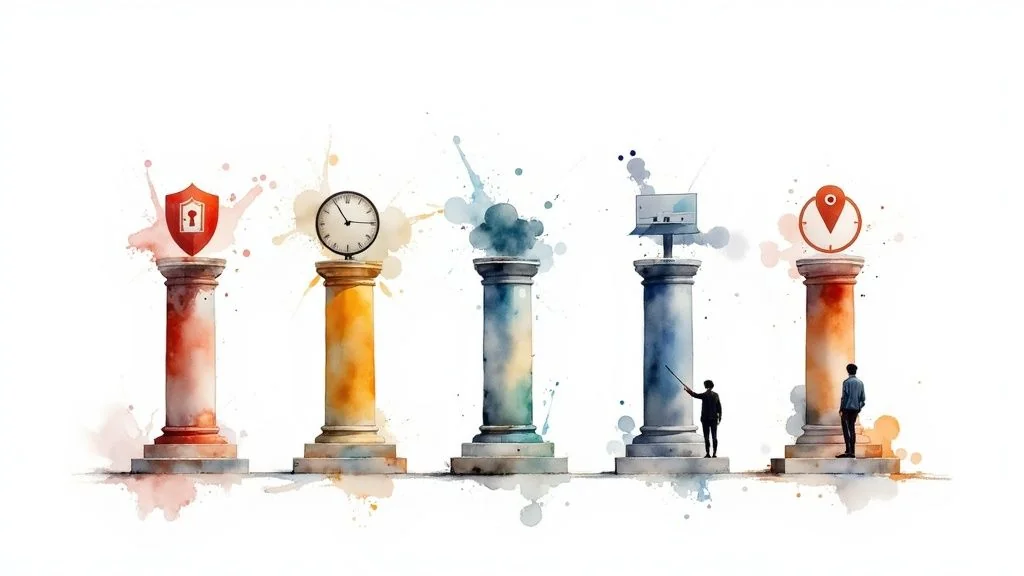
SOC 2 rests on five Trust Services Criteria (TSC), defined by the AICPA in the 2017 TSC document with revised points of focus published in 2022. The 33 Common Criteria (CC1–CC9) cover the control environment, communication, risk assessment, monitoring, control activities, logical and physical access, system operations, change management, and risk mitigation. The remaining four criteria sets — Availability, Processing Integrity, Confidentiality, and Privacy — apply only if you commit to them.
Here is what each criterion covers and the controls auditors expect.
Security: The Mandatory Foundation
Security is the only criterion required in every SOC 2 report. It protects systems and data against unauthorized access, disclosure, and damage that would undermine the other four promises.
In practice that means:
- Access controls: MFA and role-based permissions so only the right people reach sensitive systems.
- Firewalls and network monitoring: a perimeter plus active watch for suspicious traffic.
- Vulnerability management: scanning and patching weaknesses before an attacker finds them.
Without Security, the other criteria carry no weight.
Availability: Reliability You Can Prove
Availability is your commitment that systems run as promised in your SLAs. Controls include tested backups, a disaster-recovery plan you have actually run, and performance monitoring that catches trouble before customers do.
Processing Integrity: Accuracy on Time
Processing Integrity means your system processes data completely, accurately, and on time. It matters most for fintech, billing, and anything that runs calculations on customer data. Controls center on QA and data validation: testing code before it ships, checks on transaction processing, and logs that confirm data stays correct from input to output. For depth, see our guide to the SOC 2 Trust Services Criteria.
Confidentiality: Locking Down Designated Data
Confidentiality protects information that is sensitive but not necessarily personal — intellectual property, business plans, internal financials — and restricts access to a defined set of people. Controls include encryption at rest and in transit and NDAs.
Privacy: The Personal-Data Lifecycle
The Privacy criterion governs how you collect, use, retain, and dispose of personal information. Controls map to GDPR and CCPA obligations: privacy notices, consent capture, and documented retention and deletion. Privacy carries the most criteria of any supplemental category — the P1–P8 series.
Overview of The Five Trust Services Criteria
| Trust Service Criterion | Core Objective |
|---|---|
| Security | Protect systems and data from unauthorized access and damage. |
| Availability | Ensure systems are operational and accessible as promised. |
| Processing Integrity | Ensure system processing is complete, accurate, and timely. |
| Confidentiality | Restrict access to sensitive, non-personal data. |
| Privacy | Govern the collection, use, and disposal of personal data. |
Each criterion covers a different commitment. Together they set the scope your controls have to support.
How Do SOC 2 Controls Map to the Trust Services Criteria?
Each Trust Services Criterion is satisfied by specific, auditable controls: Security requires MFA, firewalls, and vulnerability scanning; Availability requires a tested disaster-recovery plan and uptime monitoring; Processing Integrity requires QA testing and input validation; Confidentiality requires encryption (commonly AES-256) and NDAs; Privacy requires consent management and documented data retention and deletion. For every control, an auditor asks for evidence that it operated throughout the audit period, not only that it exists today.
The tables below map common controls to their criteria reference, the evidence auditors in our network usually request, and the gap that most often creates an exception. For a deeper CC6/CC7 walkthrough, see our SOC 2 security controls guide.
Security Controls (CC1–CC9) Mapped to Evidence
The 33 Common Criteria are the core of every report. These are the controls auditors test first.
| Control | CC reference | Evidence auditors request | Common gap |
|---|---|---|---|
| Code of conduct + background checks | CC1.1, CC1.4 | Signed acknowledgments, screening records | New hires acknowledged after start date |
| Org chart + defined security roles | CC1.3, CC1.5 | Org chart, role descriptions, board minutes | No evidence of board/management oversight |
| Security policies communicated to staff | CC2.1–CC2.3 | Policy repository, training completion logs | Policies exist but staff never attested |
| Annual risk assessment | CC3.1–CC3.4 | Dated risk register, treatment decisions | Stale assessment, no link to controls |
| Continuous control monitoring | CC4.1–CC4.2 | SIEM dashboards, exception tickets | Monitoring is periodic, not continuous |
| Control activities / segregation of duties | CC5.1–CC5.3 | Approval workflows, access matrices | One person owns both build and deploy |
| MFA + RBAC + access reviews | CC6.1–CC6.3 | MFA config screenshots, quarterly review records | Reviews undated or skipped a quarter |
| Encryption at rest and in transit | CC6.7 | Key config, TLS settings, cloud screenshots | In-transit covered, at-rest assumed |
| Deprovisioning on termination | CC6.2, CC6.3 | Termination tickets with timestamps | Access revoked days after exit |
| Vulnerability scanning + patching | CC7.1 | Scan reports, remediation SLAs | Findings logged, never closed |
| Intrusion detection / log monitoring | CC7.2–CC7.3 | Alert logs, on-call rotation | No evidence alerts were triaged |
| Incident response plan | CC7.4–CC7.5 | IR plan, post-incident reviews, tabletop notes | Plan never tested |
| Change management + code review | CC8.1 | Pull requests, approvals, CI/CD logs | Emergency changes lack retroactive approval |
| Business-continuity + vendor risk | CC9.1–CC9.2 | BCP, vendor SOC 2 reports, DPAs | No periodic vendor reassessment |
In our network, access controls (CC6) draw the largest share of exceptions, most often from undated access reviews and slow deprovisioning. Auditors increasingly probe CC9.2 for AI vendors — model retraining and third-party LLM providers introduce risks teams often miss at reassessment time.
Availability Controls (A1.1–A1.3) Mapped to Evidence
| Control | Criterion | Evidence auditors request | Common gap |
|---|---|---|---|
| Capacity monitoring | A1.1 | Utilization dashboards, scaling alerts | No defined capacity thresholds |
| Backups + environmental protection | A1.2 | Backup logs, redundancy/architecture docs | Backups run, restores never tested |
| Tested disaster-recovery plan | A1.3 | DR plan + dated failover test results | Plan exists, no evidence it was run |
Auditors want dated failover test results. Owning a DR document is the easy part; proof it works under pressure carries the criterion.
Processing Integrity Controls (PI1.1–PI1.5) Mapped to Evidence
| Control | Criterion | Evidence auditors request | Common gap |
|---|---|---|---|
| Data definitions + processing specs | PI1.1 | System description, data dictionary | Undocumented processing logic |
| Input validation | PI1.2 | Validation rules, rejected-input logs | Validation only client-side |
| QA testing before release | PI1.3 | Test cases, sign-offs, release tickets | No QA gate on hotfixes |
| Output accuracy checks | PI1.4 | Reconciliation reports, error logs | No end-to-end reconciliation |
| Storage + retention integrity | PI1.5 | Checksums, audit trails | No tamper-evidence on stored data |
Most PI exceptions come from missing end-to-end reconciliation — proving the output matches the input across the full pipeline.
Confidentiality Controls (C1.1–C1.2) Mapped to Evidence
| Control | Criterion | Evidence auditors request | Common gap |
|---|---|---|---|
| Identify + protect confidential data | C1.1 | Data classification policy, encryption config, NDAs | No classification scheme |
| Secure disposal of confidential data | C1.2 | Deletion logs, sub-processor disposal attestations | Deletion claimed, not verified |
Confidentiality goes beyond encryption to disposal. Auditors frequently reject unverified de-identification or deletion claims, so keep deletion logs and sub-processor attestations.
Privacy Controls (P1–P8 series) Mapped to Evidence
Privacy carries the most criteria — notice (P1), choice and consent (P2), collection (P3), use, retention and disposal (P4), access (P5), disclosure and notification (P6), quality (P7), and monitoring and enforcement (P8).
| Control | Criterion | Evidence auditors request | Common gap |
|---|---|---|---|
| Published privacy notice | P1 | Privacy policy, version history | Notice does not match actual practice |
| Consent capture | P2 | Consent records, opt-in/opt-out logs | No record of consent |
| Data-collection limits | P3 | Data-flow maps, collection inventory | Collecting more than disclosed |
| Retention + secure disposal | P4 | Retention schedule, deletion logs | No defined retention periods |
| Data-subject access (DSAR) | P5 | DSAR request log, response timestamps | No process to honor access requests |
| Disclosure + breach notification | P6 | Sub-processor list, breach playbook | No breach-notification timeline |
| Data quality | P7 | Correction workflows | No way to correct inaccurate PII |
| Monitoring + enforcement | P8 | Privacy complaint log, remediation records | No internal privacy oversight |
Where Do SOC 2 Controls Most Often Fail?
In our auditor network, the most common SOC 2 exceptions cluster in a few areas: access controls (CC6) — undated access reviews and slow deprovisioning; untested disaster-recovery plans (A1.3); missing end-to-end reconciliation for Processing Integrity (PI1.4); unverified data deletion for Confidentiality (C1.2); and AI/vendor risk that goes unreassessed (CC9.2). The fix is rarely a new tool — it is dated, organized evidence that the control operated all period.
SOC 2 is principles-based: you design controls for your own risks, and auditors flag templates that don’t connect to identified threats — AI data exposure, supply-chain dependencies, and vendor sprawl among them. The sections below show where companies in our network lose the most time, the CC references involved, and a concrete fix.
1. Design Controls to Fit Your Risks (CC1, CC3)
There is no prescribed list. Start with CC1 (Control Environment) to set ownership and CC3 (Risk Assessment) to decide which controls you actually need. A stale or generic risk assessment is one of the first things an auditor catches.
Action plan
- Use the AICPA 2017 TSC (revised 2022) as your source of truth, not a third-party checklist.
- Map your highest-impact risks (AI data exposure, supply-chain attacks) to CC1.2–CC1.5 and CC3.1–CC3.4 in a one-page matrix.
- Review the risk register quarterly and date every entry so the assessment is demonstrably current.
2. Logical Access: MFA Everywhere (CC6)
User and entity access controls (CC6.1–CC6.8) draw the most exceptions in our network — usually from missing MFA on a system, undated access reviews, or deprovisioning that lags termination.
Action plan
- Enforce MFA across endpoints, internal apps, and APIs (Okta, Duo) with no exceptions.
- Automate deprovisioning via SCIM so access is revoked on termination, not days later.
- Run quarterly reviews of all privileged accounts and keep dated, signed records.
3. Change Management and Evidence Quality (CC5, CC8)
Auditors value organized, verifiable proof over sophisticated tooling. CC8 (Change Management) and CC5 (Control Activities) ask you to prove changes were authorized, tested, and documented — owning a CI/CD platform is not the same as proving it.
Action plan
- Structure evidence by CC family in folders such as
/CC6_Access/and/CC8_Change_Management/. - Tie pull requests to approvals and CI/CD logs so every production change has a trail.
- Make sure emergency changes get retroactive approval recorded in the ticket, not only a Slack thread.
4. AI and Vendor Risk (CC9)
In 2026, auditors probe CC9.2 for AI startups — they want to see that risk mitigation covers model behavior over time, beyond the underlying infrastructure. Model drift, retraining, and third-party LLM providers introduce risks teams often skip when they reassess vendors. The EU AI Act’s phased obligations (general-purpose AI rules applied from August 2025) raise the bar for companies serving EU users.
Action plan
- Keep an immutable log of training data, fine-tuning jobs, and model versions (for example, S3 Object Lock).
- Add model drift and bias checks to your pipeline and review outputs on a set cadence.
- Reassess third-party AI and data sub-processors at least annually, with their SOC 2 reports on file.
5. Monitoring: Move From Spot-Checks to Continuous (CC4)
Manual, periodic control reviews are a common reason Type 1 companies struggle on their first Type 2. CC4.1–CC4.2 (Monitoring Activities) favor monitoring that surfaces control failures quickly.
Action plan
- Wire a compliance platform (Drata, Vanta) to your SIEM, cloud provider, and ticketing system.
- Automate evidence collection and route exceptions to a remediation queue.
- Pilot on a set of critical controls before expanding to your full scope.
6. Incident Response: Test the Plan (CC7.4–CC7.5)
Incident response is part of the control environment. Auditors examine your ability to contain incidents, restore service, and learn from each event.
Action plan
- Maintain an Incident Response Plan with severity levels, containment steps, and communication paths, reviewed by management at least annually.
- Define a response team with named roles and a 24/7 contact list.
- Run a tabletop exercise at least annually and document outcomes and fixes.
7. Availability: Test Your Failover (A1.1–A1.3)
A DR plan that has never been run is a frequent exception. Auditors want dated test results, not a document.
Action plan
- Document your redundant architecture (multi-AZ, cross-region replication) in the system description.
- Run a full failover test at least once a year and keep the dated results in evidence.
- Define and monitor RPO/RTO targets so backups map to a commitment, not a guess.
8. Confidentiality: Prove Deletion (C1.1–C1.2)
Confidentiality goes beyond encryption to disposal. Auditors reject unverified de-identification and deletion claims, so the proof matters as much as the policy.
Action plan
- Automate retention and deletion policies in your data stores (S3, ADLS).
- Keep deletion logs and provide on-demand attestations.
- Vet sub-processors’ disposal practices and keep their attestations on file.
9. Processing Integrity: Reconcile End to End (PI1.1–PI1.5)
For fintech and data pipelines, most PI exceptions stem from missing end-to-end reconciliation. You must prove the output matches the input completely and on time.
Action plan
- Add input and output validation, with rejected-input and error logs as evidence.
- Run automated data-quality tests (for example, dbt) on each pipeline run.
- Keep reconciliation reports that trace data from input through stored output.
10. Privacy: Implement the Full P-Series (P1–P8)
The Privacy criterion is scoped into a growing share of AI and SaaS deals, driven by GDPR, CCPA, and the wave of US state privacy laws. Partial implementation reads as a gap.
Action plan
- Map PII data flows to the relevant privacy criteria, especially access (P5) and disclosure (P6).
- Automate consent capture and keep opt-in/opt-out records (OneTrust or similar).
- Run periodic DSAR drills that test your access and breach-notification procedures.
How Do You Implement and Document SOC 2 Controls?
Implementing SOC 2 controls requires a gap analysis against the applicable Trust Services Criteria, assigning a named owner to every control, and maintaining three documentation layers: policy documents defining requirements, control descriptions mapping each control to its CC reference, and evidence artifacts — screenshots, logs, and signed records — proving the controls operated throughout the audit period.
Clear, organized proof matters as much as the control itself. Here is how to document the work in a way an auditor can actually test.
Start With a Gap Analysis
A gap analysis compares your current security setup against the Trust Services Criteria you are targeting. The output is a prioritized list of fixes — your password policy might be solid but you may have no documented quarterly access review.
Assign an Owner to Every Control
Assign a named person or team responsible for running, monitoring, and updating each control. When an auditor asks who manages firewall rules or background checks, you need a name ready.
- Control: Quarterly user access reviews.
- Owner: Head of IT.
- Responsibility: Reviews happen, are documented, and required access changes complete within five business days.
Build Accessible Documentation
An auditor should be able to pick any control at random and trace how it was implemented, how it works, and how it was monitored across the period. Evidence quality matters more than tooling. A well-instrumented stack with disorganized proof still draws exceptions.
Keep three layers:
- Policies and procedures: the high-level rulebooks (Information Security Policy, Change Management Policy) that define what you do.
- Control descriptions: what each control does, who owns it, and the CC reference it maps to. Clear descriptions cut audit prep time.
- Evidence artifacts: the proof — screenshots, logs, signed forms, meeting notes — that controls operated.
Collect Evidence Continuously
Evidence collection is a continuous habit, not a week-before-audit scramble. Use tools that generate logs automatically, and organize the repository by Common Criteria family so prep stays fast. For manual items like a quarterly risk meeting, use a standard minutes template, fill it every time, and store it in one place. Consistent documentation over the full period carries more weight than spotty evidence.
How Do You Prepare for a SOC 2 Audit?
Audit preparation starts with an internal gap analysis against your chosen Trust Services Criteria, followed by remediating control gaps, organizing evidence by Common Criteria family, and selecting a CPA firm with direct experience auditing companies in your industry. For a Type 2 report, the observation period typically runs 6–12 months, so controls must be operating consistently before fieldwork begins.
The goal is to find and fix weak spots before fieldwork starts.
Choosing Between a Type 1 and Type 2 Report
The report type drives your timeline, cost, and scope.
-
SOC 2 Type 1: a snapshot. The auditor confirms your controls are designed correctly on a single date. It is a faster, cheaper first step.
-
SOC 2 Type 2: assesses both design and operating effectiveness over a period — usually 6 to 12 months. Most enterprise customers require it because it shows the controls worked over time.
Many young companies start with Type 1, then move to Type 2 to meet customer demands. See our breakdown of the SOC 2 Type 2 audit cost before you commit.
How to Select the Right Audit Firm
Your auditor shapes the whole engagement. Vet for:
- Experience: a CPA firm with a track record auditing companies like yours. Ask for references.
- Industry fit: an auditor who knows SaaS, fintech, or healthtech grasps your risks faster.
- Communication: responsive and clear, since you will work with them closely.
A low-quality audit can get rejected by a sharp customer, forcing a redo. The cheapest bid is rarely the cheapest outcome. Browse the SOC 2 auditor directory to compare firms by industry and get matched.
An auditor’s job is to independently verify your controls are designed and operating correctly.
Your Audit Readiness Checklist
Our SOC 2 compliance checklist covers the full process; these steps are the core.
- Self-assessment: an honest internal gap analysis against your chosen criteria.
- Remediate gaps: fix what you found — update policies, roll out tools, train the team.
- Organize evidence: one central place for every policy, log, and screenshot.
- Prepare your team: brief the people who will be interviewed and asked to pull evidence.
SOC 2 is now a baseline requirement for B2B SaaS — many companies run two or more audits a year and bundle SOC 2 with ISO 27001. For recent data, see compliance statistics and trends.
Answering Your Top SOC 2 Control Questions
The questions below come up in nearly every SOC 2 readiness conversation: how many controls you need, whether a template is enough, and how often to review.
How Many SOC 2 Controls Do I Really Need?
There is no fixed number. It depends on your business, your services, and which criteria you scope in. A lean startup might run 50–70 well-chosen controls; a larger company can have hundreds. The goal is to cover your risks against the applicable criteria, not to hit a count.
What’s the Difference Between a Control and a Policy?
A policy is the rule; a control is how you enforce and prove it. You need both.
Policy: all employees must use strong, unique passwords for company systems.
Controls:
- The system enforces a minimum password length of 12 characters.
- Complexity rules require uppercase, lowercase, numbers, and symbols.
- An automated process forces password rotation per your policy.
Can I Just Use a Template for My Controls?
A template is a starting point. Experienced auditors spot a copy-pasted control list quickly — tailor every control to your tech stack, workflow, and risks. Platforms like Vanta, Drata, or Secureframe give you the foundation; you supply the specifics.
How Often Should We Review Our SOC 2 Controls?
Review controls at least annually. Pull the review forward whenever you:
- Launch a major new product or service.
- Add a significant new platform to your stack.
- Change how you handle or store customer data.
- Go through a major reorganization.
Continuous reviews keep your posture current and the next audit easier.
Is There an Official AICPA SOC 2 Controls List?
No. The AICPA publishes criteria — the 2017 Trust Services Criteria with revised points of focus (2022) — not a list of controls. You design controls that satisfy the 33 Common Criteria plus any supplemental criteria you scope in. Any “official control list” you find online is a vendor’s interpretation, not an AICPA standard.
Choosing the right auditor has a big effect on cost, timeline, and how painful the process feels. If you want to compare firms by pricing, industry fit, and timeline, start with the SOC 2 auditor directory.