 Menu
Menu
On this page
- Is SOC 2 Type 2 a Certification?
- The Definitive Answer to What Is a SOC 2 Type 2 Report
- Comparing SOC 2 Type 1 and Type 2 Reports
- Breaking Down the Five Trust Services Criteria
- How to Actually Read a SOC 2 Type 2 Report
- Planning Your Journey to a SOC 2 Type 2 Report
- Common Pitfalls That Derail a SOC 2 Type 2 Audit
- Your Burning SOC 2 Questions, Answered
A SOC 2 Type 2 report (SOC 2 Type II) is an independent CPA firm’s opinion on whether a company’s security controls, mapped to the AICPA Trust Services Criteria, were both properly designed and operated effectively over a defined period, typically three to twelve months, rather than at a single point in time.
Quick Definition: A SOC 2 Type 2 report is an independent CPA firm’s opinion on whether a company’s security controls operated effectively over a defined observation period — typically 3 to 12 months. It verifies that controls mapped to the AICPA Trust Services Criteria were both designed correctly and consistently followed throughout the window, not just at a single point in time.
A SOC 2 Type 2 report is an independent auditor’s opinion on how a company’s security controls performed over a defined period — usually 3–12 months. It shows that your security is an operational reality, not just a written policy.
For a complete overview of SOC 2 before getting into Type 2 specifics, read What is SOC 2?. For a quick-glance comparison of the two report types, see SOC 2 Type 1 vs Type 2. Once you understand what Type 2 covers, the next decision is which platform to run your program on — compare SOC 2 compliance software or the shorter list of vetted software reviews.
Is SOC 2 Type 2 a Certification?
No. SOC 2 Type 2 is an attestation report, not a certification. A CPA firm examines your controls and issues an opinion on whether they were designed and operating effectively — there is no pass/fail badge or certificate to display, and the AICPA does not “certify” anyone. People call it “SOC 2 Type 2 certification” loosely, but the deliverable is always a report.
That distinction matters when buyers ask for proof. An ISO 27001 certificate is a one-page document confirming a passing audit; a SOC 2 Type 2 report is a detailed document (often 50–100+ pages) containing the auditor’s opinion, your system description, and the actual test results for every control. You hand over the full report — usually under NDA — not a logo or a certificate number. For the longer explanation, see whether SOC 2 is a certification.
The Definitive Answer to What Is a SOC 2 Type 2 Report
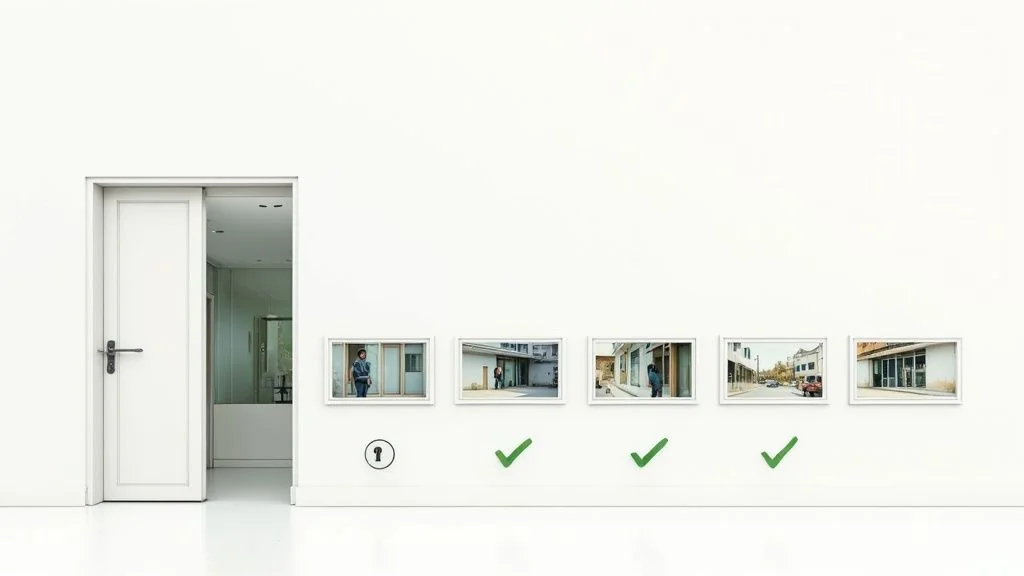
A SOC 2 Type 1 report is a point-in-time snapshot: an auditor confirms that controls are designed correctly on a specific date.
A SOC 2 Type 2 report covers a sustained period — typically six to twelve months. The auditor tests whether controls were actually followed throughout that window, not just on audit day. That distinction drives the difference in assurance level: Type 2 proves operational effectiveness, not just design intent.
A Deeper Look at the Report’s Purpose
A SOC 2 Type 2 report is the auditor’s official opinion that a company’s security practices — against the AICPA’s Trust Services Criteria — are both well-designed and consistently followed. It is the standard buyers reach for when evaluating cloud and SaaS vendors.
A recent Type 2 report reduces sales friction in concrete terms: it often satisfies enterprise security questionnaires outright, compressing due diligence from weeks to days. Secureframe has a solid breakdown of the SOC 2 Type 2 methodology.
An unqualified auditor opinion gives your prospects independent, third-party answers to the questions they care about:
- Can I trust you with my sensitive data?
- Are your security practices consistent, or just documented for audit day?
- Do you have the discipline to protect my information over time?
Why SOC 2 Type 2 Has Become a Business Imperative
Demand for this level of assurance keeps climbing. Most enterprise RFPs for B2B SaaS now ask for a SOC 2 report before signing, and the overwhelming majority of Fortune 500 procurement teams require Type 2 specifically. SOC 2 adoption climbs sharply from Series B into later funding stages. For any B2B SaaS company with enterprise sales ambitions, Type 2 has moved from competitive advantage to prerequisite.
Breaches keep getting more expensive. The IBM Cost of a Data Breach Report 2026, released July 29, 2026, puts the global average at a record $4.99 million, up 12% year over year. The United States again posted the highest regional average. For companies handling sensitive data, a Type 2 report is the proof that your controls actually held up over time — not just on the day of the audit.
The report has a direct impact on your bottom line:
- Reduce Sales Friction: It preemptively answers enterprise procurement security questions, shortening sales cycles.
- Unlock Larger Deals: Many large corporations require a valid SOC 2 Type 2 report before vendor approval.
- Build Demonstrable Trust: It provides objective, third-party validation of your security controls.
SOC 2 Type 2 Report At a Glance
To boil it all down, here’s a quick summary of the key attributes of a SOC 2 Type 2 report. This table highlights what it covers, who it’s for, and why it matters in the real world.
| Attribute | Description |
|---|---|
| Primary Focus | Tests the operational effectiveness of security controls over a period of time (e.g., 6-12 months). |
| Key Question Answered | Do your security controls actually work as intended on a consistent, ongoing basis? |
| Intended Audience | Customers, partners, and stakeholders who need deep assurance about a vendor’s security posture. |
| Business Purpose | To build trust, satisfy enterprise vendor requirements, and accelerate sales cycles by proving security maturity. |
A Type 2 report is a strategic asset, not a compliance checkbox.
Comparing SOC 2 Type 1 and Type 2 Reports
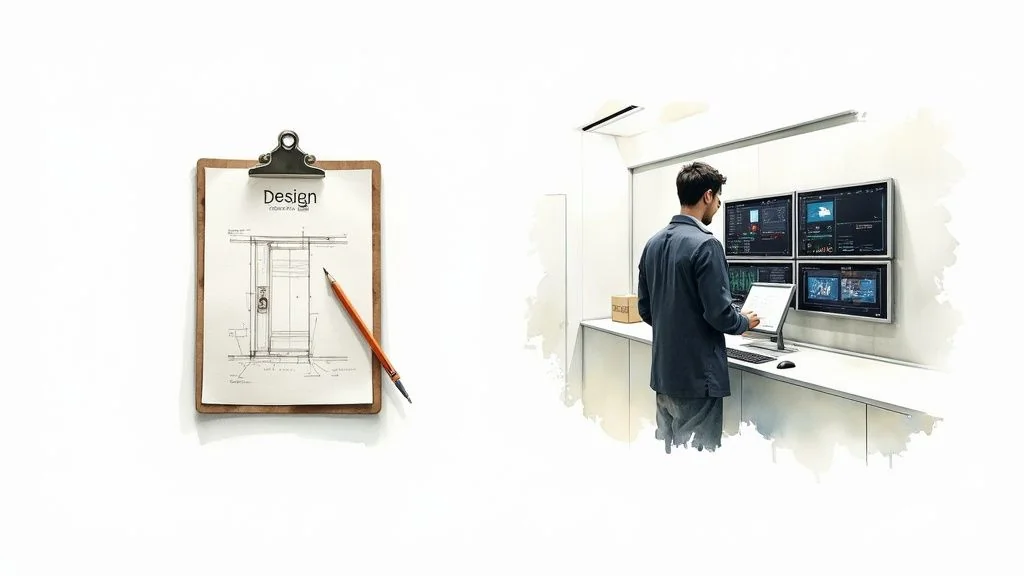
The difference between a SOC 2 Type 1 and a Type 2 report comes down to what the auditor tests and over what timeframe.
A SOC 2 Type 1 report is a point-in-time opinion: the auditor looks at your control design on a specific date and confirms it meets the criteria. It is a snapshot.
A SOC 2 Type 2 report, also written SOC 2 Type II, covers a sustained observation period — usually 3 to 12 months. The auditor tests whether controls were operating consistently throughout that window. It provides evidence that your security is a daily operational reality, not just a policy document.
The Point-in-Time Snapshot
A Type 1 report absolutely has its place. It’s a fantastic first step for a company just starting its compliance journey. Many use it as a “readiness assessment” to validate their control design before tackling the more intense Type 2. It’s also faster and cheaper to get.
But its limitation is a big one. It tells you nothing about whether those well-designed controls actually worked yesterday, are working today, or will work tomorrow. A lot can happen after the photo is taken.
The Continuous Security Story
A Type 2 report covers a period of time. An auditor does not just ask, “Do you have a firewall?” — they collect evidence that the firewall was properly configured and unchanged throughout the observation window.
That is why mid-market and enterprise clients almost always require a Type 2. They need evidence of consistent, reliable security practices, not just good documentation on a single day.
A Type 1 report shows you have a plan. A Type 2 report proves your plan actually works under real-world conditions, day after day. This distinction is the bedrock of trust in any vendor relationship.
Key Differences Between SOC 2 Type 1 and Type 2 Reports
This table summarizes the core differences across the factors that matter when evaluating a vendor’s security program.
| Factor | SOC 2 Type 1 | SOC 2 Type 2 |
|---|---|---|
| Audit Focus | Design Suitability of controls at a single point in time. | Operational Effectiveness of controls over a period of time. |
| Evidence | Primarily based on documentation, policies, and system descriptions. | Requires extensive evidence of controls operating, like logs and records. |
| Timeline | Faster to complete, as it only covers a specific date. | Longer process, requiring an observation period of 3-12 months. |
| Assurance Level | Provides moderate assurance that controls are designed correctly. | Provides high assurance that controls are designed and working effectively. |
| Best For | Early-stage companies proving initial compliance or internal readiness. | Companies selling to enterprise clients who require proof of ongoing security. |
A Type 1 report is a respectable starting point. The SOC 2 Type 2 report is what enterprise buyers require to confirm a mature, ongoing security program.
Breaking Down the Five Trust Services Criteria
At the core of every SOC 2 report are the Trust Services Criteria (TSC) — for a full list of the individual controls a Type 2 auditor tests inside each criterion, see our SOC 2 Type 2 controls reference. These are five principles the AICPA created to evaluate how a company protects customer data. Security is mandatory; the other four are selected based on what your service does and what you have promised customers.
This structure makes SOC 2 flexible. Companies prove security where it matters most to their customers, rather than checking every box in a one-size-fits-all list.
Each criterion gives an auditor a specific lens to look through when they examine your controls, ensuring the final report is both comprehensive and relevant to the promises you make. The number of control points in a report varies widely by scope and by which criteria you select. According to CBIZ’s 2024 SOC Benchmark Study, Availability appears in 75.3% of reports and Confidentiality in 64.4%, making them the two most commonly added criteria beyond the mandatory Security baseline.
The Mandatory Foundation: Security
The Security criterion is the non-negotiable foundation of every single SOC 2 audit. You can’t get a report without it. It’s often called the “Common Criteria” for this reason. It answers the fundamental question: is your system protected against unauthorized access, use, or modification?
It covers the security essentials that every audit must address:
- Access Controls: Only authorized users can access systems and data centers — logical and physical access controls both.
- Firewalls and Intrusion Detection: Network barriers and alerting for suspicious activity.
- Two-Factor Authentication (2FA): A non-negotiable layer to prevent stolen credentials from causing a breach.
- Vulnerability Management: Your process for proactively finding and patching security holes before they get exploited.
- Change Management: Your formal process for pushing changes to production systems. Auditors want to see that you’re not introducing new security holes through uncontrolled code deployments.
- System Operations Monitoring: How you monitor your infrastructure for anomalous behavior and what happens when you detect an incident.
These controls are universal. Without a solid Security foundation, the other criteria are meaningless.
Choosing Your Additional Criteria
Beyond Security, you get to choose which other TSCs to include based on your business and the commitments you’ve made to customers. This is where you tailor the audit to tell the right story.
For a deeper dive on this, check out our detailed guide on the SOC 2 Trust Services Criteria in our detailed guide.
Let’s break down the other four criteria with some real-world examples.
-
Availability: For services that commit to specific uptime SLAs — 99.9% uptime or better — this criterion tests whether your system is available as agreed. Auditors look for tested disaster recovery plans, live monitoring dashboards, and proof of backup and redundancy systems. Cloud providers and critical SaaS tools like Slack routinely include it.
-
Processing Integrity: This is crucial for any platform that performs calculations or handles transactions. It looks at whether your system processing is complete, valid, accurate, and timely. A fintech app processing payments or a payroll platform calculating employee wages needs this to prove every calculation is perfect. Auditors scrutinize data input validation, output checks, QA procedures, and error correction workflows.
-
Confidentiality: This criterion is all about protecting information that has been specifically designated as confidential. If your service handles intellectual property, sensitive M&A documents, or legal contracts, you’ll need this one. A virtual data room service used during mergers and acquisitions is a perfect candidate — its entire purpose is safeguarding highly sensitive corporate documents. Key controls include data encryption both at rest and in transit, strict access policies based on the principle of least privilege, Non-Disclosure Agreements (NDAs), and secure data disposal methods to ensure deleted data is truly gone.
-
Privacy: While it sounds a lot like Confidentiality, Privacy is laser-focused on Personally Identifiable Information (PII). It covers how PII is collected, used, retained, and destroyed. The controls for Privacy are heavily influenced by frameworks like GDPR and CCPA, focusing on the clarity of your privacy notices, your process for honoring user data requests, and your data retention policies. Any company handling customer health records, social security numbers, or other personal data — like a HealthTech platform — must include the Privacy criteria.
Picking the right TSCs is a strategic decision. Adding criteria you don’t need wastes time and money. But leaving out one that your customers expect can make your report look weak. Your choices should directly mirror the promises you make in your contracts and marketing.
How to Actually Read a SOC 2 Type 2 Report
A SOC 2 Type 2 report is often 100+ pages of dense, technical language. You do not need to read every word. The critical information is near the front, and knowing where to look lets you make a real risk decision quickly. For a section-by-section walkthrough, see our guide to the SOC 2 audit report.
Start with the Auditor’s Opinion
Start with Section 1: The Independent Auditor’s Report. This is the CPA firm’s official verdict.
The phrase you are looking for is unqualified opinion: the auditor found that the system was described fairly and controls were designed properly and operated throughout the audit period.
Anything else warrants scrutiny:
- Qualified Opinion: Issues with one or more specific controls. Dig into what failed.
- Adverse Opinion: Significant, widespread problems. The auditor believes the vendor’s controls are fundamentally ineffective.
- Disclaimer of Opinion: The auditor could not gather enough evidence to form an opinion — usually points to poor records or lack of cooperation.
Hunt for Exceptions and Scope Limitations
After checking the opinion, your next stop is the section detailing the auditor’s tests and results. Here, you’re looking for exceptions. An exception is a documented instance where a control failed when the auditor tested it.
A few minor exceptions with credible management responses are usually acceptable. A long list of exceptions — or repeated failures in access control or change management — indicates a weak security culture.
Also check the scope. If your team depends on a vendor’s mobile app but the audit only covers their web platform, that is a blind spot. A narrow scope can hide weaknesses.
Understand Your Responsibilities with CUECs
One of the most overlooked parts of a SOC 2 report is the section on Complementary User Entity Controls (CUECs). These are the security tasks the vendor explicitly says are your job, not theirs.
Think of CUECs as the security instructions that come with a new product. If a vendor says, “You are responsible for enforcing strong user passwords,” and you don’t, then any breach from a weak password is on you — even if their SOC 2 report is perfect.
Ignoring these is a common and costly mistake. For a hands-on look at where these elements appear and how they are presented in a real-world document, you can review a SOC 2 report example here. If your buyers are also asking about SOC 1, our breakdown of the difference between a SOC 1 and SOC 2 report clears up which report applies to financial vs service organization controls.
The business impact of getting this right is real. With the average cost of a data breach at a record $4.99 million in 2026, proper vendor due diligence matters — and buyers treat a Type 2 report as essential proof of a vendor’s security commitment.
Check Management’s Assertion and the System Description
Right after the auditor’s opinion, look for Management’s Assertion — a formal statement from the vendor’s leadership confirming that the system description is accurate and that the controls they claim to have were in place and working. It’s the company’s own official stamp on the report.
The System Description that follows sets the context for everything else. It describes the vendor’s services, infrastructure, software, and the people and processes that keep things secure. This is where you confirm the boundaries of what was actually audited. A suspiciously narrow system description can be just as revealing as a list of exceptions.
The Control Tests and Results
The bulk of the report is a detailed table listing every control the auditor tested. For each one, you’ll see three things: a short description of the control itself (e.g., “New user access is formally approved before being granted”), a summary of how the auditor tested it (e.g., “Inspected a sample of 25 new hire access request tickets to verify manager approval”), and a clear statement on whether it passed. Any failures are called exceptions and are documented right there. A few minor exceptions with solid management responses are usually fine. A pattern of failures — especially in access control or change management — is not.
This decision tree shows how companies typically select the Trust Services Criteria that form the basis of their audit, starting with the mandatory Security criterion.
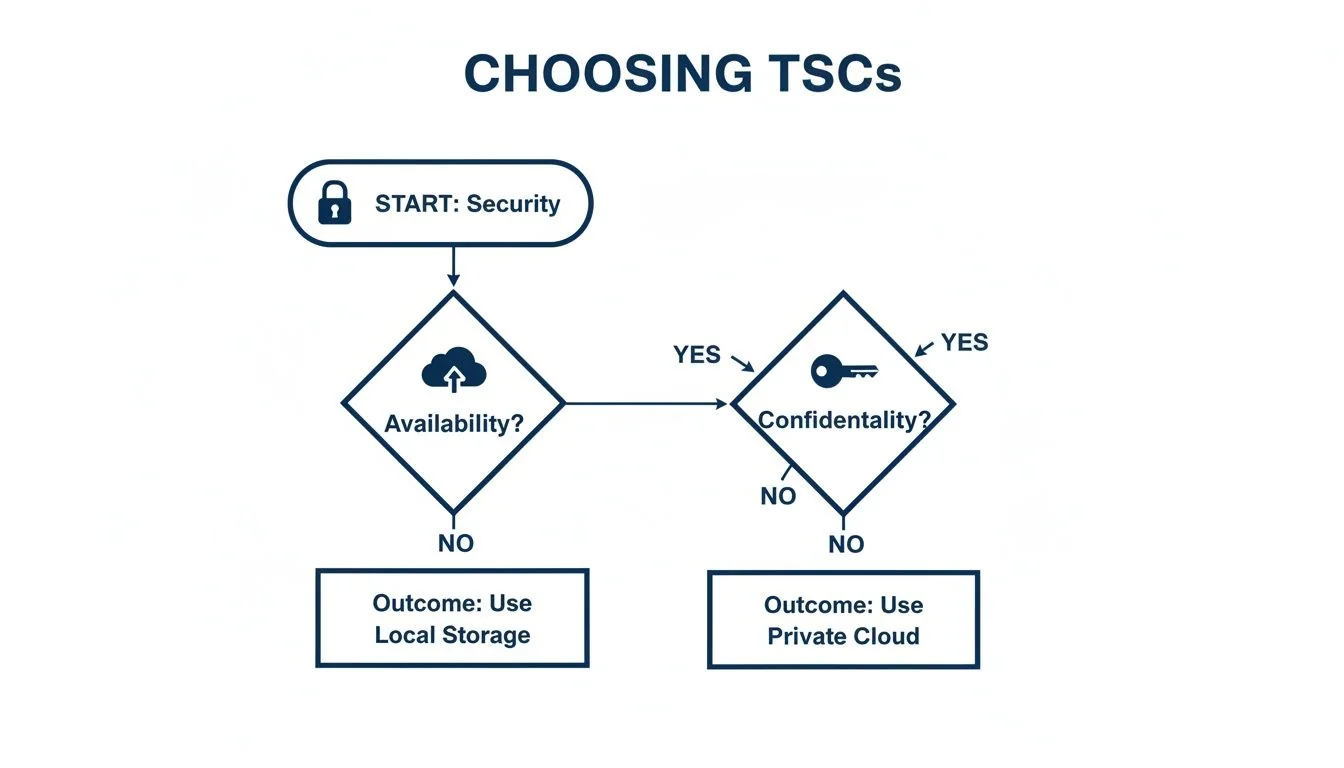
The flowchart makes it clear: after meeting the foundational Security requirements, a company’s choices for additional criteria like Availability or Confidentiality are driven entirely by the specific services they offer and the promises they make to their customers.
Planning Your Journey to a SOC 2 Type 2 Report
Getting a SOC 2 Type 2 report is a serious commitment. The most important thing you can do is map out the full journey — the timeline, the real costs, and the internal effort required — before you start.
The process begins with a readiness and remediation phase: find gaps in your controls, implement fixes, and document everything. This prep work alone can take several months.
Only after your controls are consistently in place does the observation period clock start. This is the 6 to 12-month window the auditor tests. Rushing it is the most common mistake, and it almost always produces exceptions that could have been caught in prep.
Deconstructing the Timeline from Start to Finish
A realistic timeline for a first-time SOC 2 Type 2 report is 9–15 months. Each phase builds on the last:
- Readiness and Gap Analysis (2–6 weeks assessment, 1–6 months remediation): Run a gap analysis to identify where you stand, then close the gaps — writing policies, adjusting configurations, deploying tools (endpoint detection, vulnerability scanning, security awareness training), and training staff. A thorough readiness assessment lets you fix problems on your own timeline rather than under audit pressure.
- Observation Period (6–12 months): Once controls are in place, the formal observation window opens. Your team follows the policies and collects evidence throughout.
- Audit Fieldwork and Reporting (4–8 weeks): After the observation period closes, the auditor requests evidence, interviews your team, performs tests, and writes the final report.
The total timeline is usually 9–12 months for most companies. Compliance automation platforms can compress the prep phase significantly; some startups reach audit-readiness in as little as 2 weeks. Doing it manually, expect prep alone to take 3–6 months.
Defining Your Audit Scope
Before you touch a single policy or start hunting for evidence, define the boundaries of your audit. This is the single most important first step. Scope creep is the number one reason timelines and budgets blow up. Ask yourself three questions:
- Which Trust Services Criteria do we actually need? Security is mandatory. Only add Availability, Confidentiality, Processing Integrity, or Privacy if you have specific contractual promises to customers that require them — not because they sound impressive.
- What systems are in scope? Map your production environment: databases, apps, core infrastructure. Keep development and testing environments out of scope unless they touch real customer data.
- Who are the key people? Pinpoint the engineering, DevOps, and security team members responsible for managing and securing the in-scope systems. They will own most of the evidence collection.
Running a Gap Analysis Before You Start
A gap analysis is a structured dry run: compare your current controls against the SOC 2 requirements for your chosen criteria before the observation period begins, so you know exactly what needs fixing.
For example, you might discover you don’t have a formal process for de-provisioning employee access when they leave. That’s a critical gap. Finding it during a gap analysis gives you the runway to build the process, document it, and get it operating consistently — before the auditor starts watching. For more detail, check out our guide on the SOC 2 readiness assessment.
Remediating Gaps and Collecting Evidence
Once you have the gap list, remediation begins. This is the longest stretch of prep work. Typical activities include:
- Writing and Formalizing Policies: Creating clear, written policies for everything from access control and vendor management to incident response.
- Implementing New Tools: Deploying software for endpoint detection, vulnerability scanning, or security awareness training.
- Configuring System Settings: Hardening servers, enforcing strong password policies, and ensuring logging and monitoring are properly configured.
- Training Your Team: Employees understand their security responsibilities and follow the procedures.
As you fix each control, start gathering proof immediately. A Type 2 audit requires a steady stream of logs, screenshots, meeting minutes, and signed documents from your entire observation period.
The real challenge is proving controls were working on a random Tuesday three months ago. Without automation, evidence collection becomes a time-consuming scramble prone to gaps.
Compliance automation platforms like Vanta, Drata, or Secureframe are worth serious consideration here. They plug into your cloud environment and other apps to pull evidence automatically — turning a grueling manual process into a continuous, low-error workflow. Independent research backs the savings: an IDC study of Vanta customers reported a 526% three-year ROI, 82% less time spent on audits, and 3-month payback. Forrester’s Total Economic Impact of Drata, refreshed in October 2025, found a 78% reduction in audit and data-collection time, with annual audit prep falling from 980 hours to 220 hours. For a side-by-side of all 12 leading platforms, see Compare SOC 2 compliance software.
Understanding the True Cost of an Audit
The cost of a SOC 2 report is much more than just the auditor’s invoice. While audit fees range from $7,000 to over $100,000, the all-in cost — including readiness, tools, and internal time — is usually $30,000 to $150,000 for most small to mid-sized companies. Demand for these services is strong and growing as enterprise procurement standardizes on SOC 2.
Your budget has to account for more than just the final report. The real investment is in building a sustainable compliance program. That includes tooling, expert guidance, and your team’s most valuable resource: their time.
The most common “hidden” costs to watch out for are:
- Compliance Automation Tools: Platforms that automate evidence collection and monitor controls continuously. Expect to pay $5,000 to $60,000+ a year depending on company size and platform features. The hours saved on manual labor offset the cost for most teams.
- Readiness Consultants: An expert guide through prep work reduces time and avoids costly mistakes. Budget $10,000 to $50,000+ depending on scope.
- Penetration Testing: While not technically mandatory, most auditors expect a recent pen test to satisfy the Security criterion. Budget $5,000 to $25,000 depending on environment complexity.
- Legal and Consulting Fees: Legal review of policies or specialized consultants for complex controls can run $5,000 to $50,000.
- Internal Staff Time: Getting ready for an audit often requires 200-600+ hours from your engineering and leadership teams. Teams routinely underestimate this commitment.
For a full breakdown, see our guide to the SOC 2 Type 2 audit cost. Aligning on time and budget before you start is the most reliable way to avoid overruns.
Total Cost Breakdown by Company Size
The numbers below give you a realistic picture of what the first-year investment looks like end to end — not just the auditor’s invoice, but everything that goes into getting a clean Type 2 report.
| Cost Component | Small Startup (1-50 Employees) | Mid-Market Company (51-250 Employees) |
|---|---|---|
| Readiness Assessment | $5,000 - $15,000 | $10,000 - $25,000 |
| Audit Fees (CPA Firm) | $15,000 - $35,000 | $30,000 - $75,000 |
| Compliance Automation Tool | $5,000 - $15,000 / year | $12,000 - $30,000 / year |
| Penetration Test (Often Required) | $5,000 - $15,000 | $10,000 - $25,000 |
| Legal and Consulting | $5,000 - $15,000 | $10,000 - $50,000 |
| Internal Team Time | 200-400 hours | 400-800+ hours |
| Ongoing Maintenance (Annual) | 15-20% of initial cost | 15-20% of initial cost |
| Estimated Total First-Year Cost | $30,000 - $80,000+ | $62,000 - $155,000+ |
The ranges in the table account for readiness, tooling, and internal staff hours — use the “Estimated Total First-Year Cost” row as your planning anchor, not just the audit fee line. SOC 2 is a multi-billion-dollar market with strong year-over-year growth; the signal is clear — enterprise procurement teams are standardizing it as a vendor gate.
Choosing the Right Auditor: Boutique vs Big Four
Picking an auditor is one of the most consequential decisions in the process. The choice between a smaller, specialized boutique firm and a Big Four name (Deloitte, PwC, EY, KPMG) has real implications for cost, speed, and the quality of guidance you’ll get.
Boutique audit firms tend to offer more hands-on support from senior partners, greater flexibility on timeline, and pricing that’s friendlier to startup and growth-stage budgets. They often specialize in SaaS and tech, which means they understand your environment without you having to explain it.
Big Four firms bring unmatched brand recognition — some enterprise customers and investors weigh a Big Four name heavily — plus deep resources for audits of significant scale and complexity, and global reach for multinational operations.
For most startups and growth-stage companies, a specialized boutique firm strikes the right balance of cost, speed, and expert support. The goal is a partner, not just a processor — someone who feels like an extension of your team and helps you build a stronger security posture, not just a report.
Key Questions to Ask Potential Auditors
Before you sign an engagement letter, ask potential auditors:
- Industry Experience: “How many audits have you done for companies in our specific industry — like FinTech or SaaS — and at our current size?”
- The Process: “Walk me through your audit process, from first call to final report. What’s a realistic response time?”
- Your Team: “Who will be on our engagement team? What are their qualifications?” Verify you won’t be handed to junior staff after signing.
- The Final Product: “Can we see a redacted sample report?” A clear, well-organized report is a sales tool when you share it with prospects.
- Tools and Tech: “What platforms do you use for evidence collection? Do you have experience with Vanta or Drata?”
Look for an auditor who gives context alongside findings — one who helps you improve your actual security posture, not just complete the paperwork.
The AICPA’s 2026 Peer-Review Scrutiny of Quick-Turn Audit Mills
Ask about your auditor’s peer review standing, and ask it early. Effective June 1, 2026, the AICPA Peer Review Board began proactive outreach to peer-review teams examining firms that perform a high volume of SOC 2 engagements, with enhanced oversight and a real risk of “nonconforming engagement” findings for firms caught producing near-identical reports, risk assessments, and control testing across clients by over-relying on third-party SOC platforms.
For buyers, this is a concrete, dated reason to add one more question to the list above: has this firm’s SOC 2 practice been flagged in a recent peer review, and does its work actually look tailored to your business or copy-pasted from the last client on the list? For auditors, it is a signal that the AICPA is now watching quality at scale, not just quality on paper. See the Journal of Accountancy’s coverage of the guidance for the full detail.
Common Pitfalls That Derail a SOC 2 Type 2 Audit
Even well-prepared companies stumble on these recurring mistakes. Knowing them upfront can save you months of delays and thousands in wasted spend.
1. Poor Scoping and Scope Creep. Including criteria you do not need is the most expensive mistake. Every additional criterion increases workload and cost. Start with Security (mandatory) and only add criteria that map directly to customer contractual commitments. Create a definitive scope document before the observation period begins.
2. Underestimating Evidence Collection. A Type 2 audit requires months of continuous evidence gathering, not a one-time document drop. Plan for 200-600+ internal hours on a first-time audit at a small to mid-sized company, the same range you’ll see in the cost breakdown above, with the heaviest lift concentrated around the observation period. Without automation, this pulls engineers away from their core work for extended stretches.
3. Treating Compliance as a One-Time Project. A SOC 2 Type 2 report expires after 12 months. Companies that treat the first audit as a sprint often find themselves scrambling again the following year. Many companies now run multiple compliance audits annually. Build compliance into your daily operations from day one — it is dramatically cheaper to maintain than to rebuild.
4. Lacking Executive Buy-In. When leadership views SOC 2 as a cost center rather than a business enabler, resource allocation suffers. Frame it in terms of revenue: a SOC 2 report is increasingly a precondition for enterprise contracts. Talk about how it unblocks deals and shortens sales cycles, not just about controls. Come prepared with a clear budget and timeline.
5. Rushing the Observation Period. While the AICPA sets no minimum observation window — three months is just the shortest window commonly seen in practice — going shorter than 6 months raises questions from sophisticated buyers. A rushed observation period also means less time for your team to find and fix control failures before the auditor documents them as exceptions.
Your Burning SOC 2 Questions, Answered
The most common questions from companies navigating SOC 2 for the first time.
How Long Is a SOC 2 Type 2 Report Good For?
A SOC 2 Type 2 report is generally considered valid for twelve months from the day it’s issued. After that, enterprise buyers treat it as stale and expect a fresh report.
Annual audits are the industry standard for this reason. Consistent, yearly audits demonstrate an ongoing security program, not a one-time project.
There’s also a practical gap to manage. Most reports cover a fixed period (say, January through December), but a prospect may ask for assurance in March — after the report period ended but before the next one is issued. To cover that gap, you provide a bridge letter (also called a gap letter): a short, management-signed statement confirming no significant control changes occurred since the report period closed. Bridge letters typically span up to three months and are not audited, so buyers treat them as a stopgap, not a substitute for a fresh report. See our guide to the SOC 2 bridge letter for a template and how long buyers will accept one.
Can You Fail a SOC 2 Audit?
Technically, you don’t “pass” or “fail” a SOC 2 audit. It’s not a test with a score. Instead, the auditor issues a professional opinion on how well your controls are designed and operating:
- Unqualified Opinion: Your controls are effective, with no significant issues found. This is the outcome you are aiming for.
- Qualified Opinion: The auditor found one or more issues or exceptions. Not a total failure, but it flags areas your customers will notice and ask about.
- Adverse Opinion: Significant, material problems with your security controls. Avoid this outcome.
A thorough readiness assessment is the best way to reach an unqualified opinion — it finds and fixes problems before the auditor does.
What Happens If the Auditor Finds an Issue?
Finding exceptions is common and does not mean you’ve failed. What matters is how you respond.
The auditor documents the issue; your management writes a response explaining what happened, the impact, and the steps taken to fix it. A report with a few minor, well-handled exceptions can signal a mature and transparent security program.
Is a Penetration Test Required for a SOC 2 Audit?
The AICPA does not explicitly require a penetration test, but it is effectively expected in practice. To satisfy the Security criterion, you need to show you are actively identifying and remediating vulnerabilities. A recent pen test is the clearest evidence of this, and most auditors will ask for one — particularly if you handle sensitive customer data.
Can We Get a SOC 2 Type 2 Report in Less Than 6 Months?
Technically yes, but it’s rarely advisable. The AICPA sets no minimum observation window — three months is just the shortest window commonly seen in practice — but enterprise buyers view shorter periods skeptically. A 3-month Type 2 often triggers the same follow-up questions that a Type 1 would, defeating the purpose of the longer engagement. If you’re in a genuine time crunch, consider a Type 1 as a bridge while you build toward a full 6-12 month Type 2 observation period.
Is Compliance Automation Software Required?
Compliance automation software is not officially mandatory, but managing a SOC 2 audit manually with spreadsheets and shared drives multiplies errors and consumes engineering time. Platforms like Vanta, Drata, or Secureframe automate evidence collection, centralize policy management, and continuously monitor controls. Taken together, the IDC and Forrester research cited earlier in this guide puts the reduction in manual evidence-gathering in a roughly 70-80% range, saving hundreds of hours.
How Is SOC 2 Different from ISO 27001?
SOC 2 and ISO 27001 have different scopes and philosophies.
- SOC 2 is a CPA attestation against the AICPA’s Trust Services Criteria. It tests specific controls and their operational effectiveness over a period. It is the dominant framework in North America.
- ISO 27001 is a certification of your Information Security Management System (ISMS). It validates how you manage risk across the organization and is more globally recognized.
Think of it this way: ISO 27001 certifies your system for managing security, while a SOC 2 Type 2 report attests to the actual performance of your security controls.
Does Every SaaS Company Need a SOC 2 Report?
Early-stage companies can often handle security questionnaires directly. But once you start selling to mid-market or enterprise buyers, a SOC 2 Type 2 report becomes a prerequisite. These buyers require independent proof of security. Not having one is frequently an outright disqualifier.
Who Can Issue a SOC 2 Report?
Only a licensed CPA firm can issue a SOC 2 report. The firm has to be licensed to practice public accountancy and follow the AICPA’s attestation standards (AT-C 105 and AT-C 205) when planning and performing the engagement. Consultants, readiness firms, and compliance automation vendors can help you prepare, but they cannot sign the report itself; that opinion always comes from an independent CPA firm.
How to Get a SOC 2 Type 2 Report?
Getting a SOC 2 Type 2 report follows a set path: run a readiness assessment and close the gaps it finds, hold the observation period (typically 6-12 months) while your controls operate and generate evidence, then bring in a licensed CPA firm for audit fieldwork and the final report. The timeline and cost breakdown earlier in this guide walks through what each phase actually involves.
Is SOC 2 Legally Required?
No. SOC 2 is not a law or a regulatory mandate, and no government body requires it. It has become a de facto business requirement because enterprise customers write it into procurement and vendor-risk contracts, particularly for SaaS and cloud vendors selling into mid-market or enterprise accounts. If a customer contract requires it, that requirement is contractual, not legal.
What Is SOC 2 in Simple Terms?
In plain terms, SOC 2 is an independent audit that checks whether a company actually does what it says it does to protect customer data. A CPA firm tests real controls, like access logs, backups, and monitoring, against the AICPA Trust Services Criteria, then issues an opinion. A SOC 2 Type 2 (SOC 2 Type II) report is the version that checks this over months, not just on one day.
Finding the right auditor is the most critical step in your SOC 2 journey. At SOC2Auditors, we replace endless sales calls with a data-driven matching process. Get transparent pricing, timelines, and verified reviews to choose the perfect audit firm for your company with confidence. Find your ideal SOC 2 auditor at https://soc2auditors.org.