 Menu
Menu
An internal control procedure is a formal set of rules your team follows to protect company assets, keep financial reporting honest, and make sure operations run smoothly. Think of them as the practical, step-by-step instructions for managing risk, stopping fraud, and staying compliant with standards like SOC 2.
Building a Rock-Solid Internal Control Foundation
Before you even think about writing documentation, you have to get one thing straight: internal controls are much more than a checkbox for an audit. They’re the operational backbone that protects your company, your people, and your customers’ data. A well-designed control isn’t a burden; it’s a safety net that lets you grow without breaking.
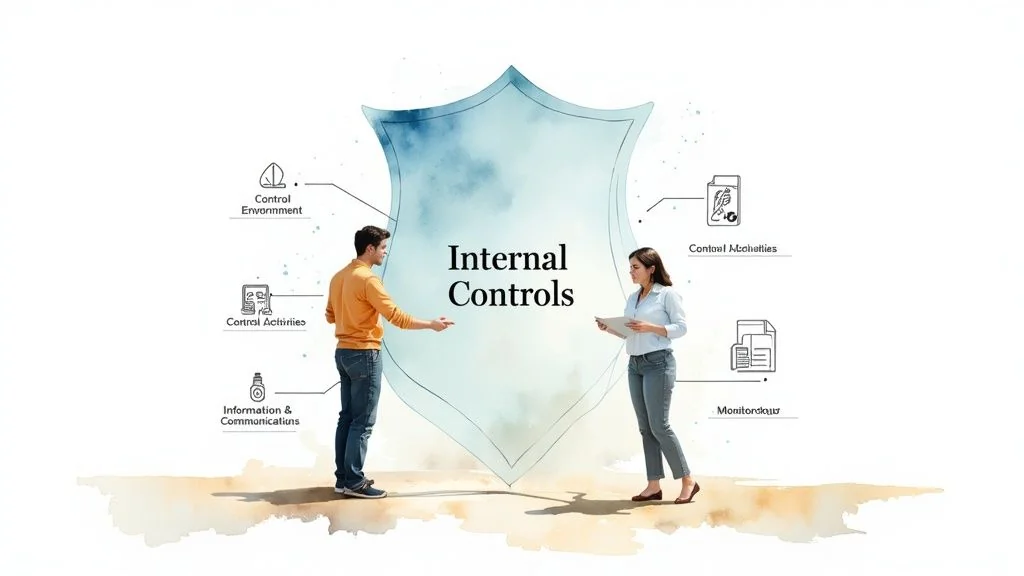
The foundation for nearly all modern internal controls is the COSO framework, created by the Committee of Sponsoring Organizations of the Treadway Commission. It’s a bit of a mouthful, but the concept is simple. COSO breaks down internal control into five interconnected components that build on each other.
-
Control Environment: This is the “tone at the top.” It’s your company’s ethics, your leadership’s commitment to doing things right, and the overall structure of who’s accountable for what. A strong control environment means people want to do the right thing, even when nobody’s looking.
-
Risk Assessment: You can’t defend against threats you don’t see coming. This is all about proactively finding, analyzing, and managing risks that could stop you from hitting your goals. For a SaaS company, that’s a data breach. For a fintech platform, it’s fraudulent transactions.
-
Control Activities: These are the procedures themselves—the specific actions you take to shut down the risks you’ve identified. Things like requiring manager approval for system access, doing monthly bank reconciliations, or forcing everyone to use multi-factor authentication.
-
Information and Communication: Controls are useless if they’re a secret. This part ensures that clear, quality information is shared internally and externally to keep everything running. It’s about solid documentation, regular training, and clear reporting channels.
-
Monitoring: Controls get stale. They can become outdated or just stop working over time. Monitoring involves ongoing checks—both routine and periodic—to make sure the whole system is still effective. This includes everything from internal audits and system log reviews to tracking performance metrics.
This simple flow chart shows how these pieces fit together in a continuous cycle.
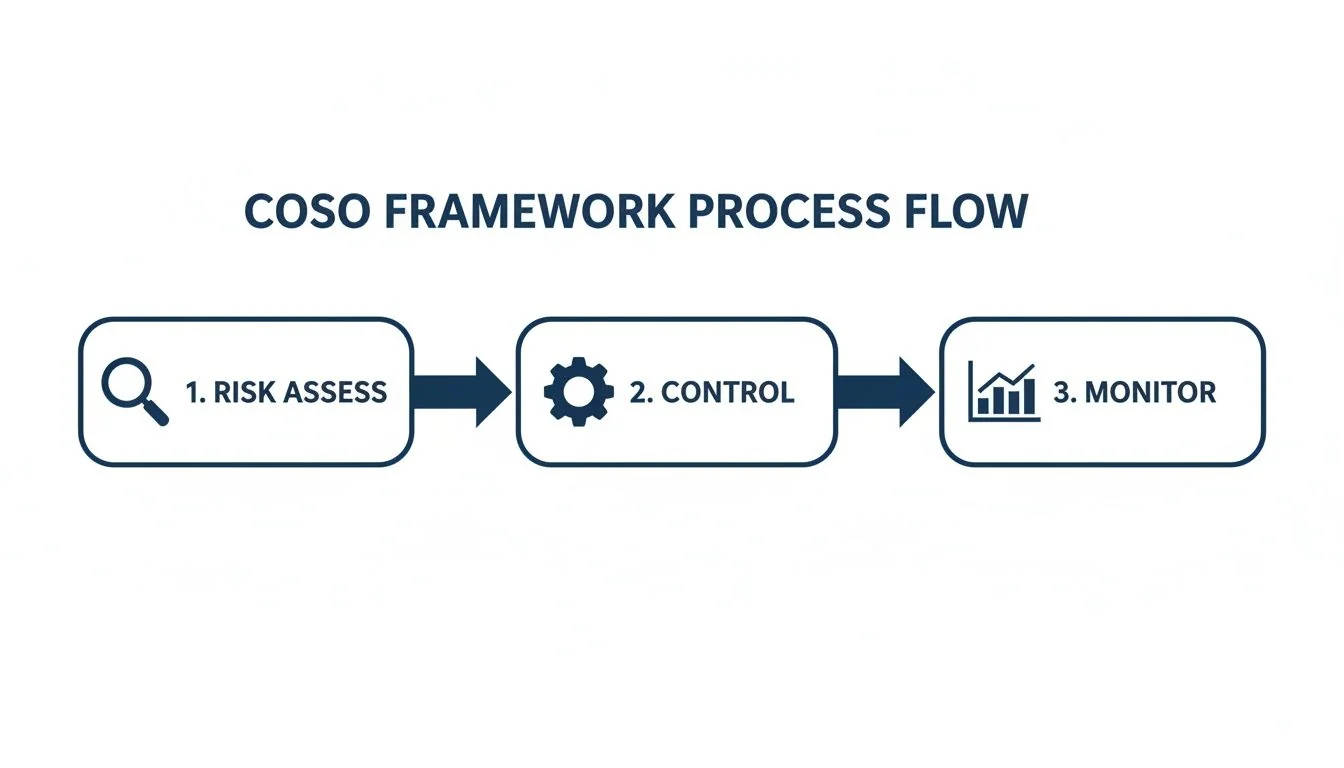
It’s a loop: risk assessment tells you what controls to build, and constant monitoring ensures those controls stay effective.
Why This Framework Matters for SOC 2
Understanding these components is the first step toward building controls that auditors—and your own team—can actually get behind. For example, a weak control environment can torpedo even the best technical controls. If leadership doesn’t enforce security policies, why would anyone else bother following them, no matter how well-written they are?
A classic mistake is jumping straight to writing control activities without doing a real risk assessment first. This leads to controls that solve the wrong problems or, even worse, completely miss critical vulnerabilities.
Before you get into the weeds of documentation, take a step back and assess where you are right now. A good guide on conducting a SOC 2 readiness assessment can give you a structured way to find gaps in what you’re already doing. This initial analysis makes sure your efforts are focused and efficient, setting a strong foundation for your entire SOC 2 project.
When you adopt this mindset, you build controls that work in the real world, not just on paper. That’s what sets you up for a much, much smoother SOC 2 journey.
Designing Controls That Auditors Actually Understand
Alright, you’ve done your risk assessment. Now for the tricky part: designing and documenting the internal controls. This is where the rubber meets the road, and frankly, where a lot of companies trip up.
They write vague, aspirational policies that sound impressive in a meeting but are useless in practice. An auditor sees a statement like “Access is restricted,” and their first question is always, “Okay, how?”
Your goal is to write controls that are specific, measurable, and directly tied to a risk. An auditor should be able to read your control description, nod, and know exactly what evidence to ask for. No confusion, no follow-up questions.
From Vague Policies to Actionable Procedures
Let’s take that classic vague statement: “Access to sensitive data is restricted to authorized personnel.” This isn’t a control; it’s a goal. It tells you what you want to achieve, but not how you do it.
To make this a real, testable control, you need to spell out the who, what, when, and how. You need to describe the actual process.
A well-designed control description tells a story. It should clearly outline the trigger for the action, the steps taken, the people responsible, and the evidence it produces. This clarity is your best defense in an audit.
Here’s what a strong, actionable version looks like:
“Upon new employee hire, the hiring manager submits an access request ticket specifying the required systems based on the employee’s role. The IT administrator grants access according to the principle of least privilege, and the ticket is closed with an audit log of permissions granted. All access is reviewed quarterly by department heads.”
See the difference? This version is an active process with clear owners (hiring manager, IT admin, department heads) and a verifiable output—the ticket and the review log. That’s what auditors love to see.
Mapping Controls to SOC 2 Criteria
For any SOC 2 audit, every single internal control you design has to map to one or more of the five Trust Services Criteria (TSC). This isn’t optional; it’s the entire foundation of the audit.
This mapping shows your auditor that you’ve been thoughtful and deliberate, connecting each of your day-to-day security activities back to the core SOC 2 requirements. It also makes their job easier, which is always a good thing.
Your documentation should explicitly state which TSC a control supports. It keeps you organized and helps the auditor move through their testing plan efficiently.
Here’s a simple table to show how common control families align with the TSC.
Mapping Internal Controls to SOC 2 Trust Services Criteria
This table provides a clear mapping of common control families to the five SOC 2 Trust Services Criteria, helping you structure your documentation effectively.
| Control Family Example | Primary Trust Service Criterion | Description of Relevance |
|---|---|---|
| User Access Reviews | Security | Ensures only authorized individuals have access to systems, preventing unauthorized changes or data exposure. |
| Change Management | Availability, Security | Guarantees that system changes are tested and approved, preventing outages or introducing vulnerabilities. |
| Incident Response Plan | Security, Availability | Defines steps to detect, contain, and recover from security incidents, minimizing downtime and data loss. |
| Data Backup & Recovery | Availability | Confirms that data can be restored in a timely manner after an incident, ensuring business continuity. |
Getting this mapping right is fundamental. If you’re looking for more concrete ideas, browsing a comprehensive guide to SOC 2 controls is a great way to see what others are doing and get inspiration for your own control set.
The Challenge of Practical Implementation
Let’s be real: documenting a control is one thing. Getting people to actually follow it every day is a whole different ballgame. There’s almost always a gap between what the policy says and what people actually do.
This isn’t just a hunch; the data backs it up.
In OECD countries, while 76% of standard criteria for internal control are met on paper, the practical implementation drops off a cliff, with only 33% of strong practice criteria being fulfilled. This highlights the massive challenge of turning beautifully written documents into consistent, daily habits.
That statistic is a powerful reminder that an internal control procedure is worthless if it’s not consistently followed. Your design process must consider real-world workflows. If a control is too complicated or annoying, your team will find workarounds. It’s human nature.
The best controls feel like a natural part of the job, often baked into the tools people already use. Automation is your best friend here—it reduces friction and eliminates the potential for human error.
Bringing Your Controls to Life with Automation
An internal control procedure sitting in a folder is useless. It’s just words on a page. The most perfectly designed controls mean absolutely nothing if they aren’t actually put into practice.
Execution is everything. This is where you turn documented theory into an active, operational reality. It’s not about just sending a memo and hoping for the best; it requires a deliberate rollout strategy.
First, you have to get genuine buy-in from your team. Let’s be honest, most employees see a new internal control as just another hurdle—an extra step that slows them down. You have to sell the “why” behind each procedure. For example, when you roll out a new change management control, don’t just say “we need this for SOC 2.” Explain how it prevents the kind of system outages that frustrate both engineers and customers. Frame it as a benefit, not a burden.
Effective training is just as important. Please, don’t just read policies aloud in a PowerPoint presentation. Create short, role-specific sessions that show each person exactly what they need to do. A developer needs to know precisely how to submit a pull request for review. A manager needs to understand their approval responsibilities within your ticketing system. Make it practical and actionable.
The Power of Automated Controls
Manual controls are incredibly fragile. They depend on busy people remembering to do the right thing, every single time. That’s a recipe for inconsistency and human error.
This is where automation becomes your most powerful ally in building a compliance program that can actually scale with your business.
Instead of asking an IT admin to manually check that multi-factor authentication (MFA) is enabled for every new user, you use an Identity and Access Management (IAM) tool to enforce it programmatically. The system doesn’t forget, get distracted, or look for shortcuts.
Automation is no longer a “nice to have”—it’s quickly becoming the standard. A recent PwC study found that 82% of companies are planning to increase their tech investment for compliance. The top areas for automation? Transaction monitoring (75%) and customer due diligence (75%). This shows a clear shift away from manual spot-checks toward intelligent, continuous systems that boost both efficiency and accuracy.
Key Automation Tools for SOC 2
To really automate your internal controls, you’ll lean on a few core types of technology. These tools do the heavy lifting, turning your policies into active, enforceable rules in your environment.
-
Identity and Access Management (IAM) Platforms: Think Okta or Azure AD. These tools are the bedrock of your access controls. They automate user provisioning, de-provisioning, and access reviews. When an employee leaves, the IAM system automatically revokes their access to all connected apps, creating an instant, audit-ready log. No manual checklists needed.
-
Security Information and Event Management (SIEM) Systems: A SIEM like Splunk or Datadog is your digital watchdog. It pulls in logs from your entire tech stack—servers, apps, firewalls—and uses rules to spot suspicious activity in real time. It can automatically flag things like multiple failed login attempts or someone trying to access a sensitive database they shouldn’t.
-
Governance, Risk, and Compliance (GRC) Platforms: These platforms act as the central nervous system for your compliance program. They connect your documented controls directly to the evidence that proves they’re working. Many GRC tools integrate with your cloud providers and other systems to automatically collect evidence, like screenshots of security group settings or lists of users with admin rights.
Pro Tip: Don’t try to automate everything at once. Start with your most critical, high-frequency controls. Focus on areas like user access changes, system configuration monitoring, and security alerting. These deliver the biggest wins by cutting down on manual work and minimizing the risk of a critical failure.
Investing in the right technology is non-negotiable for a modern SOC 2 program. If you’re exploring your options, understanding the landscape of SOC 2 compliance software will help you pick tools that fit your specific needs and budget, making your automation journey much smoother.
The goal isn’t just to pass an audit; it’s to build a resilient, secure company. By embedding your controls directly into your technology stack, you make compliance a natural byproduct of secure operations. This is how you move from a reactive, checklist-driven mindset to a proactive, scalable, and genuinely effective control environment.
Gathering Evidence to Prove Your Controls Work
Documenting your internal control procedures is a fantastic start, but it’s only half the battle. Your auditor won’t just take your word for it—they need cold, hard proof that your controls are actually working as intended, day in and day out. This is where evidence gathering comes in.
It’s the process that separates a theoretical compliance program from one that can actually withstand the scrutiny of an audit.

This entire process boils down to proving two distinct things to your auditor, and it’s critical you understand the difference between them.
Design vs. Operating Effectiveness
First up is design effectiveness. This test answers the question: “If this control is followed perfectly, will it successfully prevent or detect the intended risk?” It’s a review of the control’s logic and structure. For example, does your documented procedure for new employee onboarding actually include all the necessary steps to grant appropriate, least-privilege access?
Next comes operating effectiveness. This is the more intensive part. It answers the question: “Is this control actually being performed consistently and correctly over the audit period?” Here, the auditor isn’t just reading your procedure; they are sampling real-world instances to see it in action. They’ll pull tickets, check logs, and interview your team to confirm the control isn’t just a document—it’s a habit.
An auditor once told me, “I don’t audit your intentions; I audit your evidence.” Your documentation sets the stage, but the proof you provide is the entire performance. Without it, even the most brilliantly designed control is considered a failure.
A control can have a perfect design but fail in operation if people ignore it. Conversely, a team can be diligent, but if the control is poorly designed, their efforts won’t effectively mitigate the risk. You have to prove both are solid.
Core Testing Methods Auditors Use
To validate your controls, auditors use a handful of methods to gather their evidence, moving from simple checks to deep dives. Knowing what these are helps you prepare the right kind of proof ahead of time.
- Inquiry: This is the most basic method, where auditors simply ask you or your team how a process works. While it’s a necessary starting point, it’s never enough on its own. It provides context but needs to be backed by other, more concrete evidence.
- Observation: This is exactly what it sounds like. An auditor watches you perform a specific task. They might, for instance, sit in as a developer goes through the change management process for a code deployment, watching each step as it happens.
- Inspection of Documents: This is the most common method by far. Auditors will request and review records like signed approval forms, system-generated logs, user access review spreadsheets, or reports from your security tools. This is where the bulk of your evidence will come from.
- Re-performance: This is the most thorough test. The auditor independently re-executes a control procedure to see if they get the same result. For a financial control, this might involve them re-calculating a sample of commission payments to verify accuracy.
Your Practical Evidence Gathering Checklist
To build an airtight case for compliance, your evidence needs to be organized, relevant, and cover the entire audit period. Think of it as building a portfolio of proof for each key control family. The best advice I can give is to start collecting these items well before your audit even begins.
Here’s a practical checklist of evidence types you’ll almost certainly need to provide for a SOC 2 audit:
User Access Controls
- Screenshots of role-based access control (RBAC) configurations in your key systems (e.g., AWS, Salesforce).
- Completed and signed-off quarterly user access review reports.
- Logs from your IAM system showing the timely de-provisioning of terminated employees.
Change Management
- A sample of completed change request tickets (e.g., from Jira or ServiceNow) showing approvals, peer reviews, and testing evidence.
- Pull request logs from your version control system (e.g., GitHub) showing that code reviews are mandatory and happening.
Security and Monitoring
- Screenshots of firewall and cloud security group rule configurations.
- A sample of security alerts from your SIEM or logging platform, along with evidence of how your team responded.
- Reports from your vulnerability scanning tool and the tickets showing that you fixed the findings in a timely manner.
Organizational Controls
- Signed employee confidentiality agreements (NDAs).
- Training logs proving employees completed their annual security awareness training.
- The meeting minutes from your latest incident response tabletop exercise.
Having this evidence ready and organized proves that your internal control procedures are not just dusty documents but living, breathing parts of your company’s operations. This preparation is what turns a stressful audit into a smooth, successful engagement.
Avoiding Common Pitfalls in Your Control Strategy
Crafting a robust set of internal controls is a huge step, but the real test is making them stick. I’ve seen even the most perfectly designed controls fall apart in the real world because they weren’t practical, understood, or consistently applied. Sidestepping a few common mistakes is the key to turning your compliance work into a genuine security asset instead of just another source of friction.

One of the most frequent errors I see is creating controls that are way too complex. When a procedure is a headache, people will always find a workaround, which makes the control completely useless. The goal is to build controls that slide right into existing workflows, not blow them up.
Think about it: a change management process that requires five levels of approval for a minor typo fix on the marketing site will get ignored. A much smarter approach is a tiered system based on risk. Simple text updates? A quick peer review is fine. Major database schema changes? That’s when you bring in the stringent oversight. Practicality drives adoption.
The Last-Minute Evidence Scramble
Another all-too-common pitfall is treating evidence collection as a fire drill. So many teams wait until the week before the audit to start grabbing screenshots, logs, and reports. This frantic, last-minute scramble almost always uncovers massive gaps, leading to panic and a desperate attempt to backfill documentation.
An effective internal control procedure has to include continuous evidence collection. This means weaving proof-gathering directly into your daily operations.
- Automate Everything You Can: Use GRC platforms like Vanta or even simple scripts to automatically capture evidence, like cloud security configurations or user access logs.
- Link Evidence to Tickets: Make it a rule for developers to attach testing proof directly to their change management tickets in Jira or whatever system you use.
- Schedule Periodic Checks: Set recurring calendar reminders to perform and document tasks like quarterly access reviews. This ensures you’re generating evidence all year long.
Your internal control system is only as strong as the evidence you can show an auditor. You can’t test a control that has no proof of life. Continuous collection turns auditing from a stressful event into a routine check-up.
By making evidence collection a steady, ongoing process, you build an audit-ready posture that eliminates those year-end nightmares and proves your operational maturity.
Poor Employee Training and Adoption
You can design the perfect control, but if your team doesn’t get why it exists or how to follow it, it will fail. Just sending out a memo with a new policy is a recipe for disaster. Real adoption requires dedicated training and clear communication that actually connects with different roles.
For instance, security awareness training shouldn’t be a generic, one-size-fits-all video. Make it relevant. Show your engineers how a phishing attack could compromise their code repositories. Explain to the finance team how the same attack could lead to devastating wire fraud. When people see how a control directly protects their work, they’re far more likely to get on board.
Integrating Modern Cybersecurity Practices
Finally, a major oversight is failing to embed modern cybersecurity best practices directly into your SOC 2 controls. Compliance shouldn’t live in a silo, separate from your real-world security posture. This is especially true given the threats we all face today.
Cybersecurity is a massive priority, with 69% of chief audit executives globally ranking it as a top-five risk. This focus is no surprise when you see the numbers—cyber incidents are projected to cost the global economy $10.5 trillion by 2025. This makes building cyber-focused controls an absolute must for managing risk. You can discover more about the importance of these internal control metrics and their impact.
Instead of treating security and compliance as separate chores, weave them together in your control framework:
- Vulnerability Management: Your control shouldn’t just be “we scan for vulnerabilities.” A better internal control procedure is: “We run weekly authenticated scans, import findings into a ticketing system, assign remediation SLAs based on severity, and verify patches are applied within 30 days.”
- Incident Response: Don’t just have a plan—test it. Your control should require at least one annual tabletop exercise simulating a breach, with meeting minutes and action items serving as your evidence.
- Threat Intelligence: Don’t be reactive. Your control should incorporate threat feeds from security communities or government agencies to proactively update firewall rules and detection logic.
By integrating these practices, your SOC 2 effort stops being a compliance-only exercise and starts driving a stronger, more resilient security program.
Answering Your Top SOC 2 Control Questions
As you get into the weeds of SOC 2, a few questions about internal control procedures pop up over and over. Let’s cut through the noise and get you some straight answers so you can keep moving.
What Is the Difference Between a Policy and an Internal Control Procedure?
This is a big one, and it trips up a lot of people. The simplest way to think about it is that a policy is the what and the procedure is the how.
A policy is the high-level rule. It’s a statement of intent. An internal control procedure is the detailed, step-by-step instruction manual for making that policy a reality.
Let’s use a real-world example:
- Policy: “All employees must use multi-factor authentication (MFA) to access critical company systems.”
- Procedure: “1. IT adds the new hire to the ‘MFA Required’ group in Okta. 2. The employee receives an automated email with a link to enroll their device. 3. They must complete enrollment within 24 hours of their start date or their access is suspended…”
Your auditor isn’t just going to read your beautifully written policy. They’re going to pull a sample of new hires and test your procedure to prove you actually did what you said you would. The procedure is where your proof lives.
How Often Should We Really Test Our Internal Controls?
There’s no magic number here. The answer is always: it depends on the risk. You don’t need to test your annual risk assessment every single week, but you definitely need to check your daily server backups more than once a year.
High-risk, high-frequency controls need more frequent testing. A control that runs continuously, like an automated security alert from your SIEM, generates evidence all the time, so you might only need to do a formal review of its configuration quarterly.
The best practice is to build a testing schedule based on risk. At a bare minimum, every critical control should get a thorough review at least annually to make sure it’s still working and relevant to current threats.
A common mistake is testing everything with the same intensity. That’s a huge waste of resources. A risk-based approach shows your auditor you’re focusing on what truly matters, which is exactly what they want to see.
Can I Just Use a Template for My Control Procedures?
Templates are a great place to start. Seriously, they can save you dozens of hours by providing a proven structure. But they are absolutely not a copy-paste solution.
You have to customize every single procedure to match how your company actually operates. What tools do you use? Who is responsible for each step? An auditor will spot a generic, off-the-shelf control that doesn’t line up with your real-world workflow in about five minutes.
That kind of mismatch is a giant red flag. It tells the auditor you just checked a box instead of building a real security program. Use templates to get a running start, but then put in the work to make them a true reflection of your business.
Where Should I Start When Creating an Internal Control Procedure?
Always, always, always start with a risk assessment that’s mapped directly to the SOC 2 Trust Services Criteria. Before you write a single procedure, you need to know what specific risk you’re trying to solve.
This risk-first approach ensures every control you create has a clear purpose. It stops you from just creating security theater.
For example, to address the Security criterion, your risk assessment might identify “unauthorized access to production data by former employees.” Then, and only then, do you design the internal control procedure to fix it—like a mandatory offboarding checklist that revokes all access within one hour of an employee’s termination being communicated by HR. This ensures every control is defensible and directly tied to a real business risk.
Finding the right auditor is just as important as designing the right controls. At SOC2Auditors, we simplify the search by providing transparent data on pricing, timelines, and auditor performance. Get matched with three ideal, pre-vetted auditors for your company’s specific needs in under 24 hours. Find your perfect SOC 2 auditor with confidence.