 Menu
Menu
A security audit in network security is a deep-dive, comprehensive review of your company’s security policies, controls, and overall posture. It’s not a self-assessment. This is about getting an objective, third-party validation of your network’s defenses to uncover the real-world vulnerabilities and compliance gaps that internal teams often miss.
What Is a Network Security Audit and Why Does It Matter?
Think of it like getting a structural inspection before buying a high-value commercial building. You need an expert to confirm the foundation is solid, the wiring is up to code, and every single access point—doors, windows, locks—is actually secure. A network security audit does exactly that for your digital infrastructure.
This isn’t just about finding a few leaks. It’s about verifying the architectural integrity of your entire network. A good audit is a systematic review of everything from firewall configurations and access control lists to data encryption protocols and your patch management process. The goal is to get a completely unbiased read on your security readiness.

For startups and mid-market companies, this is far more than a technical check-the-box exercise. It’s a business accelerator. When a big enterprise customer asks for proof of your security, a clean audit report is the best answer you can possibly give.
The Business Case for a Network Audit
An audit turns security from a necessary evil into a strategic asset. It has a direct, measurable impact on growth, customer trust, and resilience by delivering tangible benefits that your founders, investors, and customers will all understand.
Here’s what a solid audit gets you:
- Accelerated Sales Cycles: An audit report, especially one mapped to a framework like SOC 2, cuts through the endless security questionnaires from enterprise prospects. It builds instant trust and helps you close deals faster.
- Reduced Breach Risk: By proactively finding and fixing holes in your defense, you dramatically lower the financial and reputational fallout from a data breach—something that can be an extinction-level event for a growing company.
- Demonstrated Due Diligence: Audits give you concrete proof for investors, partners, and your board that you are responsibly managing cyber risk. This is non-negotiable for securing funding and high-value partnerships.
- Strengthened Compliance Posture: A formal security audit in network security is almost always the first step toward getting certified for frameworks like SOC 2 or ISO 27001, which are fast becoming table stakes in B2B.
A network security audit is more than a defensive measure; it’s a proactive strategy for building a trustworthy and resilient business. It transforms security from an abstract concept into a measurable, verifiable asset that underpins customer confidence and commercial success.
Why It Matters for Founders and CTOs
For leadership teams, especially at tech companies under intense pressure to scale, an audit provides much-needed clarity. It replaces security guesswork with a data-driven roadmap, ensuring your limited time and money are spent on fixing the risks that actually matter.
Instead of just reacting to the latest security fire drill, an audit empowers your team to build a secure foundation that can handle rapid growth. This is mission-critical when you’re entering new markets or starting to handle more sensitive customer data. For Australian businesses looking for a great starting point, this ultimate cyber security audit guide is an excellent resource.
Ultimately, a robust audit process is a sign of operational maturity. It’s what separates you from the competition and positions your company for long-term, sustainable success.
The Different Types of Network Security Audits
Not all network security audits are created equal. Far from it. Choosing the right one comes down to your immediate goals, your company’s maturity, and what you’re trying to prove to customers or regulators.
Think of it like a visit to the doctor. The tests you run depend entirely on whether you’re there for a routine screening, a deep diagnostic for a specific problem, or a full physical required for an insurance policy. Getting this right means you invest in the right process, get the insights you actually need, and don’t waste a dime.
Vulnerability Assessments: The Routine Blood Test
A vulnerability assessment is the most common and foundational type of security check. It uses automated scanning tools to hunt for known weaknesses across your network—things like outdated software, missing patches, or common misconfigurations. It’s fast, efficient, and gives you a broad overview of your security health.
This is your routine blood test. It screens for common, well-known indicators of potential trouble and gives you a clear, prioritized list of vulnerabilities for your team to tackle. But it doesn’t confirm if these weaknesses are actually exploitable in your specific environment. It just points out that they exist.
Penetration Testing: The Cardiac Stress Test
While an assessment points out potential problems, a penetration test (or pen test) actively tries to exploit them. This is a simulated cyberattack, where ethical hackers use the same tools and techniques as malicious actors to try and breach your defenses. Their goal is to show you the real-world impact of a vulnerability.
If a vulnerability scan is the blood test, penetration testing is the cardiac stress test. It puts your network under controlled pressure to see how it holds up. It answers the most important question: “Can someone actually use this weakness to break in and steal our data?” The relationship between vulnerability assessment and penetration testing is symbiotic; one finds the “what,” and the other proves the “so what.”
Compliance Audits: The Full Physical Exam
A compliance audit plays a different role entirely. Its main goal isn’t just to find vulnerabilities but to measure your security program against a specific, predefined standard. Auditors will meticulously check your policies, procedures, and controls to verify that they meet the requirements of frameworks like SOC 2, ISO 27001, or HIPAA.
This is your comprehensive physical exam. It’s a detailed, evidence-based review of your entire security program to ensure it meets established health and safety standards. The output is a formal report you can hand to enterprise clients and partners as proof of your security commitment—often a non-negotiable for closing major deals.
Internal vs. External Audits
Another key distinction is who performs the audit. The choice between bringing in outsiders or keeping it in-house really depends on what you’re trying to accomplish.
-
Internal Audits: These are conducted by your own team or a dedicated internal audit department. They’re fantastic for continuous improvement, readiness checks, and finding issues before the official auditors show up. The downside? They lack the third-party objectivity that customers and regulators demand.
-
External Audits: Performed by an independent, third-party firm. This is absolutely essential for compliance and certification. An external audit provides unbiased validation of your security posture, which is critical for building trust and meeting your contractual obligations.
An external audit isn’t just a review; it’s a statement. It tells the market you are confident enough in your security controls to have them independently verified by experts, providing the highest level of assurance to your stakeholders.
Ultimately, a mature security program uses a mix of all these. Regular vulnerability scans act as your ongoing monitoring system. Periodic penetration tests validate your defenses against real-world threats. And annual external compliance audits prove your adherence to industry standards.
Your Step-by-Step Network Security Audit Process
Kicking off a network security audit can feel like planning a major expedition. You need a clear map. A structured, phase-by-phase process demystifies the whole thing and gets your internal teams aligned and ready to contribute, rather than reacting to surprise requests.
This methodical approach breaks the audit into five manageable phases. Each step builds on the last, creating a logical flow that cuts down on friction and ultimately leads to a much stronger security posture. If you want to dig deeper into the fundamentals, check out our guide on the core principles of a security audit for your network.
This flowchart gives you a quick visual of how a typical audit moves from high-level scanning to detailed compliance checks.
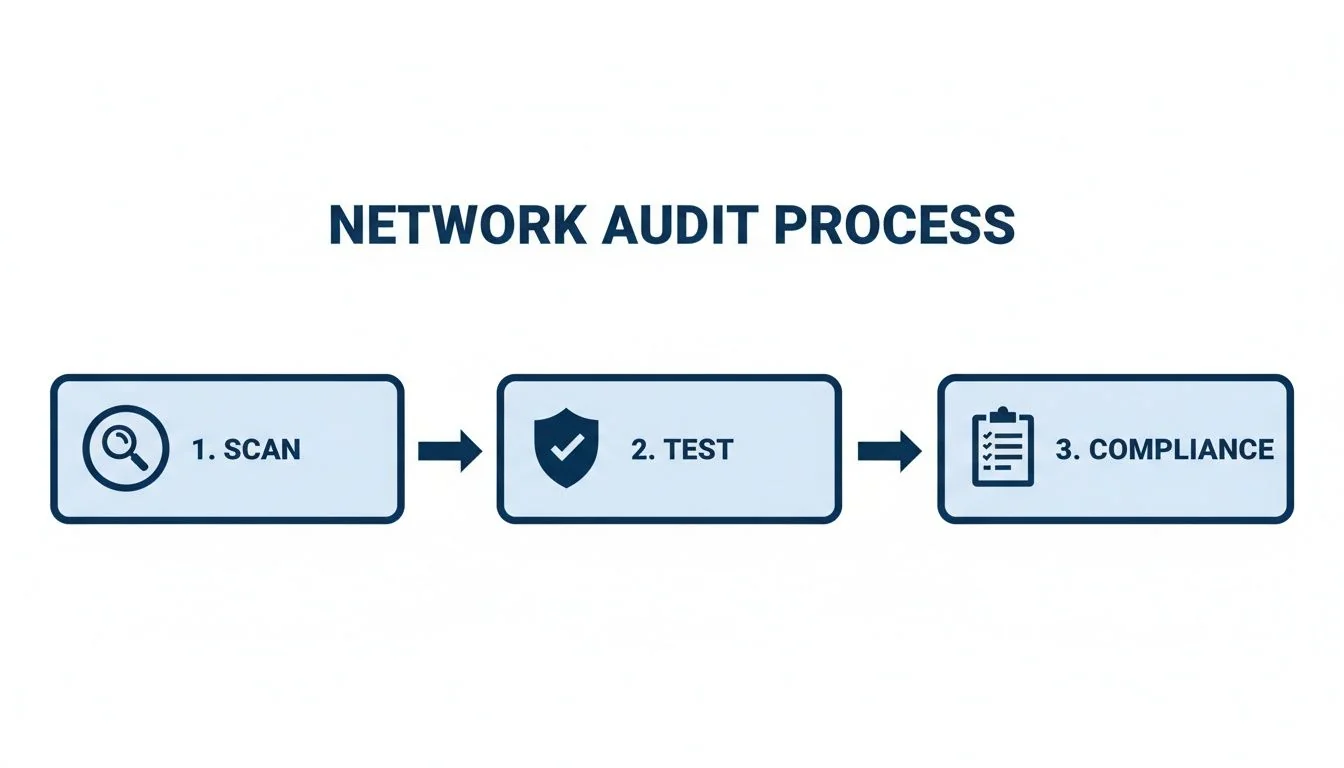
You can see how each stage provides a deeper level of assurance, validating not just your tech but your processes, too.
To give you a clearer picture of how these phases work and who gets involved, here’s a quick breakdown of the journey.
Key Phases of a Network Security Audit
| Phase | Primary Activity | Key Internal Stakeholders |
|---|---|---|
| Phase 1: Planning & Scoping | Defining the audit’s boundaries, goals, and rules of engagement. | CTO, CISO, Head of Engineering, Legal/Compliance |
| Phase 2: Information Gathering | Auditors collect documentation like network diagrams, policies, and access lists. | DevOps, IT/Network Admins, Security Team |
| Phase 3: Fieldwork & Testing | The “hands-on” part: vulnerability scanning, penetration testing, and interviews. | Engineering Team, System Administrators |
| Phase 4: Analysis & Reporting | Auditors analyze findings, prioritize risks, and draft the final report. | Security Leadership, Executive Team |
| Phase 5: Remediation & Verification | Your team fixes the identified issues and auditors re-test to confirm the fix. | Engineering Team, DevOps, IT/Network Admins |
Each phase requires different inputs and team members, making it critical to know what’s coming so you can have the right people and information ready to go.
Phase 1: Defining Scope and Objectives
First things first: you have to draw the map. This is the most critical phase, where you define exactly what you’re auditing and why.
Are you laser-focused on your AWS production environment? The internal corporate network? Or maybe a specific customer-facing application? Your objectives will dictate the entire audit. For example, trying to achieve SOC 2 compliance to land bigger deals is a very different goal than running a penetration test to find bugs before a product launch.
Getting this right means looping in your CTO and DevOps leads. They have the architectural context to ensure the audit focuses on the assets that actually matter to the business.
Phase 2: Information Gathering
With the scope locked in, the auditors start their discovery process. This is where they collect all the relevant documentation about your network and security controls. Think of it as the auditors studying your maps and trail guides before starting their climb.
You’ll typically be asked for documents like:
- Network Architecture Diagrams: The blueprints showing how all your systems connect.
- Security Policies and Procedures: Your rulebook for access control, data handling, and incident response.
- Access Control Lists: A record of who can access what.
- Previous Audit Reports: Findings from any prior security assessments.
This stage is all about collaboration with your IT and engineering teams. Having this information organized and ready to go can shave significant time off the audit.
Phase 3: The Audit and Fieldwork
This is where the action happens. Auditors execute their plan, which usually involves a mix of automated scans, manual testing, and interviews with your team.
For instance, they might run vulnerability scanners to find known weaknesses, try to exploit misconfigurations themselves, and talk to your engineers to understand how security policies are actually followed day-to-day. This hands-on work is what provides concrete evidence of your security posture—or lack thereof.
Phase 4: Analysis and Reporting
After the fieldwork, the auditors analyze everything they’ve found. They connect the dots between scan data, manual tests, and interviews to build a complete picture of your security strengths and weaknesses. The real goal here is to separate the minor housekeeping items from the critical, “fix this now” risks.
The final deliverable is the audit report. A good report doesn’t just list problems; it provides clear, actionable recommendations prioritized by risk. It’s your roadmap for improvement, written for both your technical team and the execs.
Phase 5: Remediation and Verification
The audit isn’t over when you get the report. Now, your team has to actually fix the issues. This might mean patching software, tightening firewall rules, or updating access policies.
Don’t underestimate this step. After fixes are in place, the auditors come back to verify them. They’ll re-test the specific vulnerabilities to confirm they’ve been successfully resolved, officially closing the loop and finishing the audit journey.
The Essential Network Security Audit Checklist
Before you ever bring in a third-party auditor, running through an internal review with a solid checklist can uncover a ton of low-hanging fruit. This simple step can make the formal audit process dramatically smoother.
Think of it as the quick inspection you do on a house before calling in the professional home inspector. You’re looking for the obvious stuff—the leaky faucets and broken light switches—so you can fix them ahead of time. This ensures you spend your time (and money) with the auditor focused on the truly complex challenges, not the easy-to-spot basics.
This self-assessment isn’t about passing a test; it’s about getting ready for one. By asking the right questions now, you build a stronger security foundation and walk into a formal security audit in network security with confidence. We’ve organized these questions into five core domains that mirror how auditors typically structure their own investigations.
Access Control Foundations
This is all about the principle of least privilege—making absolutely sure that people and systems only have access to what they truly need to do their jobs. Nothing more. Uncontrolled access is one of the most common ways breaches happen.
- Do we enforce multi-factor authentication (MFA) on all critical systems? This isn’t optional. It needs to be on your cloud consoles, admin portals, VPNs, and email. MFA is one of the most powerful and effective controls for shutting down unauthorized access.
- Is our user access review process documented and performed regularly? You should be checking who has access to what at least quarterly. This is how you catch and remove permissions for former employees or people who have changed roles. Stale, orphaned accounts are a huge, unnecessary risk.
- Are administrative privileges strictly limited and monitored? Privileged accounts are the keys to the kingdom. Their use should be rare, logged every time, and reviewed for any unusual activity.
Firewall and Router Configuration
Your firewalls and routers are the bouncers for your network, controlling every bit of traffic that tries to get in or out. A single misconfiguration here can leave the front door wide open for attackers.
A firewall is like a building’s security desk. It needs a strict, pre-approved guest list and a default policy of turning everyone else away. An overly permissive firewall is like a security guard letting in anyone who looks friendly—a recipe for disaster.
Here are the key questions to ask:
- Is our firewall rule set reviewed on a regular schedule (e.g., quarterly)? Business needs change constantly, and old, forgotten rules can create dangerous security holes. A regular review ensures your rules still make sense for your current security policy.
- Do we block all unnecessary inbound and outbound ports? Every open port is a potential entry point for an attacker. Your policy should be to deny all traffic by default and only open the specific ports required for business operations.
- Are all default credentials on network devices changed? Using the factory-default username and password on a router, switch, or firewall is a critical vulnerability that is embarrassingly easy to avoid. Change them immediately.
Data Protection and Encryption
This domain covers how you protect your most valuable asset—your data—both when it’s sitting on a hard drive and when it’s flying across the network.
- Is all sensitive data encrypted at rest? This applies to data sitting in databases, cloud storage buckets, and on servers. Encryption makes sure that even if someone steals a physical device, the data on it is completely unreadable.
- Is all data encrypted in transit using strong protocols like TLS 1.2+? This protects data from being snooped on as it travels between your servers and your users, or even between your own internal services.
Patch Management and Vulnerability Scanning
Outdated software is one of the leading causes of security breaches. Having a systematic process for finding and fixing software vulnerabilities isn’t just a good idea; it’s non-negotiable. For a deeper look at how this prepares you for formal validation, our comprehensive SOC 2 audit checklist offers valuable insights that build on these fundamentals.
- Do we have an automated system for identifying and deploying critical security patches? Trying to track patches manually across hundreds of systems is a losing battle. You need an automated process that guarantees patches are applied within a defined, and short, timeframe.
- Are we performing regular vulnerability scans of our internal and external networks? You can’t fix a problem you don’t know exists. Regular scanning gives you the visibility to find and prioritize weaknesses before an attacker does.
Logging and Monitoring
Finally, you have to be able to see what’s happening on your network so you can detect and respond to suspicious activity. Without good logging and monitoring, you’re flying blind.
- Are security logs from critical systems being collected and centralized? This includes logs from your firewalls, servers, and key applications. Pulling them into one place is the only way to effectively analyze them and investigate an incident.
- Do we have alerts configured for suspicious events? You need automated alerts that trigger on things like multiple failed login attempts, unusual data access patterns, or unexpected changes to critical system files. An alert is your first line of defense.
Common Audit Findings and How to Fix Them
Getting an audit report packed with findings can feel like a punch to the gut. But here’s the reality: it’s a roadmap for getting stronger, not a report card on failure. Most of the issues uncovered during a security audit in network security are shockingly common. Seeing them doesn’t mean your team is failing; it just means you’re on the same path as nearly every other growing company.
Think of these findings as shared battle scars. The key is to tackle them one by one, turning each weakness into a strength you can prove. That’s exactly what auditors, partners, and—most importantly—your customers want to see.
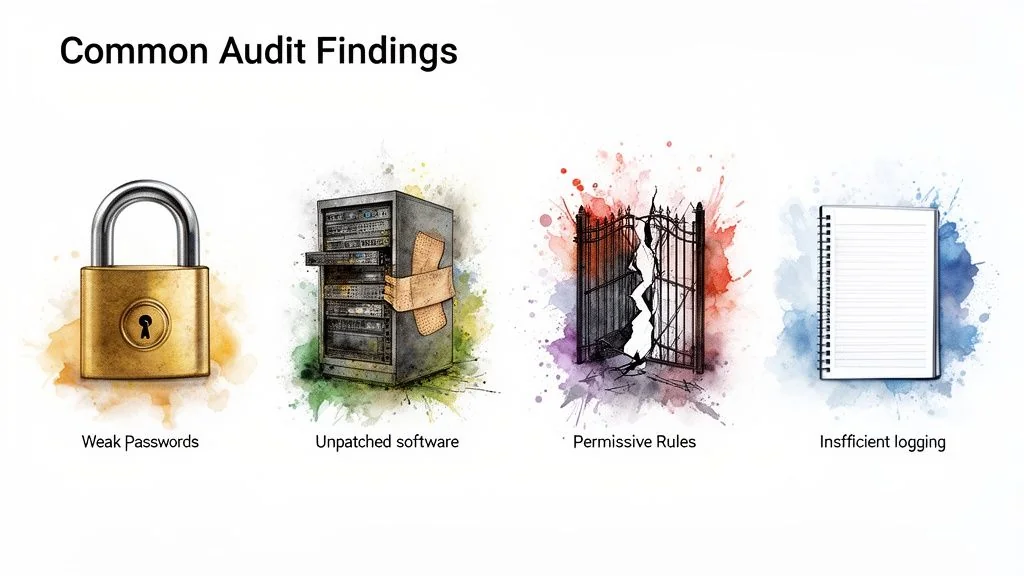
Unpatched Software and Systems
This is one of the most frequent—and dangerous—findings. Attackers are constantly running automated scans for outdated software with known vulnerabilities, making this a five-alarm fire you need to put out immediately.
- The Risk: Unpatched systems are a wide-open door for automated attacks. A single known vulnerability is all it takes for an attacker to get in, launch ransomware, or walk out with your most sensitive data.
- The Fix: Get an automated patch management system in place. This makes sure critical security updates for operating systems, apps, and firmware get rolled out quickly and consistently. You’ll also want a formal policy that dictates how fast patches are applied based on how severe the vulnerability is.
Weak or Mismanaged Credentials
From default passwords still active on network gear to flimsy password complexity rules, bad credential habits are everywhere. This bucket also includes the cardinal sin of modern security: no multi-factor authentication (MFA) on critical systems.
- The Risk: Stolen credentials are the number one cause of data breaches. Weak passwords are child’s play for attackers to guess or crack, giving them a direct line into your network.
- The Fix: Enforce a strong password policy that requires complexity, length, and regular rotation. But the real game-changer is to deploy MFA across all critical assets—cloud admin consoles, VPNs, email, you name it. This one control makes a massive difference.
It’s a sobering reality that many organizations are unprepared for modern threats. Alarmingly, 77% of organizations lack an incident response plan, while breaches have surged. Issues like the 60% of organizations harboring over 500 accounts with non-expiring passwords highlight exactly what audits are designed to find and fix. You can find more cybersecurity statistics and read the full research from Varonis here.
Overly Permissive Firewall Rules
Firewalls are often filled with rules that are way too broad. It usually starts with a “temporary” fix that someone forgets to remove, leaving a permanent security hole. Rules like “allow any” are the digital equivalent of leaving the front door unlocked.
- The Risk: These permissive rules punch holes in your network defenses, letting malicious traffic sail right past. This can expose internal services to the public internet or let a compromised machine phone home to an attacker’s command-and-control server.
- The Fix: Do a firewall rule audit every quarter. Your guiding philosophy should be “deny by default.” This means you only explicitly allow the specific traffic your business needs to function. Hunt down and delete any temporary, overly broad, or ancient rules that have no business being there.
Insufficient Logging and Monitoring
Lots of companies collect logs, but almost no one actually looks at them. Without real-time monitoring and alerting, those logs are completely useless for stopping an attack as it happens.
- The Risk: If you’re not watching your logs, you’re flying blind. This dramatically increases “dwell time”—the time an attacker is inside your network undetected—from hours to months. That gives them more than enough time to do catastrophic damage.
- The Fix: Centralize your logs from all critical systems into a Security Information and Event Management (SIEM) tool or a dedicated logging platform. The crucial next step is to set up automated alerts for high-priority events, like a flurry of failed logins, an admin logging in from a strange location, or unusually large data transfers.
Choosing the Right Auditor and Scoping the Cost
Picking the right partner for your network security audit is one of the most critical decisions you’ll make. This isn’t about bargain hunting; it’s about finding a firm that genuinely understands your business, communicates without jargon, and acts as a true partner in making you more secure.
Think of your auditor as a co-pilot. You need someone with the right flight hours for your specific route—whether you’re a SaaS, FinTech, or HealthTech company—and someone you trust to navigate the inevitable turbulence. Look past the price tag. Evaluate their communication style, check out their past reports for clarity, and ask hard questions about how they’ll support you when you need to fix things.
Boutique Firms vs. The Big Four
For most startups and mid-market companies, the choice boils down to a specialist boutique firm or one of the “Big Four” accounting giants. While the Big Four bring brand recognition to the table, they can often be slower, more bureaucratic, and a lot more expensive.
Boutique firms, on the other hand, usually offer a more personalized touch and much faster turnaround times. They’re typically more agile and give you direct access to senior auditors, something larger firms just can’t match. To get a real sense of the landscape, you can compare a curated list of vetted SOC 2 audit firms to see how different providers stack up on speed, cost, and service.
Choosing an auditor is a long-term partnership, not a one-off transaction. The right firm won’t just help you pass the audit; they’ll provide insights that make your security program fundamentally stronger and more resilient.
Demystifying the Cost of an Audit
The pricing for a network security audit can feel like a black box, but it’s really driven by a few key factors. Getting a handle on these is the key to setting a realistic budget and avoiding sticker shock later.
The final price tag will almost always come down to these variables:
- Company Size: More employees and more systems mean a more extensive audit. It’s a simple matter of scale.
- Network Complexity: A straightforward, single-cloud environment is far cheaper to audit than a sprawling hybrid-cloud setup with multiple data centers and legacy systems.
- Audit Scope: A SOC 2 Type 2 audit, which looks at your controls over a period of time, is going to be significantly more involved—and expensive—than a Type 1, which is just a point-in-time snapshot.
- Your Readiness: If your documentation is a mess and your controls are immature, the auditor has to spend more time untangling things. A well-organized company will always pay less.
Frequently Asked Questions
Even with a detailed roadmap, a few practical questions always pop up when you’re staring down the barrel of a network security audit. Let’s tackle the most common ones so you can move forward with confidence.
How Often Should We Conduct an Audit?
The old “once a year” answer just doesn’t cut it anymore. While an annual, comprehensive audit is still the baseline for compliance frameworks like SOC 2, your actual risk profile should be the real driver.
High-growth companies shipping code every day or swimming in sensitive data need to supplement that big annual audit. Think quarterly vulnerability scans or biannual penetration tests. The goal is to get away from a simple point-in-time snapshot and move toward a model of continuous assurance, making sure your security posture keeps up with the pace of your business.
Here’s an analogy: The annual audit is your required yearly physical exam. Continuous monitoring is like wearing a fitness tracker every single day. One proves compliance, but the other gives you the real-time data you need to actually stay healthy.
What Is the Difference Between an Audit and a Risk Assessment?
This is a huge point of confusion, but the distinction is critical.
A risk assessment is something you do internally. It’s the process of looking around your environment and asking, “What could go wrong?” You’re identifying potential threats, finding vulnerabilities, and figuring out what the impact would be.
A security audit, on the other hand, is an independent validation of your answers to that question. An auditor comes in to test whether the controls you’ve put in place to deal with those risks are actually designed correctly and working as intended. An assessment identifies the dangers; an audit verifies your defenses.
How Long Does a Typical Audit Take?
The timeline for a network security audit can swing wildly depending on the scope, the complexity of your network, and how prepared your team is. That said, you can use these ballpark estimates for planning:
- Startups (Under 50 Employees): For a tightly scoped audit like a SOC 2 Type 1, you should probably budget 4 to 8 weeks from the kickoff meeting to getting the final report in your hands.
- Mid-Market Companies (50-500 Employees): For a more involved SOC 2 Type 2 audit, which includes a much longer observation period, you’re looking at a timeline of 3 to 6 months.
What speeds things up? Having your documentation in order before the auditors even show up, designating a single point of contact internally, and having a technical team that can respond to requests quickly. On the flip side, a sprawling, poorly documented network or disorganized evidence collection can easily add weeks—or even months—to the project.
Navigating the world of auditors can be a challenge. At SOC2Auditors, we replace the guesswork with a data-driven matching platform. Compare real pricing, timelines, and satisfaction scores from over 90 verified firms to find the perfect partner for your security audit. Get your tailored matches at https://soc2auditors.org.