 Menu
Menu
A security audit for your network is a top-to-bottom, systematic review of your entire digital infrastructure’s defenses. It’s the process you go through to verify that your security controls are actually implemented correctly and doing their job, proving to customers and partners that you can be trusted with their data. This isn’t just a technical checkup; it’s a critical business enabler.
Why a Security Audit Is Your Secret Business Weapon

Think of a network security audit like a home inspection for your company’s digital property. Before you sell a house, you hire an expert to check the foundation, wiring, and plumbing for hidden problems. A network audit does the exact same thing for your firewalls, access controls, and data pathways, uncovering vulnerabilities before they can blow up a major partnership or lead to a costly breach.
This process is absolutely non-negotiable for any organization handling sensitive information. Enterprise clients, especially those with serious compliance needs like SOC 2, won’t just ask if your network is secure—they will demand verifiable, third-party proof. A successful network security audit report is that proof.
It gives you definitive, credible answers to the questions every potential customer is already asking:
- Are your defenses against cyber threats actually solid and well-maintained?
- Is the data we’re about to give you genuinely protected from unauthorized access?
- Can you back up your security claims with an independent, third-party validation?
By getting ahead of these questions, you turn a technical requirement into a powerful tool for building trust and closing deals faster.
Connecting Audits to Business Growth
A clean audit report isn’t just about dodging a bullet; it’s about unlocking opportunity. It’s a clear signal of operational excellence and builds the credibility you need to land larger, more security-conscious clients. In a crowded market, this formal attestation becomes a key differentiator, telling the world that your organization is a reliable and mature partner.
A network security audit moves the conversation from “we believe we are secure” to “we have proven we are secure.” This shift is fundamental to earning enterprise-level trust and accelerating your sales cycle.
This demand for proof has driven a huge surge in the need for network audits. With global cybercrime costs expected to hit roughly $10.5 trillion in 2025, big companies are more than willing to invest in partners who invest in audits to minimize their risk. This has put real pressure on auditor availability, creating a wide range of costs—from $15,000 for straightforward audits to over $400,000 for highly complex environments. You can dig into these market dynamics in the latest cybersecurity reports.
At the end of the day, a security audit is much more than a compliance box to check. It’s a strategic investment that fortifies your security, satisfies customer due diligence, and directly fuels revenue growth by building the one currency that matters most in business: trust.
Defining Your Audit Scope and Key Controls
Before an auditor can even touch your network, you have to define the battlefield. Getting your audit scope right is the single most important thing you can do to keep a project from spiraling into a chaotic, expensive mess.
Think of it like drawing a precise map for the auditor. You mark exactly which territories they need to inspect and which ones are out of bounds. Without that map, you’re just asking them to wander aimlessly. It’s the difference between asking an electrician to check your kitchen wiring versus asking them to inspect the entire neighborhood’s power grid. One is focused and manageable; the other is a complete waste of time and money.
The goal is to draw boundaries that line up perfectly with what you’ve promised customers and what your compliance goals demand, like SOC 2. This makes sure the audit is tough where it needs to be without trying to boil the ocean.
What’s In Scope vs. Out of Scope?
Figuring out what’s “in scope” means tagging every single system, app, service, and location that touches the data you’re paid to protect. This isn’t just about the servers humming away in your office anymore. Today’s network boundaries are fluid, stretching far beyond any physical building.
Your scope needs to cover all the critical pieces of how you deliver your service. That includes:
- Cloud Environments: Everything living in your AWS, Azure, or Google Cloud Platform accounts is fair game. This means virtual machines, storage buckets, VPCs, and identity management services.
- On-Premise Infrastructure: Any physical servers, data centers, routers, switches, or office networks that support your main service are definitely in scope.
- Third-Party SaaS Tools: Don’t forget the critical apps that handle sensitive data. Your CRM, customer support platform, or code repositories are part of the puzzle.
- Databases: All production databases holding customer data or sensitive operational info are a central focus of any network audit.
- People and Processes: The audit isn’t just about tech. The people and teams with admin access to these systems—and the procedures they follow—are absolutely in scope.
So, what’s out of scope? Anything not directly involved in delivering your core service or handling sensitive data. For instance, a development environment that only uses fake, anonymized data would almost certainly be excluded.
Identifying Your Most Critical Controls
Once the map is drawn, it’s time to pinpoint the key security controls within that boundary. These are the specific policies, procedures, and technical settings an auditor will poke and prod to see if your security is legit. They’re the tangible proof you’re actually doing what you say you are.
An auditor’s job is to test your controls. Your job is to make sure those controls are well-documented, consistently operated, and directly address the risks within your defined scope.
Auditors tend to zero in on a few core categories of controls that form the foundation of network security. These aren’t just technical toggles; they represent your entire strategy for protecting the network. For a better sense of how these pieces fit together, it’s worth exploring the guidance on building an effective internal control procedure.
Here are the control areas that will get the most attention:
- Access Control: Who can get to what? Auditors will dig into your policies for granting, reviewing, and yanking user access, especially for admin accounts. They’ll want to see evidence of multi-factor authentication (MFA) and proof that you’re sticking to the principle of least privilege.
- Network Segmentation: How do you keep your sensitive systems walled off? This involves a close look at your firewall rules, virtual private clouds (VPCs), and subnets to confirm that critical assets are isolated from less secure ones, which helps contain the damage if a breach occurs.
- Intrusion Detection and Prevention: How do you spot and shut down threats? Evidence here looks like logs from your Intrusion Detection Systems (IDS), Intrusion Prevention Systems (IPS), and your Security Information and Event Management (SIEM) platform.
- Configuration Management: Are your systems set up securely and consistently? Auditors will ask for documented configuration standards, change management tickets, and vulnerability scan reports to make sure your systems are hardened against common attacks.
The 5 Phases of a Network Security Audit
A network security audit can feel like prepping for a final exam—a bit intense, maybe a little intimidating. But if you break it down into clear phases, it stops being a monster under the bed and becomes a manageable roadmap. Knowing what’s coming demystifies the whole thing and gets your team ready for a smooth engagement.
This flow chart shows how the process starts: you define the environment, identify the controls that matter, and figure out what proof the auditors will need.
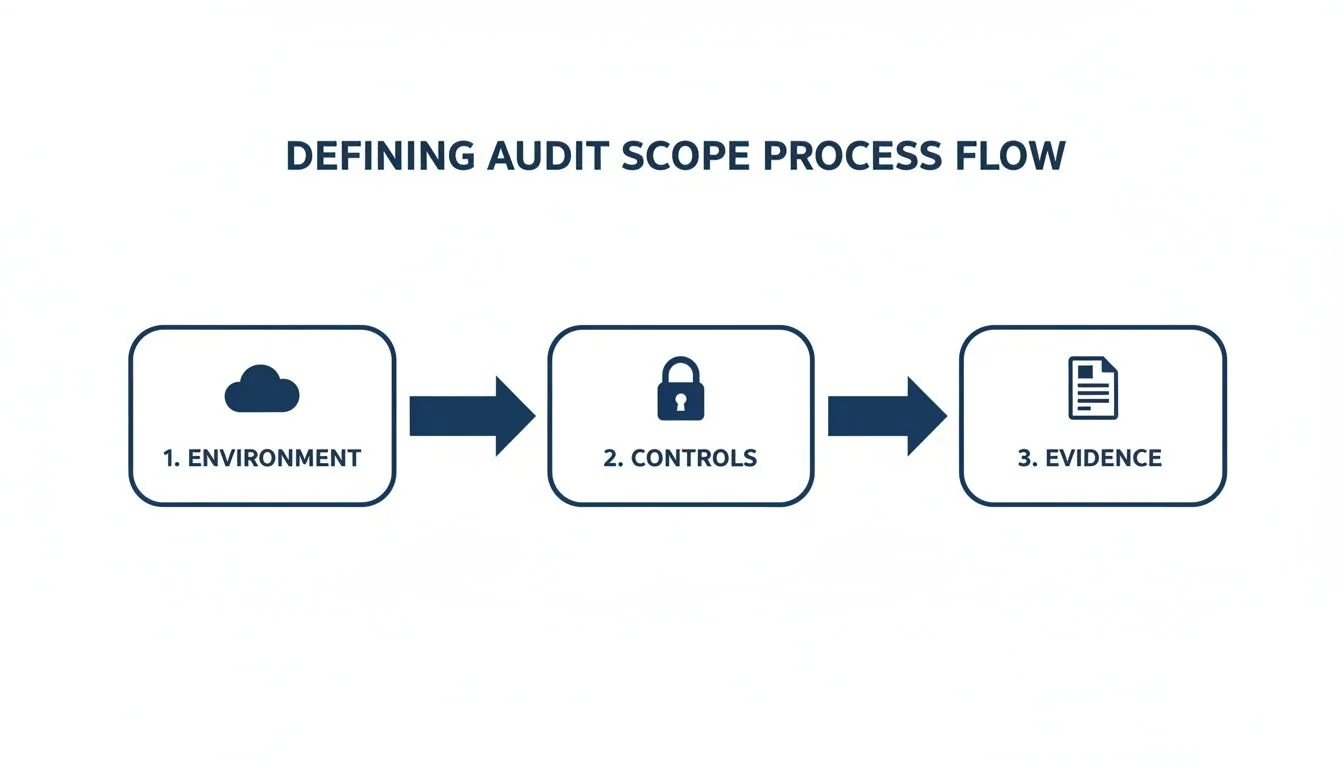
As you can see, a successful audit is won or lost long before any technical testing begins. It all comes down to clearly defining the systems, controls, and documentation that are in play.
Phase 1: Planning and Scoping
This is where you and the auditor lay down the rules of engagement. You’ll define the audit’s boundaries, what you’re trying to achieve, and the timeline. Your job is to hand over network diagrams and a full inventory of your assets. The auditor’s job is to clarify exactly which systems, locations, and data flows are fair game.
Think of it as the blueprinting stage. A tight, precise scope prevents “scope creep” and keeps the audit focused on what actually matters for your compliance goals, like SOC 2. Getting this right from the start will save you a world of hurt later on.
Phase 2: Documentation Review
Before anyone touches a keyboard, auditors pore over your existing policies, procedures, and internal documentation. They’re looking for proof that your security program isn’t just an idea in someone’s head—it’s well-defined, formalized, and actually followed.
Auditors live by a simple creed: “If it’s not documented, it didn’t happen.” This is your first real chance to show them your security program is mature and organized.
Your team will get a request list for key documents, which usually includes:
- Information security policies
- Up-to-date network architecture diagrams
- Incident response plans
- Change management procedures
- Reports from any previous audits or vulnerability scans
This phase is all about making sure your stated controls line up with industry best practices and whatever framework you’re being audited against.
Phase 3: Fieldwork and Technical Testing
Alright, now the audit moves from paper to practice. This is where auditors get hands-on with your network to confirm that the controls you’ve documented are actually working as intended. It’s the most interactive part of the audit, involving a mix of automated scans and manual checks.
For instance, an auditor might sit down with your network engineers to understand how firewall rules are really managed day-to-day. Or they might fire up their own tools to hunt for misconfigurations. They’ll ask for evidence like screenshots of firewall rulesets, access control lists, and logs from your intrusion detection systems. Success here is all about your team’s ability to pull that proof quickly and accurately.
Phase 4: Finding Validation and Analysis
When auditors find something that looks off, they don’t just slap a “FAIL” stamp on it. They bring it to your team first to validate the finding. This is a critical, collaborative step. It’s your opportunity to provide more context or evidence that might explain what they’re seeing.
Once a finding is confirmed, the auditor digs into its root cause and figures out the real-world risk. This is what separates a minor policy deviation from a major control gap that could seriously impact your final report. Getting a deeper look into the world of a computer network security audit can give you a better feel for what auditors care about most during this analysis.
Phase 5: Reporting and Remediation
This is the endgame. The whole process culminates in the formal audit report, a detailed document outlining the scope, methodology, all the findings, and the auditor’s final opinion on your security posture. If any issues were found, you’ll get a list of recommendations for fixing them.
Before even starting this process, it’s smart to run a SOC 2 readiness assessment to find and fix the low-hanging fruit yourself.
Once you have the report, the ball is in your court. Your team will need to create a remediation plan with firm deadlines for addressing every single finding. You’ll usually share this plan back with the auditor, showing you’re serious about continuous improvement and officially closing the loop on the audit cycle.
Your Essential Audit Checklist for Gathering Evidence
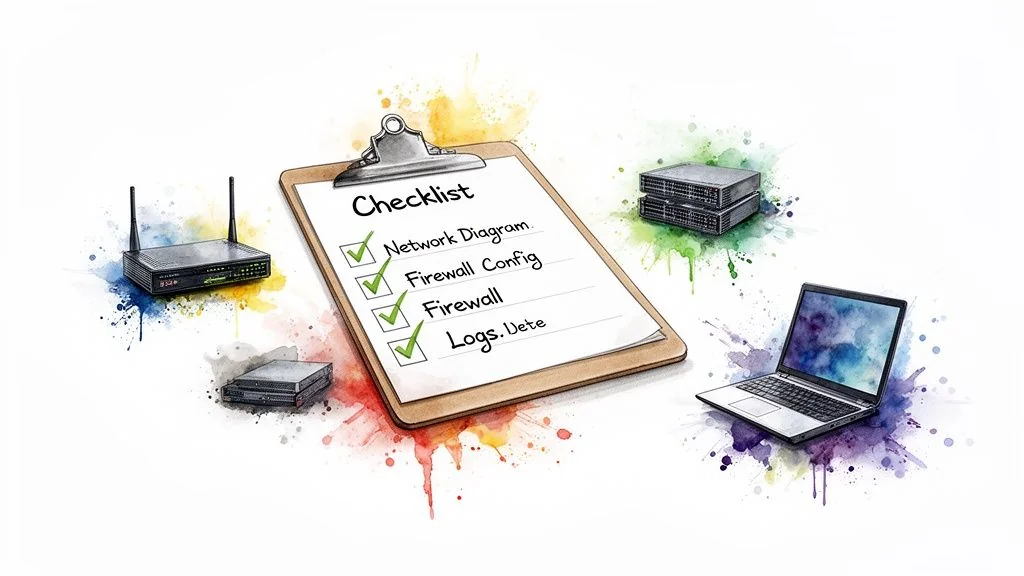
Acing a network security audit boils down to one thing: having the right evidence ready to go. Auditors need more than just your word; they need cold, hard proof that your security controls are actually working as designed. Prepping this documentation is the single best way to speed up the audit and show you know what you’re doing.
Think of it like getting ready for a tax audit. You wouldn’t just tell the IRS your deductions are legitimate; you’d show up with a folder full of organized receipts. In a network audit, your configuration files, logs, and diagrams are those receipts.
This checklist covers the core evidence you’ll need to pull together.
Network Architecture Diagrams and Data Flow
First up, auditors need a map of your world. A clean, current network architecture diagram is non-negotiable. This isn’t just a jumble of boxes and lines; it’s the visual blueprint showing how everything—servers, cloud services, databases, third-party tools—connects and communicates.
Auditors will be looking for a few key things:
- Clear Boundaries: The diagram must clearly define the audit scope, showing exactly where data enters and leaves your network.
- Data Flow: They need to trace how sensitive data moves between systems, especially from production to non-production environments.
- Security Zones: It should illustrate how you segment your network (think VPCs and subnets) to wall off your most critical assets.
This diagram provides the context for everything else. Without it, the rest of your evidence is just a pile of disconnected facts.
Firewall and Router Configurations
Your firewalls and routers are the bouncers for your network. Their configuration files are the rulebooks they follow, dictating precisely what traffic gets in and what gets blocked. Handing these over is how you prove you have a strong perimeter.
Auditors will comb through these files looking for sloppy work. They’re hunting for overly permissive rules (like allow any), default admin passwords that were never changed, and rules without a clear business reason. It’s all about proving every open port is there on purpose.
An auditor’s primary goal is to verify that your network’s configuration matches your security policy. A firewall rule that contradicts your documented access control policy is an immediate red flag.
This intense focus isn’t just for show. Breaches involving third-party supply chains are projected to double to roughly 30% of all incidents by 2025. With attackers constantly exploiting simple network misconfigurations, auditors are under pressure to validate these foundational controls. It’s no surprise that 51% of IT professionals dealt with a security incident in the last year, making a strong case for getting these audits right.
Access Control Lists and User Permissions
Proving you live by the “principle of least privilege” is a huge part of any security audit. This means showing evidence of who can access what across your network, and more importantly, who can’t.
Be ready to provide exports of user roles and permissions from your key systems.
This includes:
- Administrative Accounts: A complete list of every user with “god mode” access to servers, databases, and cloud platforms.
- Role-Based Access Control (RBAC): Proof that you assign permissions to roles, not directly to individuals, which makes management cleaner and less error-prone.
- Access Reviews: The paper trail (like support tickets or signed checklists) showing that you periodically review and remove access that’s no longer needed, especially for offboarded employees.
For cloud environments, understanding tools like AWS CloudTrail for API Activity Auditing is crucial. It provides the detailed logs of API calls that auditors need to verify who did what, and when.
Vulnerability Scans and IDS Logs
Finally, you need to show you’re actively hunting for threats, not just waiting for them to find you. This requires two types of evidence.
First, you’ll need recent vulnerability scan reports from tools like Nessus or Qualys. These reports prove you’re looking for weaknesses in your own systems. But just running the scan isn’t enough; you also need to show you’re fixing what you find.
Second, provide logs from your Intrusion Detection and Prevention Systems (IDS/IPS). These logs are the proof that you’re watching the wire for malicious activity in real-time. Auditors want to see that alerts are investigated and closed out, not just piling up in a queue. This one-two punch demonstrates a mature security posture: you find your flaws, and you watch for active attacks.
How to Choose the Right Audit Partner
Picking the right partner for your security audit network assessment is one of the most critical decisions you’ll make in your entire compliance journey. This isn’t just about hiring a firm to check a few boxes. It’s about finding an ally who actually gets your business, your tech stack, and where you are in your growth.
The right partner can make the audit a smooth, genuinely useful experience. The wrong one? You’re looking at frustrating delays, surprise costs, and a final report that does nothing to build trust with your customers.
Think of it like choosing a surgeon. You wouldn’t just go with the cheapest option or the one with a flashy ad. You’d find a specialist with deep experience in your exact procedure, a stellar track record, and a communication style that actually gives you confidence. The same logic applies here. A generic, one-size-fits-all approach to auditing is a recipe for disaster for modern tech companies.
Beyond the Brand Name
It’s tempting to just default to one of the big, well-known accounting firms. But for a fast-moving startup or a mid-market company, that’s not always the smartest move. You need to dig a little deeper and judge potential auditors on the things that will actually make or break your audit experience.
Your evaluation should be practical and focused. Here are the key areas to really dig into:
- Industry Specialization: An auditor who mainly works with manufacturing plants won’t understand the nuances of a SaaS business. Look for a firm with real, proven experience in your world—whether that’s FinTech, HealthTech, or B2B software. They’ll already speak your language and know the specific risks you’re up against.
- Technical Depth: Does the audit team actually understand your cloud stack? An auditor who is an expert in AWS but has never touched Google Cloud Platform is going to struggle to test your controls effectively. Ask them direct questions about their team’s hands-on experience with your specific infrastructure and tools.
- Communication Style: A great audit is a partnership, not an interrogation. On your initial calls, pay attention to how they answer questions. Are they clear and direct, or do they hide behind jargon? A good partner communicates proactively and works with you to understand context, not just point out flaws.
- Proven Track Record: Don’t be shy about asking for case studies or references from companies that look a lot like yours in size and industry. This is how you verify they can actually handle a company at your stage of maturity.
Key Questions to Ask Potential Auditors
Once you’ve got a shortlist, it’s time to get specific. The answers to these questions will tell you everything you need to know about an auditor’s process, transparency, and overall fit.
- What is your process for handling findings? Do they just throw a list of problems over the wall, or do they work with your team to validate findings and give you practical advice on how to fix them?
- What does a realistic timeline look like for a company of our size and complexity? This is a great way to spot auditors who are just telling you what you want to hear. A good auditor will give you a candid, milestone-based timeline.
- Who will be on the actual audit team, and what is their experience? You need to make sure the seasoned pros you talk to during the sales process are the same people who will actually be leading your audit.
- How do you support your clients between audit cycles? The best partners act more like year-round advisors, not just annual inspectors who show up once a year.
Choosing an auditor is a long-term commitment that directly impacts your ability to close deals. Focus on finding a partner who invests in understanding your business, not just auditing it. This strategic alignment is the key to a successful and repeatable compliance program.
Auditor Selection Criteria Comparison
Making this decision can feel overwhelming, especially with so much on the line. To help cut through the noise, it’s useful to compare the different types of firms you might encounter. Specialist firms that live and breathe security audits often provide a very different experience than the massive, do-it-all accounting giants.
| Evaluation Criteria | Specialist Audit Firm | Big Four / Large Firm | Key Question to Ask |
|---|---|---|---|
| Responsiveness | High (often same-day responses via Slack/email) | Low (can take days/weeks to get answers) | “What’s your typical response time during an active audit?” |
| Technical Expertise | Deep in cloud-native stacks (AWS, GCP, Azure) and SaaS | Broader, but may lack deep, hands-on tech skills | ”Describe your team’s experience with our specific technology stack.” |
| Timeline | Faster (agile, tech-driven process) | Slower (more bureaucratic, process-heavy) | “Can you provide a detailed, milestone-based timeline in the SOW?” |
| Cost | More affordable, better value | Premium pricing (you pay for the brand name) | “What are the common drivers of change orders or extra fees?” |
| Team Continuity | More consistent (same team year-over-year) | High turnover (often staffed with junior auditors) | “Will the same senior team lead our audit next year?” |
Ultimately, using a data-driven platform to compare your options can be a game-changer. You can find excellent resources to compare top SOC 2 audit firms, letting you see transparent pricing, verified client satisfaction ratings, and typical timelines side-by-side. This kind of approach helps you avoid common pitfalls like overpaying for a brand name or getting stuck with a firm that causes unexpected and costly delays.
Frequently Asked Questions
When you’re digging into a network security audit, especially with a goal like SOC 2 compliance on the horizon, a lot of questions come up. Here are some of the most common ones we hear, with straightforward, no-BS answers.
What Is the Difference Between a Network Security Audit and a Penetration Test?
This is a big point of confusion, but it’s simple once you get it. A network security audit and a penetration test (pen test) are two sides of the same coin. They answer different, but equally critical, questions about your security.
Think of a network security audit as a compliance checkup. It’s like a building inspector reviewing your blueprints, wiring diagrams, and safety plans against a strict building code. The auditor checks your network configurations, access policies, and procedures against a known framework (like the SOC 2 criteria) to confirm your security controls are designed correctly and are actually working.
A penetration test, on the other hand, is a simulated attack. It’s like hiring a team of ethical hackers to try and break into that same building. Their job is to find and exploit real-world vulnerabilities to see if they can get in.
An audit asks, “Are you following the security rules you set for yourself?” A pen test asks, “Can a determined attacker break your defenses anyway?” You really need both for a solid security program.
Ultimately, an audit verifies your documented compliance, while a pen test validates your resilience against real threats.
How Much Does a Network Security Audit Typically Cost?
There’s no single price tag. The cost of a network security audit, particularly as part of a SOC 2 engagement, is all over the map because it’s tied directly to the scope and complexity of the job.
A few key factors drive the price:
- Scope and Complexity: The more systems, cloud environments, and locations you have, the higher the cost. Auditing a simple SaaS app running on a single cloud will be way cheaper than a complex, hybrid-cloud setup in a regulated industry like FinTech.
- Audit Type (Type 1 vs. Type 2): A SOC 2 Type 1 report is a snapshot in time, so it’s less expensive. A SOC 2 Type 2 report tests your controls over a 6-12 month period, making it a much bigger—and more expensive—project.
- Your Readiness: If your documentation is a mess and your team is unprepared, auditors have to spend more time hunting for evidence. That extra time goes straight to your bill. Be organized, save money.
For a rough benchmark, a basic SOC 2 Type 1 for a small startup might start around $15,000. For a mid-sized company going for a SOC 2 Type 2, costs often land in the $30,000 to $70,000+ range. For big enterprises in heavily regulated fields, it’s not unusual for costs to blow past $100,000 and even get near $400,000 for the most complex audits.
How Long Does the Entire Security Audit Network Process Take?
The timeline depends heavily on which report you need and how prepared you are. This is a marathon, not a sprint, so set your expectations accordingly.
For a SOC 2 Type 1 report—the point-in-time snapshot—the process is relatively quick. From kickoff to final report, you’re usually looking at 3 to 6 months.
The timeline for a SOC 2 Type 2 report is much, much longer. That’s because the whole point is to prove your controls work over time.
The process has two main phases:
- The Observation Period: This is the window when your controls are being tested. It lasts anywhere from 6 to 12 months.
- The Audit and Reporting Period: Once the observation period ends, the auditor does the final testing and writes the report. This adds another 2 to 3 months.
All in, a full SOC 2 Type 2 engagement can take anywhere from 9 to 20 months from start to finish. How ready your team is, how complex your network is, and how efficient your auditor is will be the biggest factors in where you land on that spectrum.
Ready to find the right auditor without the guesswork? SOC2Auditors provides transparent, data-driven comparisons of top audit firms, helping you match with a partner that fits your budget, timeline, and tech stack. Get your tailored auditor matches at https://soc2auditors.org.