 Menu
Menu
SOC 2 controls are the real-world proof behind your security promises. They are the specific policies, procedures, and technologies you put in place to protect customer data and satisfy the SOC 2 framework’s requirements. Think of them as the detailed actions that show you’re serious about security, availability, confidentiality, processing integrity, and privacy.
For context on how controls fit into the bigger SOC 2 picture, read our complete SOC 2 compliance guide.
What Are SOC 2 Controls, Really?
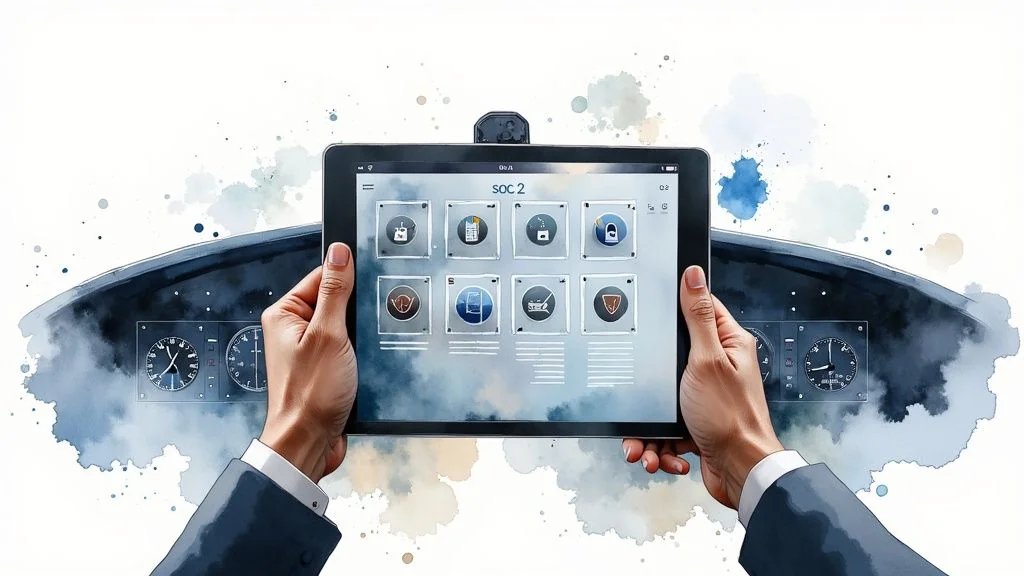
Imagine stepping into the cockpit of a modern airliner. You’re surrounded by hundreds of instruments, switches, and systems. Each one is a specific “control” designed to ensure a safe flight—one monitors engine temperature, another manages cabin pressure, and a third handles navigation. All together, they create a comprehensive system that helps pilots manage risk and get everyone to their destination securely.
SOC 2 controls work on the exact same principle, but for your company’s data security. They aren’t vague guidelines; they’re the tangible, everyday actions your team takes to keep data safe. They are the practical application of your security policies, turning high-level goals into concrete, auditable procedures.
From Abstract Rules to Actionable Steps
A security policy without controls is just a piece of paper. A policy might say, “Access to sensitive data must be restricted,” but the controls are what actually make that happen.
For instance, the controls that bring that policy to life would include things like:
- Multi-Factor Authentication (MFA): Forcing users to provide a second form of verification before they can access critical systems.
- Role-Based Access Control (RBAC): Creating specific user roles with pre-set permissions so employees can only see the data they absolutely need for their jobs.
- Access Review Procedures: Running quarterly reviews to make sure former employees have been de-provisioned and current permissions are still appropriate.
Each of these is a distinct control that an auditor can test to verify your policy is actually working. They are the fundamental building blocks of any trustworthy security program.
A SOC 2 report without clearly defined controls is like a promise without proof. The controls are the evidence that demonstrates your organization’s security commitments are being met consistently and effectively.
Why Prioritizing Controls Is a Business Imperative
Getting your SOC 2 controls right is no longer just a compliance checkbox; it’s a strategic necessity. The market is moving fast. Globally, enterprise adoption of advanced security tech is expected to hit 65% by 2025, a huge jump from 45% in 2020. This isn’t happening in a vacuum—it’s a direct response to the staggering projection that cybercrime damages will cost the world $10.5 trillion a year by 2025. You can dig into more data on this security technology adoption surge to see the global trends for yourself.
At the end of the day, strong controls do more than just get you through an audit. They build a resilient security posture that protects you from real-world threats, helps you win those big enterprise deals, and builds the kind of customer trust that lasts.
Understanding The Five Trust Services Criteria

The entire SOC 2 framework is built on five core principles known as the Trust Services Criteria (TSC). Think of them as the five essential pillars holding up your entire security program.
While your company gets to choose which criteria matter for your services (beyond the one mandatory pillar), you need to understand all five to make smart decisions. Each criterion is a specific promise you’re making to your customers about how you handle their data, and your SOC 2 controls are the specific actions you take to keep that promise.
Let’s break down what each of these pillars actually means in the real world.
Security: The Non-Negotiable Foundation
Security is the bedrock of any SOC 2 report. It’s the only criterion that is mandatory for every single company, no exceptions. This pillar is all about protecting your systems and data against unauthorized access, unwanted disclosure, and any damage that could compromise the other four promises.
Think of it as the high-tech security system for a bank vault. It’s the physical locks, the surveillance cameras, the alarm systems, and the guards at the door—all working together.
In the digital world, these controls look like:
- Access Controls: Making sure only the right people can access sensitive systems using tools like multi-factor authentication (MFA) and role-based permissions.
- Firewalls and Network Monitoring: Building a protective barrier around your network and actively watching for anything that looks suspicious.
- Vulnerability Management: Regularly scanning for and patching weaknesses in your systems before an attacker can find them.
Without a strong Security foundation, any promises you make about the other criteria are basically meaningless. It’s the absolute starting point for your entire compliance effort.
Availability: The Promise of Reliability
Availability is your commitment that your systems and services will be up and running as promised in your service level agreements (SLAs). It’s about proving to customers that they can count on you when they need you most.
This criterion is like the local power grid. Customers just expect the lights to stay on. The utility company has to have backups, disaster recovery plans, and constant performance monitoring to prevent outages and fix them fast when they happen.
The Availability criterion isn’t just about uptime; it’s about resilience. It proves you have a plan to handle disruptions, from minor performance hiccups to major system failures, ensuring business continuity for your clients.
Effective controls for Availability include things like robust backup solutions, a disaster recovery plan you’ve actually tested, and performance monitoring tools that help you spot trouble before your customers do.
Processing Integrity: The Guarantee of Accuracy
Processing Integrity ensures your system does exactly what it’s supposed to do—completely, accurately, and on time. In simple terms, it means your system gets the right answer, every single time, without errors or unauthorized tweaks.
Imagine a financial app that calculates complex loan payments. Processing Integrity is the guarantee that every calculation is perfect, every time, without any data getting corrupted or altered along the way.
Controls here are all about quality assurance and data validation. This includes rigorous testing of new code before it goes live, checks on transaction processing, and keeping detailed logs to ensure data is correct from input to output. For a deeper look at these principles, check out this detailed guide to the SOC 2 Trust Services Criteria.
Confidentiality: The Digital Vault
Confidentiality is about protecting sensitive information that isn’t necessarily personal but still needs to be locked down—think intellectual property, secret business plans, or internal financial records. It’s all about restricting access and disclosure to only a specific list of people.
Think of Confidentiality like the legal protections around a trade secret formula. Access is granted on a strict need-to-know basis, with strong technical and legal controls in place to keep it from getting out. Key controls here include data encryption (both when it’s sitting on a server and when it’s moving across the internet), strict access controls, and non-disclosure agreements (NDAs).
Privacy: The Commitment to Personal Data
Finally, the Privacy criterion focuses on how you collect, use, retain, and dispose of personal information. This is all about Personally Identifiable Information (PII) like names, addresses, Social Security numbers, and other sensitive data tied to an individual. It’s about being transparent and responsible with people’s personal data.
This is a lot like a doctor’s commitment to patient confidentiality under HIPAA. The goal is to respect an individual’s rights over their own data, provide clear privacy notices, and get proper consent. Controls in this category often align with global privacy rules like GDPR, ensuring data is handled ethically and just how users expect it to be.
To make these concepts even clearer, here’s a quick summary table that puts it all together.
Overview of The Five Trust Services Criteria
| Trust Service Criterion | Core Objective | Business Analogy |
|---|---|---|
| Security | Protect systems and data from unauthorized access and damage. | The locks, alarms, and guards on a bank vault. |
| Availability | Ensure systems are operational and accessible as promised. | The power grid keeping the lights on 24/7. |
| Processing Integrity | Guarantee that system processing is complete, accurate, and timely. | A financial calculator that always gets the math right. |
| Confidentiality | Restrict access and disclosure of sensitive, non-personal data. | Protecting a company’s secret trade formula. |
| Privacy | Responsibly handle the collection, use, and disposal of personal data. | A doctor’s commitment to patient confidentiality (HIPAA). |
Each of these pillars serves a distinct purpose, but together they create a comprehensive framework that helps you build and prove that you can be trusted with your customers’ most valuable asset: their data.
Connecting Controls to the Trust Criteria
Getting your head around the five Trust Services Criteria (TSC) is the easy part. The real work starts when you have to turn those high-level principles into actual, tangible security measures. This is where the rubber meets the road. Your SOC 2 controls are the specific policies, procedures, and technologies you put in place to prove you’re living up to the promises of each criterion.
Think of each TSC—Security, Availability, and so on—as a destination on a map. Your controls are the turn-by-turn directions that get you there. Without those specific actions, you’re just wandering around hoping you’ll eventually arrive at “secure.”
Let’s map out some of those practical routes and connect common, real-world controls to each of the five criteria.
Mapping Controls for Security
Security is the mandatory foundation for any SOC 2 report, making its controls the most critical ones to get right. This criterion is all about one thing: protecting systems and data from anyone or anything that shouldn’t have access. You’re building a fortress around your information.
Here are a few non-negotiable controls that directly back up the Security TSC:
- Multi-Factor Authentication (MFA): This is table stakes now. MFA requires users to provide at least two different ways to prove who they are before logging in. A password alone is no longer enough; MFA adds a crucial layer of defense that makes stolen credentials significantly less useful to an attacker.
- Vulnerability Scanning: You can’t defend against threats you don’t even know exist. This control means you’re regularly scanning your networks, servers, and apps for known security holes. Finding and patching these weaknesses before someone can exploit them is a core security function.
- Intrusion Detection Systems (IDS): Think of an IDS as a digital alarm system for your network. It actively monitors network traffic for shady activity or policy violations and throws up a red flag, alerting your team to potential threats as they happen.
These aren’t just good ideas; they are direct, auditable proof that you’re actively defending your systems.
Mapping Controls for Availability
The Availability criterion is your promise that customers can count on your service to be there when they need it. It’s all about making sure your systems are resilient, can handle disruptions, and can bounce back quickly from failure. The controls here show you have a rock-solid plan for when things inevitably go wrong.
Consider these controls your operational insurance policy:
- Disaster Recovery (DR) Plan: This is your documented playbook for responding to an unplanned disaster that takes down your IT infrastructure. A good DR plan isn’t just a document sitting on a shelf; it outlines specific steps to get back online and is tested regularly to make sure it actually works.
- System Performance Monitoring: You can’t guarantee uptime if you aren’t watching your system’s vital signs. This control involves using tools to track things like CPU usage, memory, and application response times. It helps you spot performance issues and potential failures before they bring the system down for users.
- Data Backup and Restoration Procedures: Regular, automated backups of critical data are a must. But more importantly, this control includes having the proven ability to restore that data accurately and within the timeframe you’ve promised in your Service Level Agreements (SLAs).
An auditor won’t just ask if you have a disaster recovery plan; they will demand evidence that you’ve tested it. For the Availability criterion, proving your controls work under pressure is just as important as having them in the first place.
Mapping Controls for Processing Integrity
Processing Integrity is all about accuracy, completeness, and timeliness. Your controls have to guarantee that your system does what it’s supposed to do, without errors, delays, or unauthorized changes. This is absolutely critical for companies handling financial transactions, running complex calculations, or processing any kind of critical data.
Here are the key controls that deliver on that promise of accuracy:
- Quality Assurance (QA) Testing: Before any new code sees the light of day in production, it needs to be put through its paces. This control means having a formal QA process that hunts for bugs, validates calculations, and ensures the changes won’t break anything already in place.
- Input and Output Validation: This is basically a “garbage in, garbage out” check. It ensures the data going into your system is correct and the information coming out is accurate. For example, a system might reject a form submission if a required field is missing (input validation) or double-check a calculation before showing the result to a user (output validation).
Mapping Controls for Confidentiality
The Confidentiality criterion covers sensitive information that needs to be protected from unauthorized eyes. This isn’t just personal data; we’re talking about things like your intellectual property, internal business plans, or proprietary customer lists that you’ve promised to keep secret.
Controls for Confidentiality act like a digital vault for your secrets:
- Data Encryption (At-Rest and In-Transit): Encryption is the cornerstone of confidentiality. This control ensures data is scrambled and unreadable while it’s just sitting on a server or in a database (at-rest) and while it’s flying across a network (in-transit).
- Non-Disclosure Agreements (NDAs): This is a procedural control, but a powerful one. It involves having employees, contractors, and partners sign legally binding agreements promising not to share sensitive information. It sets a clear, formal expectation of secrecy.
Mapping Controls for Privacy
Last but not least, the Privacy criterion zooms in specifically on the protection of Personally Identifiable Information (PII). It dictates how you collect, use, store, and get rid of personal data, all in line with your privacy policy and regulations like GDPR or CCPA.
Key controls that demonstrate your commitment to Privacy include:
- Privacy Policy and Notices: A fundamental control is simply maintaining a clear, easy-to-find privacy policy that tells users exactly what data you collect and what you do with it. No legalese, just straight answers.
- Data Retention and Deletion Policies: This control ensures you don’t become a data hoarder. It defines clear timelines for how long you keep PII and includes a reliable process for securely deleting it when a user asks or when you no longer need it for a legitimate business purpose.
How to Implement and Document Your Controls
Alright, this is where the rubber meets the road. Moving from planning your SOC 2 to actually building it is the most critical part of the entire journey. Implementing SOC 2 controls isn’t just about turning on new software; it’s about embedding security into your company’s DNA and keeping a flawless record of your work.
Auditors live by a simple, unwritten rule: “If it isn’t documented, it didn’t happen.” Your ability to hand over clear, organized proof is every bit as important as the controls themselves. Let’s walk through how to build a rock-solid control environment and the documentation to back it up.
Start With a Gap Analysis
Before you start building, you need a blueprint. A gap analysis is that blueprint. It’s a straightforward review of your current security setup compared against the SOC 2 Trust Services Criteria you’re aiming for.
This process shines a light on where you’re already strong and, more importantly, where you have gaps. For instance, you might find your password policy is great (a strength), but you have no formal, documented process for reviewing who has access to what every quarter (a major gap).
The goal here is a prioritized to-do list of weaknesses. This isn’t about pointing fingers; it’s about creating a strategic roadmap to get you from where you are to where you need to be.
Assign Clear Ownership for Every Control
A control without an owner is a ticking time bomb. It will eventually fail. For every single control on your list, you need to assign a specific person or team who is responsible for running it, monitoring it, and keeping it up-to-date.
This is all about accountability. When an auditor asks who’s in charge of managing firewall rules or running employee background checks, you need to have a name ready. No hesitation.
- Control: Quarterly User Access Reviews.
- Owner: Head of IT.
- Responsibility: Make sure reviews happen, are documented, and any needed access changes are completed within five business days.
This simple act turns a vague requirement into a real, actionable task with a clear owner, making your entire security program stronger.
Create Robust and Accessible Documentation
Your documentation is the story you tell your auditor. It needs to be clear, consistent, and easy to follow. This isn’t just about writing down policies. It’s about creating a living, breathing repository of evidence that proves your controls are working day-in and day-out.
The whole point of documentation is to create an undeniable evidence trail. An auditor should be able to pick any control at random, follow your documentation, and see exactly how it was implemented, how it works, and how you’ve monitored it over time.
Think of your documentation like a library with a few key sections:
- Policies and Procedures: These are your high-level rulebooks. Think of your Information Security Policy or your Change Management Policy. They define what you do.
- Control Descriptions: This is the nitty-gritty. A detailed explanation of each control, what it does, who owns it, and how it maps back to a specific SOC 2 criterion. A detailed SOC 2 controls list is a great reference for structuring these.
- Evidence Artifacts: This is the proof. Screenshots, system logs, signed forms, meeting notes—anything and everything that shows your controls are actually in action.
The chart below shows this perfectly, illustrating how a specific control like multi-factor authentication directly supports a broad criterion like Security.
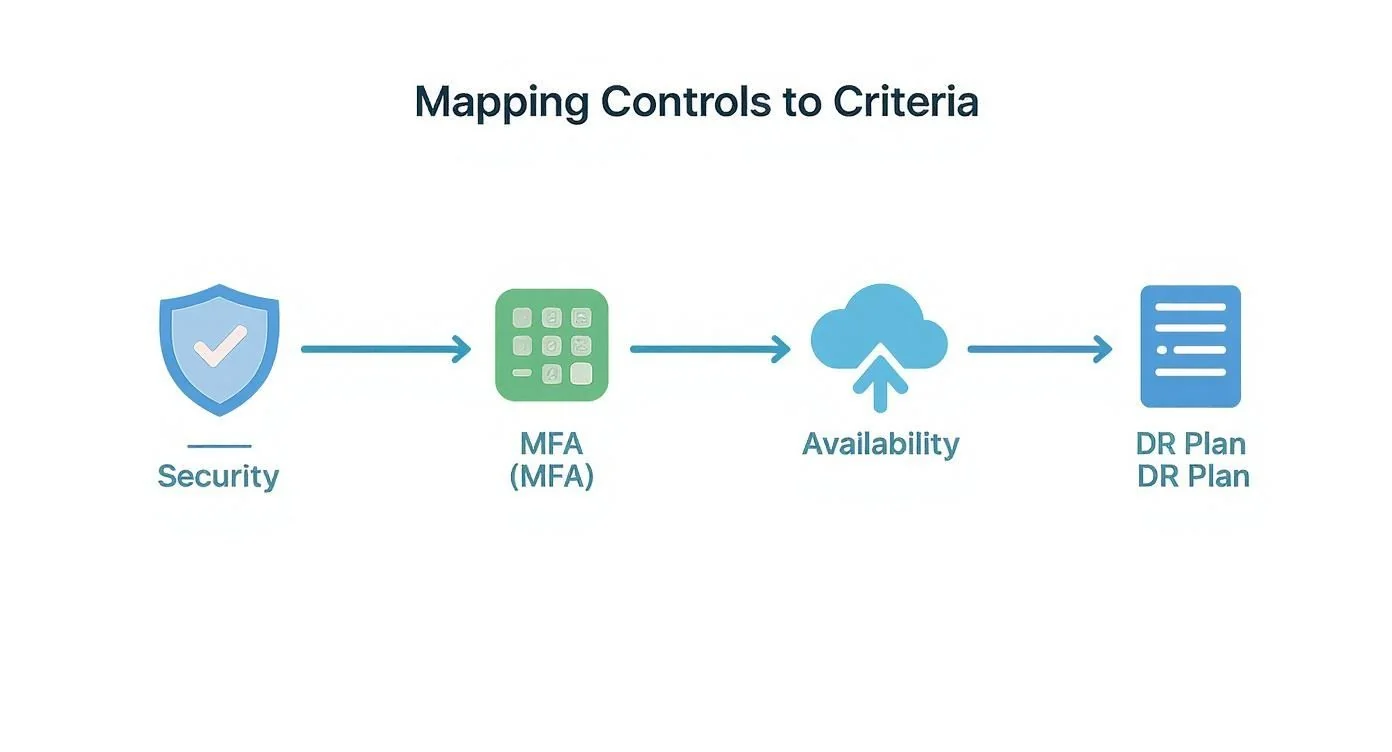
This kind of visual mapping makes it crystal clear how the actions you take directly satisfy the compliance requirements.
The Art of Evidence Collection
Collecting evidence shouldn’t be a mad dash the week before the audit. It needs to be a continuous, automated habit. Wherever you can, use tools and systems that generate logs and reports for you automatically.
For the manual stuff, like a quarterly risk assessment meeting, create a repeatable process. Make a standard template for meeting minutes, make sure someone fills it out every single time, and store it in a designated, secure folder. Consistency is king. An auditor will trust a control that has been documented like clockwork over the entire audit period far more than one with spotty, incomplete evidence.
Preparing for a Successful SOC 2 Audit
Getting to the finish line—the SOC 2 audit itself—can feel like a final exam you haven’t studied for. But it doesn’t have to be that way. With the right prep work, the audit becomes a structured review, not a high-stakes interrogation.
Solid preparation is all about building confidence. It’s your chance to streamline the whole process by finding and fixing your weak spots long before an auditor ever sees them. This is how you turn a complex compliance requirement into a manageable project with a clear end date.
Choosing Between a Type 1 and Type 2 Report
One of the first forks in the road is deciding which type of SOC 2 report you need. This choice has a major impact on the timeline, cost, and scope of your entire audit.
-
SOC 2 Type 1: Think of this as a snapshot. The auditor looks at your SOC 2 controls on a single day to confirm they’re designed correctly to meet the Trust Services Criteria. It’s a faster, cheaper first step for companies just starting their SOC 2 journey.
-
SOC 2 Type 2: This is the full motion picture. It goes much deeper, assessing both the design and the operating effectiveness of your controls over a period of time—usually 6 to 12 months. This is the gold standard that practically every enterprise customer will ask for, because it proves your security isn’t just theory; it works day-in and day-out.
For a young company, a Type 1 report can be a great way to get something on the board quickly. But be prepared: most will need to graduate to a Type 2 to satisfy customer demands and prove real, operational security.
How to Select the Right Audit Firm
Your auditor isn’t just a vendor; they’re a partner who can make or break your audit experience. Not all CPA firms are the same, and picking the wrong one can be a costly mistake. You need a team that gets your industry, your tech stack, and your business model.
When you’re vetting potential audit firms, here’s what to look for:
- Reputation and Experience: Find a CPA firm with a proven track record of performing SOC 2 audits for companies that look like yours. Ask for references.
- Industry Specialization: An auditor who already knows the difference between SaaS, FinTech, and HealthTech will grasp your specific risks and context much faster.
- Communication Style: You’re going to be talking to these people a lot. Make sure they’re responsive, clear, and feel more like a collaborator than an adversary.
Don’t just pick the cheapest option. A low-quality audit can get rejected by a sharp-eyed customer, forcing you to do it all over again. Investing in a reputable firm from day one will save you a world of pain later.
An auditor’s job isn’t to catch you messing up. It’s to independently verify that your security controls are designed well and actually working. A good firm acts as an objective partner, guiding you through the process with total transparency.
Your Audit Readiness Checklist
Showing up to an audit unprepared is the fastest way to get delays, extra costs, and a “qualified” opinion on your report (which is bad). A detailed SOC 2 compliance checklist can give you a full roadmap, but these core steps are non-negotiable.
- Perform a Self-Assessment: Before you even talk to an auditor, do an honest internal gap analysis against the Trust Services Criteria you’ve chosen.
- Remediate Known Gaps: Now, fix the problems you found. This isn’t just about ticking boxes; it means updating policies, rolling out new tools, and training your team.
- Organize Your Evidence: Create one central, easy-to-navigate place for every policy, log, and screenshot the auditor will ask for. Don’t make them hunt for it.
- Prepare Your Team: Give your key people a heads-up on what to expect. Let them know they’ll be interviewed and will need to pull evidence for the auditors.
This kind of disciplined prep work makes the actual audit a much smoother and more efficient process. These days, SOC 2 isn’t just a nice-to-have; it’s table stakes. In fact, 92% of organizations now conduct two or more audits every year. This shows that compliance is a continuous program, not a one-off project. Many are even bundling SOC 2 with frameworks like ISO 27001 to build a more robust security posture. You can see more insights from recent compliance statistics and trends to get a better sense of where the industry is heading.
Answering Your Top SOC 2 Control Questions
As you start digging into SOC 2, the same questions pop up time and again. How many controls do I need? Can I just use a template? Getting these answers right is the difference between a smooth audit and a painful one. Let’s clear up the confusion around some of the most common questions.
And this clarity has never been more valuable. The market for SOC reporting services was pegged at USD 5,392 million in 2024 and is on track to nearly double to USD 10,470 million by 2030. That explosion shows just how critical SOC 2 has become for proving you’re serious about security. You can dig into the numbers yourself in this report on the booming SOC reporting market.
How Many SOC 2 Controls Do I Really Need?
There’s no magic number here. Anyone who tells you otherwise is selling something. The right number of controls depends entirely on your business, your services, and which Trust Services Criteria you’ve chosen.
A lean startup might get by with 50-70 well-chosen controls. A sprawling enterprise? They could easily have hundreds. The goal isn’t to hit a specific count; it’s to effectively and efficiently mitigate your specific risks. Focus on relevance, not quantity.
What’s the Difference Between a Control and a Policy?
Think of it like this: a policy is the rule, and a control is how you enforce it. They’re two sides of the same coin, and you need both. A policy without a control is just a suggestion.
Policy: “All employees must use strong, unique passwords for company systems.”
Controls:
- The system is configured to enforce a minimum password length of 12 characters.
- Password complexity rules are enabled, requiring a mix of uppercase, lowercase, numbers, and symbols.
- An automated process forces password changes every 90 days.
The policy is the “what we do.” The controls are the “how we prove it.”
Can I Just Use a Template for My Controls?
Templates are a fantastic starting point, but they are only a starting point. An experienced auditor can spot a generic, copy-pasted control list from a mile away. Using a template without customizing it to your actual operations is one of the fastest ways to rack up audit findings.
Use templates and compliance automation tools to build your foundation. But then, you have to make them your own. Tailor every control to reflect your unique tech stack, your team’s workflow, and your specific business risks. This ensures they’re actually effective and will stand up to an auditor’s scrutiny.
How Often Should We Review Our SOC 2 Controls?
Your SOC 2 controls aren’t a “set it and forget it” project. The standard best practice is a full review at least once a year to make sure they’re still relevant and working as intended.
However, you should be reviewing them much sooner if your business goes through any significant changes. Pull your review forward whenever you:
- Launch a major new product or service.
- Bring a significant new technology platform into your stack.
- Change how you handle or store customer data.
- Undergo a major reorganization.
Treating this as a continuous process, not an annual chore, keeps your security posture strong all year long and makes the next audit that much easier.
Finding the right auditor is the most critical step in your SOC 2 journey. At SOC2Auditors, we replace the endless sales calls and confusing proposals with a data-driven matching platform. Get three tailored auditor matches based on your specific needs in 24 hours and make your choice with confidence. Find your ideal SOC 2 auditor today.