 Menu
Menu
Drata has become a major player in the security compliance automation space, helping countless companies achieve SOC 2, ISO 27001, and other certifications. While it’s a powerful tool, the market is filled with excellent competitors, each offering unique strengths tailored to different business needs. Whether you’re a startup on a tight budget, a scaling tech company managing multiple frameworks, or an enterprise seeking a unified GRC solution, exploring Drata alternatives is a critical step in finding the perfect fit.
This guide provides a detailed breakdown of the top platforms to help you navigate this complex decision. We move beyond generic marketing claims to offer practical insights, helping you understand which solution best aligns with your technical stack, compliance goals, and company stage. When navigating the compliance automation landscape, it’s crucial to understand key frameworks and how platforms help with things like What Is Soc 2 Compliance. This article is designed to clarify those connections.
We will analyze the leading Drata alternatives by examining:
- Ideal Customer Profiles: Who is the platform built for (e.g., startups, mid-market, enterprise)?
- Key Feature Differentiators: What unique capabilities does each platform offer?
- Potential Limitations: Where might the tool fall short for certain use cases?
- Pricing Models: What can you expect in terms of cost and structure?
Each option includes screenshots and direct links, allowing you to quickly evaluate the platforms that matter most to your organization. Our goal is to equip you with the information needed to select a compliance partner that not only helps you pass an audit but also strengthens your long-term security posture.
1. Vanta
Vanta stands as one of the most established and robust Drata alternatives, known for its mature platform and extensive integration ecosystem. It automates a significant portion of the work required for security and privacy frameworks like SOC 2, ISO 27001, HIPAA, and GDPR. The platform excels at continuous controls monitoring, pulling evidence from over 300 cloud services, HR systems, and infrastructure providers to ensure your security posture remains strong post-audit.
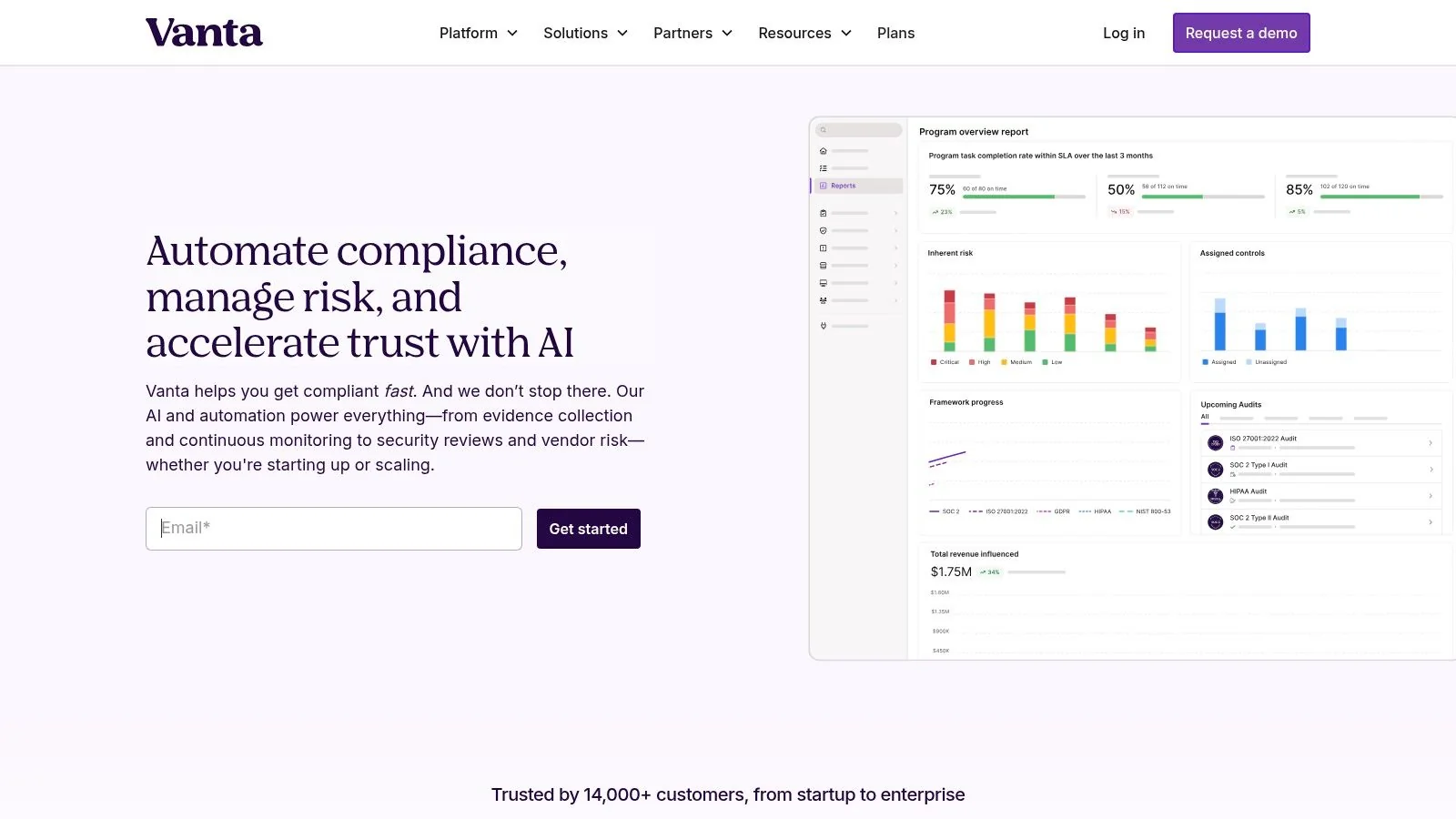
In 2025 and into 2026, Vanta has moved firmly toward what it calls an “agentic trust platform.” The Vanta AI Agent, now generally available, handles policy drafting, evidence checks, questionnaire responses (with a reported 95% acceptance rate), and issue remediation across your infrastructure. Vanta launched support for the NIST AI Risk Management Framework in early 2026, giving teams building AI products a path to demonstrate AI governance alongside their existing SOC 2 or ISO 27001 program. In April 2026, Vanta released a remote MCP server in public preview, allowing teams using Claude, Cursor, or Windsurf to query their compliance program directly from their editor and generate infrastructure-as-code fixes for failing controls across 500+ AWS, GCP, and Azure tests.
Plan structure now runs four tiers: Essentials, Plus, Professional, and Enterprise. AI Agent features are gated by plan, with more advanced agentic capabilities (issue management, agentic evidence collection, agentic policy generation) unlocking at Professional and above. Questionnaire Automation is bundled at 25 responses per year on Plus, 144 on Professional. For a more direct comparison of their features and ideal customer profiles, our detailed analysis of Vanta vs. Drata offers additional insights.
Platform Highlights
- Best For: Growth-stage startups and mid-market companies needing to build trust with enterprise customers, and teams building AI products who need NIST AI RMF coverage alongside SOC 2.
- Key Features: 300+ integrations, tiered Vanta AI Agent (policy generation, evidence checks, issue management), AI-powered questionnaire automation, Trust Center, NIST AI RMF support, remote MCP server for editor-native compliance workflows.
- Pricing: Quote-based across four tiers (Essentials, Plus, Professional, Enterprise). Procurement data from 2026 shows small teams (under 50 employees, one framework) typically pay $10,000 to $12,000 per year. Mid-market deployments with multiple frameworks run $25,000 to $55,000. Advanced AI Agent features and add-ons (vendor risk management, pen testing) are priced separately and can add $5,000 to $15,000 annually.
- Pros: Mature feature set with the deepest AI Agent integration in the category, strong sales enablement tools, AWS Marketplace procurement available, and the most extensive auditor network at roughly 500 integrated CPA firms.
- Cons: Advanced agentic features are gated at higher plan tiers, which means the headline price understates the real cost for teams who want full AI automation. Add-on pricing for vendor risk management and questionnaire automation raises the total materially versus the base license.
Website: https://www.vanta.com
2. Secureframe
Secureframe positions itself as a strong Drata alternative by combining a powerful automation platform with access to in-house compliance experts and a curated auditor network. It streamlines compliance for frameworks like SOC 2, ISO 27001, and HIPAA through continuous monitoring and automated evidence collection. The platform is designed to guide users through the entire compliance journey, from readiness assessment and policy generation to audit management, making it a comprehensive solution for companies looking for a more hands-on approach.
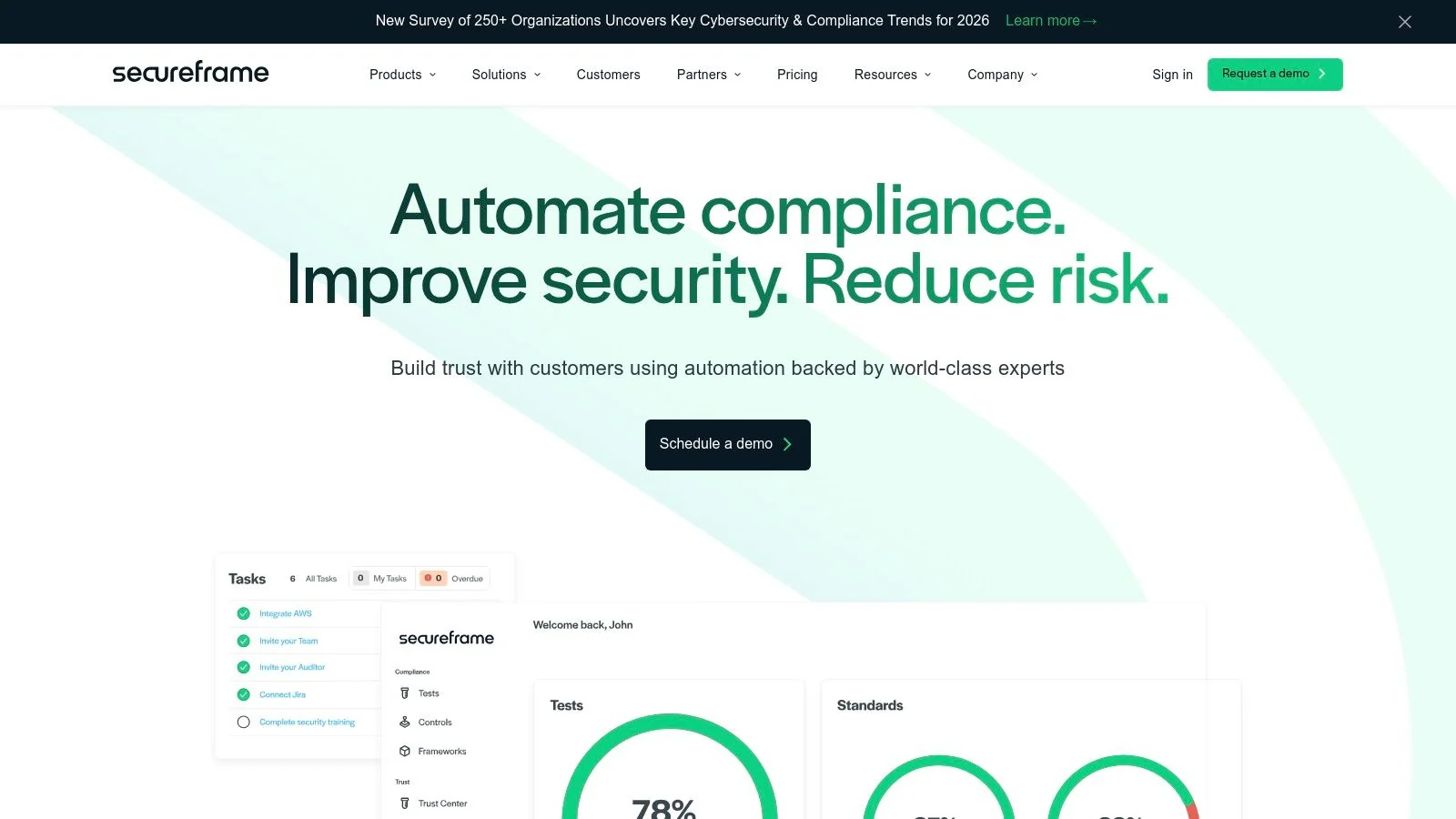
A notable aspect of Secureframe is its structured packaging, which caters to different stages of a company’s compliance maturity. It also offers a specialized add-on for federal compliance, assisting with System Security Plan (SSP) and Plan of Action & Milestones (POA&M) tracking for frameworks like FedRAMP. This makes it an appealing option not only for commercial businesses but also for those venturing into the public sector. The platform’s emphasis on expert guidance and a clear onboarding process helps demystify complex compliance requirements for teams without a dedicated GRC function.
Platform Highlights
- Best For: Companies wanting guided onboarding, and organizations that may need to pursue federal compliance frameworks in the future.
- Key Features: Continuous control monitoring, automated evidence collection, policy and risk management, built-in Trust Center, optional federal compliance module.
- Pricing: Quote-based, with packages (Fundamentals, Complete, Federal) that scale based on company needs and required frameworks.
- Pros: Strong reputation for customer support and hands-on onboarding, clear package structure helps align features with needs.
- Cons: Public pricing is not available, and some integrations or advanced capabilities are gated behind higher-priced tiers.
Website: https://secureframe.com
3. Sprinto
Sprinto positions itself as a forward-thinking Drata alternative by deeply integrating AI into the compliance workflow. Designed for cloud-native companies, the platform crossed 3,000 customers in 2026 and ships 200+ integrations covering cloud providers, HR systems, and SaaS tools. Its AI-Driven Autonomous Compliance Platform, launched in late 2025, goes beyond point automation to treat controls, evidence, and policies as a continuously self-healing system.
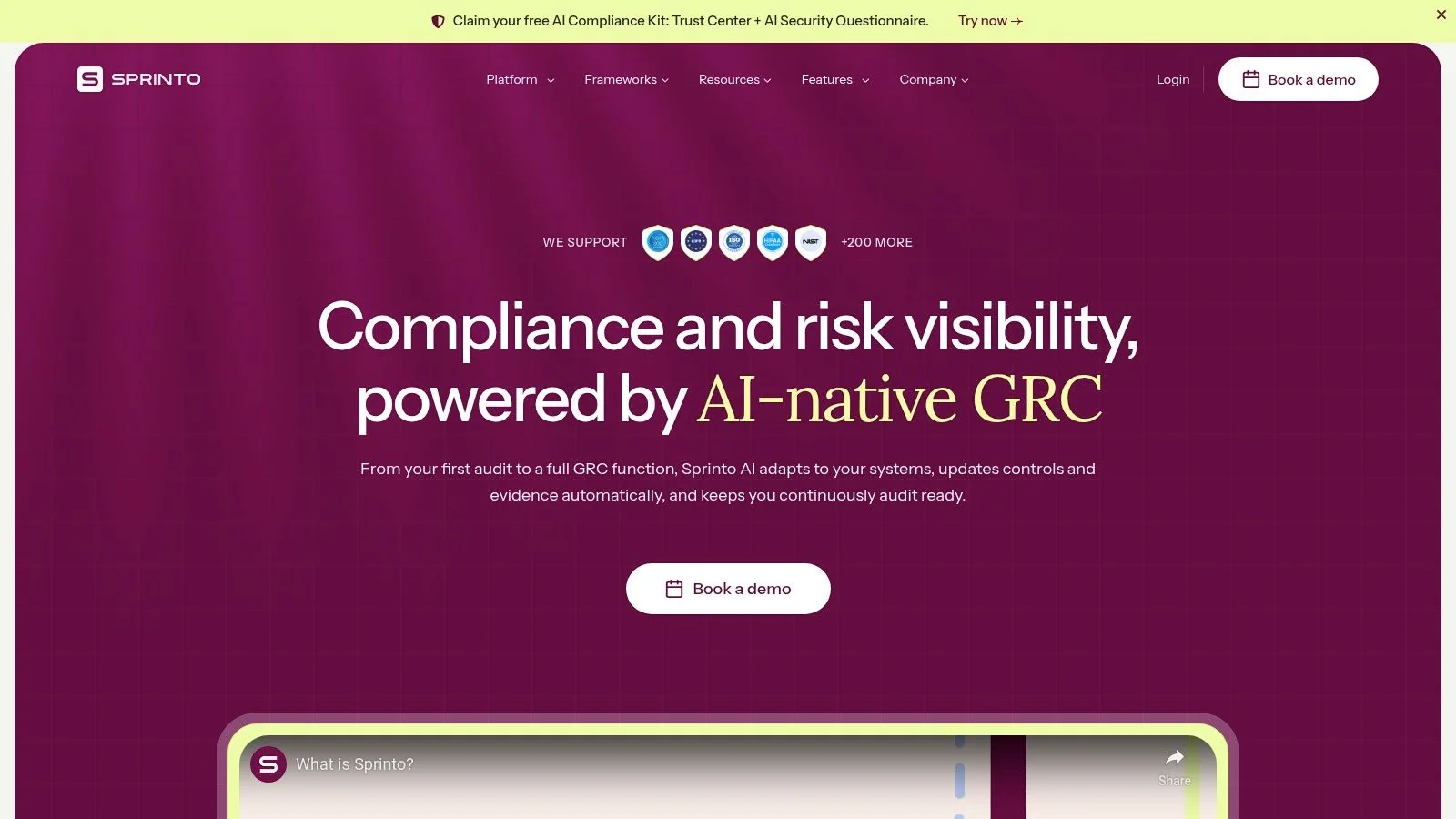
The autonomous compliance layer has four core capabilities. Autonomous control testing validates controls continuously without manual scheduling and surfaces drift as it happens. AI-assisted evidence collection identifies which artifacts map to which controls and packages them automatically. Intelligent gap analysis prioritizes the remediation backlog by risk severity rather than presenting an undifferentiated list of failing tests. Infinite Framework Mapping, released in November 2025, lets teams add new or custom frameworks in minutes by automatically detecting control overlaps and building cross-framework mappings without manual configuration. Sprinto reports 80%+ accuracy across AI-generated outputs and uses a human-in-the-loop design: evidence and policy drafts are prepared and surfaced by AI, but compliance judgment before audit submission remains a human responsibility.
The platform also includes vendor risk management, a Chrome extension for real-time evidence capture from cloud consoles, and multilingual security questionnaire automation. One of Sprinto’s standout offerings is its free, self-guided SOC 2 readiness experience, which provides a useful on-ramp for companies just beginning their compliance journey. Our complete Sprinto review offers a deeper look at its capabilities.
Platform Highlights
- Best For: Cloud-native startups and cost-conscious tech companies looking for the most price-competitive full-featured compliance automation, particularly those managing two or more frameworks simultaneously.
- Key Features: AI-Driven Autonomous Compliance Platform (autonomous control testing, AI evidence collection, gap analysis), Infinite Framework Mapping, 200+ integrations, vendor risk management, multilingual questionnaire automation, free self-guided SOC 2 readiness.
- Pricing: Quote-based with a startup entry point of $4,000 to $8,000 per year for one framework at small team sizes, making it the lowest-cost entry among the major platforms. Mid-market deals with multiple frameworks typically run $12,000 to $30,000. Year-1 discounts of up to 60% are common; renewal increases of up to 40% have been reported, so model multi-year cost before signing.
- Pros: Most price-competitive full-featured option in the category, 4.8 G2 rating, strong AI automation for evidence and control mapping, free readiness on-ramp, and broad multi-framework coverage including 200+ standards.
- Cons: The AI Autonomous Platform is maturing and evidence outputs still require human review before audit submission. Pricing is not published and renewal increases can be significant. Best suited for cloud-first environments; teams with heavily on-premise or custom infrastructure may hit integration limits.
Website: https://sprinto.com
4. Thoropass (formerly Laika)
Thoropass, formerly known as Laika, presents a unique model among Drata alternatives by deeply integrating compliance automation software with in-house audit and advisory services. This end-to-end approach is designed to eliminate the common friction between a company preparing for an audit and the independent firm conducting it. Thoropass guides companies through readiness for frameworks like SOC 2, ISO 27001, HIPAA, and GDPR, providing hands-on support from compliance experts alongside its continuous monitoring platform.
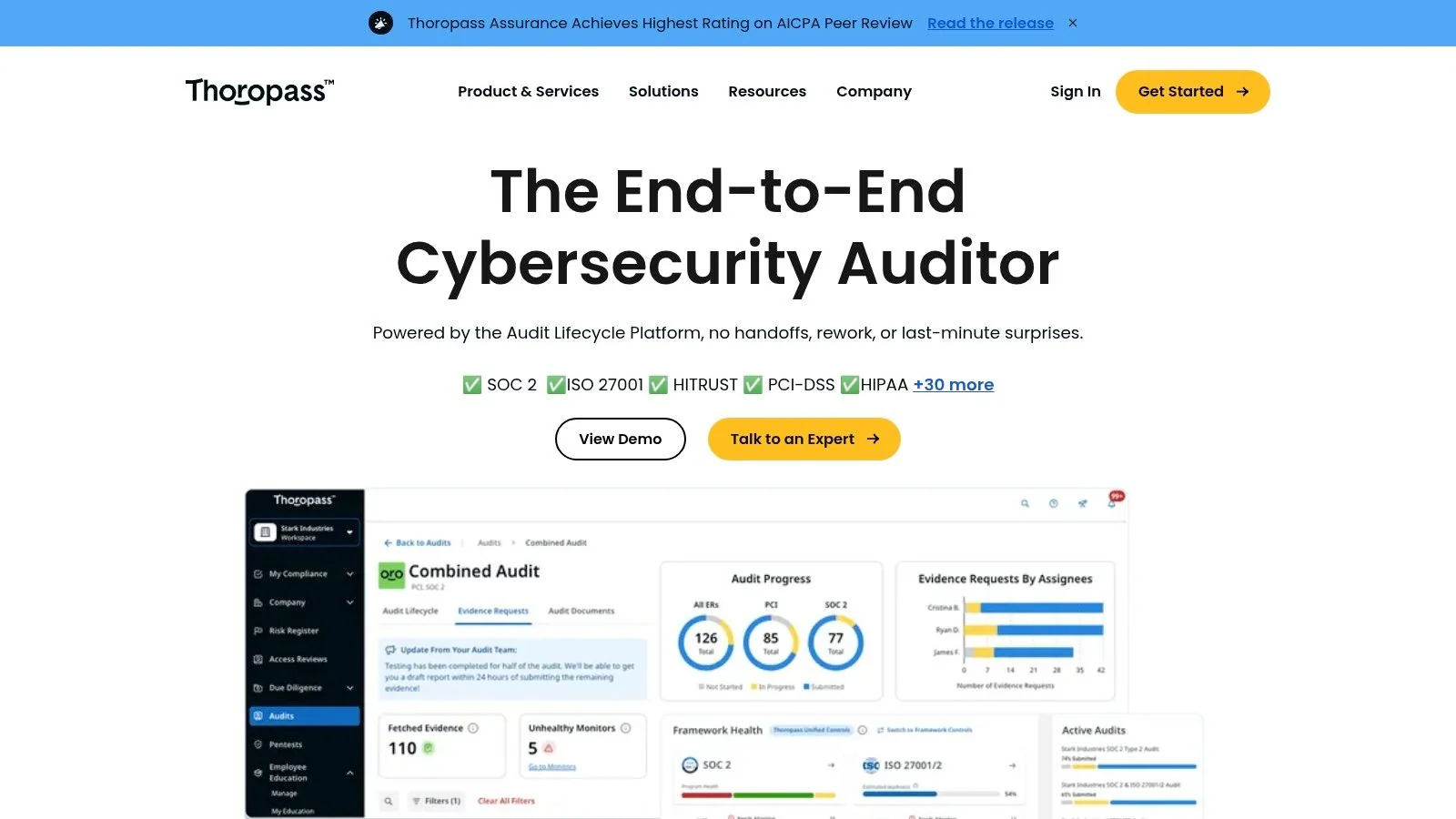
The key differentiator for Thoropass is its “audit-in-a-box” experience. Because the auditors are part of the same organization, the platform is purpose-built to gather the exact evidence they need, streamlining communication and reducing the back-and-forth that can prolong audit timelines. This integrated model is particularly beneficial for teams navigating their first audit, as the combination of software and expert services provides a clear, supported path to a successful report. Understanding the financial aspect of this process is also crucial, and our guide on how much a SOC 2 audit costs can provide valuable context.
Platform Highlights
- Best For: Companies wanting a single vendor for both compliance software and audit services, especially those undertaking their first SOC 2 or ISO 27001.
- Key Features: Integrated audit and penetration testing, software-plus-services model, continuous controls monitoring, vendor risk management.
- Pricing: Quote-based via a consultative sales process. The bundled nature can offer cost predictability but may be a larger initial investment.
- Pros: Streamlined audit process with an integrated auditor, hands-on guidance is ideal for first-timers, single point of contact for software and audit.
- Cons: The platform’s breadth may be more than what very small startups require, and companies that prefer to choose their own auditor will find the model restrictive.
Website: https://thoropass.com
5. Hyperproof
Hyperproof positions itself as a more comprehensive GRC platform, making it a strong Drata alternative for organizations maturing beyond single-framework compliance into integrated risk management. It excels at managing multiple overlapping security frameworks by using a “common control set,” allowing teams to map one piece of evidence to satisfy requirements across standards like SOC 2, ISO 27001, and NIST. This “test once, comply with many” approach is highly efficient for scaling companies.
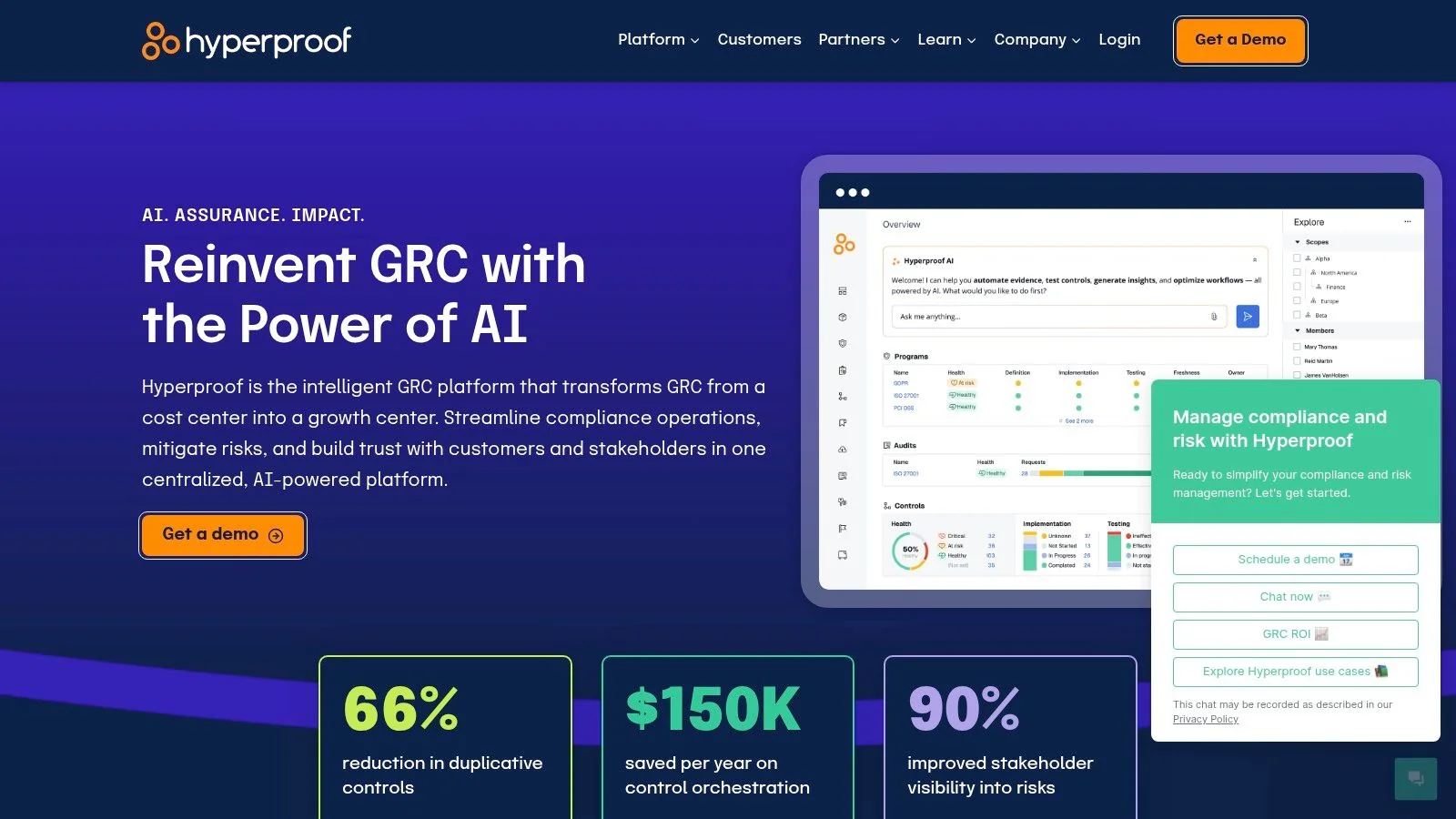
The platform is distinctly structured into modules like “Comply” for compliance operations and “Mitigate” for risk management, which can be adopted incrementally. This modular design, combined with its automated evidence collection and orchestration, provides a clear pathway from achieving an initial audit to establishing a sophisticated, ongoing GRC program. Hyperproof is particularly well-suited for companies that foresee a future where compliance and risk management must be deeply intertwined, rather than managed in separate silos. Its ability to scale with complexity makes it a strategic choice for businesses with long-term governance goals.
Platform Highlights
- Best For: Mid-market and enterprise companies managing multiple compliance frameworks or looking to integrate risk management with their compliance efforts.
- Key Features: Common control mapping for multi-framework efficiency, dedicated risk management module (“Mitigate”), automated evidence orchestration, and plan-dependent unlimited-user licensing models.
- Pricing: Quote-based and tailored to specific needs. Pricing is not public, and potential customers should anticipate setup or implementation fees as part of the total cost.
- Pros: Excellent for managing numerous overlapping frameworks, provides a strong, integrated approach to both risk and compliance, and offers a scalable path for growing GRC programs.
- Cons: The platform’s complexity and pricing model may be overwhelming for early-stage startups needing only a single certification, and it requires a custom quote and implementation process.
Website: https://hyperproof.io
6. AuditBoard
AuditBoard emerges as a powerful Drata alternative for large, complex organizations that need a unified platform for audit, risk, and compliance management. Originating with a strong focus on internal audit and Sarbanes-Oxley (SOX) compliance, its platform is engineered for enterprise-grade GRC workflows. This makes it a compelling choice for public companies or enterprises managing multiple, intersecting compliance frameworks far beyond just SOC 2 or ISO 27001.
The platform’s core strength lies in its unified data model, which connects work across audit, risk, infosec, and ESG teams, eliminating silos. AuditBoard leverages AI to accelerate reporting, identify risks, and generate insights from compliance data. A significant differentiator is its unlimited stakeholder licensing model, which encourages widespread collaboration without incurring additional seat-based costs. This is ideal for organizations where compliance involves numerous departments and cross-functional input is essential for maintaining a strong internal control environment.
Platform Highlights
- Best For: Large enterprises, public companies, and organizations requiring a unified GRC platform beyond just InfoSec compliance.
- Key Features: Unified data core for audit, risk, and compliance, AI for report generation and insights, robust analytics, and unlimited stakeholder licenses for collaboration.
- Pricing: Quote-based enterprise pricing. It is a significant investment positioned for the upper mid-market and enterprise segments.
- Pros: Deep capabilities for managing complex, multi-framework programs at scale; exceptional collaboration features for large teams.
- Cons: Overly complex and expensive for most startups and SMBs; its primary focus is broader than pure-play security compliance automation.
Website: https://www.auditboard.com
7. Scrut Automation (Scrut)
Scrut Automation positions itself as a risk-first GRC platform, making it a compelling Drata alternative for companies that prioritize continuous risk visibility alongside compliance. It excels at serving cloud-native firms by deeply integrating with their tech stack to automate evidence collection and monitor controls across multiple frameworks, from SOC 2 and ISO 27001 to GDPR and HIPAA. The platform’s approach is to embed security and compliance directly into the cloud development lifecycle.
A key differentiator for Scrut is its suite of AI-powered “Scrut Teammates,” designed to assist with specific compliance and risk management tasks. These AI assistants help streamline workflows, analyze evidence, and provide insights, reducing the manual burden on internal teams. This focus on tying cloud security posture management directly to GRC automation makes Scrut particularly valuable for organizations where the line between infrastructure security and compliance auditing is blurred. The platform is built to provide a single source of truth for both risk and compliance activities.
Platform Highlights
- Best For: Cloud-native companies that need strong cloud risk visibility integrated with their compliance automation workflows.
- Key Features: AI “Scrut Teammates” for task automation, automated evidence collection, continuous risk tracking, multi-framework support.
- Pricing: Quote-based. The platform is marketed to a wide range of company sizes, from startups to enterprises, so packaging and pricing will vary.
- Pros: Strong user satisfaction and high ratings for ease of use, excellent for tying cloud posture management directly to compliance needs.
- Cons: Non-public pricing requires a sales call, and it delivers the most immediate value for organizations heavily invested in a cloud-centric tech stack.
Website: https://www.scrut.io
8. TrustCloud (formerly Kintent)
TrustCloud, formerly known as Kintent, positions itself as a strong Drata alternative by focusing on building customer trust through a comprehensive security assurance platform. Its unique modular approach allows companies to address first-party compliance, third-party risk, and sales enablement within a single ecosystem. The platform emphasizes transparency and accessibility, offering a freemium Starter tier that makes foundational compliance achievable for very early-stage teams.
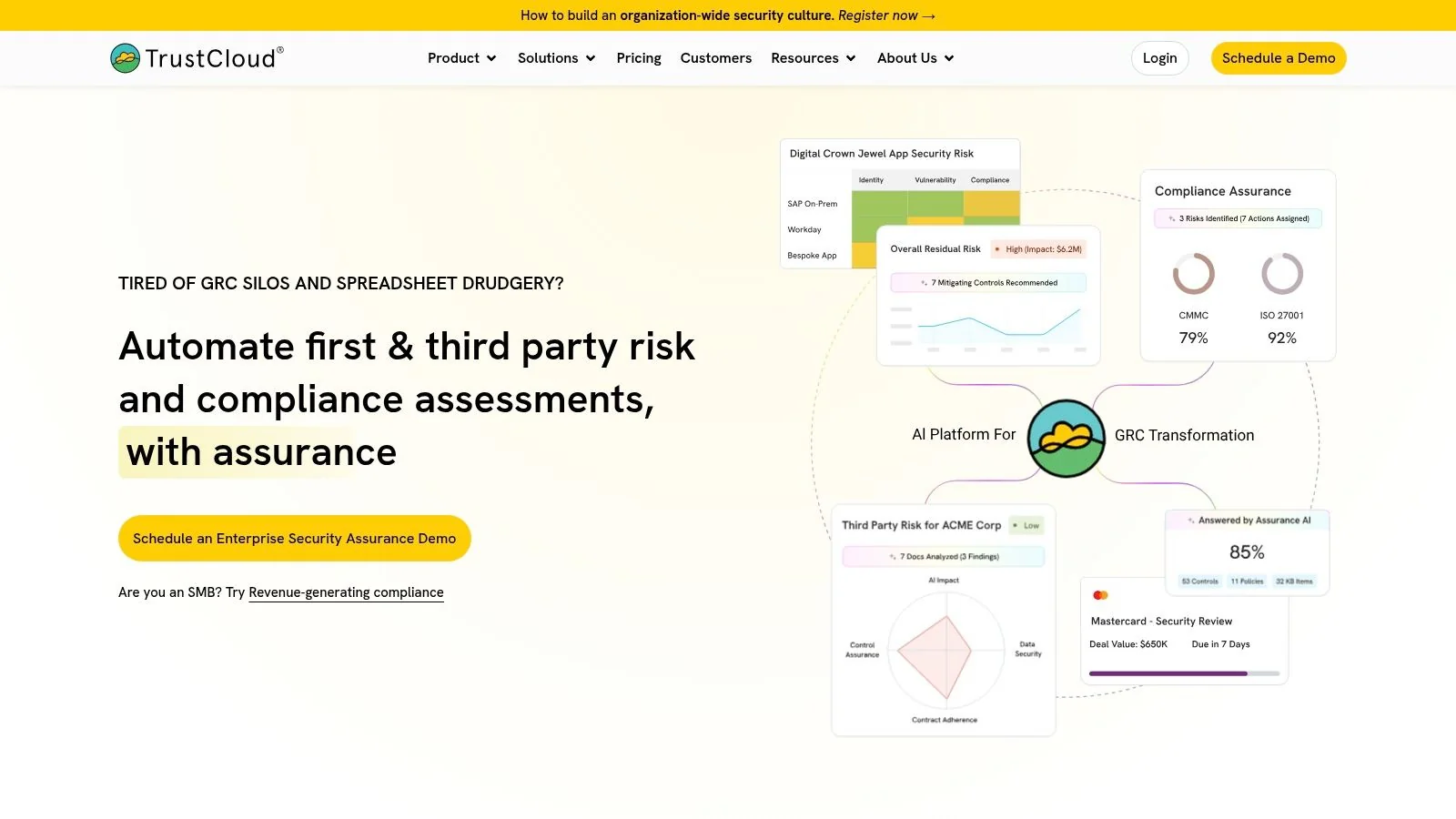
A key differentiator for TrustCloud is its TrustShare portal and AI-powered questionnaire tooling, which are designed to streamline the sales process. By providing a secure, centralized location for sharing compliance documentation and automating responses to lengthy security inquiries, TrustCloud helps businesses accelerate deal cycles. Its common control mapping allows teams to manage evidence for multiple frameworks simultaneously, reducing redundant work as they scale their compliance programs from SOC 2 to ISO 27001 and beyond. This makes it a compelling choice for companies that need to demonstrate security assurance to close deals but want a flexible, cost-effective entry point.
Platform Highlights
- Best For: Early-stage startups needing a free entry point into compliance and growth companies focused on sales enablement.
- Key Features: Modular platform (Compliance, Risk, Trust), TrustShare portal for sales, AI-assisted questionnaire responses, common control cross-mapping.
- Pricing: Offers a free Starter tier for companies with up to 20 employees. Paid plans are value-based and require a custom quote.
- Pros: Transparent and accessible entry with a free tier, strong focus on customer assurance and questionnaire automation.
- Cons: Heavier enterprise capabilities require custom quotes, and paid tiers may involve annual billing commitments with variable pricing.
Website: https://www.trustcloud.ai
9. Strike Graph
Strike Graph positions itself as a strong Drata alternative for companies that prioritize transparent pricing and a scalable, all-in-one compliance and audit solution. It stands out by publicly listing its pricing, including a free “Launch” tier, which removes the ambiguity common in the GRC platform market. The platform is designed to be an AI-native solution that not only automates evidence collection but also offers integrated audit and penetration testing services as optional add-ons, simplifying procurement for lean teams.
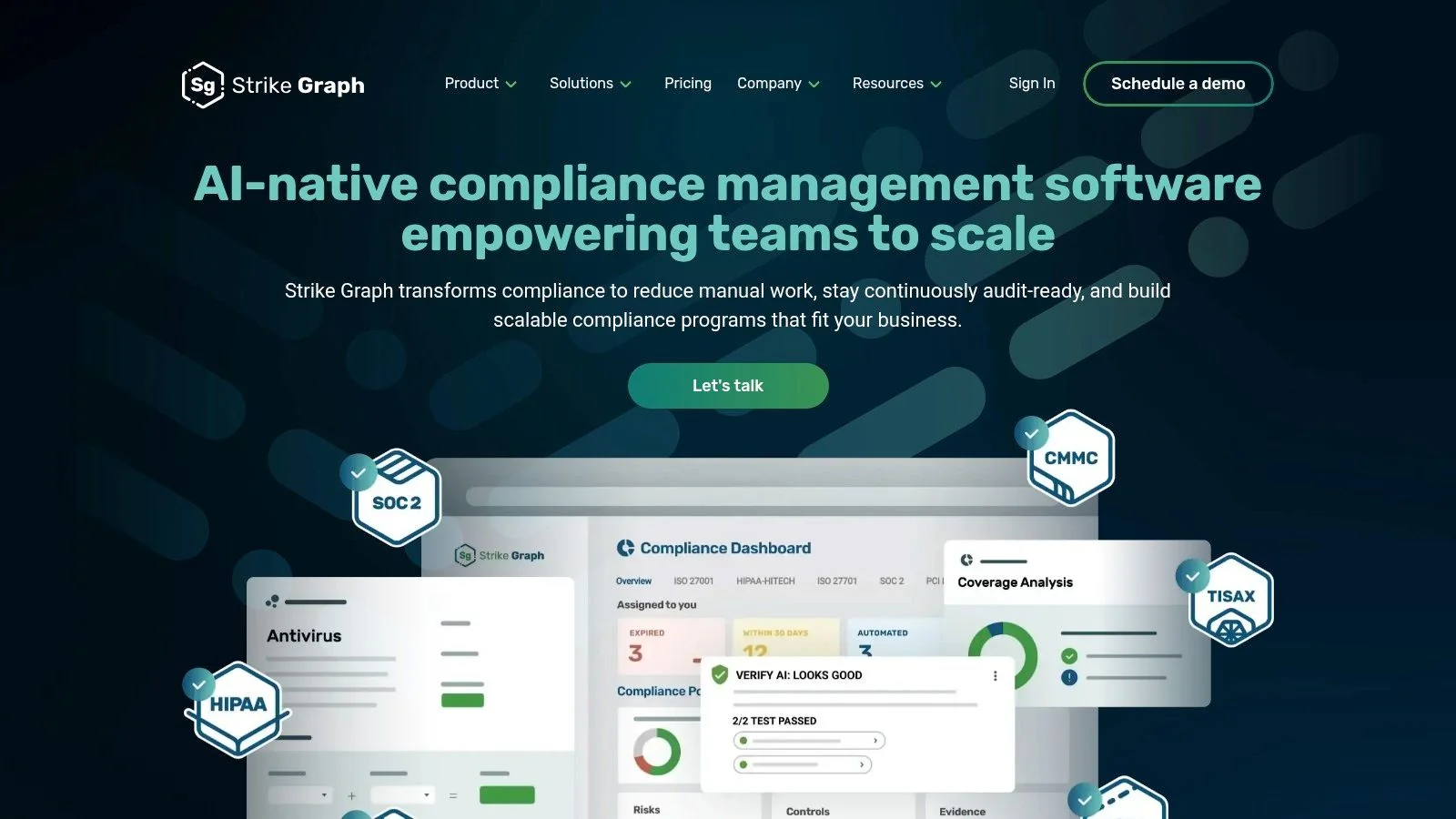
A key differentiator for Strike Graph is its business model, which includes unlimited user seats on all paid plans. This approach is particularly beneficial for growing organizations where multiple stakeholders from engineering, sales, and management need access without incurring additional per-user fees. While core frameworks like SOC 2 and ISO 27001 are included in standard plans, the platform’s a-la-carte model for other frameworks and advanced features like SBOM monitoring allows companies to build a compliance package that precisely fits their needs and budget, avoiding payment for unused capabilities.
Platform Highlights
- Best For: Startups and SMBs seeking transparent, predictable pricing and the option to bundle compliance automation with audit services from a single vendor.
- Key Features: AI-powered evidence collection, questionnaire tooling, SBOM monitoring, cross-mapping between frameworks, optional integrated audits and pen tests.
- Pricing: Publicly listed pricing with a free entry-level tier. Paid plans are quote-based but start from a transparent foundation, with add-ons for specific frameworks or services.
- Pros: Transparent pricing model eliminates guesswork, unlimited users on paid plans offer great value for growing teams, and bundling audits can streamline vendor management.
- Cons: The a-la-carte model can increase the total cost significantly as more frameworks or integrations are added, and the integration library is less extensive than some mature competitors.
Website: https://www.strikegraph.com
10. Scytale
Scytale positions itself as a strong Drata alternative by combining a powerful AI-driven automation platform with dedicated human expertise. This hybrid approach is designed to accelerate compliance for frameworks like SOC 2, ISO 27001, and HIPAA. The platform offers 24/7 continuous control monitoring and real-time alerts, ensuring that security and compliance gaps are identified and addressed immediately, preventing last-minute audit surprises.
A key differentiator for Scytale is its integrated, expert-led services, including advisory and penetration testing. This makes it a one-stop shop for companies that prefer a guided, hands-on experience rather than a purely self-service tool. Its AI-powered security questionnaire automation and customizable Trust Center also help sales teams build credibility and unblock deals faster. This model is particularly effective for teams who want both sophisticated software and the assurance of expert support to navigate complex compliance landscapes and achieve certification quickly.
Platform Highlights
- Best For: Companies that want a blend of high-tech automation and dedicated expert guidance, especially those needing integrated pen-testing.
- Key Features: Continuous control monitoring, AI security questionnaire automation, integrated pen-testing and advisory services, supports over 40 frameworks.
- Pricing: Quote-based. Pricing is not publicly available and requires a demo to determine the cost based on specific needs.
- Pros: The software-plus-service model provides comprehensive support, leading to a faster time-to-readiness for audits.
- Cons: Not ideal for teams seeking a purely self-service, software-only solution; the requirement for significant expert involvement might not suit all budgets or workflows.
Website: https://scytale.ai
11. OneTrust (Compliance Automation)
OneTrust is a major player in the broader GRC (Governance, Risk, and Compliance) space, making it a powerful Drata alternative for large enterprises looking to consolidate multiple functions. Its Compliance Automation product is just one module within a vast ecosystem that also covers privacy, ethics, and ESG. This platform leverages a “collect once, comply many” philosophy, allowing you to reuse evidence across more than 50 frameworks, which is a significant advantage for global companies managing numerous regulations.
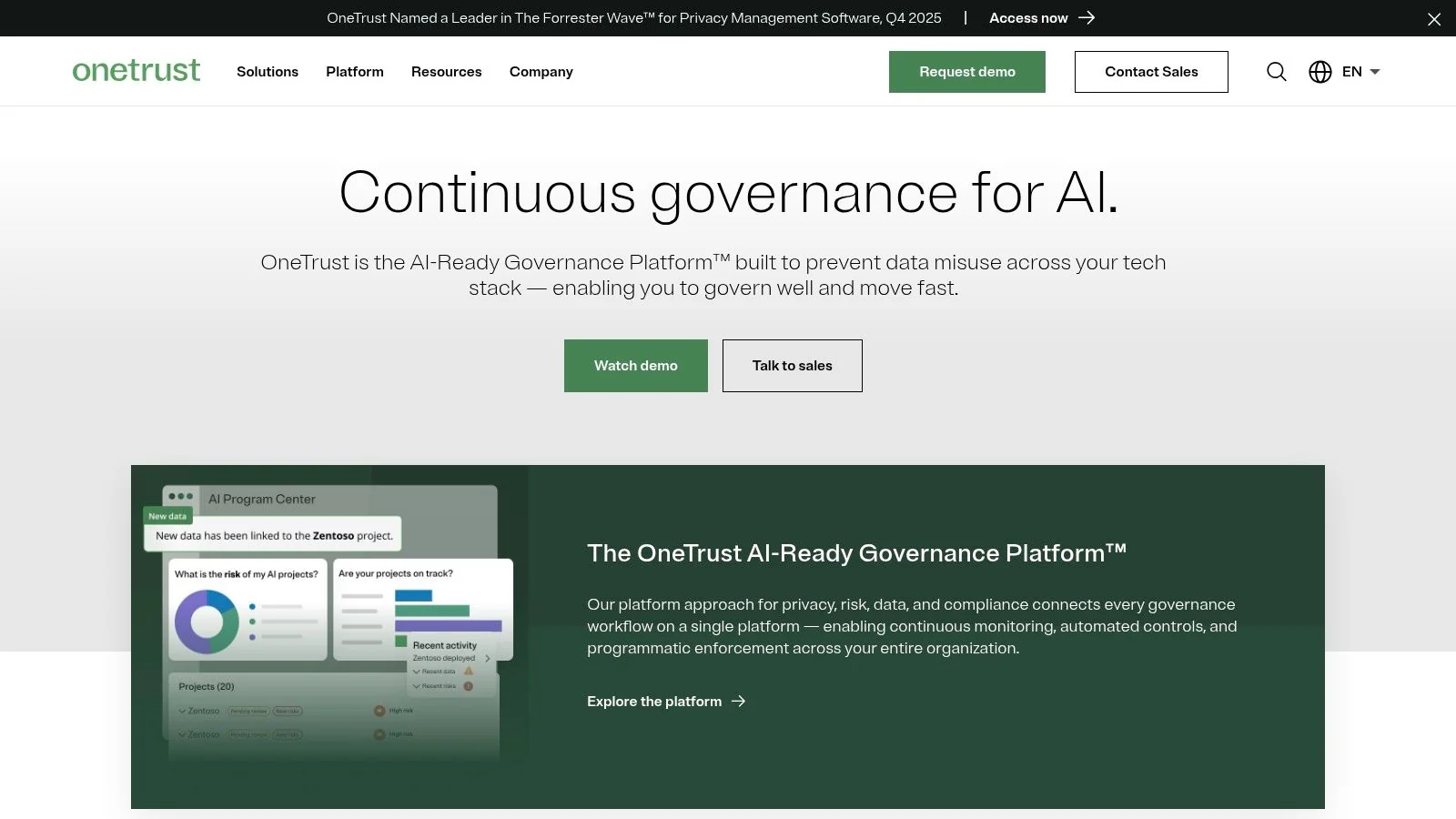
The key differentiator for OneTrust is its enterprise scale and integrated approach. While startups may find it overly complex, a multinational corporation can manage SOC 2 alongside GDPR, CCPA, and internal risk assessments all within a single, interconnected platform. This unified view simplifies governance by linking security controls directly to privacy policies and risk registers, providing a holistic perspective that standalone compliance tools often lack. It is best suited for organizations that have outgrown point solutions and need a centralized command center for all GRC activities.
Platform Highlights
- Best For: Large enterprises and global organizations needing to consolidate security, privacy, and risk management into a single platform.
- Key Features: Pre-mapped controls across 50+ frameworks, automated evidence collectors, dynamic reporting, and deep integration with other OneTrust governance modules.
- Pricing: Quote-based and customized for the enterprise. Pricing is not publicly available and requires engagement with their sales team.
- Pros: Highly scalable platform that grows beyond just security compliance, and ideal for consolidating GRC tools and centralizing evidence.
- Cons: The enterprise-focused sales process and substantial configuration needs can be overwhelming for smaller teams, making it less agile than startup-focused tools.
Website: https://www.onetrust.com
12. G2 — Drata Alternatives & Competitors
While not a direct compliance automation platform itself, G2’s dedicated page for Drata alternatives serves as an essential research tool for any team evaluating the market. It aggregates user reviews, ratings, and feature comparisons, providing a real-world perspective on how different platforms perform. This makes it a crucial first stop for shortlisting vendors and understanding their strengths and weaknesses from the vantage point of actual customers, from small businesses to enterprise users.
The platform allows you to perform side-by-side comparisons of key players, filtering by company size, user satisfaction, and specific features. This helps cut through marketing language to see how tools stack up in practical use. Beyond the direct comparisons of platforms like Drata and its listed competitors, exploring a broader analysis of the Top 12 Best Governance Risk and Compliance Software for 2026 can provide valuable insights for your decision-making. Using G2 effectively means validating the information you gather by visiting the vendors’ official sites for demos and current pricing.
Platform Highlights
- Best For: Teams in the initial research and shortlisting phase of selecting a compliance automation tool.
- Key Features: Crowdsourced reviews and ratings, side-by-side vendor comparisons, G2 Grid reports, links to vendor websites and demos.
- Pricing: Free to access and use for research purposes.
- Pros: Excellent for viewing unfiltered customer feedback, helps identify both popular and niche alternatives, and provides a broad market overview.
- Cons: Sponsored placements can influence visibility, user reviews may vary in quality and recency, and listed features should always be verified on the vendor’s site.
Website: https://www.g2.com/products/drata/competitors/alternatives
Drata Alternatives — 12-Tool Comparison
| Platform | Core features | Best for | Speed & support | Pricing | Unique selling point |
|---|---|---|---|---|---|
| Vanta | 300+ integrations; continuous controls; AI questionnaire; Trust Center; Auditor API | Mature startups & mid-market | Fast onboarding; strong questionnaire enablement | Quote-based (can be heavy for very early-stage) | Broad ecosystem + built-in customer Trust Center |
| Secureframe | Continuous monitoring; automated evidence; policy & risk tools; Trust Center | Teams wanting guided onboarding (SMB → Mid) | Known for strong onboarding and in-house expert support | Package tiers (Fundamentals/Complete/Federal); no public pricing | Clear package structure + federal compliance add-on |
| Sprinto | AI agents; questionnaire automation; vendor risk workflows; free self-guided SOC 2 | Cloud-native startups | Self-guided free readiness; AI-driven automation | Not public | AI agents + free SOC 2 readiness on-ramp |
| Thoropass (Laika) | Continuous monitoring; auditor connections; software + services | Teams seeking hands-on advisory (first-time audits) | Integrated auditor experience reduces back‑and‑forth | Sales/consultative pricing | Software + expert advisory with integrated audit workflow |
| Hyperproof | Common control set; automated evidence orchestration; risk modules | Scaling orgs managing many frameworks | Mature risk–compliance alignment; may require implementation | Custom quotes (no public pricing) | Strong multi-framework mapping and risk integration |
| AuditBoard | Unified audit-risk-compliance core; AI reporting; analytics | Large enterprises (SOX, multi-framework) | Deep collaboration at scale; enterprise support | Enterprise pricing via sales | Enterprise-grade audit & SOX roots with AI insights |
| Scrut Automation | Continuous control monitoring; AI teammates; cloud posture visibility | Cloud-native companies | High satisfaction; fast value for cloud stacks | Not public | Cloud-first risk visibility + AI teammates |
| TrustCloud (Kintent) | TrustShare portal; AI questionnaire automation; cross-mapping | Small teams → growing companies (freemium) | Transparent entry path; customer-assurance focus | Freemium Starter (≤20 employees); paid tiers vary | Free Starter tier + strong questionnaire tooling |
| Strike Graph | SOC2/ISO/HIPAA plans; questionnaire tooling; SBOM & evidence API | Teams wanting transparent costs & self-serve | Published pricing; free Launch tier; scalable add-ons | Public pricing; free Launch; unlimited users on paid plans | Transparent public pricing + optional audit/pen-test add-ons |
| Scytale | Continuous monitoring; AI questionnaire; integrated pen-testing | Teams wanting software + expert pen-test/advisory | Fast time-to-readiness with hands-on support | Demo/quote required (no public pricing) | Integrated pen-testing + advisor-backed automation |
| OneTrust (Compliance Automation) | Pre-mapped frameworks; automated collectors; shared evidence model | Large enterprises consolidating governance | Enterprise onboarding; substantial configuration | Enterprise quotes (no public pricing) | “Collect once, comply many” across privacy & security |
| G2 — Drata Alternatives | Crowdsourced reviews; side-by-side comparisons; vendor links | Buyers shortlisting vendors | Quick market view; variable recency/quality of reviews | Free to browse; vendor links to pricing/demos | Marketplace reviews + comparison context for shortlisting |
Making Your Choice: Automation Platform + The Right Auditor
Navigating the landscape of compliance automation tools can feel overwhelming. As we’ve explored, the market for Drata alternatives is robust, offering a wide array of platforms each with its own strengths, weaknesses, and ideal customer profile. Your final decision should not be based on features alone but on a strategic alignment with your company’s unique trajectory and operational DNA.
The right choice hinges on a clear-eyed assessment of your specific circumstances. An early-stage, cloud-native startup may prioritize speed and affordability, finding a perfect fit with a platform like Sprinto or Scrut Automation. In contrast, a mid-market company juggling multiple frameworks like SOC 2, ISO 27001, and GDPR will find immense value in the sophisticated control mapping and GRC capabilities of a tool like Hyperproof or AuditBoard.
Key Takeaways for Selecting Your Platform
Remember that the goal is to find a partner, not just a product. As you finalize your decision, revisit these critical factors:
- Company Stage and Scale: Your current size and growth ambitions are paramount. A platform designed for a 10-person startup will likely falter under the complexity of a 500-person enterprise, and vice-versa.
- Framework Complexity: Are you pursuing a single SOC 2 report, or is a multi-framework GRC strategy on your roadmap? Platforms vary significantly in their ability to manage overlapping controls and evidence across different standards.
- Technical Stack Integration: The level of automation you achieve is directly tied to how well the platform integrates with your existing tools (e.g., AWS, GCP, Azure, GitHub, Jira). Deep, API-driven integrations are the key to continuous monitoring and reduced manual effort.
- Budget and Total Cost of Ownership: Look beyond the sticker price. Based on 2026 procurement data, most first-time buyers with 20 to 100 employees pay $10,000 to $30,000 per year for a single-framework subscription. Mid-market companies managing two or more frameworks typically land in the $30,000 to $75,000 range. Enterprise deals exceed $100,000 routinely. Implementation fees, add-on modules (vendor risk management, pen testing, questionnaire automation), and headcount-based renewal increases can each add materially to the Year-1 and Year-2 totals. Model the three-year all-in cost before signing, not just the annual license.
The Critical Missing Piece: Your Independent Auditor
Choosing the perfect compliance automation platform is a major victory, but it is only half of the equation for achieving your SOC 2 attestation. The software collects evidence and monitors controls; it does not, and cannot, perform the audit itself. You still require an independent, licensed CPA firm to conduct the actual audit, review the evidence, and issue your final SOC 2 report.
This is a crucial distinction. Many automation platforms have preferred auditor partnerships, which can feel convenient but may limit your options and negotiating power. The ideal audit firm for your company might not be in their network. Your auditor’s expertise in your specific industry, their communication style, and their pricing structure are just as important as the features of your automation software.
By decoupling your software choice from your auditor selection, you empower your organization. You ensure that you are pairing a best-in-class tool with a best-in-class audit partner, rather than accepting a bundled compromise. This strategic separation gives you the leverage to find an auditor that truly understands your business, technology, and compliance goals, leading to a smoother, more efficient, and more valuable audit experience.
Don’t leave your auditor selection to chance. SOC2Auditors provides a free, unbiased platform to compare over 90 verified CPA firms, giving you access to real pricing data and timelines. Find the perfect audit partner to complement your chosen automation tool at SOC2Auditors.
Comparing SOC 2 software? See our side-by-side breakdown of all 12 compliance platforms — pricing, best-for, and what each one gets wrong. Independent editorial, no pay-to-rank.