 Menu
Menu
The real difference in the Vanta vs. Drata debate boils down to one simple question: Are you sprinting to your first audit, or are you building a compliance engine for scale?
Vanta is built for early-stage startups. Its mission is speed. It helps companies get audit-ready as quickly as possible, especially for their first SOC 2, thanks to a massive library of integrations that just work. If you prioritize a fast, user-friendly path to a certificate, Vanta is your sprinter.
In contrast, Drata is designed for scaling companies and mid-market businesses. It’s for organizations that need more than just a quick win. Drata offers deeper automation, more granular control over evidence, and a more structured, hands-on support model to handle the complexities of multiple frameworks and maturing security programs.
What Makes Vanta Different from Drata?
Vanta is built for early-stage companies that need their first SOC 2 fast — 375+ integrations, simple setup, and a path to audit-ready in months. Drata is built for scaling companies managing multiple frameworks — deeper automation, real-time continuous monitoring, and an Audit Hub where your auditor works directly inside the platform.

Both platforms automate the evidence collection and continuous monitoring work that makes compliance painful, but they serve different stages of company growth.
This guide goes beyond the marketing fluff to give you the detailed, real-world analysis you need to choose the right partner for your company’s growth.
Market data tells a clear story about their positions. As of 2025, Vanta has a strong foothold with 11.1% of the compliance management market, while Drata holds a solid 7.0%. You see this reflected in user feedback all the time. Vanta users rave about its “plug-and-play” feel, perfect for smaller teams that need to move fast. Drata reviews, on the other hand, consistently praise its powerful, scalable automation that grows with you.
To get a quick read on which platform might be a better fit, here’s a high-level breakdown of their core differences.
Key Differences: Vanta vs. Drata at a Glance
This table highlights the critical differentiators between Vanta and Drata, enabling a rapid assessment based on your company’s immediate compliance needs and growth stage.
| Attribute | Vanta | Drata |
|---|---|---|
| Ideal Company Stage | Early-stage to mid-sized startups | Scaling startups, mid-market, and enterprise |
| Core Strength | Speed to compliance, ease of use, broad integrations | Deep automation, scalability, auditor collaboration |
| Onboarding | Fast, self-serve focused setup | Structured, hands-on support model |
| Pricing Philosophy | Accessible entry point, often bundled | Value-based, scales with complexity and features |
| Best For | First-time SOC 2, companies with diverse tech stacks | Complex audits (Type 2), multi-framework needs |
This table should give you a starting point. As you dig deeper, it helps to understand the full landscape of SOC 2 compliance software to ensure your choice aligns perfectly with where your business is headed.
How Do Vanta and Drata Compare on Core Platform Capabilities?
Vanta prioritizes breadth and speed: 375+ integrations, hourly automated checks, and a simple interface built for teams without dedicated compliance staff. Drata prioritizes depth: fewer but more granular integrations, real-time continuous monitoring, and a collaborative Audit Hub where your auditor works directly inside the platform.

When you get down to brass tacks, the core capabilities of Vanta and Drata reveal two very different philosophies. Both are excellent at automating the grunt work of compliance, but their approaches to automation, monitoring, and the user experience are built for different types of companies at different stages of growth. Let’s move beyond the feature checklist and look at how these platforms actually function in the wild.
Vanta’s game is all about speed and breadth. For a startup that needs to get SOC 2 compliant yesterday to unblock a pipeline of enterprise deals, Vanta’s massive library of over 250 integrations is a lifesaver. You can connect just about every tool in your tech stack—from cloud providers to HR systems—and start pulling in evidence almost instantly.
This rapid-fire setup is a huge win for organizations that just need to get to their first audit report as fast as humanly possible. The platform’s interface gets a lot of praise for being intuitive, which makes it approachable even if you don’t have a full-time compliance guru on staff.
Automation Engines and Continuous Monitoring
The engine is the heart of any compliance automation platform, and this is where you see a clear fork in the road. Vanta runs its automated tests on an hourly basis across all your connected systems. When a control drifts out of compliance, you get an alert. For most companies, especially those new to this, that frequency is perfectly fine for maintaining a solid security posture.
Drata, on the other hand, is built for depth and precision. Its integration library is smaller (around 75-130+), but the connections are designed to be deeper, giving you more granular data in real-time. Drata’s system is engineered for continuous, near-instantaneous monitoring. This is a critical distinction for more mature organizations where a compliance gap, even one that lasts for an hour, can introduce real business risk.
The difference is subtle but incredibly important. Vanta’s hourly checks are like a security guard making their rounds diligently. Drata’s real-time monitoring is like a sophisticated sensor network that trips an alarm the second a door is unlocked. For a scaling tech company with a complex cloud environment, that real-time visibility is priceless.
Key Takeaway: Vanta’s automation is optimized for collecting evidence across a huge number of tools to get you audit-ready fast. Drata’s automation is engineered for deep, real-time control monitoring, providing the granular visibility that complex, high-stakes environments demand.
Evidence Management and Audit Experience
How a platform handles evidence collection and your interactions with the auditor can save you hundreds of hours. This is a major differentiator in the Vanta vs. Drata conversation.
Vanta keeps things simple by linking automated tests directly to your documentation, giving you a clean way to present everything to an auditor. The whole workflow is largely self-contained within the Vanta platform, and its success can hinge on how familiar your auditor is with Vanta’s way of doing things.
Drata takes this a huge step further with its Audit Hub. This feature is a game-changer. It creates a dedicated, shared workspace where your team and your auditor can work together directly. Auditors can request evidence, pull samples, and track remediation tasks right inside the platform. This completely eliminates the nightmare of back-and-forth emails and messy spreadsheets. For a closer look at how this feature transforms the audit process, check out our in-depth Drata review.
Dashboard and User Experience
Both platforms have slick, well-designed dashboards that show your compliance health, but they’re clearly built for different audiences.
- Vanta’s Dashboard: This is your high-level executive summary. It’s straightforward, easy to digest, and perfect for founders who just need a quick status check on audit readiness.
- Drata’s Dashboard: This one is for the practitioners. It offers much more detail, with granular views into specific control health, risk management, and vendor security. It’s built for CISOs and security teams who need to dig into the weeds.
At the end of the day, Vanta is built to solve the immediate problem: get a compliance certification with as little friction as possible. Its huge integration list and simple UI make it a beast for startups. Drata, however, provides a more robust, scalable foundation for long-term trust and security management. Features like the Audit Hub and real-time monitoring are designed to handle the complexity that comes with growth.
How Do Vanta and Drata Compare on Integrations and Framework Support?
Vanta offers 400+ integrations built for breadth — connect most tech stacks quickly for fast evidence collection. Drata offers 250+ integrations with deeper API-level connections for custom-stack environments. Both support SOC 2, ISO 27001, HIPAA, PCI DSS, GDPR, NIS 2, DORA, and FedRAMP; both now exceed 30 frameworks.
Your compliance platform is only as good as the tools it talks to. Both platforms have grown their integration libraries significantly, but their philosophies remain distinct. Vanta goes for breadth to get you moving fast, while Drata prioritizes API depth for teams with custom or non-standard stacks.
Vanta’s library now exceeds 400 integrations, covering cloud, HRIS, endpoint, identity, code repos, and procurement tools. If you run a mainstream cloud-native stack, Vanta can likely connect to everything you touch and start pulling evidence on day one.
Drata’s integration count has grown considerably too, now reaching 250+. While smaller than Vanta’s catalog, Drata’s connectors tend to go deeper at the API level, and its Custom Tests feature lets engineering teams script evidence collection for internal tooling that neither platform natively supports out of the box.
Key Integration Categories
Cloud Providers (AWS, GCP, Azure) Both platforms cover the major cloud providers well. Vanta’s advantage is speed: link your cloud accounts quickly and start pulling evidence for key controls like security group configurations and IAM roles almost immediately.
Drata’s cloud integrations pull more granular data for teams running complex, multi-region environments. For a larger SaaS company with significant AWS footprint, Drata’s control-level detail can help surface root causes rather than just flagging symptoms.
Scenario Example: A FinTech startup using AWS plus a niche PaaS provider will benefit from Vanta’s wider catalog, which is more likely to have a native connector ready to go. A scaling company with custom internal tooling will find Drata’s API path and Custom Tests more useful for filling coverage gaps.
HRIS and Identity Providers (Okta, Google Workspace) This is where automation proves its worth for onboarding, offboarding, and access reviews. Both platforms connect seamlessly with major HRIS and IdP tools. Vanta’s strength is straightforward set-it-and-forget-it automation for these common controls. Drata gives you more customizable review cycles and evidence workflows, which matters when proving least-privilege access during a SOC 2 Type 2 audit.
Evaluating Framework Support
Both platforms have expanded their framework libraries considerably. The table below reflects the current state as of 2026.
Integration and Framework Breakdown Vanta vs Drata
| Category | Vanta | Drata |
|---|---|---|
| Total Integrations | 400+ (Largest catalog on the market) | 250+ (Deep API coverage, strong custom test support) |
| Integration Philosophy | Breadth for rapid setup; 1,300+ pre-built tests | Depth for custom stacks; scriptable evidence collection |
| Total Frameworks | 35+ | 30+ |
| SOC 2 | ✔️ (Core Strength) | ✔️ (Core Strength) |
| ISO 27001 | ✔️ | ✔️ |
| HIPAA | ✔️ | ✔️ |
| PCI DSS | ✔️ | ✔️ |
| GDPR | ✔️ | ✔️ |
| NIS 2 / DORA | ✔️ | ✔️ |
| ISO 42001 (AI) | ✔️ | ✔️ |
| FedRAMP | ✔️ (FedRAMP 20x Moderate Authorized, April 2026) | ✔️ |
| Custom Frameworks | ✔️ (AI-assisted control mapping) | ✔️ (Advanced builder, Compliance as Code) |
One meaningful update for 2026: Vanta is now FedRAMP 20x Moderate Authorized, having completed the pilot program in April 2026. Government-adjacent SaaS vendors can use Vanta Government Cloud on AWS GovCloud for federal workloads, removing one reason that used to push teams toward Drata for that requirement.
Both platforms also now support the newer regulatory frameworks gaining traction in 2025 and 2026: NIS 2 (the EU cybersecurity directive), DORA (for financial services), and ISO 42001 (AI management systems). If your compliance roadmap includes any of these, either platform can handle it, though you should verify specific control coverage during a demo.
Ultimately, the right platform comes down to your tech stack’s complexity and your long-term compliance goals. You can explore our detailed guides on the best SOC 2 software available today for a broader view of the market.
How Much Do Vanta and Drata Cost in 2026?
Vanta starts around $10,000/year for a single framework; Drata starts around $7,500/year. At the entry level, Drata is roughly $2,500/year cheaper. The gap closes at higher tiers, and per-framework add-on costs favor Drata significantly: roughly $1,500 per additional framework versus Vanta’s $5,000. Neither publishes public pricing.
Neither platform puts pricing on their website. Both require a sales call, and the final number depends on headcount, frameworks needed, and which add-on modules you include. That said, enough real-world quotes have surfaced from procurement data and buyer communities to give you solid working ranges.
The more important number to nail down before you start a demo is not the base subscription. It is the per-framework cost, because that is where the two platforms diverge most sharply.
Deconstructing the Pricing Tiers
Both Vanta and Drata build your quote using a similar set of levers.
- Employee Headcount: Usually the biggest driver. More employees means more controls around onboarding, offboarding, and security awareness training.
- Frameworks Required: Each additional framework increases the annual cost. This is where the pricing gap between the two platforms becomes most significant (see below).
- Add-On Modules: Vendor Risk Management, Trust Center, and Questionnaire Automation are sold separately on Vanta’s lower tiers. Drata includes more of these in its higher tiers rather than treating them as add-ons.
- Contract Length: Both vendors offer roughly 10 to 15 percent discounts for multi-year commitments. Negotiating this upfront protects against renewal increases.
Realistic Cost Ranges Vanta vs Drata
| Tier | Vanta (approx.) | Drata (approx.) |
|---|---|---|
| Entry (1 framework, under 50 employees) | ~$10,000/yr | ~$7,500/yr |
| Mid (1–2 frameworks, 50–150 employees) | $15,000–$30,000/yr | $15,000–$25,000/yr |
| Growth (2–3 frameworks, 150–300 employees) | $30,000–$50,000/yr | $20,000–$35,000/yr |
| Enterprise (300+ employees, multi-framework) | $50,000–$80,000+/yr | $40,000–$100,000+/yr |
The headline difference at entry level is roughly $2,500 per year in Drata’s favor. For a company adding three frameworks over time, the difference becomes much larger: Vanta charges around $5,000 per additional framework while Drata charges closer to $1,500. A company running SOC 2, ISO 27001, and HIPAA could save over $7,000 annually on framework costs alone by choosing Drata.
One counterforce: Vanta includes vendor risk management and questionnaire automation as separate add-ons on lower tiers (typically $5,000 to $15,000 extra per module), while Drata bundles more of these into its upper tiers. Run the total with add-ons included before comparing line items.
Watch for renewal increases. Buyers on G2 and Reddit consistently report first-to-second-year renewal jumps on both platforms, sometimes 40 to 100 percent as introductory discounts expire. Vanta’s median annual spend across verified purchases sits around $19,800; Drata’s average contract value is roughly $13,500. Negotiate multi-year terms upfront on whichever platform you choose.
Calculating the Total Cost of Ownership
The subscription fee is only part of the calculation. A compliance automation platform should pay for itself by reducing the engineering time that would otherwise go into manual evidence collection and audit prep. Fewer engineer-hours spent chasing screenshots equals real dollar savings, and the platforms deliver meaningfully on that promise for most companies running their first SOC 2.
Budget separately for your audit firm fees, which typically run $10,000 to $50,000 for a SOC 2 Type 2 engagement regardless of which platform you use. The platform automates evidence collection; the CPA firm still conducts the audit.
Which Platform Is Right for Your Company Stage?
For startups under 75 employees running their first SOC 2, Vanta’s speed and 375+ integrations win. For scaling companies managing multiple frameworks or a SOC 2 Type 2, Drata’s real-time monitoring, Audit Hub, and deeper automation deliver more long-term value.
Choosing between Vanta and Drata isn’t just about features—it’s a strategic call that needs to align with where your company is today and where it’s headed. Get it right, and the platform becomes an engine for growth, unlocking enterprise deals and building trust. Get it wrong, and you’re looking at friction, wasted engineering cycles, and a compliance program that slows you down.
This is where the conversation shifts from a simple feature list to a question of fit. Let’s break down the Vanta vs. Drata decision into real-world scenarios so you can map your business needs, technical stack, and budget to the right tool for the job.
The Startup Sprint: Vanta for Early-Stage Speed
Picture this: you’re an early-stage SaaS startup with about 30 employees. A massive enterprise client is ready to sign, but they need a SOC 2 Type 1 report, and they need it yesterday. Your engineering team is already maxed out, and your tech stack is a classic startup mix of mainstream and niche tools. Speed is everything.
In this scenario, Vanta is almost always the better choice. Its superpower is getting you from zero to audit-ready, fast. With a massive library of 375+ integrations, Vanta can connect to just about every tool in your stack in hours, letting you start collecting evidence on day one.
Vanta’s interface feels like it was designed for teams without a full-time compliance manager. Onboarding is quick, dashboards are intuitive, and the path to that first SOC 2 report is crystal clear. With entry pricing often starting around $10,000–$25,000, it’s a financially smart move for startups needing to prove compliance without a huge upfront investment.
The Verdict for Startups: If your primary goal is to land your first certification (like SOC 2) to unblock sales, and you value a broad, easy-to-use platform, Vanta offers the fastest, most efficient path to that win.
This decision tree shows how team size often maps to the best-fit platform, steering startups toward Vanta and growing companies toward Drata based on typical cost and complexity.
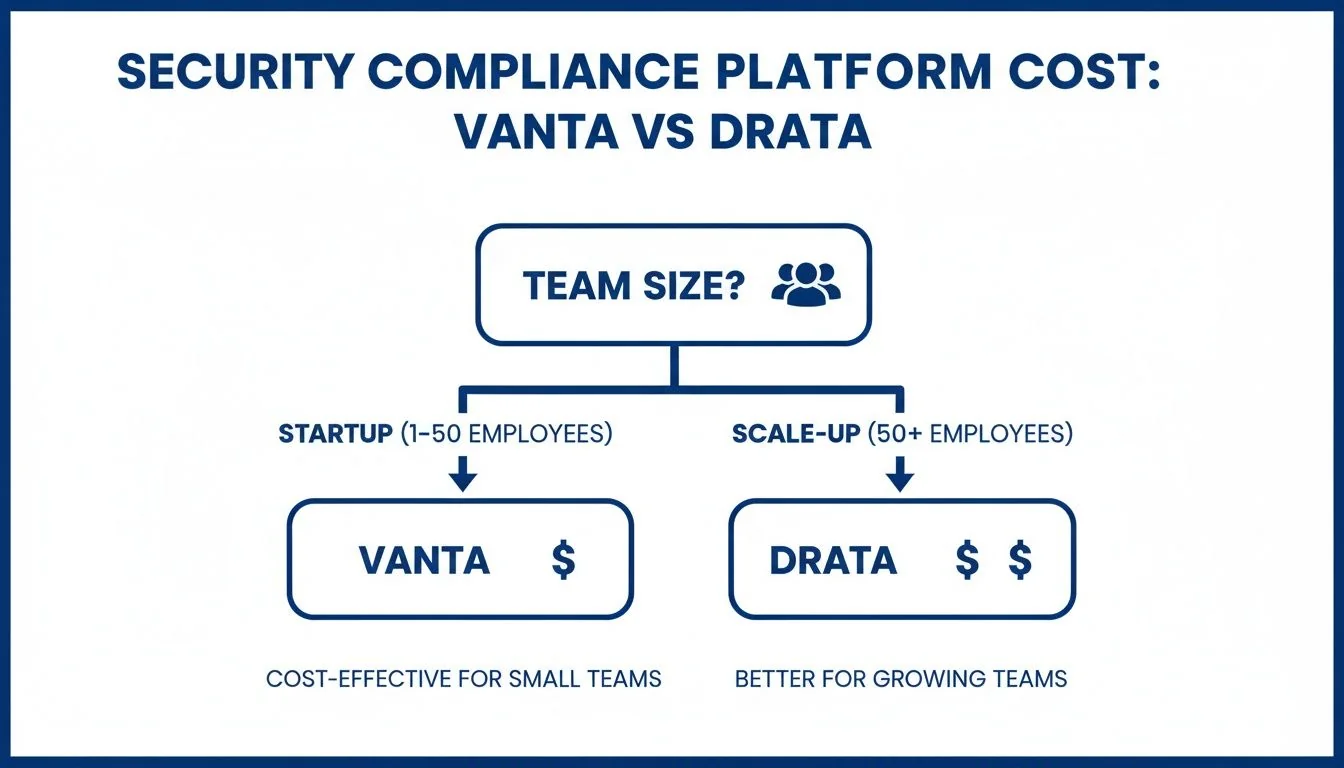
The image really drives home a key point: as a company gets bigger, its compliance needs and budget evolve, making Drata’s scalable model a much better fit for larger, more complex organizations.
The Scale-Up Marathon: Drata for Growth-Stage Maturity
Now, let’s switch gears. Imagine you’re a growth-stage FinTech company with 150 employees. You’ve already got your SOC 2 Type 2, but now you’re tackling ISO 27001 and GDPR. Your security program is maturing, you have a dedicated security lead, and your auditors are asking for deeper proof of continuous monitoring.
For this company, Drata delivers far more long-term value. While it might cost more upfront (typically $20,000–$50,000), that investment pays dividends through deeper automation and scalability. Drata’s real-time, continuous control monitoring gives mature organizations the high-fidelity visibility they need, moving beyond hourly checks to a constant pulse on their security posture.
While Drata has fewer integrations (130+), they’re built for depth. This allows for more precise automation, especially in complex cloud environments. Plus, features like the integrated Audit Hub completely change the audit experience, turning a painful back-and-forth with auditors into a streamlined, collaborative process. This saves hundreds of hours for everyone involved.
Drata’s advanced risk management is another huge differentiator for scaling companies. As your business grows, so does your risk surface. Drata gives you the tools to build a formal risk register, tie risks directly to controls, and automate vendor security reviews—all foundational pieces of a mature GRC program.
-
When to Choose Vanta:
- You’re an early-stage startup (under 75 employees).
- Your main goal is getting that first SOC 2 or ISO 27001 done quickly.
- You prioritize ease of use and need a wide range of integrations for a diverse tech stack.
- Budget is tight, and you need an accessible entry point.
-
When to Choose Drata:
- You’re a scaling or mid-market company (75+ employees).
- You’re managing multiple, complex compliance frameworks at the same time.
- You demand deep, real-time automation and granular control over your evidence.
- You’re building a long-term, scalable GRC program, not just checking a box for one audit.
At the end of the day, the Vanta vs. Drata decision comes down to your company’s stage. Vanta is the sprinter, built to get you across the finish line of your first audit with incredible speed. Drata is the marathon runner, engineered with the endurance and power to support a comprehensive trust management program that grows right alongside you.
How Do You Make the Final Decision Between Vanta and Drata?
If speed to your first audit matters most, choose Vanta. If you’re scaling, managing multiple frameworks, or need real-time control depth, choose Drata. Either way, choosing an auditor who knows your platform is the next critical step — a mismatch costs hundreds of hours.
Choosing between Vanta and Drata really comes down to a gut check on your company’s immediate needs versus its long-term compliance strategy. The right platform should feel like another member of your team—the one who handles all the tedious stuff and gives you a clear, honest look at your security posture.
So, how do you make the final decision? Let’s get practical.
If you’re an early-stage company laser-focused on getting that first SOC 2 or ISO 27001 report in hand, Vanta is a beast. Its speed and massive integration library are built to get you from zero to audit-ready with the least amount of friction.
But if you’re a scaling business juggling multiple frameworks, or you’re staring down the barrel of a complex SOC 2 Type 2, Drata’s deeper automation and powerhouse features like the Audit Hub offer a more strategic long-term play. It’s designed for companies that view compliance as a continuous part of operations, not just a box to check.
Your Platform is Only Half the Equation
Okay, you’ve picked your software. Don’t pop the champagne just yet. The next decision—choosing the right audit firm—is just as critical. Picking the wrong auditor can completely undermine the investment you just made in Vanta or Drata.
A great auditor who knows your chosen platform makes the whole process smoother. An inexperienced one turns it into months of painful back-and-forth emails.
Your auditor should be a partner who knows how to work with your tech, not an obstacle who has to be trained on it. Finding a firm that’s already fluent in Vanta or Drata means they know exactly where to find the evidence and understand the automated controls, saving you from endless clarification calls.
This is where you need to be proactive. Don’t wait until your readiness dashboard hits 100%. Start talking to audit firms early. Find one that fits your timeline, budget, and actually gets your industry.
A mismatch here is more than just frustrating; it’s expensive. Imagine picking an auditor who has never seen Drata’s Audit Hub. You’ve just paid for a feature that your auditor can’t even use, negating one of the platform’s biggest time-savers.
At SOC2Auditors, we prevent these exact scenarios. Our platform lets you compare verified data on 100+ firms, and you can filter specifically for expertise in tools like Vanta and Drata. We give you real pricing and timeline data so you can connect with an auditor who’s the perfect match for your new compliance engine—ensuring you get that report on time and without the headache.
Frequently Asked Questions About Vanta and Drata
Vanta and Drata are the two most commonly evaluated SOC 2 automation platforms. Here are direct answers to the questions compliance leads and founders ask most often before committing to one platform.
Do I Need an Auditor Before I Buy Vanta or Drata?
No, and you shouldn’t. Think of Vanta or Drata as the first step in the process. These platforms are designed to get you organized and audit-ready before an auditor ever sees your environment.
Picking your compliance automation tool first prepares all your systems and documentation, which makes the actual audit process infinitely smoother once you do bring in a firm.
Can Vanta or Drata Handle Complex Frameworks Like SOX?
Yes, both platforms have expanded well beyond SOC 2 and can manage frameworks that include IT General Controls (ITGC), which are critical for financial reporting. When you’re dealing with regulations like Sarbanes Oxley cyber security compliance, having a tool to help automate those IT controls is a massive advantage.
Key Insight: Drata tends to shine brighter here. It generally offers more granular control mapping and customization for complex or niche frameworks. If you have a mature GRC program with multiple overlapping regulations, Drata is likely the stronger choice.
Which Platform Has Better Customer Support?
This is a classic “it depends” situation, as both get high marks but for different reasons. Your preference will come down to what kind of help you actually need.
- Vanta’s support is fantastic for tactical, in-the-moment problems. If your team is stuck on a specific integration or evidence collection task, Vanta’s support is incredibly efficient at getting you unblocked and back on track.
- Drata’s support is often described as more strategic. They provide access to GRC experts and dedicated success managers who help you think about building a sustainable, long-term compliance program, not just passing one audit.
So, are you looking for quick-fix help to get across the finish line, or a strategic partner for the long haul? Your answer will point you to the right platform.
Making the right platform choice is half the battle; finding the right auditor is the other. SOC2Auditors helps you connect with audit firms that have proven expertise with your chosen software, ensuring a seamless and efficient audit experience. Get your tailored matches at https://soc2auditors.org.
Comparing SOC 2 software? See our side-by-side breakdown of all 12 compliance platforms — pricing, best-for, and what each one gets wrong. Independent editorial, no pay-to-rank.