 Menu
Menu
A HIPAA compliance audit can set you back anywhere from $20,000 to over $100,000. If you’re a smaller organization, you’ll likely land on the lower end of that spectrum, while larger, more complex enterprises will see much higher figures.
The final price tag isn’t a fixed number. It’s a direct reflection of your company’s size, complexity, and how prepared you are for the audit. Think of it less like buying an off-the-shelf product and more like a strategic investment to head off much, much larger financial risks down the road.
Why Audits Are a Strategic Investment
Just looking at the HIPAA compliance audit cost as an expense is missing the bigger picture. In reality, it’s a critical investment in your company’s financial health, operational stability, and reputation in the market.
Being proactive about finding and fixing security gaps is vastly cheaper than cleaning up after a data breach. A breach can trigger massive regulatory fines, crippling legal fees, and cause irreparable damage to the trust you’ve built with your customers.
An audit also gives you objective, third-party proof that your security controls actually work. This kind of validation is often a non-negotiable requirement for closing deals with enterprise customers, securing key partnerships, and showing investors you’ve done your due diligence.
Understanding the Cost Spectrum
So why the wide price range? It’s simple: no two organizations are the same.
The final cost really boils down to a few key factors:
- Organizational Size: More employees, more departments, and more data create a larger surface area that needs to be audited.
- System Complexity: A straightforward, cloud-native tech stack is going to be less expensive to audit than a sprawling hybrid environment full of legacy systems.
- Data Scope: The sheer volume and sensitivity of the Protected Health Information (PHI) you manage directly influence how deep the audit needs to go.
Benchmarking Your Potential Cost
Full third-party assessments typically land in the $20,000 to $50,000 range, but that number climbs quickly with technical complexity. We see this all the time with SaaS and HealthTech companies that bundle their HIPAA assessment with other frameworks like SOC 2.
The cost is driven by the intense validation required by the HIPAA Security Rule, which involves hundreds of test points for safeguards like encryption, access controls, and risk management.
Here’s a quick look at what you can generally expect:
HIPAA Audit Cost Ranges at a Glance
This table offers a high-level summary of estimated audit costs based on organization size and audit type, helping you quickly benchmark your potential expenses.
| Organization Profile | Gap Assessment Cost Range | Full Third-Party Audit Cost Range |
|---|---|---|
| Small Business / Startup (Under 50 employees) | $5,000 - $15,000 | $20,000 - $35,000 |
| Mid-Sized Company (50-250 employees) | $12,000 - $25,000 | $35,000 - $60,000 |
| Large Enterprise (250+ employees) | $20,000 - $40,000+ | $60,000 - $100,000+ |
Keep in mind these are just ballpark figures. The more complex your systems and the broader your scope, the more you should budget.
An audit is more than a compliance checkbox; it is a clear signal to the market that you take data protection seriously. This builds the trust necessary to compete and grow in the healthcare industry.
By treating the audit as a proactive measure, you shift your mindset from seeing compliance as a burden to seeing it as a competitive advantage and a core part of risk management.
For a more personalized estimate, you can use our audit cost tool to see how your specific needs might affect pricing.
Deconstructing Your HIPAA Audit Invoice
To really get a handle on the HIPAA compliance audit cost, you need to look past the final number on the proposal. Think of it like building a house; the total price isn’t just one lump sum. It’s a combination of architectural blueprints, framing, electrical, plumbing, and final inspections. An audit invoice is exactly the same, with each line item representing a critical step toward becoming secure and compliant.
Breaking down these components gives you a transparent view of where your money is going. It lets you have smarter conversations with potential auditors and helps you see where you can do some prep work internally to keep expenses down. Each service isn’t just a checkbox—it’s a foundational layer of your security posture.
The Foundational Blueprint: Risk Assessments
The first major line item you’ll almost always see is the HIPAA Security Risk Assessment. This is the architectural blueprint for your entire compliance program. Auditors don’t just glance around; they meticulously map out how your data flows, pinpoint where Protected Health Information (PHI) lives, and analyze every potential threat and vulnerability.
This isn’t a quick check-up. It’s a deep dive that results in a detailed report outlining every single one of your compliance gaps. The cost here is directly tied to how complex your organization is—more systems, more apps, and more ways you handle data means more hours for the auditors. A thorough risk assessment is non-negotiable and sets the stage for everything else.
Building the Framework: Policy and Procedure Development
After the risk assessment, you’ll find costs for policy and procedure development or review. These are the building codes for your organization. Think of them as the formal, written rules that dictate how your team handles PHI, responds to a security incident, and manages who gets access to sensitive systems.
If you already have mature, well-documented policies, this part of the bill will be lower because the auditor just needs to review them. But if you’re starting from scratch, the auditor will have to dedicate significant time to help you create these documents from the ground up, which adds a hefty chunk to the invoice.
Stress-Testing the Structure: Technical Evaluations
Once the blueprint and framework are in place, it’s time to see if the structure can withstand a storm. This is where technical services show up on your invoice, designed to find real-world weaknesses before an attacker does.
These evaluations often include:
- Vulnerability Scanning: An automated process that scans your networks and systems for known security flaws, like old software with known exploits or common misconfigurations.
- Penetration Testing: This is a much more hands-on approach where ethical hackers actively try to break into your systems to simulate a real cyberattack. It’s the final inspection that proves your security controls actually work under pressure.
These technical tests are priced based on the scope of the systems being tested. They are absolutely essential for proving that your safeguards aren’t just theoretical but can hold up in the real world. Finally, the last major component is the formal audit itself—the review of all this evidence and the issuance of your final report.
This is how all these pieces typically stack up, from the initial assessment to the full-blown audit.
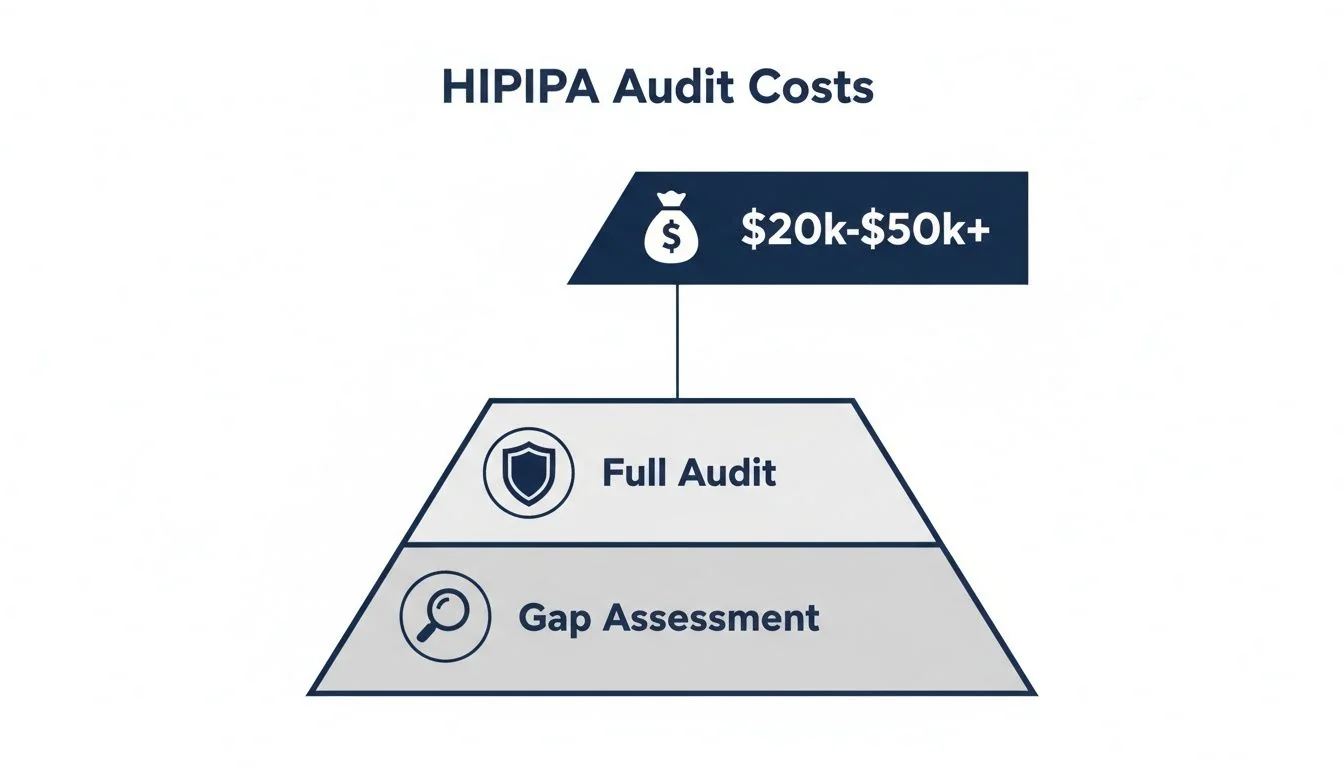
As you can see, a gap assessment often forms the essential foundation, which then leads into the more comprehensive (and more expensive) full audit.
The Key Factors That Drive Your Final Cost
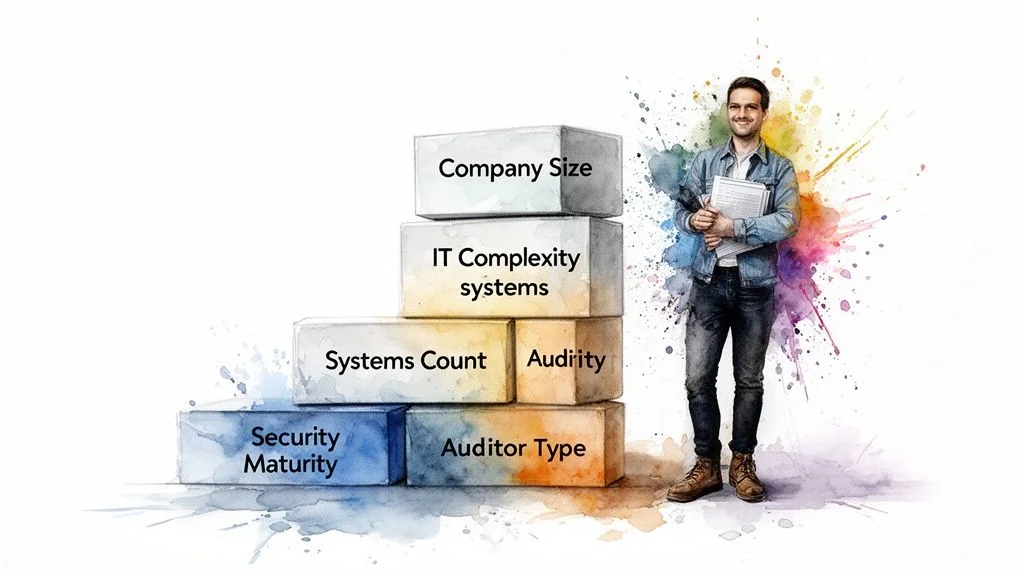
That huge range in HIPAA audit costs isn’t random. It’s a direct reflection of your company’s unique DNA. No two audits are ever the same because no two organizations are. Several key variables tangle together to determine the scope, complexity, and ultimately, the final price tag for your audit. Getting a handle on these drivers is the first real step toward budgeting accurately and keeping your costs in check.
Your company’s size is the most obvious starting point. A larger organization with more employees, departments, and physical locations simply creates a bigger footprint for an auditor to trace. They have to spend more time interviewing staff, digging through access logs, and checking controls across a much wider surface area.
Your Technical Environment and Data Scope
Beyond just headcount, the complexity of your IT stack plays a massive role. A lean startup using a handful of modern, cloud-based apps is going to have a much simpler—and cheaper—audit than a large hospital system juggling a mix of clunky on-premise servers, multiple electronic health record (EHR) systems, and countless connections to third-party vendors.
The more systems you have that create, receive, maintain, or transmit Protected Health Information (PHI), the more hours an auditor has to pour into the project. That scope is what directly inflates the final bill.
The core principle is simple: complexity drives cost. An auditor has to follow the entire journey of PHI through your systems. The more twists and turns that journey takes, the longer and more expensive the audit becomes.
The Impact of Your Security Maturity
This might be the single biggest cost driver of them all: your organization’s current security maturity. A company with a well-documented, established compliance program will always pay less. Period.
If your policies are already written, your team is trained, and you have proof of ongoing risk management, the auditor’s job is just to verify your work. But if you’re starting from scratch, you’re going to need a lot of hand-holding. The auditor has to spend a ton of time helping you build policies, guiding you through fixing problems, and organizing your evidence. All that prep work dramatically inflates the cost.
It’s also why many organizations find it’s more efficient to bundle their HIPAA efforts with other compliance frameworks. If you’re looking at other certifications, you can learn more about how SOC 2 compliance services might overlap and save you time—or browse our curated list of SOC 2 auditors with healthcare experience to find firms who handle both.
For digital health startups, the numbers can be a real wake-up call. A full privacy and security audit can easily run between $25,000 and $75,000. The mandatory annual risk analysis tacks on another $2,000 to $20,000 to the budget. Once you factor in things like penetration testing, the total first-year costs for a mid-market company can easily climb into six figures.
The Hidden Costs of HIPAA Non-Compliance
While the upfront HIPAA compliance audit cost might seem steep, it’s a drop in the bucket compared to the financial devastation of a data breach. Viewing an audit as a mere expense completely misses the point. Think of it as a critical insurance policy protecting your organization from a catastrophic event.
The most obvious penalties are the government-imposed fines. The Office for Civil Rights (OCR) doesn’t pull punches, enforcing a tiered penalty structure where fines can climb as high as $1.5 million per violation category, per year.
But those fines? They’re just the tip of the iceberg.
Beyond Government Fines
The penalties issued by regulators are often just the opening act. The real, lasting damage comes from the secondary business costs that cascade after a breach, crippling an organization long after the initial incident is contained.
Here’s where the real pain is:
- Reputational Damage: Trust is the currency of healthcare. One breach can shatter your brand, making it incredibly difficult to attract and keep patients or partners.
- Expensive Legal Battles: Non-compliance is often a direct invitation for class-action lawsuits from affected individuals. This means staggering legal fees and potentially massive settlements.
- Mandatory Breach Notifications: You are legally on the hook to notify every single person affected. This process involves expensive credit monitoring services, public relations campaigns, and call centers to manage the fallout.
Let’s break down the official penalty structure from the OCR. The fines are categorized into four tiers based on the organization’s level of negligence.
HIPAA Violation Penalty Tiers
| Penalty Tier | Level of Culpability | Fine Range Per Violation | Annual Penalty Cap |
|---|---|---|---|
| Tier 1 | Lack of Knowledge | $137 to $34,464 | $34,464 |
| Tier 2 | Reasonable Cause | $1,379 to $68,928 | $137,854 |
| Tier 3 | Willful Neglect (Corrected) | $13,785 to $68,928 | $344,638 |
| Tier 4 | Willful Neglect (Not Corrected) | $68,928 (minimum) | $2,067,813 |
As you can see, even a violation you didn’t know you were committing can be costly, but willful neglect can quickly escalate into multi-million dollar penalties.
When the HIPAA Privacy Rule first rolled out, the initial cost estimates seemed manageable. Today’s reality is a completely different story. Healthcare data breaches in the U.S. cost organizations over $10 million on average in 2022. Proactive auditing isn’t just a best practice anymore; it’s an essential financial safeguard.
Think of your audit cost as a strategic investment. It’s the price you willingly pay to shield your organization from a far greater financial and operational disaster that could threaten its very existence.
Understanding the broader landscape of data privacy regulations can also be helpful. Many organizations find themselves navigating parallel frameworks, such as the stringent GDPR compliance requirements in Europe, which reinforces the global importance of robust data protection.
Actionable Strategies to Reduce Your Audit Costs
Let’s be clear: controlling your HIPAA compliance audit cost isn’t about cutting corners on security. It’s about working smarter. Strategic preparation can slash the hours an auditor spends digging through your systems, which translates directly to a smaller final bill. Your goal is to make their job easy and predictable.
This work starts long before the audit kicks off. When you identify and fix your own compliance gaps beforehand, you present a clean, organized house that doesn’t need a deep forensic investigation. This single step—being ready—is the most powerful way to manage your costs and guarantee a smoother process.

Embrace Automation and Bundled Audits
Manually gathering evidence is a massive time-suck for everyone involved. Modern compliance automation tools change the game entirely. They plug into your systems, collect evidence around the clock, and map it to specific HIPAA controls, saving hundreds of hours of painful, manual work.
Another power move is bundling your audits. If you also need a SOC 2 or ISO 27001 report, do them at the same time as HIPAA. Auditors can test overlapping controls just once, eliminating redundant work and bringing down the total cost significantly.
The most expensive audits are the ones filled with surprises. A thorough internal readiness assessment acts as your dress rehearsal, allowing you to find and fix issues on your own time—and on your own dime—before the main event.
Proactive Measures That Pay Dividends
Even simple, proactive steps can produce huge savings down the road. For instance, think about how you get rid of old equipment. For old hard drives and servers, it’s wise to use services that provide HIPAA compliant recycling for electronic waste.
Here are a few high-impact strategies you can put in place now:
- Conduct a Gap Assessment: This is your internal pre-audit. It shines a light on your weak spots before an auditor does. It’s always cheaper to fix things proactively than to pay for remediation during a live audit.
- Centralize Documentation: Create a single, organized repository for every policy, procedure, and piece of evidence. If an auditor has to spend billable hours just hunting for documents, your invoice will reflect it.
- Train Your Team: Human error is still one of the biggest compliance killers. Consistent, role-based training ensures your staff knows exactly what to do (and what not to do), reducing the risk of a costly mistake.
Finally, choosing the right partner is crucial. If you’re juggling multiple compliance frameworks, finding an audit firm that understands your world is essential. It’s worth the time to explore a curated list of top-tier IT audit companies to find one that fits both your needs and your budget.
Common Questions About HIPAA Audit Costs
As you start to budget for HIPAA compliance, a lot of practical questions pop up. Getting clear, straightforward answers is the key to planning effectively and avoiding nasty surprises down the road. Let’s tackle some of the most common questions we hear from companies figuring this out for the first time.
Getting these answers straight demystifies the whole process, letting you focus on what really matters: building a compliance program that actually protects data and wins deals.
Can We Perform a HIPAA Audit Ourselves to Save Money?
While you absolutely must perform your own internal risk assessments, a self-audit is not a substitute for an independent, third-party audit. It’s like a student grading their own homework—it completely lacks the objective credibility that partners, customers, and regulators demand.
Relying only on your own team often means you’ll miss critical gaps simply because you’re too close to your own processes. More importantly, it gives you zero objective proof to build trust in the market. That creates a much bigger financial risk than the cost of an audit, especially if a breach happens.
How Often Do We Really Need a HIPAA Audit?
HIPAA regulations require you to conduct a risk analysis at least annually. While the rule itself doesn’t set a specific frequency for formal third-party audits, an annual audit has become the undeniable industry standard.
For any company serious about operating in the healthcare space, an annual third-party audit is now just a cost of doing business. Your enterprise customers and savvy partners will almost always ask for an up-to-date report to prove you’re keeping up with your security obligations before they’ll even consider signing a contract.
A common and costly misconception is that using a HIPAA-compliant cloud provider makes your organization compliant. This is fundamentally incorrect and can lead to a false sense of security.
Does a HIPAA-Compliant Cloud Provider Make Us Compliant?
No, absolutely not. Using a cloud provider like AWS or Google Cloud that signs a Business Associate Agreement (BAA) is a critical first step, but that BAA only covers the security of the cloud infrastructure itself.
You remain 100% responsible for the security of your data within the cloud. Your HIPAA audit will focus on how you configure their services, how you manage access controls, and how you protect the patient data you put into that environment. Think of it this way: your provider secures the foundation, but you are still responsible for building a secure house on top of it.
Finding the right auditor is one of the most critical steps in managing your HIPAA compliance audit cost. At SOC2Auditors, we replace sales calls and uncertainty with a data-driven matching platform. Compare real pricing, timelines, and verified client feedback from over 90 firms to find the perfect audit partner for your budget and needs. Get three tailored matches in 24 hours at https://soc2auditors.org.