 Menu
Menu
Encryption is the process of converting plaintext data into ciphertext to prevent unauthorized access. This is achieved through an algorithm and a key, where the algorithm dictates the transformation method and the key provides the specific parameter for that transformation. A strong cryptographic system relies on the secrecy of the key, not the algorithm itself, a concept known as Kerckhoffs’s Principle.
This article explores a historical progression of encryption methods, framing them as Scytale alternatives, to demonstrate a critical point for any company pursuing a security certification. By examining ciphers from the simple Rail Fence to the complex Enigma machine, we will illustrate why only modern, standardized encryption like AES-256 is acceptable for a successful SOC 2 audit. This resource is designed for CISOs, CTOs, and compliance managers who need to understand not just what controls to implement, but why specific cryptographic standards are non-negotiable for meeting AICPA Trust Services Criteria. Each section will answer a direct question: “Why does this matter for someone pursuing SOC 2?“
1. Rail Fence Cipher (Zigzag Cipher)
The Rail Fence Cipher is a form of transposition cipher that rearranges the letters of a plaintext message without substituting them. It works by writing the message’s characters in a zigzag or diagonal pattern across a predefined number of imaginary “rails” and then reading the resulting text row by row to create the ciphertext. For example, the message ‘WE ARE DISCOVERED’ with three rails would be written as:
W … E … C … R … E . R . D . S . O . E . E … A … I … V … D
Reading the rails horizontally produces the ciphertext: ‘WECR ERDSOEE AIVD’. Decryption requires knowing the number of rails used to reverse the process.
Why does this matter for someone pursuing SOC 2?
From a SOC 2 perspective, using a Rail Fence Cipher for any production system would be a direct violation of the Trust Services Criteria, particularly within the Security (Common Criteria) principle. Specifically, it fails to meet the requirements of CC6.6, which states that the entity “implements logical access security measures to protect against threats from security events to meet the entity’s objectives.” A Rail Fence Cipher provides obscurity, not modern encryption, and offers no meaningful protection against digital threats, making it an inadequate control. An auditor would identify its use as a critical design flaw in the security architecture. While it is a useful educational tool for explaining why modern, complex encryption is necessary, it must never be used to protect sensitive data. Understanding its weaknesses helps teams appreciate the robust cryptographic standards required for modern compliance.
2. Columnar Transposition Cipher
The Columnar Transposition Cipher is a more advanced form of transposition cipher that rearranges plaintext characters based on a secret keyword. The message is written out in rows of a fixed length determined by the keyword’s length. The columns are then reordered based on the alphabetical order of the letters in the keyword. Finally, the ciphertext is created by reading the characters down each rearranged column. For instance, with the keyword ‘ZEBRAS’ and the message ‘WE ARE DISCOVERED’, the grid would be:
Z E B R A S (Keyword) 6 2 1 5 0 4 (Alphabetical Order Index)
W E A R E D I S C O V E R E D U N D
Reading the columns in numerical order (A, B, E, S, R, Z) produces the ciphertext: ‘ACD ESEERD DEND ROU WIR’. Decryption is impossible without knowing the original keyword.
Why does this matter for someone pursuing SOC 2?
Using a Columnar Transposition Cipher in any system handling sensitive data would represent a major failure to meet SOC 2 Trust Services Criteria. Its use would directly conflict with CC6.6 (on designing and implementing logical access security software) and CC6.3, which requires procedures to authorize, modify, and remove access to data based on a user’s role. A simple shared keyword system, as used in this cipher, lacks the robust access control, logging, and revocation capabilities that modern key management systems provide and that an auditor would expect. The cipher offers a false sense of security while providing no real protection against unauthorized access. It serves as a clear example of why “rolling your own crypto” is a dangerous practice and why reliance on established, audited cryptographic standards is a foundational requirement for building a SOC 2 compliant environment.
3. Gronsfeld Cipher (Vigenère Variant)
The Gronsfeld Cipher is a polyalphabetic substitution cipher, a variant of the more well-known Vigenère cipher. Instead of using a keyword, it employs a repeating numerical key to shift plaintext letters. Each character in the plaintext is shifted by an amount determined by the corresponding digit in the key sequence. For example, using the key ‘314’ on the message ‘ATTACK’ would shift ‘A’ by 3 places (to ‘D’), ‘T’ by 1 place (to ‘U’), and the next ‘T’ by 4 places (to ‘X’). The key then repeats, shifting the next ‘A’ by 3, and so on, producing the ciphertext ‘DUXDWN’.
Why does this matter for someone pursuing SOC 2?
From a SOC 2 compliance viewpoint, implementing the Gronsfeld Cipher for any system handling sensitive information would represent a severe control failure. Its use would directly conflict with multiple Trust Services Criteria. For instance, it fails to meet the standards of CC6.6, which mandates the use of logical access security measures to protect information assets from security events. This cipher provides no meaningful protection and would be identified as a critical deficiency during an audit. Moreover, relying on such a primitive method violates the principles of CC7.1, which requires procedures “to detect changes to its configuration that result in the introduction of new vulnerabilities, and to ascertain that the entity’s infrastructure is configured in accordance with its security configuration baselines.” A system secured with a Gronsfeld Cipher is inherently vulnerable; using it demonstrates a lack of due care in designing a secure architecture. It powerfully illustrates the gap between historical obscurity and the robust, mathematically-proven security required to meet today’s compliance standards.
4. Playfair Cipher
The Playfair Cipher is a manual symmetric encryption technique that substitutes digraphs, or pairs of letters, instead of single letters. It uses a 5×5 grid of letters, constructed with a secret keyword, to define the substitution rules. Plaintext is broken into pairs, and each pair is encrypted based on the relative positions of its letters within the grid, combining substitution with positional logic.
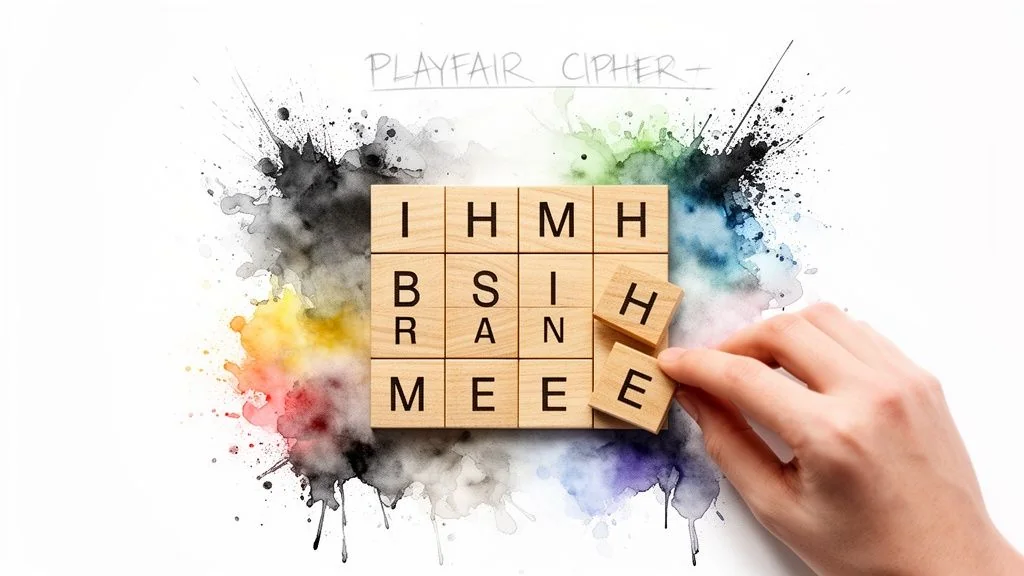
Unlike simple substitution, Playfair encrypts two letters at once, making it more resistant to basic frequency analysis. For instance, the most common letter ‘E’ will not always map to the same ciphertext character; its encryption depends on the letter paired with it. This method was notably used by the British military through the early 1900s for field communications before the adoption of more complex machine ciphers in WWI.
Why does this matter for someone pursuing SOC 2?
From a SOC 2 compliance standpoint, the Playfair Cipher is fundamentally inadequate and would represent a critical failure of security design. Its use for protecting any sensitive information would violate the Trust Services Criteria, most directly CC6.6, which mandates the implementation of logical access security measures to protect assets from security events. This cipher provides no meaningful protection against even unsophisticated digital attacks. Furthermore, relying on such a system would conflict with CC7.1, which requires procedures to detect and monitor security failures. The Playfair Cipher is a known broken system; its use is not a security measure but a liability. For any team preparing for a SOC 2 audit, understanding the weaknesses of historical scytale alternatives like Playfair reinforces why modern, vetted cryptographic standards (such as AES-256) are non-negotiable.
5. One-Time Pad (Vernam Cipher)
The One-Time Pad (OTP), or Vernam Cipher, is an encryption technique that is information-theoretically secure, meaning it is impossible to break if implemented correctly. It operates by combining a plaintext message with a secret random key of the same length. Typically, this is done using modular addition or an exclusive-or (XOR) operation on each character. For the cipher to maintain its perfect secrecy, the key must be truly random, used only once, and kept entirely secret from any third party. Famous implementations include the Moscow-Washington hotline during the Cold War and communications by intelligence agencies for their most sensitive information.
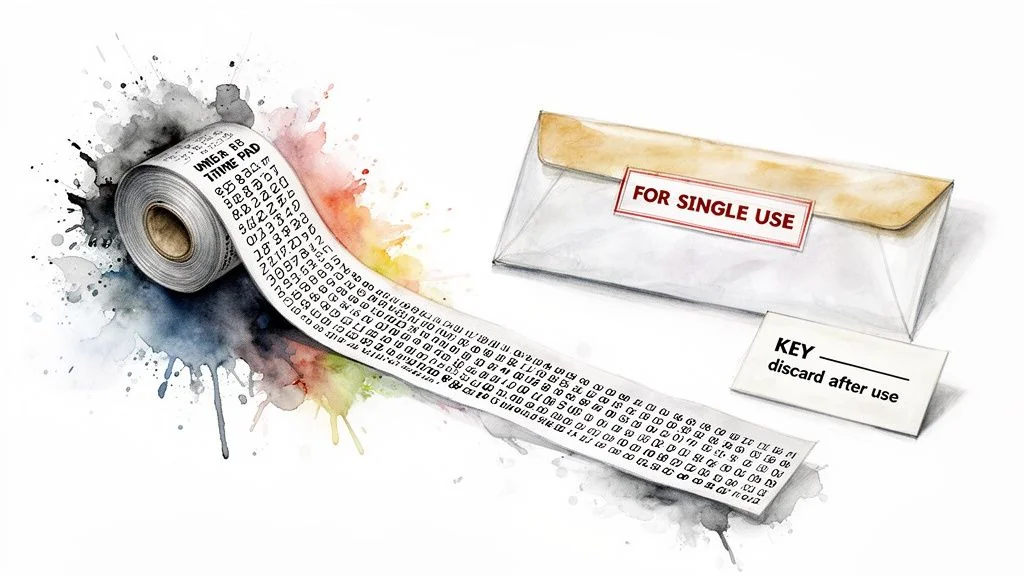
Why does this matter for someone pursuing SOC 2?
From a SOC 2 standpoint, the One-Time Pad is more of a theoretical benchmark than a practical control. While its perfect secrecy would technically satisfy the criteria for data protection under CC6.6 (logical access security measures), its implementation challenges introduce significant operational risks that auditors would scrutinize. An auditor would focus on the procedures for key management, which fall under CC6.1, which addresses “logical access security software, infrastructure, and architectures.” You would need to provide exhaustive evidence of cryptographically secure random number generation, secure out-of-band key distribution, and auditable proof of single-use and destruction. Attempting to implement an OTP in a typical SaaS environment would likely be flagged as an unnecessarily complex and high-risk control. The lesson is not to use an OTP, but to understand what it achieves so you can select appropriate, vetted cryptographic controls that meet compliance demands without introducing unmanageable operational burdens.
6. Enigma Machine (Rotor-Based Polyalphabetic Substitution)
The Enigma machine is an electro-mechanical cipher device that implements a polyalphabetic substitution cipher. It uses a series of rotating discs (rotors) with internal wiring to scramble plaintext letters. Each keypress rotates one or more rotors, changing the substitution alphabet for the next character, which prevents simple frequency analysis. A plugboard added another layer of scrambling by swapping pairs of letters before and after the rotor encryption, creating a vast keyspace that made it a formidable encryption tool during its time.
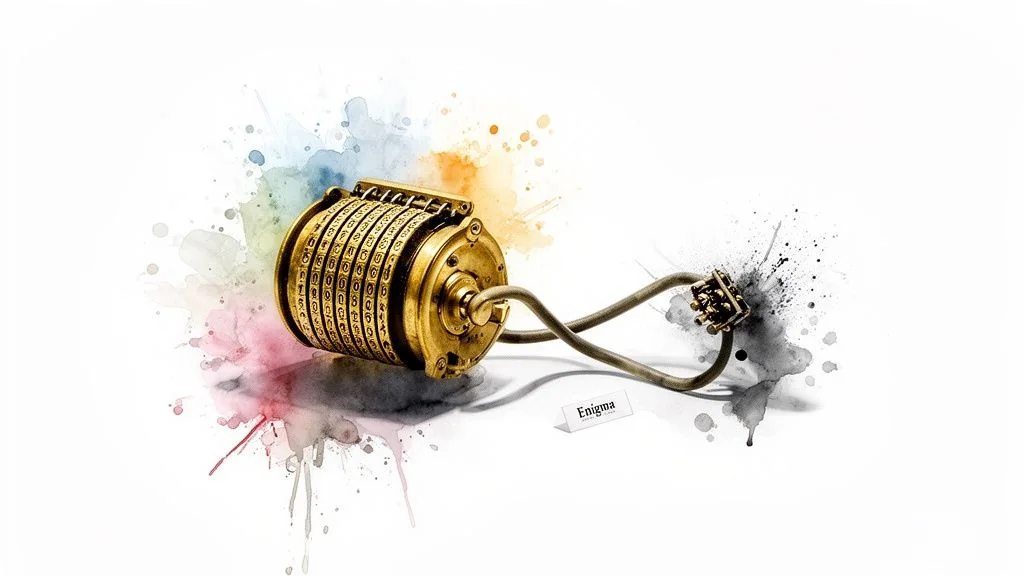
Why does this matter for someone pursuing SOC 2?
From a SOC 2 compliance viewpoint, the Enigma machine is a powerful historical case study illustrating what not to do in a modern security architecture. Its use for protecting any sensitive data would be an immediate and critical failure against the Trust Services Criteria. Specifically, it would violate CC6.6 (related to logical access security measures) and CC7.1 (regarding the use of detection and monitoring procedures), as it provides no real protection against modern threats and would be flagged as a severe design flaw. Understanding the Enigma’s weaknesses, such as its susceptibility to known-plaintext attacks and its reliance on flawed key management, helps security professionals appreciate the necessity for protocols like TLS and algorithms like AES-256. The story of the Enigma reinforces the principle that security is not a static state; it requires continuous evaluation and the adoption of vetted, industry-accepted cryptographic standards to meet compliance and effectively defend against adversaries.
7. Modern AES-256 Encryption (NIST FIPS 140-2 Compliant)
The Advanced Encryption Standard (AES) with a 256-bit key is a symmetric block cipher that has become the global standard for securing data at rest and in transit. Standardized by the National Institute of Standards and Technology (NIST), AES-256 operates on 128-bit blocks of data and executes 14 rounds of substitution and permutation operations to convert plaintext into ciphertext. Its strength comes from the complexity of these operations and the massive key space, which makes brute-force attacks computationally infeasible. AES-256 is required by the U.S. government to protect classified information and is the foundation of modern data protection frameworks, including TLS 1.2+ for HTTPS communication and AWS S3 encryption.
Why does this matter for someone pursuing SOC 2?
From a SOC 2 perspective, using a NIST-validated implementation of AES-256 is not just a best practice; it is a baseline expectation for meeting the Trust Services Criteria. Its use directly supports compliance with several common criteria. For example, CC6.6 requires the implementation of logical access security measures to protect assets, and encrypting sensitive data with AES-256 is a fundamental control for achieving this. Likewise, CC6.1 addresses “logical access security software, infrastructure, and architectures,” where the entire key management lifecycle—including key generation, storage, rotation, and destruction—must be securely implemented and documented. Auditors will scrutinize your key management practices, expecting to see keys stored in a Hardware Security Module (HSM) or a managed service like AWS KMS, along with documented rotation schedules. Failing to use strong, standardized encryption or mishandling keys is a clear path to a qualified opinion or finding in a SOC 2 report.
7-Point Comparison of Scytale Alternatives
| Cipher | Core Characteristics | Security & SOC 2 Relevance | Target Audience / Use Cases | Key Advantages | Main Limitations / Risks |
|---|---|---|---|---|---|
| Rail Fence Cipher (Zigzag) | Geometric zigzag transposition; adjustable rails (2–8); deterministic/reversible | Educational only; not acceptable for SOC 2 encryption | Students, demos, puzzles | Extremely simple and fast; easy to implement | Minimal security; rail-count discovery breaks cipher; not for sensitive data |
| Columnar Transposition Cipher | Keyword-driven column reordering; handles padding; double variants available | Historical/teaching value; not SOC 2 compliant | Intermediate crypto training, historical examples | Adds key-based complexity; manual or digital use | Vulnerable to cryptanalysis; keyword compromise exposes plaintext |
| Gronsfeld Cipher (Vigenère variant) | Numeric-key polyalphabetic substitution; repeating key shifts | Educational reference; insufficient for SOC 2 controls | Cryptanalysis practice, historical study | Stronger than simple substitution; easy manual use | Susceptible to Kasiski/index attacks; key discovery undermines security |
| Playfair Cipher | 5×5 digraph substitution grid; keyword-initialized; digraph rules | Teaching artifact; not suitable for SOC 2 compliance | Military history, classroom exercises, puzzles | Resists simple monoalphabetic analysis; historically practical | Digraph frequency attacks with large texts; grid exposure compromises cipher |
| One-Time Pad (Vernam) | Random key equal to message length; XOR or modulo addition; single-use | Theoretically unbreakable but impractical for SOC 2 operations; informs key entropy practices | High-value, tightly controlled diplomatic/intel use (rare) | Information-theoretic security if keys are truly random & single-use | Key generation/distribution and storage impractical at scale; reuse catastrophic |
| Enigma Machine (rotor) | Rotor + plugboard polyalphabetic substitution; mechanical stepping; large manual keyspace | Historical milestone; obsolete for SOC 2; useful for cryptanalysis education | Museums, simulations, cryptography courses | Historically robust for manual ops; illustrates rotor mechanics | Proven broken by cryptanalysis; operational weaknesses; obsolete today |
| AES-256 (NIST FIPS 140-2) | 256-bit symmetric block cipher; 14 rounds; multiple modes (GCM, CBC, CTR) | Required/recommended for SOC 2; auditors verify algorithm, keys, rotation, KMS | Startups to enterprise: cloud storage, TLS, audit log protection | NIST-approved; widely implemented; fast in HW/SW; AEAD modes available | Key management complexity; side-channel risks; improper mode choice leaks data |
Connecting Cryptographic Choices to SOC 2 Audit Readiness
The journey from the Scytale to AES-256 is a direct lesson in risk management that is central to SOC 2 audit readiness. Each obsolete cipher demonstrates a specific vulnerability—such as pattern analysis, key weakness, or implementation error—that modern standards are designed to mitigate. For an organization pursuing a SOC 2 report, selecting and implementing cryptographic controls is a strict requirement. An auditor will specifically test these controls against criteria like CC6.6 (Logical Access Security) and CC6.1 (Control Implementation). They will verify the use of industry-standard algorithms like AES-256 and assess the entire key management lifecycle, from generation to destruction. The weaknesses of historical scytale alternatives illustrate why these modern cryptographic standards are non-negotiable for achieving a clean SOC 2 opinion. Your ability to demonstrate effective, modern cryptographic controls will be a deciding factor in proving to your customers that you are a trustworthy steward of their data.