 Menu
Menu
A SOC 2 compliance automation platform is a software solution designed to streamline and centralize the process of preparing for a SOC 2 audit. It functions by integrating with a company’s technology stack—such as cloud infrastructure providers, HR information systems, and version control systems—to automatically collect evidence required to demonstrate adherence to the American Institute of Certified Public Accountants (AICPA) Trust Services Criteria (TSC). The primary purpose of these platforms is to replace manual evidence gathering, reduce human error, and provide continuous monitoring of security controls, thereby structuring and accelerating an organization’s journey to audit readiness.
What Are SOC 2 Compliance Automation Platforms?
A SOC 2 compliance automation platform is a centralized software system for managing the activities required to successfully undergo a SOC 2 examination. Its core function is to operationalize the process of meeting the AICPA’s Trust Services Criteria by automating evidence collection, managing security policies, and continuously monitoring internal controls.
These tools integrate directly with an organization’s technical environment, such as AWS, Google Cloud, HR systems like Gusto, and developer tools like GitHub. This allows the platform to programmatically gather the evidence auditors require. For instance, instead of an engineer manually providing screenshots of infrastructure change logs to satisfy control CC7.2 (Change Management), the platform can automatically pull these logs. Similarly, it can verify that new employee background checks are completed, satisfying a key requirement of CC3.2 (Personnel Screening). This automation is designed to replace manual tracking in spreadsheets, minimize human error, and significantly shorten the audit preparation timeline. The global SOC Reporting Services market’s projected growth from USD 5,392 million in 2024 to USD 10,470 million by 2030 underscores the increasing reliance on these solutions.

Why Automation Matters for SOC 2
For an organization pursuing a SOC 2 report, these platforms provide a systematic, repeatable framework for achieving and maintaining compliance. This is essential not only for passing the audit but also for building and preserving the trust of enterprise customers who often require a SOC 2 report as a prerequisite for business.
The primary benefits for a SOC 2 audit are:
- Continuous Monitoring: The software automatically identifies and flags control failures, such as an improperly configured S3 bucket or a user with excessive permissions. This enables proactive remediation before an auditor discovers the issue, directly supporting control criteria related to monitoring activities (e.g., CC4.1).
- Centralized Evidence: All policies, procedures, configurations, and logs are aggregated in a single location, creating a “single source of truth” for the audit. This streamlines the auditor’s review process and ensures evidence is readily available.
- Efficiency and Speed: Automation drastically reduces the manual effort required from engineering and IT teams. This accelerates the audit readiness timeline from months to weeks, enabling the organization to obtain its SOC 2 report faster.
Key Insight: A compliance automation platform operationalizes the concept of “continuous compliance.” For SOC 2, this is critical because it embeds security and compliance practices into daily operations, ensuring that the controls described in the system description are not just designed but are also operating effectively over the audit period.
While SOC 2 is a primary focus, many organizations handle data subject to other regulations. For instance, if payment card data is processed, understanding PCI DSS is also a critical requirement.
Ultimately, a well-implemented automation tool transforms the SOC 2 audit from a disruptive, one-time project into a manageable, ongoing business process. For someone pursuing SOC 2, this is paramount because it provides a structured methodology to consistently meet the AICPA’s criteria. The platform becomes the mechanism for demonstrating that controls are not only in place but are functioning continuously, which is the core objective of a SOC 2 Type 2 examination.
Comparing the Top Secureframe Alternatives
When selecting a SOC 2 compliance automation platform, the choice between Secureframe, Vanta, Drata, and TrustCloud is a decision about how to operationalize your audit preparation. These platforms are engines for automating evidence collection, managing policies, and monitoring controls. However, their approaches, integration capabilities, and feature sets vary significantly.
The choice of platform directly impacts the efficiency and success of a SOC 2 audit. A platform with shallow or unreliable integrations for controls like CC7.2 (system change management) requires engineers to manually gather evidence, defeating the purpose of automation. Conversely, an effective tool with deep integrations for your specific tech stack makes evidence collection for complex controls like CC7.1 (System Development Life Cycle) nearly automatic. This frees up technical resources and reduces the risk of human error in the audit process.
Core Differentiators for SOC 2 Success
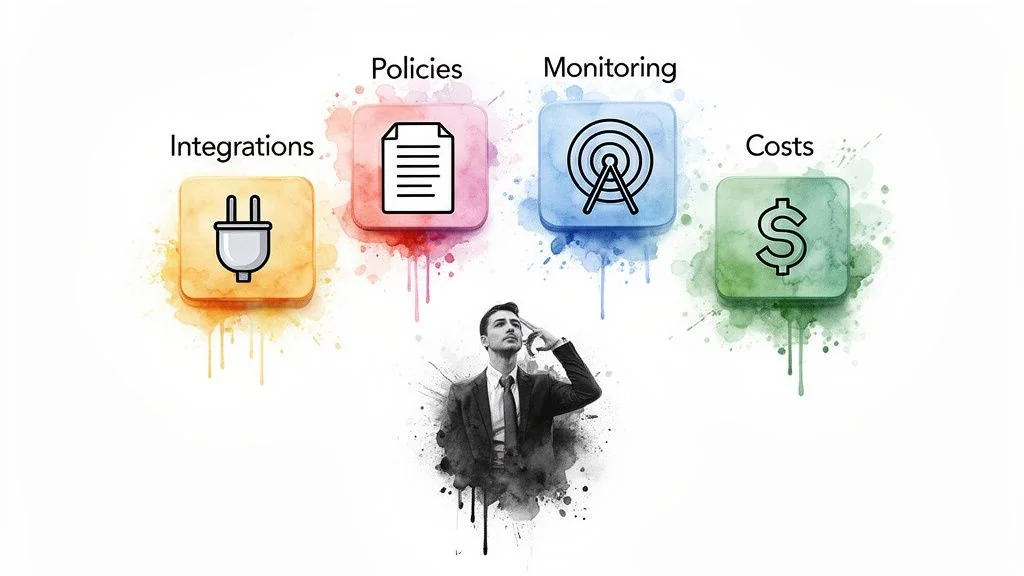
Beyond marketing claims, the primary differentiators that impact a SOC 2 audit are the depth of integrations, the flexibility of policy customization, and the sophistication of continuous monitoring.
A superficial integration that only confirms a tool is connected is insufficient for a SOC 2 audit; it must pull specific evidence, such as logs or configuration settings, that auditors require. Rigid policy templates that don’t align with an organization’s actual processes create significant friction, forcing a choice between altering business operations or performing extensive manual edits. This is particularly relevant for meeting criteria like CC2.1 (Control Environment), which requires policies and procedures that reflect the entity’s commitment to integrity.
These platforms are part of a broader security ecosystem. Understanding their place among top managed security solutions provides context for how they help solve security and compliance challenges from a SOC 2 perspective.
Detailed Platform Comparison for SOC 2
This comparison focuses on the attributes of Secureframe, Vanta, Drata, and TrustCloud that are most critical for achieving a successful SOC 2 audit.
Secureframe vs Vanta vs Drata vs TrustCloud A Detailed Comparison
This table provides a breakdown of how the leading platforms perform against criteria crucial for SOC 2 audit success, specifically integration depth, policy customization, and continuous monitoring maturity.
| Evaluation Criterion | Secureframe | Vanta | Drata | TrustCloud |
|---|---|---|---|---|
| Integration Depth | Strong coverage with major cloud and SaaS tools. Known for a more guided, hands-on integration process, which is beneficial for teams with less in-house compliance expertise. | Possesses a mature and extensive integration ecosystem with deep connections into developer tools and CI/CD pipelines. This makes it a strong choice for technology-focused companies. | Offers the broadest range of integrations, particularly for emerging SaaS tools. Its “Automate Everything” philosophy is aimed at minimizing manual evidence collection. | Utilizes an API-first approach, focusing on creating programmatic links between controls and live evidence. It prioritizes deep, auditable connections over the sheer quantity of integrations. |
| Policy Customization | Provides a robust library of pre-built policy templates. Customization is possible but can be somewhat rigid, potentially requiring manual adjustments to align with unique business processes. | Offers excellent policy flexibility. Its templates are well-regarded and easily adaptable, which helps align them with existing company practices without significant friction. | Features strong, customizable templates with clear, embedded guidance. The platform effectively maps modified policies back to specific controls and the corresponding evidence. | Built around a risk-based “Trust Assurance” model where policies are dynamically linked to live evidence from integrated systems. Customization is a core component of its approach. |
| Continuous Monitoring | Robust monitoring for cloud environments and key SaaS systems. Alerts are clear and actionable, focusing on critical misconfigurations relevant to a SOC 2 audit. | Features an advanced monitoring engine particularly adept at identifying infrastructure drift and code-level security issues. It is a preferred solution for engineering-led organizations. | A leader in real-time monitoring across its vast list of integrations. The dashboard provides an immediate, comprehensive view of the organization’s compliance posture. | Differentiates itself with risk-based monitoring. It uses AI to predict and prioritize compliance gaps, allowing teams to address potential audit findings proactively. |
Key Takeaway: For companies with complex technology stacks, Drata and Vanta are often the preferred Secureframe alternatives due to their extensive and deep integrations. TrustCloud appeals to organizations focused on building a proactive, risk-based security program that extends beyond audit preparation. Secureframe maintains a strong position with its guided, high-touch experience, which is ideal for teams requiring more direct support.
The right selection depends on an organization’s technical maturity, risk appetite, and available internal resources. For additional details, our complete guide on SOC 2 compliance software can provide further guidance. This level of detail is crucial for a SOC 2 audit. A platform with deep, reliable integrations for your specific HRIS and version control system automates evidence gathering for controls related to CC3.1 (Hiring Practices) and CC7.1 (System Development), making the audit journey faster and more predictable.
Analyzing the True Cost of Compliance Automation
When evaluating compliance automation platforms, focusing solely on the annual subscription fee provides an incomplete picture. The total cost of ownership (TCO) is a more accurate metric, encompassing the platform subscription, separate audit fees, and the internal labor hours required to manage the process.
Miscalculating TCO can lead to significant budget overruns and jeopardize the SOC 2 audit. A platform that appears inexpensive may prove costly if its weak integrations necessitate extensive manual work from the engineering team, diverting them from core product development and increasing the risk of control failures.
Breaking Down the Platform Fees
The most visible cost is the annual fee paid to the platform vendor. These fees vary widely based on factors like employee count, the number of integrations needed, and the specific frameworks being pursued (e.g., SOC 2, ISO 27001, HIPAA).
For an early-stage startup, SOC 2 platform packages typically range from $7,500 to $15,000 annually. For a mid-market company with a larger workforce and a more complex technology stack, this cost can escalate to $30,000 to $60,000 or more.
Key Insight: When comparing Secureframe alternatives, it is crucial to request a detailed pricing structure. Ask specific questions about how costs scale with employee growth and what features, such as risk management modules or additional compliance frameworks, are included in the base price versus being paid add-ons.
The Inevitable Cost of the Audit Itself
No compliance platform can issue a SOC 2 report; this can only be done by a licensed CPA firm. This external audit represents a separate and substantial cost. While platforms like Secureframe, Vanta, and Drata facilitate introductions to audit firms through their partner networks, the financial engagement is directly with the auditor.
Audit fees can range from $12,000 to $50,000, depending on the firm’s reputation and the complexity of the audit scope. Vanta’s partners often quote in the $15,000–$35,000 range. Secureframe’s preferred auditors, such as BDO and Schellman, are typically in the $20,000–$50,000 range. Partners of TrustCloud often provide competitive pricing between $12,000–$30,000. To better understand market rates, you can explore detailed SOC 2 audit cost data.
Uncovering the Hidden Costs
The most significant and often underestimated costs are the internal labor hours spent on implementation, remediation, and policy management. This internal resource allocation is a direct expense and must be included in any TCO calculation.
Consider these resource drains:
- Implementation and Onboarding: The number of engineering hours required to set up integrations and configure the platform. A tool with shallow or poorly documented integrations creates a significant manual workload for expensive technical staff.
- Evidence Remediation: The platform will identify control gaps and misconfigurations. When it flags an issue, such as an unencrypted database, an internal team member must remediate it. The quality of the platform’s alerts and remediation guidance directly affects the time required for this task.
- Policy Customization: The generic policy templates provided by all platforms rarely align perfectly with an organization’s actual operating procedures. Leadership, legal, and technical teams must invest time to customize these documents to accurately reflect business practices.
These hidden costs are critical for SOC 2 readiness. Underestimating them can lead to resource exhaustion and force teams to cut corners on security, resulting in control failures during the audit. This undermines the ability to demonstrate a commitment to integrity and ethical values, a foundational requirement of the SOC 2 framework under CC1.1 (Commitment to Integrity and Ethical Values).
Matching the Right Platform to Your Company Profile
Selecting the appropriate compliance automation platform is a strategic decision that must align with your company’s specific characteristics. Each platform is designed with a particular customer profile in mind, and a mismatch can lead to process friction, increased manual effort, and potential delays in the SOC 2 audit.
A tool that does not fit your company’s technology stack, workflow, or internal expertise will create more problems than it solves. This is especially critical for a SOC 2 audit because a platform mismatch directly impairs evidence collection capabilities. For example, if your company uses a niche HRIS system for which the chosen platform lacks a robust integration, you will be forced to manually upload evidence for every new hire. This not only defeats the purpose of automation but also introduces a high risk of human error for a critical control like CC3.1 (Hiring and Onboarding Practices).
For the Developer-Led, High-Growth Startup
Engineering-driven startups require a platform that integrates seamlessly with their developer-centric workflows. For these companies, the objective is often “compliance as code,” where security controls are automated within CI/CD pipelines and managed through infrastructure-as-code (IaC) solutions.
- Ideal Profile: Companies with a strong DevOps culture utilizing tools like GitHub, GitLab, Terraform, and Kubernetes.
- Top Contenders: Vanta and Drata are leading Secureframe alternatives for this profile. Their extensive integration libraries and developer-first workflows are specifically designed to automate evidence collection from complex, modern tech stacks.
A key differentiator for this profile is the platform’s ability to provide actionable remediation advice directly within a developer’s existing tools. The most effective platforms not only flag a vulnerability but also offer code snippets or direct links to resolve the issue, minimizing disruption and maintaining engineering velocity.
For the Mid-Market Company Needing Structure
Mid-market organizations typically face different challenges, including legacy systems, larger teams, and a greater need for structured governance and oversight. They prioritize features like robust risk management modules, guided implementation support, and comprehensive reporting that provides leadership with a real-time view of their compliance posture.
Technical teams in these companies are often stretched, making a platform with strong, hands-on support a significant advantage.
- Ideal Profile: Companies with 100-1,000 employees, established operational processes, and a need to manage multiple compliance frameworks (e.g., SOC 2, ISO 27001, HIPAA).
- Top Contenders: Secureframe often excels in this segment due to its guided, high-touch onboarding and support model. TrustCloud is another strong candidate, with its focus on programmatic risk management and linking policies directly to live evidence, which appeals to more mature GRC functions.
This decision-making flowchart illustrates how company size and strategic focus can guide the selection process among the top platforms.
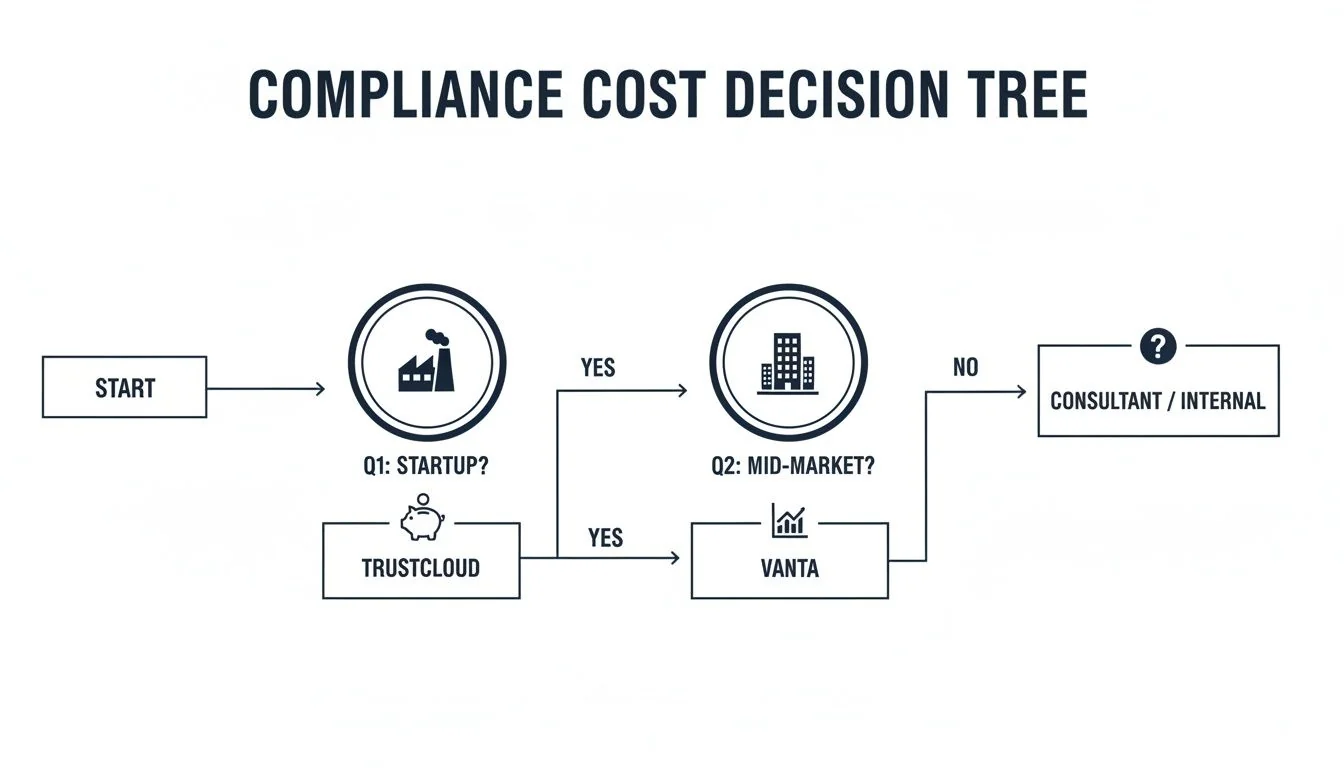
As shown, a budget-conscious startup may find TrustCloud to be a suitable starting point, whereas a well-funded mid-market company might gravitate towards Vanta’s extensive feature set.
For the Budget-Conscious Early-Stage Company
For pre-seed and seed-stage startups, budget constraints are a primary concern. The high cost of traditional compliance creates a significant barrier to entry, as reflected in market data. While approximately 45% of companies with over $100 million in funding have a SOC 2 report, only 7% of startups with less than $1 million in funding have achieved it. Across the broader SaaS market, just 18% of companies are SOC 2 or ISO 27001 compliant, indicating a clear need for more accessible solutions. You can find more data on the compliance market landscape for deeper insights.
- Ideal Profile: Bootstrapped or seed-funded startups that require a SOC 2 report to secure their first enterprise customers.
- Top Contenders: TrustCloud is often positioned as a cost-effective yet powerful option for this market segment. Several emerging Secureframe alternatives also cater to this niche with more flexible pricing models and focused feature sets.
Matching your company profile—your technical architecture, organizational maturity, and budget—to the right platform is the most critical step in your SOC 2 journey. The correct choice provides a solid foundation for success, transforming the audit into a streamlined process. A mismatched tool, however, leads to wasted resources, frustrated engineers, and control failures that endanger both the audit and your business objectives.
Evaluating Support Models and Auditor Partnerships
The software platform itself is only one component of a successful SOC 2 engagement. The true value of a compliance automation solution is often determined by two external factors: the quality of the human support provided by the vendor and the caliber of the auditors within its partner network.
When facing a tight audit deadline and an auditor’s inquiry about a piece of evidence, the availability of a dedicated compliance expert versus a generic support queue can be the determining factor between passing and failing. These elements are non-negotiable considerations when evaluating Secureframe alternatives.

How Support Models Actually Differ
The support model directly influences the speed and efficiency of the audit preparation process. Platforms like Secureframe are known for a high-touch, guided experience, often providing access to dedicated compliance experts. This model is ideal for organizations that lack in-house compliance personnel.
Other platforms offer different tiers of support:
- Dedicated Experts: A named contact, often a former auditor, is assigned to your account. This expert gains a deep understanding of your business and can provide tailored guidance on interpreting complex control requirements.
- Shared Success Managers: A team of customer success managers handles a portfolio of clients. They offer standardized best practices but may lack the deep, personalized context of a dedicated expert.
- Email-Only Support: Typically offered with lower-priced tiers, this model relies on a standard ticketing system. It can be slow and inefficient for resolving complex, time-sensitive audit-related questions.
Key Insight: During a SOC 2 audit, you will inevitably encounter ambiguous evidence requests from your auditor. A support model that provides direct access to an expert who can help you interpret the request and formulate an appropriate response offers a significant advantage over a slow, impersonal help desk.
The Strategic Choice of Auditor
The second critical factor is the auditor network. The compliance platform does not conduct the audit; it connects you with a licensed CPA firm. The choice of auditor has significant implications for the audit’s cost, timeline, and the ultimate acceptance of the report by your customers.
Platforms like Secureframe, Vanta, and Drata maintain extensive partner networks that include large, global firms as well as smaller, specialized boutique firms.
Comparing Auditor Types
| Auditor Type | Typical Profile | Best For | SOC 2 Implications |
|---|---|---|---|
| Large National Firms | ”Big Four” or other top-tier firms like BDO or Schellman. | Enterprises needing a globally recognized report for conservative, established customers. | Higher cost and longer timelines are common, but their brand carries significant weight. They can also be less flexible in interpreting controls for modern technology environments. |
| Specialized Boutiques | Smaller firms focused on technology, startups, or specific industries like FinTech. | Startups and mid-market companies seeking a collaborative, pragmatic, and cost-effective audit experience. | Generally faster and more agile. These firms understand modern cloud architectures and offer practical guidance for meeting control objectives without excessive bureaucracy. |
For those new to the process, our guide on SOC 2 audit firms can provide valuable context. Selecting an auditor with relevant industry experience is crucial for a smooth audit.
This matters for SOC 2 because your support contact and auditor are essential partners. When an auditor questions the evidence for a control like CC9.2 (Incident Response Testing), having a platform expert who can help articulate your testing process is invaluable. A weak support system or an auditor unfamiliar with your technology stack can delay the audit, create unnecessary work, and put your clean SOC 2 report at risk.
Making the Call: From Choosing a Platform to Getting Audit-Ready
Having reviewed the options, the final step is to select the right platform. This decision is not merely a software procurement but a strategic choice that will define your path to SOC 2 compliance. The right platform acts as a force multiplier, automating tedious tasks and creating a clear path to a successful audit.
Conversely, a poor fit leads to control gaps, missing evidence, and excessive manual work for your engineering team. This is the fastest way to derail your audit timeline and exceed your budget.
Your Final Decision Checklist
To make an informed decision, you must look beyond marketing materials and feature lists and focus on how each platform will function within your organization. Choosing one of the many Secureframe alternatives must be a deliberate decision based on your company’s specific needs and context.
Use this checklist to guide your final evaluation:
- Real-World Integration: Does the platform offer deep, reliable integrations for your entire technology stack? A missing or superficial connection to your primary HR platform, cloud provider, or source code repository will create a significant amount of manual work.
- Total Cost of Ownership (TCO): Have you calculated the true cost? This includes the platform subscription, fees from the partner audit firm, and the internal engineering hours required for setup, remediation, and ongoing management.
- The Support Model: What level of support is provided? Determine whether you will have access to a dedicated compliance expert, a shared customer success manager, or an email-based ticketing system. Your team’s in-house compliance expertise will dictate which model is most appropriate.
- Scalability: Will the platform support your company’s growth? Consider its ability to handle additional frameworks like ISO 27001 or HIPAA, manage risk as your organization matures, and support an increasingly complex control environment.
Choosing a platform is an investment in your security posture. The goal is not just to pass a single audit but to build a sustainable compliance program that enables enterprise sales and demonstrates a serious commitment to security.
From Platform Selection to Audit Readiness
Once a platform is selected, the implementation phase begins. This is where the promise of automation is put into practice. A well-planned implementation is crucial for a smooth and efficient journey to audit readiness.
- Assign an Owner: Designate a single individual to lead the implementation project. This person will serve as the primary liaison with the platform’s support team and will be responsible for delegating tasks internally.
- Connect Core Systems First: Begin by integrating your most critical systems: your cloud infrastructure (AWS, GCP, Azure), identity provider (Okta, Google Workspace), and source code repository (GitHub, GitLab). These integrations will automate the majority of your evidence collection.
- Customize Policies: Work with your leadership and legal teams to tailor the platform’s policy templates. The final policies must accurately reflect how your organization operates, as auditors can easily identify generic, unmodified templates.
- Remediate Gaps: The platform will begin identifying security issues and misconfigurations immediately. Develop a remediation plan, prioritizing the most critical vulnerabilities first to strengthen your control environment.
Choosing and implementing a compliance automation platform is a foundational step in preparing for a SOC 2 audit. While the platform provides the necessary tooling and structure, your team is still responsible for implementing and maintaining the controls. By selecting the right platform and executing a thoughtful implementation plan, you can make the SOC 2 audit a predictable and manageable process that demonstrates your commitment to security and prepares your organization for the scrutiny required to earn and maintain customer trust.