 Menu
Menu
So, is Drata the right move for your SOC 2 report? For a huge number of tech companies, the answer is a firm yes. Drata is built to take the chaos of manual audit prep and turn it into a clear, automated workflow.
Is Drata Your Best Path to a SOC 2 Report?
Trying to get a SOC 2 report on your own can feel like building a car from scratch with a blurry instruction manual. You know you need to prove your security to win customer trust, but the path is littered with tedious, soul-crushing tasks—endless screenshots, massive spreadsheets, and hounding engineers for evidence.
This is the exact headache Drata was built to cure.
Think of Drata as your audit co-pilot. It doesn’t just hand you a to-do list; it plugs directly into your company’s tech stack. By connecting to your cloud provider (like AWS or GCP), HR system, and code repositories, it automatically gathers the proof auditors need to see. This continuous monitoring means Drata is always watching your security posture, flagging problems in real-time before they can blow up your audit.
Who Gets the Most Out of Drata?
While any company can use the platform, Drata really shines for startups and mid-market tech companies. These are the businesses that often don’t have a big, dedicated compliance team and need a tool that can do the heavy lifting for them.
Drata’s core features hit their biggest pain points head-on:
- Automated Evidence Collection: Drata pulls proof directly from your systems, saving hundreds of engineering hours that would otherwise be wasted on manual grunt work.
- Continuous Controls Monitoring: The platform constantly scans your configurations against SOC 2 requirements. It’ll immediately alert you to critical gaps, like a database accidentally exposed to the public or a key employee missing multi-factor authentication.
- Centralized Policy Management: It comes with a library of pre-built security policy templates you can quickly customize, get approved, and track right inside the platform.

The platform’s dashboard gives you a clean, at-a-glance view of your compliance status, making it easy to see where you stand and what needs fixing now. It turns a mountain of complex compliance data into simple, actionable insights.
Key Takeaway: Drata isn’t just another project management tool. It’s an automation engine that creates a live, persistent link between your technical environment and the auditor’s checklist. That connection is what makes it so powerful for getting—and staying—compliant.
To help you figure out if Drata is the right fit, here’s a quick breakdown based on different company profiles.
Drata Suitability Quick Guide
| Company Profile | Ideal for Drata | May Need Alternatives |
|---|---|---|
| Company Size | Startups (Series A+) & Mid-Market (50-1,000 employees) | Very small startups (<20 employees) or large enterprises with highly custom needs. |
| Technical Setup | Cloud-native companies using standard tech (AWS, GCP, Azure, Okta). | Organizations with extensive on-premise infrastructure or non-standard proprietary systems. |
| Compliance Goal | First-time SOC 2 or ISO 27001; need for speed and efficiency. | Mature programs requiring deep GRC features beyond standard compliance automation. |
If you fall into the “May Need Alternatives” column or just want to see the whole landscape, you can explore other options in our detailed guide on the top-rated SOC 2 software.
How Drata’s Automation Actually Works
“Automation” gets thrown around a lot, but what does it actually mean for your SOC 2 audit? It’s not magic. It’s a specific, methodical process that turns your compliance program from a static checklist into a living, breathing system.
Drata connects directly to the tools you already use every day—think of it as building a digital nervous system for your company.
Imagine your tech stack as a series of separate islands. Your cloud provider (AWS), your HR system (Gusto), and your code repository (GitHub) all hold critical evidence. The old way of getting SOC 2 ready involved sending someone in a rowboat to each island, manually taking screenshots, downloading logs, and pasting it all into a massive, nightmarish spreadsheet. Drata builds secure bridges to these islands.
The Three Steps of Drata’s Automation
The platform’s automation isn’t a black box; it’s a straightforward, three-part sequence that systematically replaces manual grunt work with continuous, verifiable proof.
-
Connect via Secure APIs: First, you grant Drata read-only access to your business systems. Using secure API connections, it plugs into dozens of services—your cloud infrastructure, identity providers like Okta, HR platforms, and more. This is the foundation that everything else is built on.
-
Map Infrastructure to Controls: Once connected, Drata doesn’t just suck in raw data. It intelligently maps your configurations to specific SOC 2 controls. For example, it will scan your AWS settings to confirm that multi-factor authentication is enforced for all IAM users, directly providing evidence for a key access control.
-
Flag Gaps in Real-Time: Here’s where the real value kicks in. If a setting ever drifts out of compliance—maybe an engineer accidentally makes an S3 bucket public while troubleshooting—Drata catches it almost instantly. It flags the issue, creates a task, and tells your team exactly what’s wrong and how to fix it.
This constant monitoring cycle is the heart of Drata’s value proposition. It shifts compliance from a frantic, once-a-year fire drill to a calm, managed, and ongoing process. You drastically reduce the risk of ugly, last-minute surprises during your audit. According to Verizon’s 2022 Data Breach Investigations Report, a staggering 82% of data breaches involve a human element—precisely the risk this kind of automation is designed to shrink.
From Manual Chaos to Automated Clarity
This system completely replaces the endless spreadsheets and screenshot hunts that used to define audit prep. Instead of reacting to an auditor’s request list, you’re proactively managing your security posture year-round. By taking the most tedious, error-prone tasks off your plate, Drata frees up hundreds of precious engineering hours.
As Drata streamlines compliance, it’s a good reminder of the broader benefits of adopting efficient automated infrastructure management to improve operational reliability across the board.
Ultimately, Drata gives your auditor a single, trusted source of truth. They can see live evidence pulled directly from your systems, which builds confidence and often speeds up the entire audit timeline. To see how this concept applies across different tools, check out our deep dive on SOC 2 automation platforms.
Exploring Core Features for Audit Readiness
Drata’s real power isn’t just giving you a glorified checklist; it’s about how the platform actively dismantles the manual, soul-crushing tasks that make audit prep so painful. It doesn’t just manage the project—it becomes a core part of your compliance engine. Let’s break down the features that actually get you audit-ready.
Continuous Controls Monitoring
Think of this feature as a 24/7 digital security guard plugged directly into your tech stack. Once you connect your cloud providers (AWS, GCP, Azure), identity tools, and other key systems, Drata never looks away. This isn’t some once-a-quarter spot check; it’s a relentless, real-time feed of your security posture.
If a critical setting drifts—say, an engineer accidentally disables MFA on a sensitive system or an S3 bucket is made public—Drata flags it instantly. You get an alert telling you what broke, who owns it, and exactly which SOC 2 control is now at risk. This constant vigilance turns compliance from a reactive scramble into a proactive, manageable process. No more last-minute audit surprises.
Automated Evidence Collection
The single biggest time-suck in any manual audit is collecting evidence. It’s an awful cycle of taking screenshots, downloading logs, and bugging engineers for proof that your controls are actually working. Drata automates almost all of it.
The platform continuously pulls evidence directly from your integrated systems. For a control requiring vulnerability scanning, Drata automatically fetches the reports from your scanner. For a control about employee offboarding, it verifies the former employee’s accounts were actually deactivated in your HR and identity provider systems.
This simple flow is what makes the magic happen.
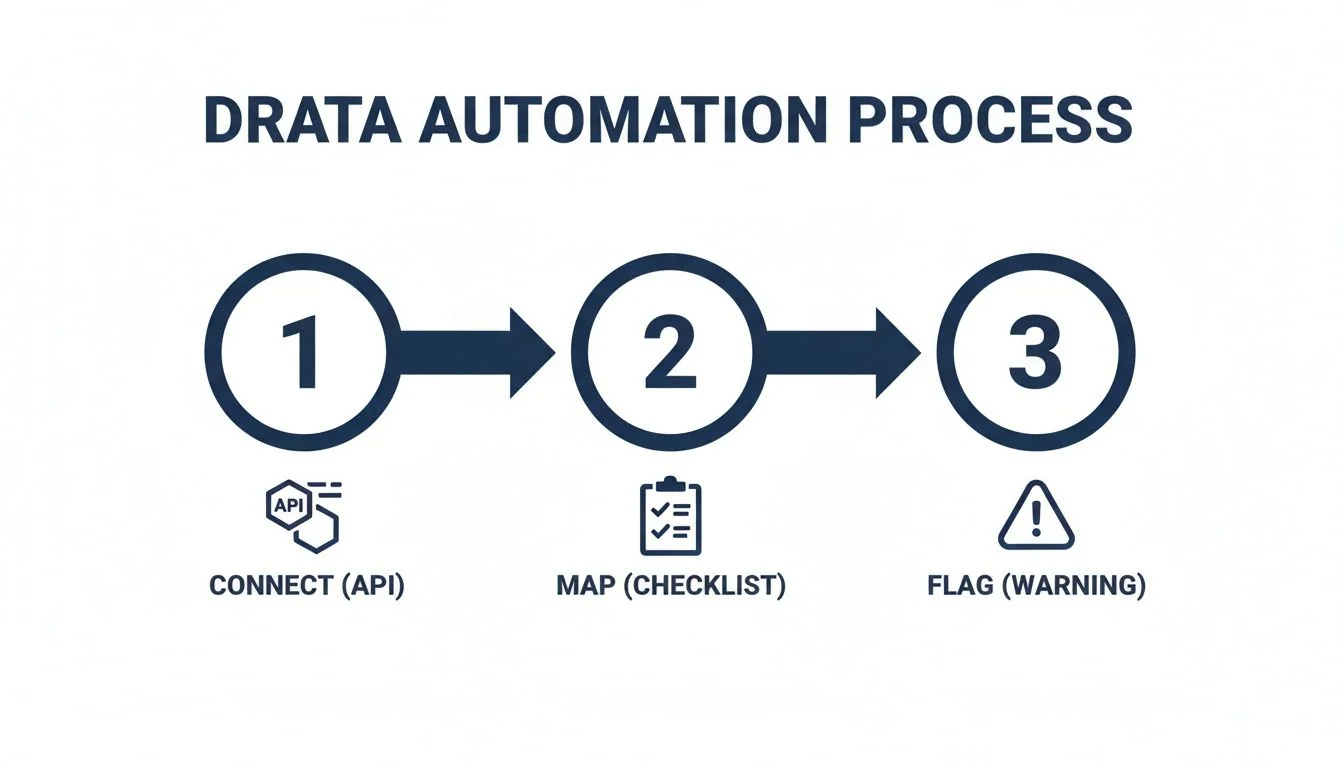
This process replaces thousands of potential manual tasks with a reliable, automated workflow, making sure your evidence is always current and ready for an auditor’s inspection.
Key Insight: This is about more than saving time. Automated evidence collection builds a massive amount of trust with auditors. When they see timestamped, unalterable proof pulled directly from a source system, it carries far more weight than a folder full of manually captured screenshots they have to second-guess.
Integrated Security Training and Policy Management
A solid SOC 2 isn’t just about tech; it’s about your people and processes. Drata gets this and has built-in tools to handle the often-dreaded documentation side of compliance.
The platform comes loaded with a library of pre-built, auditor-approved security policies covering everything from incident response to data classification. Instead of staring at a blank page, you can:
- Customize their templates to fit how your company actually works.
- Manage policy versions and track approvals right inside Drata.
- Automatically assign policies to new hires as part of their onboarding.
This keeps your documentation organized and accessible. Drata also tracks security awareness training completion for all employees, collecting the evidence automatically and flagging anyone who is overdue. This ensures your entire team is meeting the “human” requirements of the SOC 2 framework.
The Growing Importance of Comprehensive Controls
The need for robust tools like Drata is becoming painfully obvious as the compliance world matures. SOC 2 is no longer a “nice-to-have.” Recent analysis shows it’s a clear marker of a company’s readiness to scale, with 45% of companies with over $100 million in funding being compliant, compared to just 7% of seed-stage startups.
And these audits are getting tougher. The percentage of SOC 2 reports with more than 150 security controls jumped from 16% in 2023 to 23% in 2024. This trend tells a clear story: auditors are demanding more comprehensive proof of security, making manual evidence collection a nearly impossible task to scale. You can dig into more of these evolving SOC 2 audit trends on secfix.com.
Drata’s features are built to tackle this growing complexity head-on. By automating control monitoring and evidence collection across an ever-expanding list of requirements, it helps companies meet higher auditor expectations without having to hire a bigger compliance team.
Understanding Drata Pricing and Its ROI
So, let’s get to the two questions that really matter: What does it cost, and is it actually worth it? Any real review of Drata has to tackle pricing and return on investment head-on, because it’s about more than just the sticker price. It’s about business value.
Drata doesn’t list public pricing on its website, and for a good reason. Think of it less like buying off-the-shelf software and more like getting a custom suit tailored—the final price depends entirely on the fit for your company.
Deconstructing the Pricing Model
While you’ll need to get a custom quote for the exact number, Drata’s pricing really boils down to a few key variables. Knowing these will give you a good idea of where you’ll land.
- Company Size: This is the big one. The total number of employees is a primary driver because it dictates the scale of monitoring required. A 50-person startup will see a very different price than a 500-person company.
- Frameworks Needed: Are you going for just SOC 2? Or do you need to bundle in ISO 27001, HIPAA, or PCI DSS? Each additional framework adds to the scope and, naturally, the cost.
- Integration Complexity: The number and type of systems you need to connect also factor into the final price. A simple stack is cheaper than a complex, sprawling one.
For a startup chasing its first SOC 2 report, you can expect pricing to start somewhere in the $7,500 to $15,000 range for an annual subscription. For larger companies or those stacking multiple frameworks, the cost can easily scale into the tens of thousands. To get the full picture on related expenses, check out our detailed guide on how much a SOC 2 audit costs.
Calculating the Real Return on Investment
Just looking at Drata as an expense is the wrong way to think about it. It’s an investment in operational efficiency and, more importantly, a sales accelerator. The true ROI becomes crystal clear when you weigh the subscription cost against the massive “hidden costs” of trying to do this manually.
Getting SOC 2 certified has a real financial impact. We’ve seen certified companies pull in a 10–15% revenue increase over their uncertified competitors and achieve up to 10% higher client retention in regulated industries. For a $50 million company, just a 5% bump in contract win rates translates to $2.5 million in new annual revenue. That’s the power of having proven security. Operationally, the benefits are just as strong, with certified organizations seeing up to 30% fewer data breaches.
The ROI Equation: The cost of Drata is measured against the cost of engineering hours, stalled sales deals, and the catastrophic risk of a failed audit. When viewed through this lens, automation quickly pays for itself.
Without a tool like Drata, the manual slog is a huge resource drain:
- Engineering Hours: Manually grabbing screenshots and pulling logs can chew up hundreds, if not thousands, of hours from your most expensive engineers.
- Lost Sales Opportunities: Let’s be blunt: lacking a SOC 2 report is a deal-breaker for most enterprise customers. It locks you out of a massive market.
- Audit Failure Risk: A failed audit doesn’t just waste the money you spent on the auditor; it damages your reputation and sends you all the way back to square one.
Drata automates the most time-consuming, error-prone parts of compliance, directly tackling these costs. It gives your engineers their time back to build the product, speeds up your sales cycle with instant proof of security, and dramatically boosts your chances of getting a clean audit report on the first try.
A Balanced Look at Drata’s Strengths and Weaknesses
No tool is a silver bullet, and an honest look at Drata means weighing its massive advantages against its potential blind spots. Getting this right is the key to deciding if it’s the right investment for your SOC 2 journey.
Drata’s biggest win is making a famously brutal process feel manageable. For teams staring down their first SOC 2 or ISO 27001 audit, the platform carves a clear path up an intimidating mountain, breaking it down into achievable steps.
Where Drata Truly Shines
The platform absolutely nails a few things that fast-growing tech companies desperately need. Its whole design philosophy feels built around speed, clarity, and automation, knocking down the typical hurdles that make manual compliance a nightmare.
-
Clean, Intuitive Interface: The dashboard is a masterclass in simplicity. It gives you a real-time compliance score, making it dead simple for even non-technical execs to grasp where you stand and what needs fixing.
-
Massive Integration Library: This is the engine under the hood. Drata plugs into a huge ecosystem of cloud providers, HR systems, and developer tools, allowing it to pull evidence directly from the source. No more chasing down screenshots.
-
Top-Notch Customer Support: You’ll hear this one again and again. Users consistently rave about Drata’s responsive and genuinely knowledgeable support. When you don’t have a compliance expert on staff, having a dedicated Customer Success Manager to walk you through setup is a game-changer.
These strengths combine to create a powerful machine for getting audit-ready, fast. By automating the soul-crushing parts of compliance, Drata gives your team the freedom to build your product instead of building binders of evidence.
Potential Limitations and Weaknesses
But as powerful as it is, Drata isn’t a magic wand. There are a few scenarios where its approach might create friction, and it’s critical to remember that it’s a tool—not a substitute for thinking.
Crucial Reality Check: Automation platforms like Drata streamline how you meet controls. They don’t decide what your security strategy should be. You still need human expertise to define your risk appetite and write policies that actually fit your business.
Keep these potential drawbacks in mind:
-
Setup for Non-Standard Stacks: If you’re running on mainstream cloud services, setup is a breeze. But for companies with heavily customized, on-prem, or older tech stacks, that initial connection can be more complex and require more manual legwork.
-
The “Set It and Forget It” Trap: The automation is so good it can lull teams into a false sense of security. Compliance isn’t a one-and-done project; it demands ongoing human oversight, strategic planning, and a healthy security culture.
-
Cost for Very Early-Stage Startups: For pre-seed companies still finding their footing, the subscription can feel like a hefty investment. The ROI is undeniable once sales are blocked by compliance needs, but the upfront cost can be a hurdle before you hit that wall.
Drata Pros and Cons for SOC 2 Buyers
Here’s a summary of Drata’s key advantages and potential limitations to consider during your evaluation.
| Area of Evaluation | Strengths | Weaknesses |
|---|---|---|
| User Experience | Clean, intuitive dashboard with a real-time compliance score. Easy for the whole team to understand. | Automation can feel like a “black box” if you don’t understand the underlying controls. |
| Automation & Integrations | 75+ deep integrations pull evidence automatically, saving hundreds of hours of manual work. | Less effective for companies with non-standard, custom, or on-premise tech stacks. |
| Support & Onboarding | Highly-rated customer success team provides expert guidance, which is invaluable for first-timers. | The tool is the focus; strategic security consulting or policy writing is outside the scope. |
| Cost & ROI | High ROI for growth-stage companies needing to unblock enterprise sales. | Can be a significant upfront cost for pre-revenue or very early-stage startups. |
| Audit Readiness | Streamlines evidence collection and auditor collaboration, significantly reducing audit friction. | Risk of over-reliance; teams must still own their security posture and culture. |
Ultimately, Drata is an exceptional tool for its target audience. The key is knowing what you’re buying: a platform to automate and simplify the execution of your compliance program, not one that builds it from scratch for you.
What to Do After Choosing Your Compliance Platform
Getting a platform like Drata up and running is a huge win. You’ve officially ditched the chaotic spreadsheets for automated evidence collection and continuous monitoring. That’s a massive step forward.
But it’s critical to remember what comes next. A tool like Drata makes you audit-ready; it doesn’t conduct the audit. Your next—and most important—move is finding the right SOC 2 auditor to validate all of your hard work.
This is a distinction that trips a lot of people up. Think of your Drata dashboard as the perfectly organized, comprehensive package of evidence you’ll hand over to an independent CPA firm. The better that package looks, the smoother (and cheaper) your audit will be. Drata prepares the case file; the auditor is the judge who issues the final verdict.
Leveraging Drata to Find the Best Auditor
Your organized Drata instance is more than just a compliance tool—it’s your single best asset for getting accurate quotes from audit firms.
When you can show a potential auditor a complete, real-time view of your controls and evidence, they can give you a much sharper price. A messy, manual approach screams “this is going to be a long, painful audit,” and auditors will absolutely price that risk in.
Walking into that conversation with a mature Drata setup shows you’re prepared and serious. This almost always leads to:
- More Accurate Quotes: Auditors see the exact scope and state of your controls, which kills the uncertainty in their pricing models.
- Faster Audit Timelines: With all the evidence neatly collected, auditors can get straight to testing instead of chasing down screenshots for weeks.
- Reduced Audit Fees: A faster, more efficient audit saves the firm time, and those savings often get passed on to you.
Choosing an Auditor in a Booming Market
The demand for SOC 2 audits has absolutely exploded. The global market for these services was valued at USD 5,392 million in 2024 and is on track to nearly double to USD 10,470 million by 2030.
This growth means a flood of new audit firms has entered the market. While that creates competition, the quality can vary dramatically. It makes picking the right partner more important than ever.
An auditor isn’t just another vendor; they’re a partner in building trust with your customers. The right one will actually understand your business and your tech, offering insights that go way beyond a simple pass/fail grade.
Building a solid compliance foundation with a platform like Drata is the first step. It proves you’re committed to a culture of security that extends to everything you do, including mastering the software bug life cycle for better products. This is exactly what good auditors want to see.
Use your Drata implementation as proof that you are a well-prepared, professional client. You’ll attract higher-quality audit partners who are ready to help you succeed, not just check a box.
Drata FAQs
When you’re looking at a tool like Drata, you move past the marketing fluff and get down to brass tacks pretty quickly. Here are the real-world questions that come up most often, answered with the kind of clarity you need before making a decision.
How Long Does It Really Take to Set Up?
This is the big one, especially if you’ve got a sales deal hanging on getting that SOC 2 report. The good news? You’re looking at weeks, not months.
For a typical cloud-native company running on standard stuff like AWS, Okta, and GitHub, you can get the core systems connected and see your compliance status in a matter of days. The integrations are that smooth. The bulk of the “setup” time isn’t technical; it’s about customizing the policy templates to fit your business and assigning control ownership to the right people on your team.
Do I Still Need a Compliance Consultant?
Yes, but their job changes completely. Drata automates the grunt work, but it doesn’t replace strategic thinking.
Here’s the best way to think about it: Drata is like a world-class MRI machine. It gives you a perfect, real-time picture of what’s happening inside your security program. A consultant is the specialist doctor who interprets that MRI, diagnoses the root cause of any issues, and prescribes the right long-term treatment plan.
The winning combination for most companies is using both:
- Drata handles the 24/7 monitoring and evidence collection that would otherwise take thousands of hours of manual work.
- A consultant helps you nail down the initial audit scope, make sense of tricky controls, and build a security program that actually fits your business risks, not just checks a box.
The Bottom Line: Drata automates the what and how of evidence collection. A great vCISO or consultant helps you define the why behind your security strategy, ensuring you’re not just compliant, but genuinely secure.
How Does Drata Change How We Work with Auditors?
It turns an adversarial, painful process into a collaborative one. Gone are the days of endless email chains with spreadsheets and screenshots flying back and forth.
Instead, you give your auditor read-only access directly into your Drata dashboard. This is a game-changer. They can see the live, timestamped evidence for themselves, pulled straight from your systems. It’s an immutable source of truth.
This builds a massive amount of trust and makes the whole audit faster and cheaper. Auditors love it because the proof is right there—no manual curation, no wondering if a screenshot is from last week or last year. It just works.
Ready to stop chasing spreadsheets and start your audit with confidence? Find the perfect SOC 2 audit firm to pair with your new compliance platform. At SOC2Auditors, we connect you with vetted, top-rated auditors tailored to your company’s specific needs and budget. Get your free, matched quotes today!