 Menu
Menu
SOC 2 automation takes the soul-crushing, manual slog of compliance and turns it into a smooth, continuous process. It’s the difference between using a paper map for a cross-country road trip and just plugging the destination into your GPS.
The whole idea is to connect your tech stack—think AWS, Jira, GitHub, and all your other tools—to one central platform. This platform then automatically gathers evidence, keeps an eye on your security controls 24/7, and flags problems before they ever show up in an audit.
What Is SOC 2 Automation and Why It Matters Now
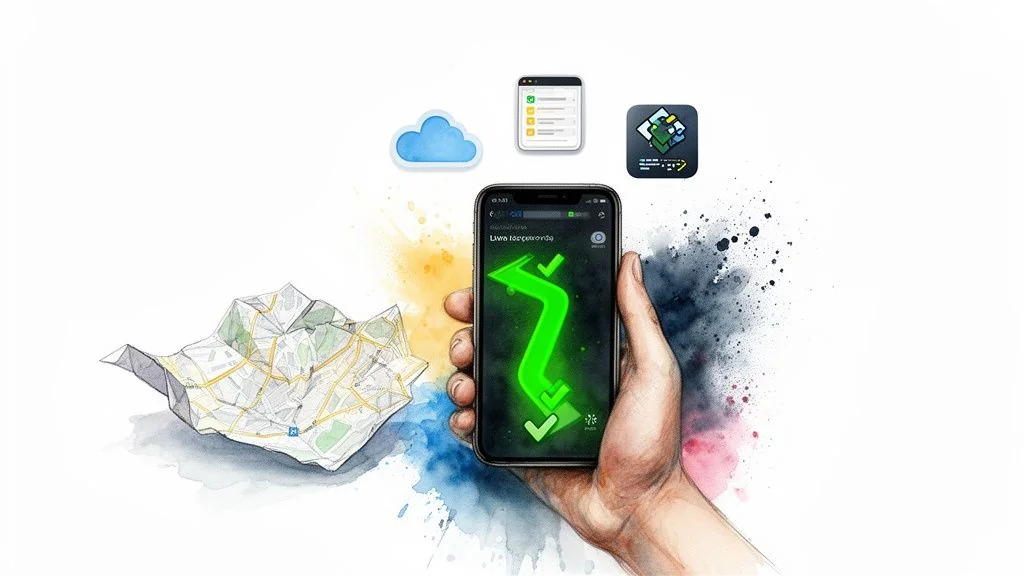
Picture what it’s like to prep for a SOC 2 audit the old-fashioned way. It’s a mad dash that lasts for months, buried in spreadsheets, taking endless screenshots, and constantly bugging your engineering team for data.
Not only is that approach slow and incredibly stressful, but it also gives you a snapshot of your security posture on one single day. You’re completely blind to the compliance gaps that pop up the day after the audit is done.
SOC 2 automation completely flips the script. Instead of a periodic fire drill, compliance becomes a predictable, always-on part of your operations. It’s a simple concept with a powerful impact: a central hub that talks to all the systems you use to run your business.
From Manual Chaos to Automated Clarity
This hub is your command center for compliance. It constantly pulls data and evidence from your tools, automatically mapping everything to the specific SOC 2 controls it satisfies. This completely gets rid of the manual evidence collection, which is easily the biggest time sink in any audit. To really get it, you have to understand the basics of AI-driven workflow automation.
This isn’t just about being more efficient; it’s a real strategic edge. Today, you need to prove your security posture on demand to close big deals, earn the trust of enterprise customers, and just stay in the game. In fact, the demand for SOC 2 reports has jumped by roughly 32% year-over-year as companies get more serious about managing third-party risk. It’s a huge shift in how businesses validate security, turning it from a one-time project into a continuous need.
SOC 2 automation transforms compliance from a defensive, reactive chore into a proactive, strategic part of your business. It gives you a live view of your security, so you can fix issues the moment they happen, not six months later when an auditor points them out.
Why This Matters for Modern Businesses
For startups and mid-market companies, the payoff is immediate and significant. An automated approach means you are always ready for an audit. This constant state of readiness lets you:
- Speed Up Sales Cycles: When an enterprise prospect asks for your SOC 2, you have it ready to go. No delays, no excuses.
- Slash Audit Costs: You dramatically cut down the hours your team—and your auditors—spend on mind-numbing manual tasks.
- Build Real Customer Trust: You can show you have a mature, ongoing commitment to keeping their data safe.
Ultimately, adopting SOC 2 automation is about building a more resilient and trustworthy company. It gives you the systems to manage security methodically, ensuring you can meet the high bar set by today’s market. You might want to check out our deep dive on the SOC 2 certification process to see what the full journey looks like.
Understanding the Pillars of Automated Compliance
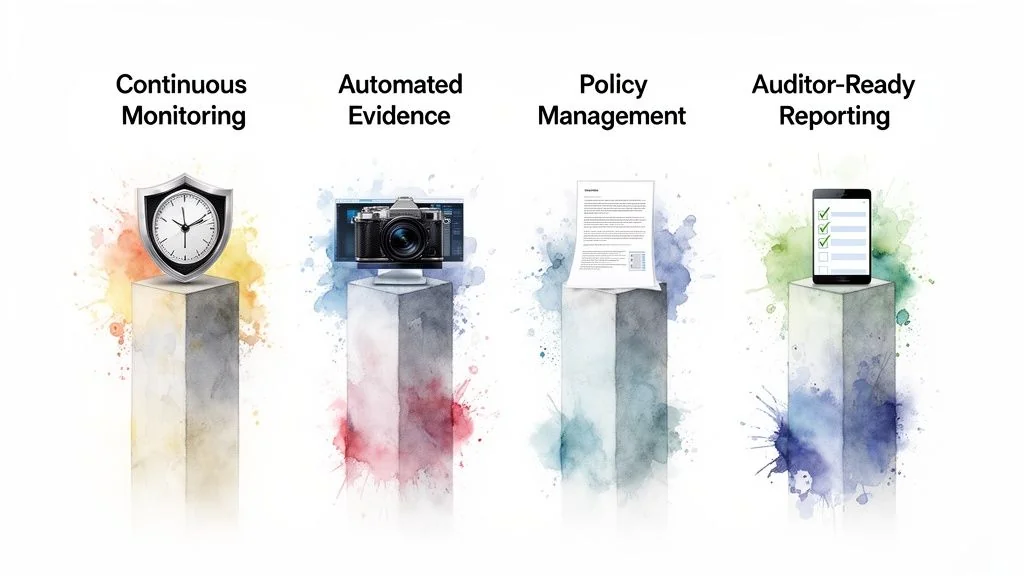
To really get what SOC 2 automation does, you need to look under the hood. It’s not some magic button you push. It’s a set of interconnected functions all working together.
Think of it like the dashboard in a modern car. It’s constantly checking your fuel, engine health, and tire pressure so you don’t have to get out and inspect everything before every single trip. Automated compliance runs on the same idea, built on four core pillars that turn a stressful, manual audit into a predictable, always-on system.
Continuous Control Monitoring
The first and most important pillar is continuous control monitoring. In the old manual world, a team might check a small sample of user accounts once a quarter to make sure multi-factor authentication (MFA) is turned on. This “point-in-time” check is better than nothing, but it leaves huge blind spots. What happened the day after the check?
An automation platform, on the other hand, plugs directly into your tech stack. It can verify that MFA is active on every single user account, every hour of every day. If a new engineer is onboarded and their MFA isn’t set up right, the system flags it almost instantly.
This constant vigilance gives you a much, much higher level of assurance. Instead of just hoping you pass the audit, you have a live feed of your compliance status. You can fix problems long before an auditor ever sees them.
A manual audit is like a single photograph of your security posture. Continuous monitoring is like a live video feed—it shows you the complete, ongoing reality of your controls in action.
Automated Evidence Collection
Next up is automated evidence collection, which wipes out the single most soul-crushing part of any audit. Traditionally, compliance managers spend weeks—sometimes months—chasing down engineers for screenshots, log files, and config settings just to prove that controls are working.
SOC 2 automation tools do this for you. For instance, to prove that terminated employees lose system access right away, the platform can:
- Watch your HR system: It sees when an employee’s status flips to “terminated.”
- Check your identity provider: It then confirms the user’s account was shut down within the required time frame.
- Log the proof: The platform automatically captures this whole sequence with timestamps, creating a perfect, unchallengeable audit trail.
This completely ends the frantic, last-minute scavenger hunt for evidence. Everything is collected quietly in the background and neatly organized by control, ready for your auditor whenever they need it.
Integrated Policy Management and Reporting
The final pieces are integrated policy management and auditor-ready reporting. Automation platforms don’t just watch your controls; they tie them directly to your company’s written security policies. This creates a crystal-clear line between the rules you wrote down and the technical proof that you’re actually following them.
When it’s audit time, the platform pulls everything together into a secure, central portal. Instead of emailing hundreds of disorganized files back and forth, you just grant your auditor access. They get a clean dashboard where they can see every control, the related policy, and all the supporting evidence in one place.
Making the auditor’s job this easy doesn’t just feel good—it often leads to a faster, smoother, and less expensive audit.
The Business Case for Automating SOC 2 Compliance
Let’s get straight to the point. The decision to automate SOC 2 isn’t just a technical one; it’s a fundamental business decision. You’re choosing between a slow, brutally expensive manual process and a modern approach built for speed.
When you dig into the numbers, the ROI for SOC 2 automation becomes crystal clear. It comes down to three things: crushing your audit timeline, saving a ton of money, and gaining the massive strategic advantage of being continuously compliant.
Manual audit prep is a notorious time-sink. We’re talking three to six months of painful, mind-numbing work where your team does nothing but chase down evidence, take screenshots, and wrestle with spreadsheets. Automation doesn’t just speed this up—it completely changes the game. By collecting and organizing evidence around the clock, what once took half a year can now get done in a few weeks.
Slashing Audit Timelines and Costs
This newfound speed has a direct impact on your bottom line. The manual process burns hundreds of valuable engineering hours that should be spent building your product, not proving your security. On top of that, you often have to hire expensive consultants just to manage the chaos.
With SOC 2 automation, those costs just evaporate.
The old way was a point-in-time sprint—a frantic rush to look good for the auditors. The new way is a state of constant readiness, giving you the confidence that you are secure and compliant every single day.
The financial impact is huge. A SOC 2 Type 2 audit, which looks at your controls over 6–12 months, is the most resource-intensive compliance lift. Manually, costs can easily run from $25,000 to over $70,000, and that’s just the auditor’s fee.
But automation flips the script. Companies that invest $6,000–$20,000 a year in a modern compliance platform often see that money come right back through faster audits, zero reliance on pricey consultants, and far fewer costly fixes after the audit. For a deeper dive, check out these insights on SOC 2 auditor cost structures and how automation is changing the game.
From Audit Panic to Continuous Confidence
Maybe the biggest win here is the shift from “audit panic” to a state of continuous confidence. Instead of treating compliance like a painful annual event, automation bakes it right into your daily operations.
You get a real-time dashboard showing your exact compliance posture. This lets you spot and fix issues the moment they appear, not six months later when an auditor finds them. It’s a massive strategic advantage that helps you close enterprise deals faster, build real trust with customers, and run a fundamentally more secure business.
The difference between the two approaches isn’t subtle. The table below lays out the stark reality of doing things the old way versus the new way.
Manual vs Automated SOC 2 Compliance: A Comparison
This table breaks down the practical differences between tackling SOC 2 manually and using an automated platform. The contrast in time, effort, and visibility is what drives the business case for automation.
| Metric | Manual SOC 2 Approach | Automated SOC 2 Approach |
|---|---|---|
| Audit Prep Time | 3-6 months of intense, disruptive effort. | 2-4 weeks with minimal team disruption. |
| Evidence Collection | Manual, repetitive, and prone to human error. | Continuous, automatic, and timestamped. |
| Compliance Visibility | A single snapshot, blind to daily risks. | 24/7 real-time dashboard of control status. |
| Engineering Impact | High; engineers pulled from product work. | Low; minimal impact on developer workflows. |
| Audit Readiness | A frantic, last-minute sprint. | Always audit-ready, every single day. |
Ultimately, automation transforms SOC 2 from a disruptive, expensive hurdle into a streamlined, ongoing process that makes your business stronger and more competitive.
How to Choose the Right SOC 2 Automation Platform
Picking the right SOC 2 automation platform is one of those decisions that will echo through your entire compliance journey. Get it right, and you’ll fly. Get it wrong, and you’ll be stuck in the mud. With a sea of vendors all shouting about their features, it’s easy to get distracted. The trick is to tune out the noise and focus on what actually moves the needle: deep integrations, a user-friendly design for non-experts, and how well it plays with your auditor.
Think of an automation tool as the central nervous system for your compliance program. For it to do its job, it has to plug into every part of your company’s tech stack. A platform with just a few shallow, generic integrations will leave you with massive blind spots, forcing you right back into the manual grunt work you were trying to escape.
Evaluate Core Technical Capabilities
Before you even think about booking a demo, grab a whiteboard and list out every critical system you use. A platform worth its salt will have robust, pre-built integrations for the tools your team lives in every day.
- Cloud Infrastructure: Does it have a deep, native connection to your cloud provider like AWS, Azure, or GCP? It needs to do more than just scratch the surface; it should be able to monitor configurations and security settings automatically.
- Identity and HR Systems: Can it sync with your HRIS (like Gusto or Rippling) and identity provider (like Okta or Google Workspace)? This is non-negotiable for automatically tracking employee onboarding and offboarding controls.
- Developer and Project Tools: How does it connect with Jira, GitHub, and your CI/CD pipeline? This is key for monitoring change management and keeping your development practices secure.
Shallow integrations are a major red flag. The whole point is to automate evidence collection across your entire environment, not just a tiny corner of it. You can see a detailed comparison of the top players in our guide to SOC 2 compliance software.
Prioritize Usability and Auditor Experience
Look, a powerful tool that nobody on your team can figure out is just expensive shelfware. The platform’s dashboard should give you a clean, at-a-glance view of your compliance posture, built for both your engineers and your head of sales. If it takes a security expert to decipher the interface, it will never become the single source of truth you need it to be.
Just as important is how the platform treats your auditor.
A top-tier platform makes the auditor’s job easier, not harder. Look for a dedicated, read-only auditor portal where they can securely and independently access controls, policies, and evidence. This single feature can dramatically reduce back-and-forth communication and accelerate the audit timeline.
The audit world itself is blowing up. The global market for SOC reporting services was valued at USD 5,392 million in 2024 and is projected to hit USD 10,470 million by 2030. This explosive growth is pushing auditors to find efficiencies, making tools that streamline their workflow incredibly attractive. You can dive into the numbers by checking out the latest SOC reporting services market analysis.
Finally, don’t overlook the quality of the policy templates. A good platform won’t just dump a bunch of generic documents on you. It will provide a library of well-written, auditor-vetted policies that you can easily tailor to your business. This alone can save you dozens of hours and ensures your foundational governance is solid from day one. By focusing on these practical, real-world criteria, you’ll choose a partner that actually gets you to a successful SOC 2 audit faster.
Your Step-by-Step Implementation Roadmap
Jumping into SOC 2 automation can feel like a massive undertaking, but it’s really just a series of manageable steps. With a smart roadmap, you can get from manual chaos to a state of continuous compliance without burning out your team. The key is to focus on getting the biggest wins first to build momentum.
Think of this process not as one giant sprint, but as four distinct legs of a relay race. Each phase hands off cleanly to the next, building a solid foundation for a successful audit.
Phase 1: Scope Your Audit and Key Systems
Before you touch a single tool, you need a map. You have to define your audit scope—which systems, data, and services are actually on the line for your SOC 2? Answering this question early prevents “scope creep” and makes sure your automation efforts are aimed where they’ll have the most impact.
Once your boundaries are set, identify your core systems. Don’t try to connect everything at once. The 80/20 rule is your best friend here: focus on the critical few that hold the most sensitive data and pose the biggest risk.
For most tech companies, this means starting with:
- Your primary cloud provider (like AWS, Azure, or GCP)
- Your identity provider (like Okta or Google Workspace)
- Your code repository (like GitHub)
Nailing these first will give you the biggest initial impact and cover a huge chunk of your evidence requirements right out of the gate.
Phase 2: Integrate and Map Your Controls
With your core systems picked out, the next step is to plug them into your automation platform. Modern compliance tools make this pretty painless, usually with secure API connections you can set up in minutes. The goal is to get a live feed of data and configurations flowing from your systems into your compliance hub.
Once you’re connected, you start mapping this data to specific SOC 2 controls. This is where the magic of automation really kicks in. Instead of wrestling with spreadsheets, you’ll use the platform’s pre-built templates for the Trust Services Criteria (TSC). These templates are packed with hundreds of automated tests and evidence collectors designed for the exact controls in your scope. From there, you can tweak and customize them to fit how your company actually operates.
This phase is where the theory of compliance meets the reality of your tech stack. It’s about teaching the automation platform what “good” looks like for your specific business, turning generic SOC 2 requirements into concrete, monitorable rules.
This process flow shows what really matters when you’re choosing a platform to help you through this.
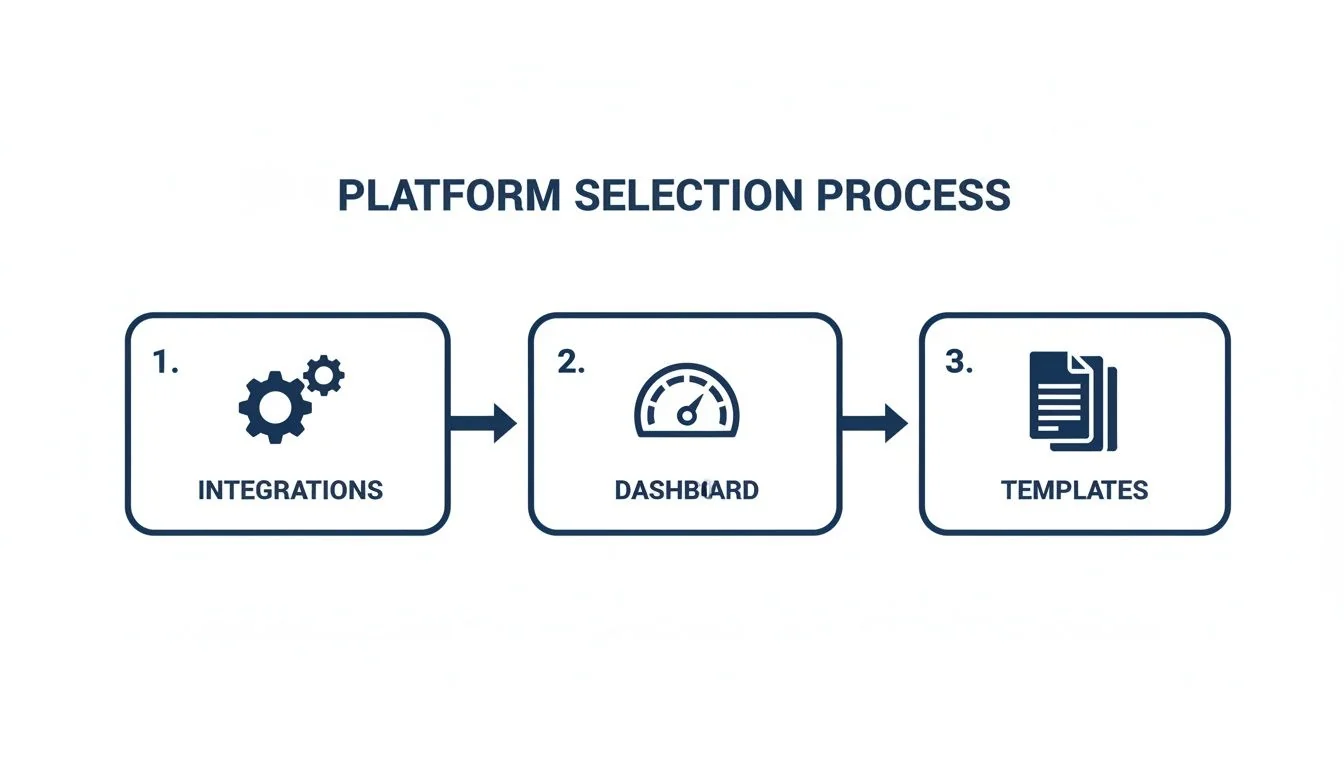
This visual gets right to the point: deep integrations, a clear dashboard, and solid templates are the three pillars of any good automation tool.
Phase 3: Operationalize Continuous Monitoring
Now it’s time to flip the switch. With your controls mapped, you can activate continuous monitoring. Your platform will now run its automated tests 24/7, constantly checking your systems against the rules you’ve defined. If a security group gets misconfigured or a new hire isn’t set up with MFA, the system will flag it in near real-time.
A common hurdle here is getting your engineering team on board. The best way to do this is to pipe alerts directly into the tools they already use—like creating a ticket in Jira or sending a notification to a specific Slack channel. This makes compliance a natural part of their daily work, not some annoying task they have to deal with separately.
To make sure you’re tracking all the right things from day one, it helps to work from a comprehensive SOC 2 audit checklist. This gives you a clear view of what auditors will eventually look for and makes the move to full automation feel both achievable and effective.
Common Pitfalls on Your Automation Journey
Jumping into SOC 2 automation is a game-changer, but it’s not a silver bullet. A few wrong turns during setup can easily lead to wasted time, a frustrated team, and a painful audit. The smartest way to guarantee a smooth ride is to learn from the mistakes others have made.
One of the biggest blunders is treating your new platform as a “set it and forget it” solution. This is a classic trap. An automation tool is just that—a tool. It’s not a substitute for human judgment. You still need someone to manage the alerts, adapt the tool as your tech stack evolves, and actually interpret the data it’s spitting out.
Another critical mistake is keeping your auditor in the dark until the last minute. Don’t spring your new platform on them the day the audit kicks off. Walk them through it early. Show them how it works. This builds trust and ensures they’re comfortable with the evidence it generates before the clock is ticking.
Key Mistakes and How to Fix Them
To sidestep these common issues, you need a proactive, integrated approach from day one. You can get a head start by reviewing some great, practical advice on the Common Challenges In Automation Testing And How To Overcome Them.
Here are a few more specific pitfalls and how to dodge them:
-
Pitfall: Picking a tool that doesn’t play well with your tech stack.
- Do This Instead: Before you even start looking at vendors, map out your essential systems—your cloud provider, HR platform, code repos, etc. Prioritize automation platforms that have deep, native integrations with the tools you actually use every day.
-
Pitfall: Forgetting to train your team on the new way of doing things.
- Do This Instead: Run short, focused training sessions. Don’t just show them the platform; show them how it fits into their existing work. For example, demonstrate how they can now handle compliance alerts directly in Slack or Jira, making it part of a workflow they already know.
Your Top Questions, Answered
Even with a clear path forward, a few common questions always pop up when teams start thinking seriously about SOC 2 automation. Let’s tackle them head-on so you can move forward with confidence.
Can Automation Replace My Compliance Manager?
Not a chance. Think of automation as a force multiplier for your compliance experts, not a replacement.
Automation is brilliant at the grunt work—the endless, repetitive evidence gathering that drains hours from your team’s week. But it can’t handle strategic risk management, interpret nuanced control data, or investigate exceptions. The tool gives you the “what” (this control is failing); the human provides the “why” (it’s failing because of a recent system change) and the “how” (here’s our plan to fix it).
Automation doesn’t eliminate the need for compliance experts; it elevates their role. It frees them from manual drudgery to perform high-value analysis and strategic oversight that a machine simply can’t replicate.
How Do Auditors View Automated Evidence?
Most modern auditors love it. Seriously. Evidence from a reputable automation platform is a dream come true for them—it’s organized, timestamped, and tied directly to the specific controls they need to test. This makes their job dramatically more efficient.
The key is to bring them into the loop early. Don’t spring your new tool on them the week the audit starts. Show them the platform, walk them through how it works, and get them comfortable with the format long before fieldwork begins. Clear communication upfront makes the entire audit process smoother.
Is SOC 2 Automation Only for Tech Startups?
Absolutely not. While startups definitely use automation to get audit-ready at lightning speed, the benefits are universal.
Established companies use it to tame complex, sprawling compliance programs that have become a nightmare to manage manually. The core value—slashing manual effort, gaining real-time visibility into your security posture, and making audits predictable—is just as critical for a 500-person company as it is for a 15-person startup.
Finding the right auditor is just as critical as choosing the right automation tool. SOC2Auditors helps you compare 90+ verified firms based on price, timeline, and real client satisfaction scores, so you can select your audit partner with confidence. Find your perfect auditor match today.