 Menu
Menu
Picking the right partner from the sea of SOC 2 compliance companies is a huge business decision, not just a box to check. Get it right, and you can unlock enterprise deals and build serious customer trust. Get it wrong, and you’re looking at expensive delays and a report that doesn’t even meet your client’s needs. Your whole SOC 2 journey starts right here.
Understanding the SOC 2 Compliance Landscape
Choosing an auditor is your first real step. This decision shapes everything that follows—your timeline, your budget, and the quality of the final report. The market is packed with options, but they really boil down to two main camps, each built for different kinds of companies.
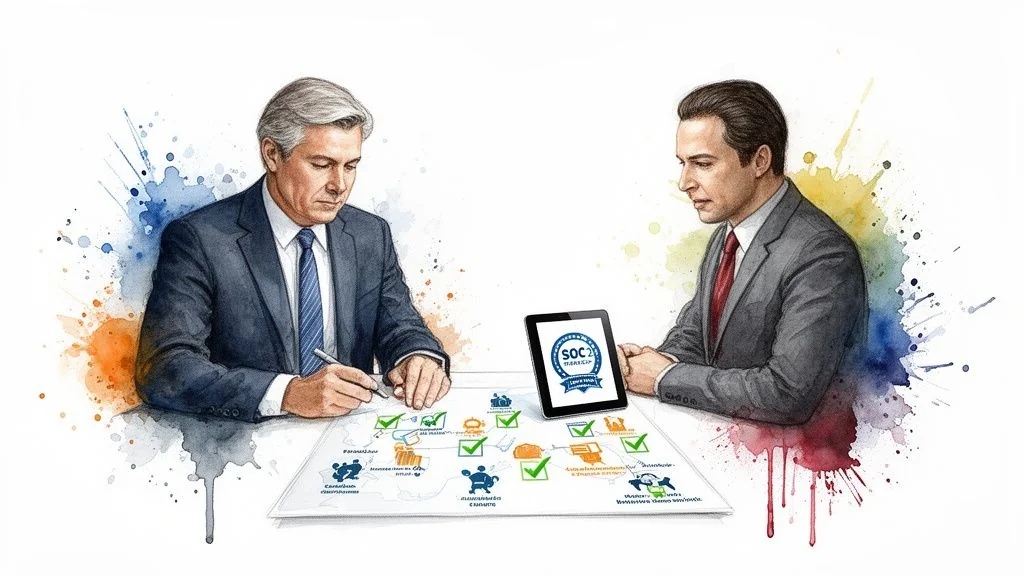
This explosion in third-party assurance has created a massive market. The SOC Reporting Services space, currently valued at USD 5,392 million, is on track to nearly double to USD 10,470 million by 2030. What’s driving this? Escalating cyber threats and tougher regulations, with audit services alone making up almost 45% of the market as companies scramble to prove they’re secure.
The Two Primary Types of Auditors
As you start your search, you’ll quickly notice two types of firms. Knowing the difference is key to building a shortlist that actually makes sense for you.
-
Specialist Firms: These are the smaller, more nimble shops that live and breathe frameworks like SOC 2, ISO 27001, and HIPAA. They usually offer more hands-on service and better pricing, which makes them a go-to for startups and mid-market companies.
-
Big Four and Large National Firms: This is where you find the global household names (Deloitte, PwC, EY, KPMG) and other major national players. They bring brand recognition that can be a big plus for enterprise-level companies, but they come with bigger price tags and rigid, less personal ways of working.
Define Your Needs First
Before you even think about looking at firms, you have to figure out what you need. A good place to start is getting a handle on the basic documentation required, which means understanding the crucial distinction between policies and procedures. From there, ask yourself these questions:
- What’s our real goal here? Are we just trying to close one big enterprise deal? Do we need to shore up our internal security? Or is this a hard requirement in a contract?
- What’s our actual budget? SOC 2 audits can run anywhere from $15,000 to over $400,000. You absolutely need a number in mind.
- What’s our timeline? A Type 1 report can be done in a few months. But a Type 2 requires a minimum observation period, stretching the process out to a year or more.
Answering these questions first will give you the clarity you need to cut through the noise. It lets you filter the huge market of SOC 2 compliance companies and focus only on the ones that fit what you’re trying to achieve.
How to Actually Evaluate SOC 2 Audit Firms
Picking the right SOC 2 auditor isn’t just about comparing prices. It’s a disciplined process, and your choice will directly impact the quality of your audit, how long it takes, and whether it actually helps you close deals. A structured approach is the only way to find a firm that gets your tech stack and aligns with where your company is headed.
The first filter is non-negotiable: accreditation. A real SOC 2 report can only be issued by a licensed, independent Certified Public Accountant (CPA) firm. This isn’t just a best practice; it’s a hard requirement from the American Institute of Certified Public Accountants (AICPA), the organization that owns the SOC 2 framework.
Seriously, an auditor’s opinion from a non-CPA firm is completely worthless. Before you even talk numbers, verify the firm’s CPA license. This one step weeds out unqualified providers and protects your entire compliance investment.
Industry and Business Model Fit
Once you’ve confirmed a firm is a licensed CPA, the next test is relevance. Sure, any decent firm understands the SOC 2 framework. But you need one with deep experience in your world—whether that’s FinTech, HealthTech, or B2B SaaS.
This specialized knowledge makes the entire audit more efficient. An auditor who knows your industry won’t waste your team’s time learning the basics of your business model. They’ll ask smarter questions, which leads to a much stronger and more credible report because they already understand the common threats and customer expectations in your sector.
An auditor who has worked with 20 other SaaS companies at your growth stage will anticipate your challenges with multi-tenancy, data segregation, and CI/CD pipelines. This context is invaluable and prevents you from having to educate your auditor on the basics of your operations.
To figure this out, ask for case studies or anonymized examples of their work with companies like yours. Get specific. Ask about their experience with your tech stack (e.g., AWS, GCP) and with companies at a similar stage of growth. You can dig deeper into the general SOC 2 auditor requirements in our detailed guide.
Report Capabilities and Firm Professionalism
Not all auditors offer the same services or operate with the same level of professionalism. You need to know what they can actually deliver.
- Type 1 vs. Type 2 Expertise: A Type 1 report is a snapshot that assesses the design of your controls. A Type 2 is the real prize—it evaluates their operating effectiveness over 6-12 months. Make sure the firm has extensive experience with the more rigorous Type 2 audits, because that’s what enterprise customers demand.
- Trust Services Criteria (TSC) Scope: Beyond the mandatory Security criterion, can the firm effectively audit Availability, Confidentiality, Processing Integrity, and Privacy? A good partner will help you scope the right TSCs based on your promises to customers, not just push for more criteria to inflate the fee.
It’s also a good sign if the firm takes its own risk management seriously. Do they carry robust Errors & Omissions (E&O) insurance? This coverage protects against claims of professional negligence and shows they’re committed to high standards. A firm that manages its own risk well is better equipped to help you manage yours.
Communication and Support
Finally, don’t underestimate the human element. An audit is a long, collaborative, and often stressful project. A responsive, clear, and proactive auditor can make all the difference.
Pay close attention to how they communicate during the sales process. That’s usually the best they’ll ever be.
- Are they quick to respond to your emails?
- Do they explain complex SOC 2 concepts patiently and clearly?
- Who will be your actual day-to-day contact during the audit? Is it the partner you’re talking to now, or a junior associate?
- What’s their process for handling questions when you’re in the middle of evidence collection?
A great partner acts as a guide, not just an inspector. They should give you a detailed project plan, clear expectations, and regular updates. Ask for client references and ask specifically about the support experience—it’s often the biggest differentiator between technically skilled firms.
Comparing Specialist Firms and Big Four Auditors
Choosing between the two main camps of SOC 2 compliance companies—nimble specialists and the Big Four—is one of the most critical decisions you’ll make. This isn’t about finding the “best” auditor in general, but the best partner for your company’s specific stage, risk profile, and goals. Get it right, and you accelerate growth. A mismatch can lead to a torched budget and painful delays.
A common myth is that this choice is just about brand recognition. Sure, the Big Four (Deloitte, PwC, EY, KPMG) offer an undeniable stamp of authority. But specialist firms bring a level of focus, speed, and cost-efficiency that’s often a much better fit for tech companies, especially in the early or growth stages.
This comparison goes beyond the usual talking points to give you real situational guidance. We’ll break down the key differences across cost, timelines, client experience, and industry relevance, helping you decide which path makes sense for your business right now.
Cost Structures and Budgetary Fit
The most immediate—and frankly, shocking—difference is the price tag. The cost gap isn’t small; it reflects two completely different business models, overhead structures, and target customers.
- Specialist Firms: These firms run lean, focusing almost exclusively on frameworks like SOC 2 and ISO 27001. That specialization creates efficiencies they pass on to you. A typical SOC 2 Type 2 audit with a specialist firm will run you $25,000 to $75,000.
- Big Four Firms: These are global giants with massive operational costs, layers of internal review, and a brand prestige that commands a premium. Their services are priced for huge enterprises where the audit fee is a rounding error. For the exact same SOC 2 Type 2, expect to pay $100,000 to over $400,000.
For an early-stage SaaS startup, dropping an extra $100,000+ just for a brand name is almost never a smart move. That budget is better spent on product development or sales. On the flip side, a global bank handling billions in transactions might see the Big Four brand as a non-negotiable requirement for their board and regulators.
To help you compare your options, here’s a quick breakdown of how these two types of firms stack up on the most important decision-making criteria.
Auditor Type Comparison: Specialist vs Big Four
| Criteria | Specialist Firms | Big Four Firms |
|---|---|---|
| Price (Type 2) | $25k - $75k | $100k - $400k+ |
| Timeline | Fast (6-10 months) | Slow (12-18+ months) |
| Best For | Startups, SaaS, mid-market tech | Public companies, Fortune 500, regulated industries |
| Client Experience | Hands-on, partner access, responsive | Formal, junior staff-led, bureaucratic |
| Tech Stack Expertise | Deep knowledge of cloud-native (AWS, GCP) | Generalist, may lack specific tech depth |
| Brand Recognition | Respected within tech, but not a household name | Unmatched global brand authority |
| Flexibility | High adaptability to client needs and timelines | Low flexibility, rigid standardized process |
This table makes it clear: the “better” choice is entirely dependent on your specific situation—your budget, timeline, and who your customers are.
Timelines and Operational Agility
Speed to report is often everything, especially when a massive enterprise deal is on the line, pending your SOC 2 compliance. Here, the operational differences between specialists and the Big Four create wildly different experiences.
Specialist firms are built for speed. Their teams are more accessible, their processes are less bureaucratic, and they can pivot to your timeline much more easily. They get that for a startup, a three-week delay can mean losing a key customer.
The Big Four, in contrast, operate with more rigid, standardized playbooks. Project timelines are often longer, bogged down by multiple levels of internal review and partner sign-off. This slow, deliberate pace is great for quality control on a massive scale, but it can be a huge source of frustration for a fast-moving tech company that needs a report in hand now.
For any company that needs to get from readiness to a Type 2 report in under a year, a specialist firm is almost always the more practical choice. Their focused teams and streamlined processes are designed for the velocity modern tech companies run on.
Depth of Expertise and Client Experience
While any licensed CPA firm can technically perform a SOC 2 audit, the quality of their expertise and your experience as a client will vary dramatically. Specialist firms live and breathe your world. They work exclusively with cloud-native companies, understand modern tech stacks like AWS and GCP, and know the tools you’re using, from CI/CD pipelines to infrastructure-as-code.
That shared context is priceless. It means less time educating your auditor and more time having real conversations about your actual controls. To find a curated list of top firms with proven industry expertise, you can explore the best SOC 2 auditors and compare them based on verified client reviews.
The Big Four serve everyone, from manufacturing to retail. While they have technology audit practices, your specific team may or may not have deep, hands-on experience with a company your size or with your business model. The experience can also feel less personal, with most communication happening through junior associates.
This flowchart breaks down the essential evaluation steps to help you structure your decision.
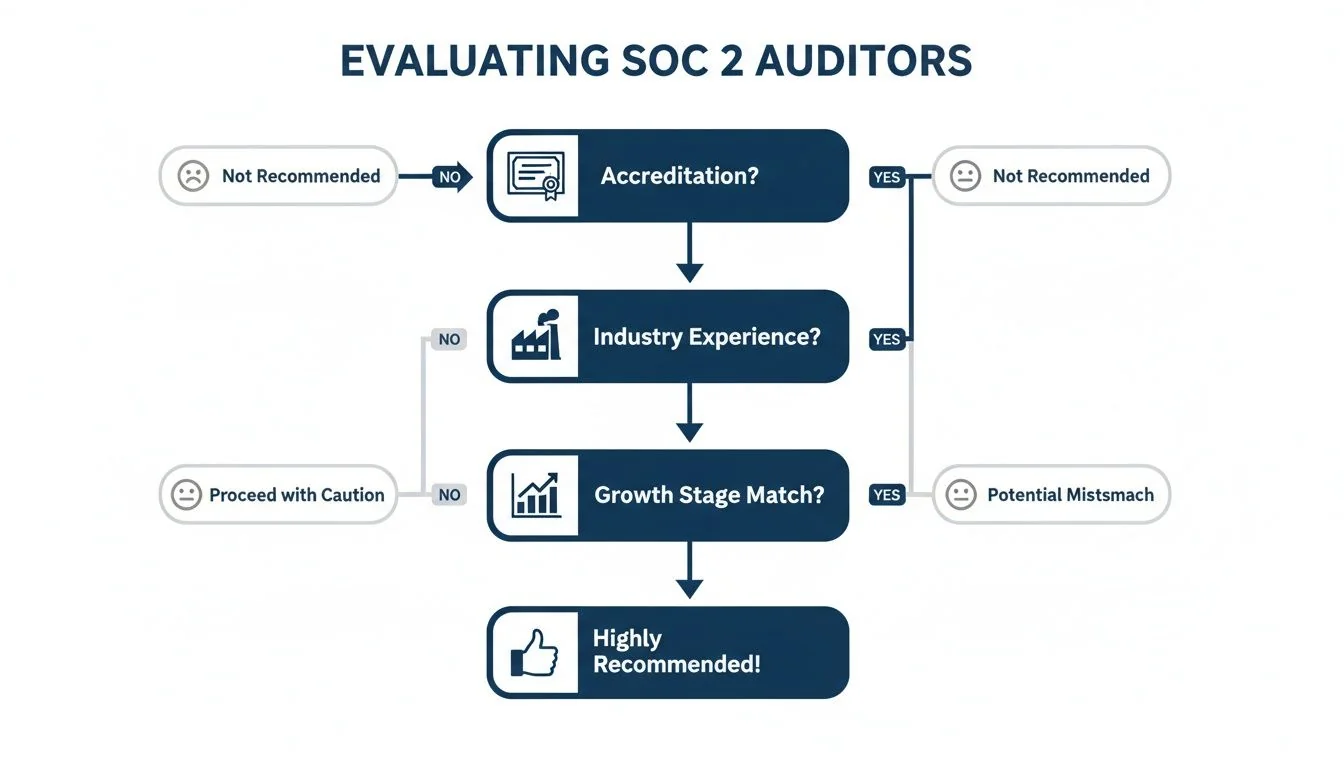
As the decision tree shows, after you verify basic accreditation, matching the auditor’s industry focus and growth stage experience to your own is the most critical step for a successful audit.
Making the Right Situational Choice
Ultimately, this decision comes down to your specific circumstances. There is no universally “correct” answer, only the right answer for your company, right now.
- Choose a specialist firm if: You’re a startup or mid-market tech company, budget is a major factor, you need to move fast, and you want a hands-on partner who actually understands your cloud-native environment.
- Choose a Big Four firm if: You’re a large public enterprise, brand recognition is critical for your stakeholders, your customers are exclusively Fortune 500 companies in heavily regulated fields, and a much higher cost is acceptable for the perceived lower risk.
Uncovering Real SOC 2 Pricing and Timelines
Trying to budget and plan for a SOC 2 audit can feel like you’re shooting in the dark. It’s tough to know if a quote is fair or if a timeline is even remotely realistic when there are no clear benchmarks. Get this wrong, and you’re looking at major budget overruns and painful delays that put critical deals on the line.
Let’s start by accepting the market’s massive variability. The SOC 2 journey is notorious for its opaque pricing, spanning from $15K to over $400K, with timelines that can stretch anywhere from 3 to 20 months. This lack of clarity leaves you vulnerable to overpaying or getting stuck in a never-ending audit cycle. Thankfully, data aggregation platforms are finally bringing some much-needed transparency to the audit firm landscape, empowering you to make a choice backed by real numbers.
To set a budget that holds up, you first need to understand what actually drives the cost. It’s not random. Auditors base their fees on the effort required, which boils down to a few key variables.
Key Factors That Influence Audit Costs
The price tag on your SOC 2 audit is a direct reflection of its scope and complexity. Four main factors will determine the final number on any proposal you get.
- Company Size and Complexity: It’s simple math. A larger company with more employees, systems, and processes has a more complex control environment. That means more testing for the auditor. A 500-person company will always have a higher price tag than a 50-person startup.
- Number of Trust Services Criteria (TSC): Every SOC 2 audit has to include the Security criterion. But if you add Availability, Confidentiality, Processing Integrity, or Privacy, each one expands the scope—and the cost—because more controls need to be tested.
- Report Type (Type 1 vs. Type 2): A Type 1 report is cheaper because it just assesses the design of your controls at a single point in time. A Type 2 report, which tests their operating effectiveness over a 6-12 month period, requires a much heavier lift from the auditor and is therefore more expensive.
- Overall Control Maturity: If your security program is well-documented and organized, the audit will run smoothly and efficiently. If your controls are a mess, the auditor has to spend more time untangling things, which drives up the cost.
Knowing these drivers allows you to have a much more intelligent conversation with potential SOC 2 compliance companies.
A common mistake we see is companies trying to cut costs by opting for a shorter observation period on their Type 2 report. While a 3-month period is technically an option, most enterprise customers expect to see a 6-12 month period to have real confidence in the results.
Mapping Realistic SOC 2 Timelines
Just as critical as the cost is the timeline. A classic pitfall is falling for an auditor’s promise of an impossibly fast turnaround. This almost always leads to a rushed, low-quality audit that won’t pass muster with savvy customers. A successful SOC 2 journey follows a structured, multi-phase process.
Here’s a realistic breakdown of the timeline you should be planning for:
- Readiness Assessment (3-6 Months): This is your prep phase. You work with a consultant or the audit firm to find and fix control gaps. Rushing this step is the single biggest reason audits fail.
- Type 1 Audit (1-2 Months): Once your controls are designed and in place, the Type 1 audit itself is pretty quick. The auditor is just testing the design of your controls as of a specific date.
- Type 2 Observation Period (6-12 Months): This is the non-negotiable monitoring window where your controls have to be operating effectively. You can’t shorten this period; it’s a hard requirement for a credible Type 2 report.
- Type 2 Audit Fieldwork and Reporting (1-2 Months): After the observation period closes, the auditor performs their final testing and writes the report.
When you add it all up, a first-time SOC 2 Type 2 report realistically takes between 10 to 20 months from start to finish. You should be extremely skeptical of any firm promising to do it significantly faster.
How to Build Your Auditor Decision Matrix
Choosing the right SOC 2 partner from your shortlist can feel a little… squishy. To get past gut feelings and make a choice you can actually defend, you need a simple evaluation tool. A weighted decision matrix is perfect for this—it takes the subjectivity out of the process and makes sure your final pick truly matches what your company needs.
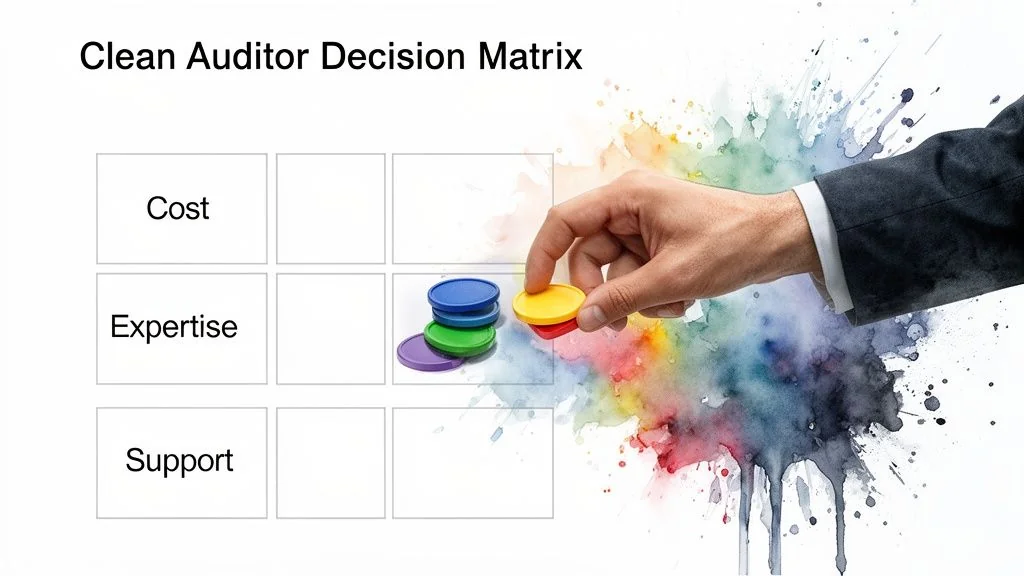
This whole exercise forces you to figure out what actually matters before you even look at a single proposal. Is getting the report done fast for a huge sales deal the number one priority? Or is deep, proven expertise in HIPAA an absolute deal-breaker? A matrix makes these trade-offs obvious and objective.
Let’s be real, a structured evaluation is more than just a nice-to-have. With 47% of companies failing formal audits multiple times, as pointed out in recent compliance statistics from Vanta.com, picking the right partner is a critical risk-management step. A good matrix helps you dodge the common pitfalls by making sure your chosen auditor has the right skills from day one.
Step 1: Identify and Weight Your Criteria
First thing’s first: list the handful of criteria that will make or break this partnership for your business. Go beyond just the price tag and think about the qualitative stuff. Then, assign a “weight” to each one based on how important it is, making sure the total adds up to 100.
Here’s what a typical list might look for a growth-stage SaaS company:
- Industry Expertise (Weight: 30%): Have they actually worked with cloud-native, B2B SaaS companies our size before?
- Cost (Weight: 25%): Is the total fee competitive and does it fit our budget?
- Communication & Support (Weight: 20%): How fast and clear were they during the sales process? Do we get a dedicated contact?
- Timeline & Agility (Weight: 15%): Can they hit the deadline we need for our report?
- Client References (Weight: 10%): Are their references from companies like ours? Was the feedback genuinely positive?
Your weights will be different. A big bank might give “Brand Recognition” a heavy weight, while a bootstrapped startup could easily put 40% on “Cost.”
Step 2: Score Each Firm Objectively
Now, build your matrix. Put your criteria down the first column and your shortlisted firms across the top row. For each criterion, score every firm on a simple 1-to-5 scale (1 = Poor, 5 = Excellent).
Pro Tip: Define what each score actually means before you start grading. For “Cost,” a 5 might be “Significantly under budget,” while a 1 is “More than 20% over budget.” This simple step keeps personal bias from sneaking in and skewing the results.
Scoring this way forces you to base your ratings on real data you’ve gathered—quotes, notes from reference calls, and details from their proposals.
Step 3: Calculate the Weighted Scores
This is where the magic happens and a clear winner emerges. For each firm, just multiply its score (1-5) in a category by that category’s assigned weight. For instance, if Firm A got a 4 for Industry Expertise (which you weighted at 30%), its weighted score for that line item is 120 (4 x 30).
Add up all the weighted scores for each firm to get a final number. The firm with the highest total score is, mathematically speaking, your best fit based on the priorities you set from the start.
This structured approach doesn’t just give you a clear winner; it gives you a documented, logical reason for your decision. It gets everyone on your team aligned and gives you the confidence to explain your choice for a SOC 2 compliance company to anyone who asks.
Got Questions? We’ve Got Answers
Even after you’ve narrowed down your list of potential auditors, a few common questions always seem to pop up. These are the details that can make or break your decision, so let’s clear them up with some straightforward, no-BS answers.
Think of this as the final check-in before you sign an engagement letter. Getting these last few things right will save you a world of headaches down the road.
What’s the Difference Between a Readiness Assessment and the Audit Itself?
A readiness assessment is your practice run. It’s a pre-audit where a consultant (or sometimes your future auditor) helps you find and fix the gaps in your security controls before the real audit begins. It’s an essential step to make sure you pass the first time.
The audit is the main event. This is the formal evaluation by a licensed CPA firm that results in your official SOC 2 report—the document you’ll actually show to customers.
To keep things objective, many companies use one firm for the readiness work and a different, independent firm for the official audit. This avoids any conflict of interest and ensures the auditor’s final opinion is completely unbiased.
Which Trust Services Criteria Should We Actually Include?
Every SOC 2 report has to include the Security criterion, also known as the Common Criteria. It’s the foundation. The other four—Availability, Confidentiality, Processing Integrity, and Privacy—are optional.
Here’s the key: only add criteria that align with what you promise your customers. Don’t just check all the boxes. For instance, if your SLA guarantees uptime, you absolutely need to include Availability. If you’re handling sensitive healthcare data (PHI), then Confidentiality and Privacy are non-negotiable.
A classic rookie mistake is adding all five criteria to look more impressive. This just inflates your audit’s cost and complexity for no real gain. Stick to the criteria that directly map to your service promises and customer risks.
Can We Switch Auditors Between a Type 1 and Type 2 Report?
Yes, absolutely. You are never locked in. While sticking with the same auditor provides some continuity, it’s not a requirement, and it might not even be the best move.
The reality is that the firm that was perfect for a quick, point-in-time Type 1 report may not be the right partner for the much deeper, longer-term Type 2 engagement. Switching auditors is a common and accepted practice. A new firm will simply review your previous Type 1 report during their planning. Your priority should always be picking the right firm for the job at hand, not sticking with one out of convenience.
What Are the Biggest Red Flags to Watch for in an Audit Firm?
Spotting red flags early can save you from a complete nightmare. If an auditor seems unprofessional or is cutting corners during the sales process, those problems will only get worse once they have your money.
Keep a close eye out for these warning signs:
- Vague or Opaque Pricing: Any reputable firm will give you a detailed cost breakdown. If you just get a single, unexplained number in a proposal, run.
- Lack of Industry Experience: Ask for examples of clients in your space (SaaS, FinTech, etc.). If they can’t provide relevant references, they probably don’t understand your specific risks.
- A “Guaranteed Pass”: This is the ultimate red flag. An independent auditor’s job is to be objective, not to promise a certain result. A guarantee completely undermines the integrity of the audit.
- High-Pressure Sales Tactics: This is a professional service, not a timeshare pitch. Aggressive, pushy sales tactics are a clear sign the firm cares more about its revenue than your success.
- Poor Communication: If they’re slow to respond, give you unclear answers, or won’t let you talk to the actual audit team before you sign, it’s a preview of the poor service you’ll get later.
Trust your gut. If something feels off during your evaluation, it probably is. This vetting process is your best chance to see how a firm really operates.
Finding the right auditor is a high-stakes decision, but it doesn’t have to be a blind one. SOC2Auditors provides the verified data and transparent comparisons you need to choose with confidence. Get three tailored auditor matches based on your specific industry, budget, and timeline. Find your perfect SOC 2 auditor today.