 Menu
Menu
If you’re a startup gunning for enterprise clients, SOC 2 compliance isn’t just a “nice-to-have” anymore. It’s the price of admission. Think of it as the key that unlocks upmarket deals and proves to customers and investors you’re serious about security.
For the full picture on SOC 2—including requirements, costs, and the complete audit process—see our SOC 2 compliance guide.
Why SOC 2 Is a Growth Engine, Not a Roadblock

I get it. Most founders hear “compliance” and see a black hole for engineering resources and a detour from the product roadmap. But that view is shortsighted. The reality is that SOC 2 compliance for startups is one of the most powerful sales tools you can have. It flips security from a defensive cost center into a real business advantage.
When you’re trying to land a big logo, their security and procurement teams will hit you with a mountain of questions. A SOC 2 report answers most of them before they’re even asked, replacing a 200-item security questionnaire with a single, trusted document. It’s an instant credibility boost that greases the wheels of your sales cycle.
The New Benchmark for Trust and Investment
In the B2B world, enterprise customers and VCs now see SOC 2 as table stakes. Not having it can get you disqualified from a deal before you even get to the demo. Imagine spending months nurturing a huge enterprise lead, only to watch it fizzle out at the finish line because you can’t pass their security review. It happens all the time.
The data doesn’t lie. Over 60% of businesses are more likely to work with a startup that has its SOC 2. And on the fundraising side, around 70% of VCs prefer to back companies that are already SOC 2 compliant. It just removes a layer of risk.
A SOC 2 report is more than a certificate; it’s a key that unlocks access to larger, more lucrative markets. It signals to the world that your startup is mature, secure, and ready for enterprise-level business.
From Compliance Hurdle to Competitive Edge
Looking at SOC 2 only in terms of cost is a massive strategic error. Frame it as an investment in your company’s foundation. The process itself forces you to build solid internal controls and security best practices that do more than just check a box for an auditor.
These aren’t fuzzy benefits; they hit the bottom line:
- Faster Sales Cycles: You’ll fly past those dreaded security questionnaires and shorten the time from demo to signed contract.
- Bigger Deal Sizes: Earning the trust of larger organizations means you can compete for much larger, more strategic contracts.
- More Investor Confidence: A strong security posture screams operational maturity, making you a much more attractive bet for investors.
- Better Internal Processes: It forces you to build scalable, secure-by-design operations that prevent costly data breaches down the line.
Ultimately, SOC 2 is about building a company that is trusted by default. It’s a proactive move that proves you’re a reliable partner ready to handle sensitive data with the seriousness it deserves. If you need a refresher on the basics, our guide on what is SOC 2 compliance is a great place to start.
Navigating Your First Big Decision: Type 1 vs. Type 2
Choosing between a SOC 2 Type 1 and Type 2 report feels like a technical decision, but it’s really the first major strategic choice you’ll make on your compliance journey. This single decision directly impacts your sales pipeline, budget, and timeline.
Get this wrong, and you could either miss a critical sales window or burn precious runway on a report you don’t need just yet.
Think of it like this: a Type 1 report is a snapshot. It’s an auditor’s opinion that on one specific day, your security controls were designed correctly. It’s a powerful signal of intent.
A Type 2 report, on the other hand, is a video. It shows those same controls operating effectively over a period of time, usually three to twelve months. This provides a much higher level of assurance and is the long-term goal for most SaaS companies.
The Startup’s Dilemma: A Real-World Scenario
Imagine you’re in the final stages of a game-changing enterprise deal. The prospect is ready to sign, but their security team hits the brakes. They need proof of your security posture, and a lengthy questionnaire just won’t cut it.
This is where the tactical value of a Type 1 report shines.
You can get a Type 1 attestation relatively quickly—often in just a few months. It’s the perfect tool to unblock that specific deal. You’re showing the prospect, “We have designed the right security controls, and an independent auditor agrees.” This is often enough to satisfy procurement and get the contract signed.
For a startup, a SOC 2 Type 1 report isn’t a lesser achievement; it’s a tactical move. It buys you credibility and revenue now, while you work toward the more comprehensive Type 2 report needed for long-term market trust.
This approach lets you lock in immediate revenue, which can then help fund the longer, more involved Type 2 audit process down the road.
Breaking Down the Reports: What the Auditor Looks For
The American Institute of Certified Public Accountants (AICPA) provides a great overview of what goes into these reports. This visual helps clarify the components an auditor will actually examine.
As you can see, the structure is comprehensive, covering everything from management’s assertion to a detailed description of your system. The key difference is that a Type 1 focuses on the design of your controls, while a Type 2 adds rigorous testing to prove their operational effectiveness over time.
To make this crystal clear, here’s a quick cheat sheet for startups trying to decide which report to tackle first.
SOC 2 Type 1 vs. Type 2: A Startup’s Cheat Sheet
| Factor | SOC 2 Type 1 | SOC 2 Type 2 |
|---|---|---|
| What it proves | Your controls are designed correctly at a single point in time. | Your controls are operating effectively over a period of time. |
| Analogy | A snapshot of your security posture. | A video showing your security in action. |
| Timeline | 3-8 months from start to report. | 6-18 months (includes observation period). |
| Primary Use Case | Unblocking a specific sales deal, showing quick progress. | The enterprise gold standard, required for most large contracts. |
| Auditor’s Role | Reviews design documents, policies, and system architecture. | Tests evidence of controls working over 3-12 months. |
| Startup Strategy | A tactical first step to close an immediate deal. | The long-term goal for market trust and scalability. |
Ultimately, most startups find that starting with a Type 1 is the most pragmatic path forward. It delivers a quick win and tangible business results.
From Snapshot to Long-Term Credibility
After you’ve closed that initial deal with your Type 1, the clock starts ticking for your Type 2. Your new enterprise client will absolutely expect you to deliver on your promise of sustained security. The observation period for your first Type 2 audit should begin right after your Type 1 report date.
This is where the real work of maintaining compliance comes in. You have to continuously gather evidence that your controls are working just as you said they would.
Here’s a practical look at how that transition plays out:
- Months 1-3: Go all-in on readiness and achieving your Type 1 report to unblock sales.
- Months 4-9: Your Type 2 observation period officially begins. This is when your team has to live and breathe the controls you’ve implemented.
- Month 10: Your auditor starts the Type 2 fieldwork, testing all the evidence you’ve collected during the observation period.
This phased approach makes SOC 2 compliance for startups feel much more manageable. You get an early win with the Type 1, then build the operational muscle for the Type 2. For a deeper dive, our guide on what is a SOC 2 Type 2 report breaks it down even further. This strategic timing aligns your compliance efforts directly with business growth and customer expectations.
Building Your Practical SOC 2 Compliance Roadmap
Alright, you get the “why” of SOC 2 and you’ve made the strategic call between a Type 1 and Type 2 report. Now it’s time to roll up your sleeves and turn theory into action. Building a SOC 2 compliance roadmap for a startup can feel like a mountain, but it’s really just a project plan. A manageable one, I promise.
Breaking the journey into distinct stages transforms a massive, scary undertaking into a series of achievable milestones. It lets your team focus on one thing at a time, use resources wisely, and actually track your progress without derailing your entire product dev schedule. Think of it as building your security foundation one organized layer at a time.
First, The Readiness Assessment
Before you build anything, you need a blueprint. A readiness assessment is exactly that—a critical diagnostic to understand your current security posture and pinpoint the gaps between where you are and where you need to be for a clean audit.
Whatever you do, don’t skip this.
Rushing into implementation without a proper assessment is a recipe for wasted effort and a painful, exception-filled audit. You might spend weeks building controls you don’t even need or, worse, completely miss critical ones that will get you flagged. A thorough readiness assessment, often done with a vCISO or a compliance automation platform, gives you a clear, prioritized to-do list.
This phase usually involves:
- Defining Your Scope: Clearly outlining which systems, data, people, and processes are in-bounds for the audit. The key for any startup is to start small. Scope creep is your enemy.
- Gap Analysis: A straightforward comparison of your current practices against the specific SOC 2 Trust Services Criteria you’ve chosen.
- Risk Assessment: Identifying potential threats to your systems and data and evaluating the controls you have (or need) to shut them down.
The goal here isn’t to be perfect overnight. It’s to create a realistic, actionable plan that focuses your very limited startup resources on the highest-impact security fixes first.
Define Your Audit Scope Like a Strategist
For a startup, nailing down the audit scope is arguably the single most important decision in the entire process. Go too broad, and you’ll exponentially increase the cost and complexity of your audit. Your first goal should always be to define the minimum viable scope that will satisfy your customers.
For example, if you run a SaaS app, your initial scope might only include the production environment that touches customer data. You could explicitly exclude development environments, internal HR systems, or office networks. This tight focus dramatically reduces the number of controls you need to implement and the mountain of evidence you have to collect.
You can always expand the scope in your second or third year. For your first audit, keeping it laser-focused is a winning strategy.
Next Up: Control Implementation and Documentation
With your roadmap in hand, it’s time to start closing those gaps. This phase is about two things: implementing new security controls and, just as importantly, documenting everything.
Auditors live for documentation. If it isn’t written down, it effectively didn’t happen in their world.
A crucial first step is to develop your core information security policy. You don’t have to start from scratch; using a solid information security policy template can save you a ton of time. This is the foundational document that sets the rules for how your company protects data.
From there, you’ll start creating and formalizing other key processes. Start with the controls that deliver the biggest security wins and are almost always on an auditor’s checklist.
Priority Controls for Startups:
- Access Controls: Implement role-based access control (RBAC) to ensure people only have access to what they absolutely need for their job. This is a cornerstone of the Security principle.
- Vendor Management: Create a process for vetting the security of your key vendors (think AWS, your CRM, your analytics tools). Your security is only as strong as your weakest link.
- Change Management: Set up a formal process for testing and approving changes to your production environment. This shows you have control over your system’s integrity.
- Security Awareness Training: Make sure every single employee, from the CEO down, completes basic security training. This is low-hanging fruit and a common audit requirement.
Evidence Collection: Don’t Do It Manually
The final phase before the audit is gathering proof that your controls are actually working as designed. This is where many manual SOC 2 efforts completely fall apart. Constantly asking your engineers to take screenshots and pull logs is a surefire way to create friction and kill productivity.
This is where compliance automation platforms become a startup’s best friend. These tools plug directly into your tech stack—AWS, GitHub, G-Suite, you name it—and automatically collect evidence 24/7.
Instead of you manually checking that every S3 bucket is encrypted, the platform monitors your AWS configuration and flags any non-compliant settings in real-time. It collects the “proof” for you, creating a clean repository of evidence that’s ready for your auditor.
This infographic shows how the choice between a Type 1 and a Type 2 report often comes down to immediate business pressure.
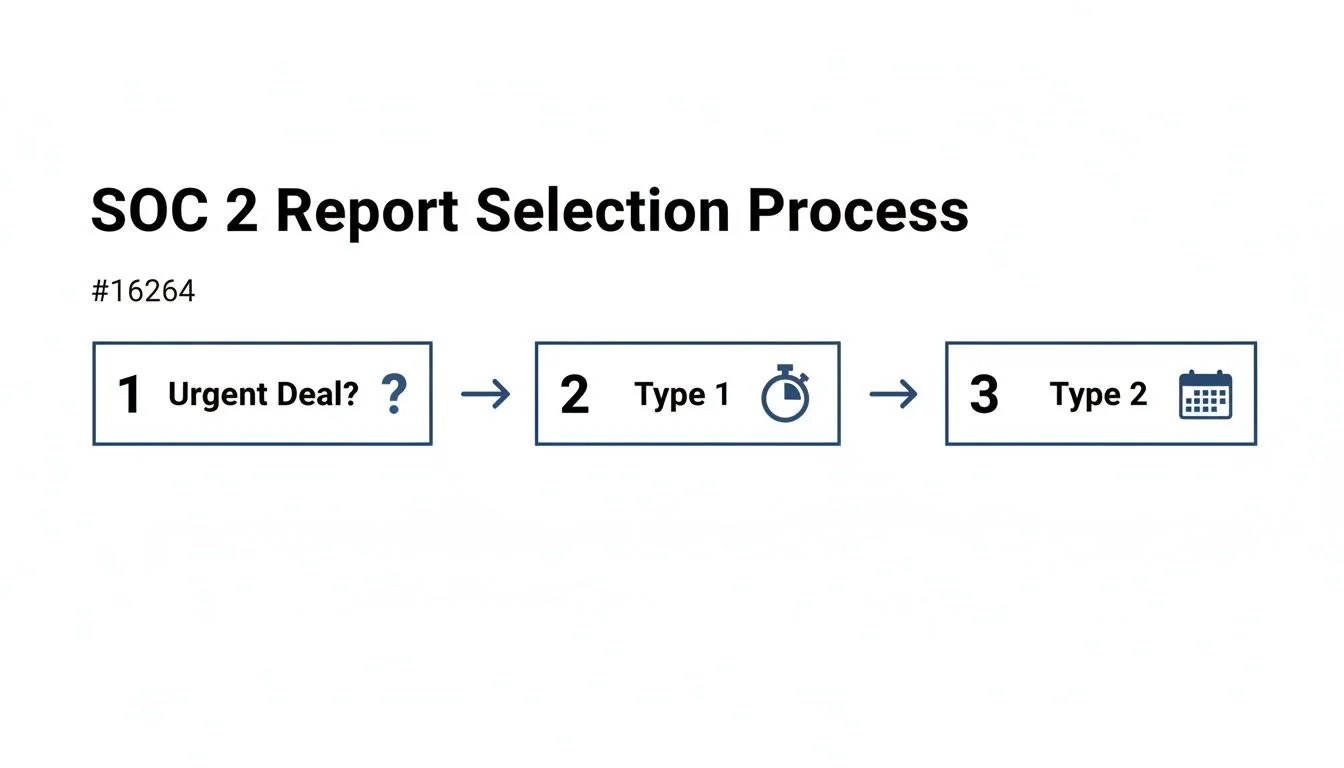
As the flowchart shows, an urgent deal often pushes a company toward a faster Type 1 report, while the Type 2 is part of a more deliberate, long-term compliance strategy.
By automating this busywork, your team can stay focused on building your product while the compliance engine runs quietly in the background. This not only saves hundreds of hours but also ensures you’re continuously compliant, making your annual audit a simple review instead of a frantic, all-hands-on-deck scramble. A structured roadmap makes this whole process manageable, not monstrous.
Decoding the Real Costs of SOC 2 Compliance
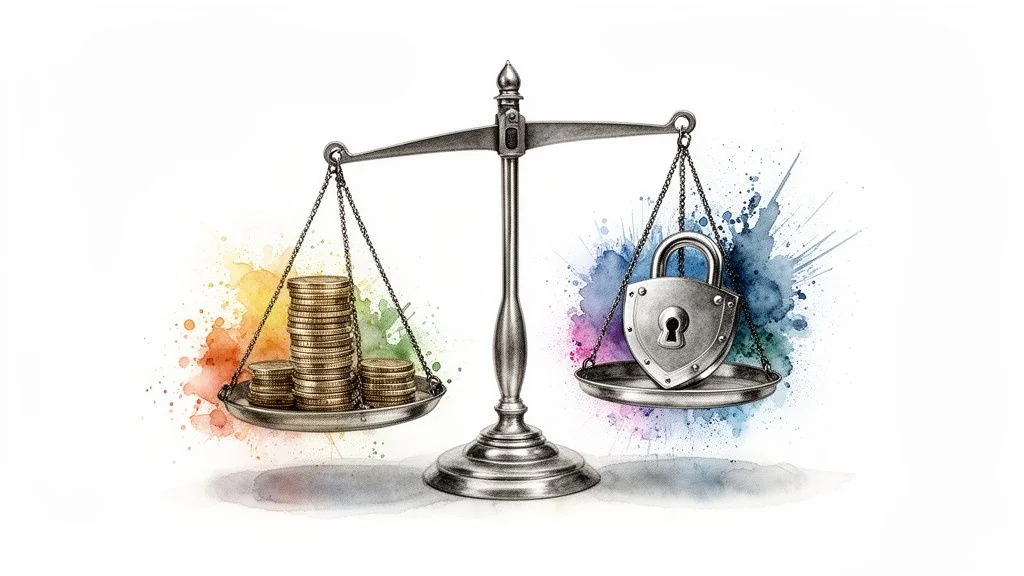
For a startup, every dollar counts. So when it comes to SOC 2 compliance for startups, the big question isn’t just “why?” but “how much?” Getting a handle on the real financial investment is the first step toward building a realistic budget and justifying the spend to your board.
Let’s get past the vague estimates. The total cost of SOC 2 isn’t just one check you write to an auditor. It’s an investment spread across your tools, your team’s time, and professional services—and knowing what those are ahead of time prevents painful surprises down the road.
The costs really fall into three main buckets: readiness and automation software, external auditor fees, and the internal hours your team will sink into the project. That last one is a very real, though often hidden, expense.
Breaking Down the Major Expenses
Your budget needs to cover the whole journey, not just the finish line. The prep work has its own price tag, and planning for each piece is key to a smooth process that doesn’t drain your runway.
Here are the core expenses you’ll run into:
- Readiness & Automation Platforms: These tools are pretty much non-negotiable for startups today. They offer policy templates, connect to your tech stack to automate evidence collection, and give you a central dashboard to manage everything. Expect to pay anywhere from $5,000 to $20,000+ per year.
- External Auditor Fees: This is your single biggest direct cost. The price varies wildly based on the firm’s size, the scope of your audit, and whether you’re going for a Type 1 or Type 2 report. For a first audit, a mid-sized firm is often the sweet spot.
- Penetration Testing: While not technically a direct SOC 2 requirement, a pen test is a common customer request and a security best practice that auditors love to see. A quality pen test can set you back between $5,000 and $20,000.
- Internal Time (The Hidden Cost): Never underestimate this. Your CTO, engineers, and a designated compliance lead will spend a ton of time implementing controls, writing policies, and managing the audit itself.
Real-World Cost Benchmarks
So, what’s the final tally? It really depends on whether you’re aiming for a Type 1 or Type 2 report.
For a lean startup chasing a SOC 2 Type 1—which just verifies your controls are designed correctly at a single point in time—you’re typically looking at a budget between $10,000 and $50,000.
The investment jumps significantly for a SOC 2 Type 2. For growing scale-ups and enterprises that need to prove their controls work over time, budgets usually fall between $75,000 and $150,000. More complex environments can even push past $200,000.
Don’t make the mistake of choosing an auditor based on the lowest price tag alone. An inexperienced auditor can lead to a messy, exception-filled report that undermines the very trust you’re trying to build with customers.
How to Manage Your SOC 2 Spend
Getting compliant doesn’t have to break the bank. With the right strategy, you can keep these costs under control.
Start by picking a mid-sized, tech-savvy audit firm instead of a ‘Big Four’ giant. They usually have more experience with cloud-native startups and offer better pricing without sacrificing quality.
Next, invest in a compliance automation platform early. It easily pays for itself by saving your engineers hundreds of hours on manual evidence collection.
Finally, keep your audit scope tight for the first year. Focus only on the systems and Trust Services Criteria that are absolutely essential to landing your key customers. You can always expand it later. For a more granular look, check out our guide on the full breakdown of SOC 2 Type 2 audit costs to help you budget with confidence.
Choosing the Right Auditor for Your Startup
Your SOC 2 auditor isn’t just a vendor you hire to check a box. Think of them as a partner in your compliance journey—one whose expertise can mean the difference between a smooth, valuable process and a frustrating, exception-filled nightmare. Picking the right firm is one of the most critical decisions you’ll make, especially for your first audit.
The wrong partner will bog you down in irrelevant requests, apply an old-school, on-prem mindset to your cloud-native stack, and hand you a report that creates more questions than answers for your enterprise prospects. A great partner gets the startup world, communicates clearly, and helps you achieve a strong security posture without derailing your product roadmap. We’ve put together a directory of startup-focused SOC 2 auditors ranked by speed, pricing transparency, and client satisfaction—a good starting point for shortlisting firms.
Look Beyond the Big Four
When startups think of auditors, the massive “Big Four” firms often come to mind. While they have incredible brand recognition, they’re usually not the best fit for an early-stage company. Their processes are built for the Fortune 500, which translates to higher costs, less flexibility, and auditors who might not be deeply familiar with modern tech stacks like AWS or GCP.
Instead, many startups find incredible value with mid-sized, tech-forward CPA firms that specialize in SOC 2 for SaaS companies. These firms live and breathe the world of cloud infrastructure. Their teams are built to audit companies like yours, meaning they’re more efficient, their advice is more relevant, and their pricing is typically much more startup-friendly.
Your auditor should feel like an extension of your team—a guide who helps you navigate the audit, not an adversary looking to catch you out. Their goal should align with yours: to produce a clean, credible report that accurately reflects your commitment to security.
Key Qualities of a Startup-Friendly Auditor
So, what separates a great startup auditor from a mediocre one? It boils down to a few key traits you should actively screen for. These are the non-negotiables that ensure your partner understands your reality.
- Cloud-Native Expertise: They need to speak your language. If you mention AWS Lambda, IAM roles, or GCP Security Command Center, they shouldn’t just nod along—they should get the security implications.
- Experience with Your Tools: A top-tier auditor will be deeply familiar with the compliance automation platform you’re using, whether it’s Vanta, Secureframe, or another provider. This familiarity drastically reduces friction, as they know exactly how to work within the tool to find evidence, saving everyone time.
- A Reputation for Efficiency: Check their references and ask about their process. You want a firm known for sharp communication, organized evidence requests, and a deep respect for your team’s time.
Smart Questions to Ask Potential Auditors
Once you have a shortlist of firms, it’s time to interview them. This is about more than just getting a price quote; it’s about vetting their expertise, process, and cultural fit. Arm yourself with pointed questions that cut past the sales pitch and reveal how they truly operate.
Here’s a checklist of questions designed to help you find the perfect partner for your SOC 2 compliance for startups journey.
- Tech Stack Experience: “Can you share examples of auditing companies with a similar tech stack to ours? How do you approach auditing serverless environments or containerized applications?”
- Handling Exceptions: “How do you handle evidence exceptions for a fast-moving startup? What’s your process if a control isn’t perfectly implemented on day one?”
- Communication and Process: “Who will be our main point of contact? What’s your typical response time for questions, and how do you manage evidence requests to minimize disruption to our engineering team?”
- Automation Tool Familiarity: “Which compliance automation platforms are you most experienced with? How does your workflow change when a client is using a platform like Vanta?”
- Long-Term Partnership and Pricing: “What does your pricing structure look like for subsequent annual audits? Do you offer discounts for multi-year commitments, and what would cause the price to change down the road?”
Finding an auditor who gives clear, confident answers to these questions is a strong signal that they understand the startup ecosystem. This diligence upfront ensures you partner with a firm that won’t just get you through the audit but will also help strengthen your security posture for the long haul.
Life After the Audit Maintaining Continuous Compliance
Getting that first SOC 2 report is a huge milestone, but it’s really the starting line, not the finish line. The true victory isn’t the PDF report sitting on your drive; it’s the secure, repeatable processes you built to earn it. Now, the game is all about keeping that momentum.
When you maintain compliance year-round, your next audit transforms from a frantic, last-minute scramble into a routine check-up. This means baking these new security habits into your startup’s DNA, making sure your team follows the controls every single day, not just during the audit window.
Treating compliance like an operational rhythm saves you from the soul-crushing, pre-audit fire drills that hijack engineering resources and bring productivity to a grinding halt. That shift in mindset is non-negotiable if you want to scale.
Building on Your SOC 2 Foundation
Think of your SOC 2 achievement as the foundation of your company’s trust architecture. As you grow your business and start targeting larger customers, you’re going to run into other compliance asks. Enterprise clients in different industries will bring up frameworks like ISO 27001, HIPAA, or GDPR.
Here’s the great news: all the heavy lifting you just did for SOC 2 compliance for startups is incredibly reusable. The controls you designed, the policies you wrote, and the evidence you gathered map directly to many requirements in these other frameworks. You’ve already got a massive head start.
Your SOC 2 controls aren’t just for a single audit; they are strategic assets. They accelerate future certifications, turning compliance from a recurring cost into a cumulative advantage that grows right alongside your business.
This isn’t just a theory; it’s becoming the standard. For instance, at the repeatable tier of the NIST CSF, a whopping 91% of organizations successfully maintain their SOC 2 compliance year after year. Better yet, 23% are already tackling dual-standard compliance, like pairing SOC 2 with ISO 27001, to meet the demands of a global market. You can dig deeper into the compliance trends for scaling companies to see where things are headed.
By embracing continuous compliance, you’re not just checking a box. You’re building a security posture that scales with your company, ready for whatever your next big customer or new market throws at you.
Your Top SOC 2 Questions, Answered
If you’re new to the world of compliance, you’ve probably got a lot of questions. Here are some quick, no-nonsense answers to the things we hear most often from startups diving into SOC 2.
How Long Does a SOC 2 Audit Take?
The timeline really depends on how prepared you are and which report you’re going for.
If your controls are in a good spot, you can knock out a SOC 2 Type 1 report—which is just a snapshot of your controls on a single day—in about 2-4 months.
But most customers want a Type 2 report, which proves your controls work over time. That requires an observation period of anywhere from 3 to 12 months. When you add that in, the whole process for a Type 2 can take anywhere from 6 to 15 months from the day you start to the day you have the report in hand.
Can a Small Team Handle SOC 2?
Absolutely. We see small startups get through SOC 2 successfully all the time.
The trick is to not go it alone. The best approach is to name a “compliance lead”—usually the CTO or Head of Engineering—and then lean hard on a compliance automation platform. These tools are lifesavers for small teams; they provide policy templates, plug into your tech stack to grab evidence automatically, and keep the whole audit organized.
What Are the Most Common Startup Mistakes?
The biggest pitfalls we see are pretty consistent:
- Scoping too broadly. Trying to include every system and process from day one is a recipe for disaster. Start small.
- No clear ownership. Every single security control needs a specific person responsible for it. If ownership is vague, things fall through the cracks.
- Last-minute evidence scramble. Waiting until the audit is underway to start gathering proof is incredibly stressful and leads to delays.
A solid readiness assessment is your best defense against these common traps. It forces you to get organized and smooths out the entire audit process.
Want to stay sharp after the audit? An internal audit checklist is a great tool for keeping your processes tight and your team aligned for future reviews. It helps turn compliance from a one-time project into an ongoing habit.
Related Resources
Ready to find the right auditor without the guesswork? SOC2Auditors helps you compare 90+ verified firms based on real pricing, timelines, and startup experience. Get three tailored matches in 24 hours at https://soc2auditors.org.