 Menu
Menu
Achieving SOC 2 compliance can feel like a grueling, manual marathon. But it doesn’t have to be. Using a platform like Drata turns the entire process from a frantic scramble into a managed, automated workflow.
Drata essentially acts as the central hub for your entire SOC 2 evidence collection and continuous monitoring program, connecting directly to your tech stack to make audit readiness a whole lot simpler.
How Drata Simplifies Your SOC 2 Journey
Getting started with a SOC 2 audit often feels like trying to map a huge, complex territory with a pen and paper. It’s a mess. Teams burn countless hours manually grabbing screenshots, pulling server logs, and chasing down evidence from dozens of different systems. This old-school approach is not just slow; it’s a recipe for human error, delays, and a whole lot of stress.
Drata completely changes that dynamic. Think of it as your automated command center for compliance. It plugs directly into the tools your company already uses every day—your cloud provider like AWS or Google Cloud, your identity platform like Okta, and your developer tools like GitHub.
From Manual Chaos to Automated Clarity
Instead of pulling your best engineers off product work for weeks to handle mind-numbing evidence gathering, Drata does the heavy lifting for you. It continuously pulls the required data from all your connected systems, automatically mapping it back to the specific SOC 2 controls your auditor needs to see.
This is what that clarity looks like—a real-time, organized view of your entire security posture, right from the dashboard.
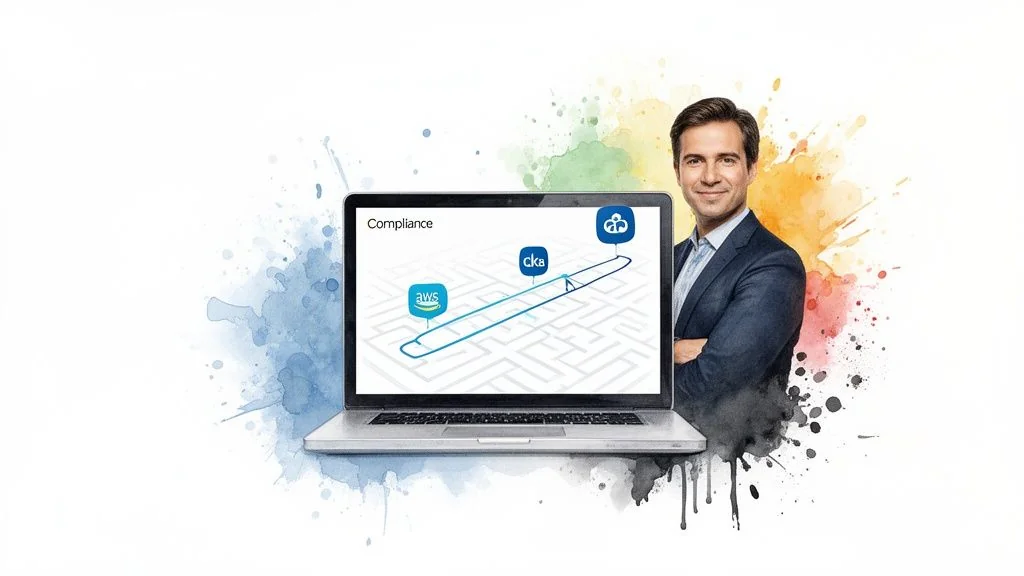
This centralized view immediately shines a spotlight on compliance gaps, failed tests, and any outstanding tasks. Your team can finally stop hunting for problems and start focusing on fixing them.
This level of automation is why the compliance market is exploding. The SOC 2 automation space, where Drata is a major player, is projected to hit $850 million in 2025 and an estimated $2.7 billion by 2028. For SaaS founders, this is huge. It means shrinking the audit readiness phase from months down to days, freeing up priceless engineering time.
The table below breaks down just how stark the difference is between the old way and the new way.
Traditional Manual Process vs Automated Drata Process
| Compliance Task | Traditional Manual Process | Automated Drata Process |
|---|---|---|
| Evidence Gathering | Manually taking screenshots and downloading logs from 20+ systems. | Continuously and automatically collects evidence via API integrations. |
| Control Mapping | Tediously matching each piece of evidence to a SOC 2 control in a spreadsheet. | Evidence is automatically mapped to the relevant SOC 2 controls. |
| Monitoring | Periodic, manual checks performed quarterly or annually. Prone to gaps. | 24/7 real-time monitoring of all connected systems for compliance drift. |
| Gap Identification | Gaps are often discovered weeks or months late, usually during the audit itself. | Compliance gaps are flagged instantly with alerts for remediation. |
| Audit Preparation | A frantic, multi-week scramble to organize and share evidence with auditors. | Auditor is granted read-only access to a pre-organized, trusted evidence portal. |
As you can see, the shift is dramatic. It’s less about just saving time and more about fundamentally changing the way you manage security and compliance.
The Core Benefits of a Drata-Led Approach
By moving away from manual checklists and embracing automated monitoring, your company can achieve a state of what we call “perpetual readiness.” This means you’re prepared for an audit at any time, not just during a panicked, year-end fire drill.
Here are the key advantages:
- Significant Time Savings: Drata automates tasks that would otherwise eat up hundreds of hours from your engineering and security teams.
- Reduced Audit Fatigue: It gives auditors a single, trusted place to find evidence, which means way fewer back-and-forth emails and requests for clarification.
- Real-Time Visibility: You can see your compliance status at a glance, spot risks the moment they appear, and handle them before they blow up into major problems.
Ultimately, Drata helps turn the audit from a painful, disruptive event into a manageable, continuous part of your operations. To see how this fits into the bigger picture, check out our complete guide on how to get SOC 2 certification.
Automating Evidence and Monitoring in Real Time
The real magic of Drata for SOC 2 is how it turns evidence gathering from a soul-crushing, manual scavenger hunt into a quiet, automated process humming in the background. Instead of your engineers burning weeks taking screenshots and exporting logs, Drata plugs directly into your tech stack. It acts like a tireless compliance bot, working 24/7.
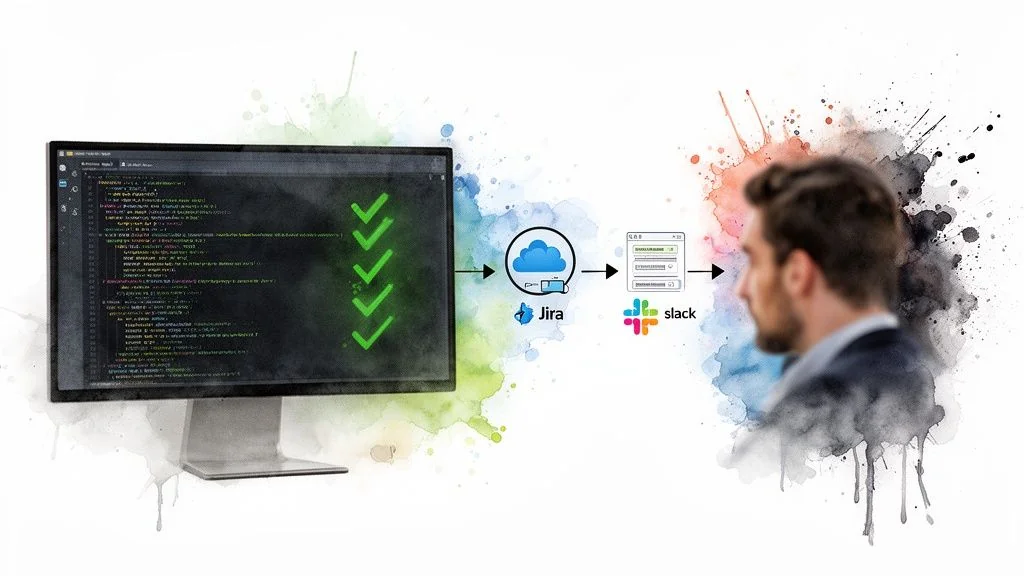
This automation is driven by over 100 pre-built integrations that connect to the tools you already use every day. Drata pulls proof from your cloud infrastructure, identity providers, HR systems, and a whole lot more. This isn’t just a simple data dump, either; it’s intelligent.
For example, Drata will check that your cloud storage buckets aren’t public, confirm new hires finished their security training, and verify that code changes followed the right approval steps in Jira. The underlying mechanics are similar to general automated approval workflow systems, but purpose-built for the specific demands of security compliance.
Shifting to Perpetual Readiness
This automated evidence collection is the foundation for a much bigger idea: continuous monitoring. The old way of doing audits was a frantic, once-a-year scramble. Continuous monitoring flips that entire model on its head, moving your company toward a state of “perpetual readiness.”
Instead of finding a misconfiguration during the audit (the worst possible time), Drata flags it the moment it happens. This gives your team a real-time view, allowing them to fix compliance gaps as they pop up, long before an auditor ever lays eyes on them.
Continuous monitoring fundamentally changes the audit dynamic from a reactive, stressful event to a proactive, manageable process. It ensures that security controls are not just designed correctly but are operating effectively every single day.
This approach massively reduces the risk of audit failures and last-minute surprises. It creates a predictable, stable environment where your security posture is always visible and ready for inspection.
How Continuous Monitoring Works in Practice
Let’s get practical. Imagine an engineer accidentally disables multi-factor authentication (MFA) on a critical production server. In the old manual world, that mistake might sit there for months, completely undiscovered.
With Drata, the platform sees that change almost instantly.
Here’s how that automated feedback loop works to protect your compliance:
- Detection: An integration with your cloud provider detects the non-compliant MFA setting.
- Alerting: Drata immediately flags the control as “at risk” and pings the right people, usually through Slack or email.
- Remediation: The engineer gets the alert with all the context, fixes the misconfiguration, and Drata’s next automated check confirms the control is healthy again.
This constant loop is what makes a Drata-powered SOC 2 audit so efficient. By the time your auditor logs in, hundreds of these little fires may have already been spotted and put out, leaving behind a clean, organized compliance record. This level of automation is a major differentiator when evaluating different types of SOC 2 compliance software.
The result is a smoother, faster audit with way fewer surprises and minimal disruption for your technical teams.
Plugging Drata into Your Tech Stack
A compliance automation tool is useless if it can’t talk to the software you already run your business on. Drata’s real power comes from its massive library of pre-built integrations that connect directly to your company’s core systems. This turns your existing tech stack into an automated evidence-gathering machine for SOC 2.
This isn’t just about linking accounts. It’s about giving Drata read-only permission to see configurations, check logs, and monitor events as they happen, in real time.
Think of each integration as a dedicated sensor. One sensor keeps an eye on your cloud infrastructure, another watches your employee lifecycle in the HR system, and a third monitors your code pipeline. Working together, they paint a live, comprehensive picture of your compliance health without anyone having to manually upload a single screenshot.
Cloud Infrastructure and IaaS Providers
For nearly every tech company, the cloud is the center of the universe. Drata plugs right into the big players like Amazon Web Services (AWS), Google Cloud Platform (GCP), and Microsoft Azure.
These connections are non-negotiable for proving some of the most critical SOC 2 controls are in place. Drata automatically scans for things like:
- Secure Storage: Is encryption turned on for all your S3 buckets and critical databases?
- Public Access: Are any sensitive data stores accidentally left open to the public internet?
- Access Control: Are your Identity and Access Management (IAM) policies set up to enforce the principle of least privilege?
This means that instead of an engineer spending a week taking hundreds of screenshots of AWS settings, Drata just pulls the proof automatically, 24/7.
Identity, HR, and Single Sign-On Systems
Your people are a huge part of your security posture. To cover that, Drata connects to Human Resources Information Systems (HRIS) like Gusto and Rippling, plus identity providers such as Okta and Google Workspace.
These integrations automate the tedious work of collecting evidence for employee-related controls. Drata can instantly verify that:
- New hires actually finished their security awareness training within 30 days.
- Departing employees had their access to key systems shut off immediately.
- Multi-factor authentication (MFA) is actually enforced for everyone in the company.
By connecting directly to these systems, Drata gives auditors undeniable proof that your security policies are being followed consistently. It eliminates the “he said, she said” and saves an incredible amount of time during the audit.
The market for these services is blowing up for a reason. The SOC Reporting Services market, which includes platforms like Drata, hit an impressive USD 5,392 million in 2024 and is on track to nearly double by 2030. This explosive growth shows just how vital automated evidence collection has become for any company trying to land enterprise deals. You can dig into more market trends on MarkSpark Solutions. This integration-first strategy is what makes getting a Drata SOC 2 report so much faster than doing it the old-fashioned way.
A Step-by-Step Drata and Auditor Workflow
A successful SOC 2 audit depends entirely on how well your compliance platform and auditor work together. With a tool like Drata, the old, painful process of digging up evidence for your auditor gets a major upgrade. Forget the endless email chains and version-control nightmares with spreadsheets. Instead, you create one central place for evidence that both you and your auditor can actually trust.
This whole thing starts long before your auditor ever enters the picture. The first, most critical step is all on you: getting your Drata dashboard “green.” This just means connecting all the tools in your tech stack—from AWS to your HR system—and fixing any of the failing controls the platform flags. Your only job at this stage is to clear out all the red and get those automated tests passing.
This is where the real work happens, but it’s done on your own time, not in a last-minute panic when the auditor is knocking on your door. Once your dashboard looks healthy, you’re ready to bring in the pros.
Granting Secure Auditor Access
When you’re ready for the audit to begin, you simply invite your audit firm into your Drata account. This is a huge deal. You give them secure, read-only access, which means they can see every piece of evidence, every control, and every policy they need without ever being able to change a single thing in your environment.
That one click replaces what used to be months of back-and-forth emails and requests for screenshots. The auditor can log in and find everything they need, perfectly organized. This diagram shows how data flows from all your systems into Drata, which then becomes the hub your auditor works from.
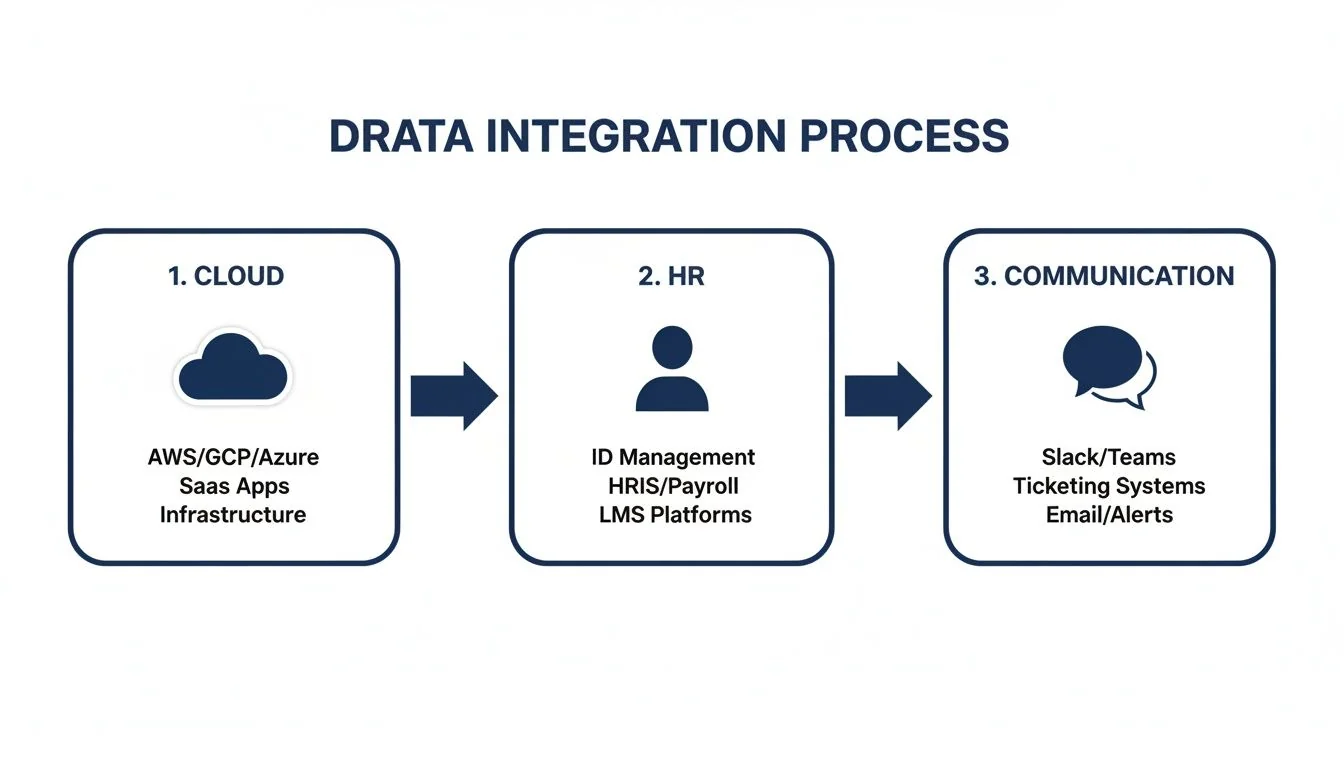
As you can see, Drata pulls information from your cloud setup, HR platforms, and even communication tools, building a single source of truth for the audit.
Differentiating Type 1 and Type 2 Workflows
The actual workflow inside Drata will look a bit different depending on which type of SOC 2 report you’re after. It’s really important to understand this difference to set the right expectations for your team and your auditor.
-
For a SOC 2 Type 1 Report: The auditor uses Drata to check out your controls at a single point in time. They’re looking at the design of your controls—reviewing policies and configurations to make sure they’re set up correctly to meet the SOC 2 criteria. Think of it as a snapshot. The audit is pretty quick.
-
For a SOC 2 Type 2 Report: This is a much deeper dive. The auditor uses Drata to watch the operating effectiveness of your controls over a longer period, usually 6 to 12 months. They’ll review the continuous stream of evidence Drata has been collecting to prove your controls have been working day in and day out.
The real magic here is that Drata provides an unchangeable, time-stamped trail of evidence. An auditor can easily filter by a date range to see proof that, for instance, every single departing employee was de-provisioned on time, every month, for the entire audit period.
This constant, automated evidence collection is what makes a SOC 2 Type 2 audit with Drata so much less painful. The auditor isn’t just taking your word for it; they’re looking at a complete historical record. This dramatically cuts down on manual sampling and follow-up questions, leading to a smoother, faster, and more trusted audit for everyone.
Budgeting for Your Drata SOC 2 Audit
Let’s talk about the real numbers. Planning your budget for a SOC 2 audit with a platform like Drata requires understanding that you’re making two separate investments.
First, you have the subscription fee for the Drata platform itself. Second, you have the professional fees you’ll pay directly to your independent CPA firm to actually perform the audit. These are not a package deal; you’ll have a contract with Drata and a separate one with your auditor.
Think of it like building a house. Drata gives you the advanced tools, automated machinery, and the architectural blueprints to make the construction process faster and far more reliable. The audit firm is the licensed inspector who comes in to verify that everything was built to code. Both are essential, and you pay for each separately.
Your total cost will hinge on a few key things. Company size is a big one—larger teams and more complex cloud environments simply require more testing. The scope of your audit also matters. If you’re going beyond the mandatory Security criterion to include others like Availability or Confidentiality, the price will go up accordingly.
Breaking Down the Costs
Getting a handle on the typical price ranges is key to setting realistic expectations and avoiding any last-minute surprises. While every company’s situation is unique, we can map out the general financial commitments for both the software and the audit service.
Here’s what you can generally expect:
- Drata Platform Subscription: This is an annual SaaS fee. The pricing is tiered based on your employee count, how many compliance frameworks you need (SOC 2, ISO 27001, etc.), and the number of integrations required to connect to your tech stack.
- Auditor Professional Fees: This cost covers the auditor’s time, expertise, and final report. A SOC 2 Type 1 audit, which is just a snapshot in time, is naturally less expensive than a Type 2. A Type 2 requires the auditor to test your controls over a period of 6-12 months, making it a much bigger lift.
A common misconception is that the automation platform replaces the auditor. In reality, Drata makes the auditor’s job dramatically more efficient. This efficiency often leads to more predictable and lower audit fees compared to a completely manual, spreadsheet-driven process.
Typical Timelines and Financial Ranges
A well-planned Drata SOC 2 project follows a pretty predictable path. Nailing the implementation and understanding the costs upfront is crucial. For a much deeper dive into audit expenses, check out our detailed guide on how much a SOC 2 audit costs.
When you use a platform like Drata, the readiness phase usually costs between $5K-$15K. A Type 1 audit can then range from $10K-$60K, while the more intensive Type 2 audit often falls between $30K-$100K in 2025.
The real win here is that automation can trim 20-40% from traditional audit costs, mainly by cutting down the hours spent on manual evidence collection. You can find more insights on these 2025 auditor cost benchmarks on dsalta.com.
As for timelines, you should plan for 1-3 months to get your Type 1 report back after the audit officially kicks off. A Type 2 is a longer game; it requires a minimum 3-6 month observation period plus another 1-2 months for the audit itself, bringing the total timeline to around 4-8 months for your first report.
Drata for SOC 2: Your Questions Answered
Even with all the benefits laid out, jumping into a platform like Drata is a big decision. Let’s tackle the most common questions teams have before they pull the trigger.
Does Using Drata Guarantee a Passing SOC 2 Audit?
No. That’s the short answer. Think of Drata as the world’s best co-pilot for your audit. It’s your navigation system, your automated checklist, and your real-time alert system all rolled into one. It handles the mind-numbing work of evidence collection and keeps everything perfectly organized for your auditor.
But you’re still the pilot. Drata can tell you a control is failing, but it can’t log into your systems and fix it. Your team is still responsible for implementing the actual security controls, remediating issues, and running the business according to your own policies. The auditor is ultimately evaluating your company’s real-world security posture, not just your Drata dashboard.
Can I Switch Auditors if I Am Already Using Drata?
Absolutely. This is one of the biggest wins of using a compliance platform. All of your evidence, controls, policies, and historical data live inside Drata, totally separate from any single audit firm.
If you decide to switch auditors next year—maybe you found a better price, faster service, or a firm with more expertise in your niche—the process is painless. You just revoke the old auditor’s access and grant secure, read-only access to the new one.
This completely eliminates the nightmare of starting from scratch and re-gathering years of evidence. It gives you the power to choose the best audit partner for your business, year after year, without blowing up your compliance program.
Is Drata Only for Tech Startups?
While Drata is a huge favorite among startups for its slick interface and how quickly it gets you ready for an audit, it’s built to scale. The platform has a library of over 100 integrations, which means it can easily connect to the complex tech stacks you see in mid-market and enterprise companies.
And it’s not just a one-trick pony for SOC 2. Drata supports a whole roster of compliance frameworks that larger organizations juggle, including:
- ISO 27001: The global standard for information security.
- HIPAA: A must-have for any company touching protected health information.
- GDPR: Critical for businesses that handle data from EU citizens.
- PCI DSS: A requirement for any organization processing credit card data.
For bigger companies, this means Drata can act as the central command center for their entire governance, risk, and compliance (GRC) program. It provides one place to get a real-time view of risk across global standards, making the Drata SOC 2 process just one piece of a much larger security strategy.
Ready to find the right auditor to pair with your Drata platform? At SOC2Auditors, we help you compare over 90 verified audit firms to find the perfect match for your budget, timeline, and industry. Get three tailored matches in 24 hours.
Comparing SOC 2 software? See our side-by-side breakdown of all 12 compliance platforms — pricing, best-for, and what each one gets wrong. Independent editorial, no pay-to-rank.