 Menu
Menu
A System and Organization Controls (SOC) 2 report is an attestation issued by an independent, licensed Certified Public Accountant (CPA) firm that evaluates a service organization’s internal controls. It is based on the Trust Services Criteria (TSC)—Security, Availability, Processing Integrity, Confidentiality, and Privacy—established by the American Institute of Certified Public Accountants (AICPA). The report provides assurance to customers that a service organization, such as a fintech company, has implemented effective controls to protect their data and systems.
What Is SOC 2 and Why Does It Matter for a Fintech’s SOC 2 Audit?

For a fintech company, a SOC 2 report is not a certification but a formal opinion issued by a CPA after evaluating internal controls against the AICPA’s Trust Services Criteria (TSC). This matters for someone pursuing SOC 2 because it serves as the primary mechanism to demonstrate security and operational integrity to enterprise customers, partners, and regulators. The entire business model of a fintech is predicated on trust, and a data breach or system failure poses an existential threat. A SOC 2 report provides verifiable, third-party validation that the controls necessary to mitigate these risks are in place and operating effectively, directly addressing the due diligence requirements of sophisticated buyers.
The Business Case for SOC 2 in Financial Technology
Achieving compliance is the most direct way to answer the long and painful due diligence questionnaires you get from potential enterprise customers. Large financial institutions, B2B partners, and sharp corporate clients simply won’t risk their data—or their reputation—on an unaudited platform. Lacking a SOC 2 report is often an immediate deal-breaker in the procurement process. This matters for someone pursuing SOC 2 because the attestation report acts as objective proof that your security claims are not just marketing promises but have been independently verified by a licensed auditor. It shifts the conversation from “Do you have security?” to “Here is our audited report that proves it.”
The process of preparing for a SOC 2 audit forces a fintech company to implement and document mature internal processes that are critical for scaling securely. For someone pursuing SOC 2, this is important because it provides a clear framework for building the specific controls auditors will test:
- Vendor Risk Management: To meet TSC CC9.2 (Vendor Management), you must implement and document formal processes to review third-party service providers, such as payment gateways or data aggregators. This control is essential for demonstrating that you manage the risks introduced by your supply chain.
- Access Controls: To align with TSC CC6.1 (Logical and Physical Access Controls), you are required to enforce the principle of least privilege. This means demonstrating that engineers and support staff can only access the sensitive customer data they absolutely need to perform their jobs, a core requirement for preventing unauthorized data exposure.
- Change Management: To satisfy TSC CC8.1 (Change Management), you must establish and follow documented procedures for deploying code to production. This includes mandatory steps like peer reviews and testing, providing auditors with evidence that changes are authorized and will not introduce vulnerabilities.
Ultimately, preparing for a SOC 2 audit is about building a durable, secure, and trustworthy organization from the inside out. The policies, procedures, and technical controls you put in place become the bedrock of your entire security program, giving you a structured framework to manage risk effectively. This internal discipline is what gives you long-term audit readiness and a mature security posture you can confidently take to market.
Decoding the Trust Services Criteria for Fintech Operations
A SOC 2 audit is structured around five core principles known as the Trust Services Criteria (TSCs), which are the AICPA’s framework for evaluating how well an organization protects customer data and maintains system integrity. This matters for someone pursuing SOC 2 because selecting the appropriate TSCs defines the scope of the audit and determines which controls will be tested. While the Security criterion is mandatory for every SOC 2 report, the other four—Availability, Processing Integrity, Confidentiality, and Privacy—are optional. Fintech companies must strategically choose which criteria to include based on their service commitments and customer requirements.
For a payment platform or lending service, these criteria represent specific, auditable promises about system performance and data protection. Understanding what each one requires is the first step toward a successful audit.
The Five Trust Services Criteria Explained
Your auditor will test your controls against the TSCs you select for your audit scope. For someone pursuing SOC 2, it is critical to understand what each criterion means in a fintech context to gather the correct evidence.
-
Security (The Common Criteria): This is the non-negotiable foundation of any SOC 2 audit. It requires controls to protect systems and data against unauthorized access, disclosure of information, and damage to systems that could compromise the other TSCs. For a fintech, this is ground zero for preventing financial fraud and data theft. This is why it is mandatory. For a deeper dive into all five principles, you can read our complete guide on the SOC 2 Trust Services Criteria.
-
Availability: This criterion addresses whether the system is available for operation and use as committed or agreed. In fintech, where downtime can cause direct financial loss for customers, this is crucial. This matters for a SOC 2 audit because if you make contractual promises about uptime (e.g., a 99.9% uptime SLA), you must have controls like network performance monitoring, disaster recovery plans, and failover strategies to prove you can meet them.
-
Processing Integrity: This criterion focuses on whether system processing is complete, valid, accurate, timely, and authorized. For a fintech, this is critical because it directly relates to the core function of handling financial transactions. To pass an audit with this criterion, you must prove that your platform calculates loan interest correctly, posts wire transfers to the right accounts, and processes transactions without error or manipulation.
-
Confidentiality: This criterion concerns the protection of information designated as “confidential.” For a fintech, this often applies to sensitive business data like M&A documents, partnership agreements, or proprietary trading algorithms that are shared under non-disclosure agreements. This is distinct from Privacy and matters for a SOC 2 audit because it demonstrates your ability to enforce data access and disclosure restrictions as contractually agreed.
-
Privacy: This criterion specifically addresses how Personally Identifiable Information (PII) is collected, used, retained, disclosed, and disposed of. For any B2C fintech, this is paramount. Including the Privacy criterion in your SOC 2 audit matters because it provides independent validation that your data handling practices align with your privacy policy and comply with the principles of regulations like GDPR or CCPA.
Applying SOC 2 Trust Services Criteria in a Fintech Context
To pass a SOC 2 audit, a fintech must provide specific evidence that its controls are designed and operating effectively. This matters for someone pursuing SOC 2 because auditors require tangible proof, not just policies. The table below shows how the TSCs translate into specific, auditable controls within a fintech environment.
| Trust Service Criterion | Core Principle | Specific Fintech Control Example & Why It Matters for SOC 2 |
|---|---|---|
| Security | Protecting systems and data from unauthorized access. | Control: Implementing multi-factor authentication (MFA) for all administrative access to production databases containing customer financial data. Why it Matters: This provides auditors with concrete evidence (e.g., configuration screenshots, access logs) that you are enforcing strong authentication to prevent unauthorized access, a core requirement of the Security criterion. |
| Availability | Ensuring systems are operational and accessible as promised. | Control: Maintaining a tested disaster recovery (DR) plan with a specified Recovery Time Objective (RTO). Why it Matters: Auditors will demand to see the DR plan, test results, and RTO metrics to verify you can restore service within your stated commitments, satisfying the Availability criterion. |
| Processing Integrity | Ensuring transactions are processed completely, accurately, and on time. | Control: Implementing automated reconciliation reports that compare transaction logs from your system against statements from your upstream banking partner. Why it Matters: This provides a verifiable audit trail showing that you actively monitor for and correct processing errors, which is essential for demonstrating Processing Integrity. |
| Confidentiality | Protecting sensitive information as agreed upon with partners or clients. | Control: Using data loss prevention (DLP) tools to block the transmission of documents marked “Confidential” outside of the corporate network. Why it Matters: DLP logs and rule configurations serve as evidence for auditors that you have technical controls in place to enforce contractually agreed-upon confidentiality. |
| Privacy | Handling Personal Identifiable Information (PII) according to a stated privacy policy. | Control: Creating an automated data retention workflow that anonymizes or deletes customer PII 90 days after an account is closed. Why it Matters: This demonstrates to auditors that your data handling practices are not just words in a privacy notice but are systematically enforced, a key requirement for the Privacy criterion. |
Choosing the right TSCs is a strategic decision that directly impacts the scope and cost of your audit. For someone pursuing SOC 2, the goal is to align the audit scope with customer demands and contractual commitments, which dictates the evidence required and shapes the final report’s value.
Integrating SOC 2 with Other Fintech Regulations
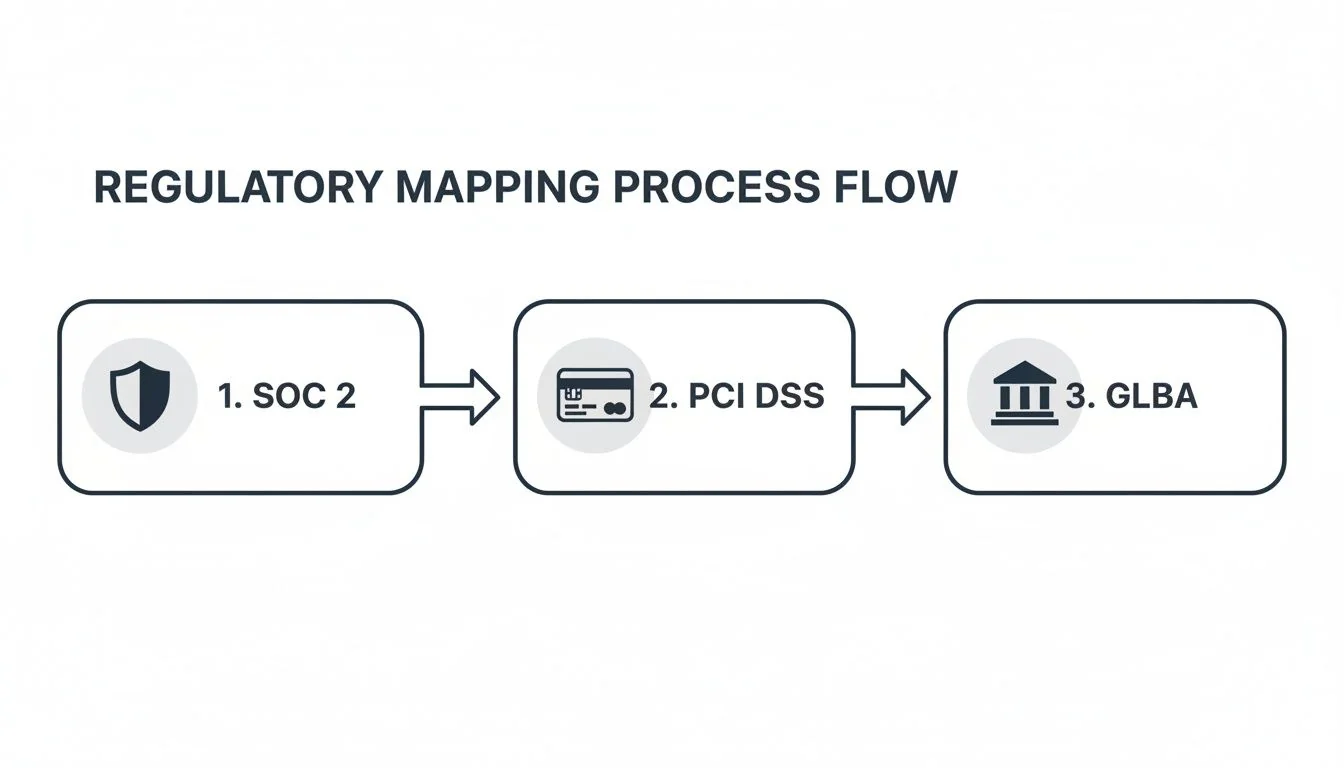
For a fintech company, SOC 2 does not exist in a vacuum. It is part of a complex regulatory landscape that includes frameworks like PCI DSS compliance, the Gramm-Leach-Bliley Act (GLBA), and various privacy laws. This matters for someone pursuing SOC 2 because a “map once, comply many” approach can significantly reduce audit fatigue and cost. The security controls implemented for SOC 2 can be directly mapped to satisfy requirements in other frameworks, creating a unified compliance program.
Mapping SOC 2 Security to PCI DSS
For any fintech that stores, processes, or transmits cardholder data, PCI DSS is a mandatory requirement. This matters for a SOC 2 audit because there is substantial overlap between the SOC 2 Security criterion and PCI DSS requirements, particularly around network security and access control. By mapping these controls, the same evidence can be used for both audits.
For example, consider these common control overlaps:
- Firewall Configuration: SOC 2’s CC3.1 requires procedures to detect and monitor for malicious activity. This directly supports PCI DSS Requirement 1, which mandates a firewall configuration to protect the cardholder data environment. The evidence—firewall rule sets and review documentation—satisfies both.
- Access Control: SOC 2’s CC6.1 requires controls to prevent unauthorized access. This aligns perfectly with PCI DSS Requirement 7 (“Restrict access to cardholder data by business need to know”). The access control lists and quarterly review evidence you produce for SOC 2 can be repurposed for your PCI DSS assessment.
- Vulnerability Management: Both frameworks require robust vulnerability management. The processes and evidence created for SOC 2’s CC4.1 (identifying and managing system flaws through scans and remediation tracking) directly fulfill the needs of PCI DSS Requirement 11 (regularly testing security systems).
For someone pursuing a SOC 2 audit, documenting these overlaps allows you to provide the same evidence—vulnerability scan reports, access control reviews, firewall configurations—to both your SOC 2 auditor and your PCI DSS Qualified Security Assessor (QSA), streamlining the process.
Connecting SOC 2 with GLBA and Privacy Rules
The GLBA Safeguards Rule requires financial institutions to develop a written information security plan. This is important for a fintech’s SOC 2 pursuit because the SOC 2 framework—particularly with the Security, Confidentiality, and Privacy criteria—provides the ideal structure for building and demonstrating that plan.
The policies and procedures developed for a SOC 2 audit, such as the risk assessment, vendor management program, and incident response plan, are the very documents required by the GLBA Safeguards Rule. The resulting SOC 2 report becomes tangible proof of a compliant GLBA program. This is further enhanced when the SOC 2 Privacy criterion is included. This criterion is designed to demonstrate how an organization collects, uses, and disposes of personal information in accordance with its privacy notice and the AICPA’s privacy principles. This evidence is invaluable for demonstrating adherence not only to GLBA but also to the principles of GDPR and other state-level privacy laws. By mapping these controls, SOC 2 becomes the operational core of a fintech’s entire compliance program, making it the most efficient path to demonstrating enterprise-grade security.
Scoping Your Audit and Gathering the Right Evidence
Defining the audit scope is the most critical step in preparing for a SOC 2 audit. This matters for someone pursuing SOC 2 because an improperly defined scope—one that is too narrow or too broad—is a primary cause of audit exceptions or failure. For a fintech company, the scope must include a clearly defined boundary around all systems, processes, people, and locations involved in processing, storing, or transmitting customer data. Failing to include a critical database or a key third-party vendor will prevent an auditor from issuing a clean opinion, as the controls over that component cannot be assessed. A successful audit depends on having well-defined processes and methodology that you can prove.
Visualizing Your System Boundary
The most effective way to define scope is to create a data flow diagram that illustrates how sensitive data enters, moves through, and leaves the in-scope system. This diagram is crucial for someone pursuing SOC 2 as it becomes the map both your team and your auditor will use to understand the system boundary.
For a fintech platform, this map must include:
- Core Infrastructure: Specific cloud services (e.g., AWS EC2 instances, S3 buckets, RDS databases), on-premise servers, and network devices.
- Applications: The production web application, mobile apps, and internal administrative tools that interact with customer data.
- Third-Party Integrations: All API connections to payment processors (Stripe, Braintree), credit bureaus (Experian), KYC/AML providers (Plaid, Jumio), and other critical vendors.
- People: The personnel (engineering, support, operations) and their roles with access to the in-scope systems.
This diagram makes the abstract concept of “scope” tangible and ensures alignment between your team and the auditors from day one.
Gathering Verifiable Audit Evidence
Once the boundary is defined, you must gather evidence to prove your controls are effective. This matters for SOC 2 because auditors do not take your word for it; they require verifiable proof that controls are designed appropriately (for a SOC 2 Type 1) and have operated effectively over a period of time (for a SOC 2 Type 2). It is a common mistake to wait until the audit period begins to think about evidence. Evidence collection should be automated and integrated into daily operations to avoid a last-minute scramble.
Fintech auditors will look for specific types of evidence, and mapping controls to multiple frameworks like PCI DSS and GLBA can improve efficiency.
For someone pursuing a SOC 2 audit, here are actionable examples of the evidence you must be prepared to provide:
- Vulnerability Scans (CC4.1): Provide reports from tools like Nessus or Qualys showing regular infrastructure scans and a documented process for remediating identified vulnerabilities within a defined SLA.
- Change Management Tickets (CC8.1): Present records from Jira or GitHub that demonstrate every production code change underwent documented peer review, testing in a staging environment, and formal approval before deployment.
- Access Control Reviews (CC6.1, CC6.3): Supply exported logs or screenshots from AWS IAM or Okta showing that quarterly user access reviews are conducted for all sensitive systems, with evidence of management sign-off.
- Employee Background Checks (CC1.2): Furnish documentation from your HRIS or background check provider proving that criminal and financial background checks were completed for all employees with access to customer financial data, per your policy.
Defining your scope and systematically collecting this type of verifiable evidence are foundational for a successful SOC 2 audit. This process transforms your security program from abstract policies into a collection of auditable controls, which is the entire purpose of the engagement.
Closing Common Security Gaps Before Your Audit
Conducting a gap analysis to identify and remediate control weaknesses before the audit begins is essential. This matters for someone pursuing SOC 2 because unaddressed gaps in areas like vendor management, logging, or change control are common reasons for qualified opinions or audit failures. By proactively fixing these issues, you transform potential negative findings into evidence of a mature and effective security program.
Common Fintech SOC 2 Gaps and How to Fix Them
For fintech companies, recurring control gaps often appear in the same areas. For someone pursuing SOC 2, it is crucial to address these proactively. The table below outlines these common weaknesses and provides actionable remediation steps aligned with specific Trust Services Criteria.
| Common Gap | Relevant Trust Service Criterion | Actionable Remediation Step |
|---|---|---|
| No formal vendor review | CC9.2 (Vendor Management) | Implement a tiered vendor risk management program. Classify vendors by risk level (e.g., high, medium, low) based on data access. Mandate and document security reviews (e.g., reviewing their SOC 2 report) for all high-risk vendors before onboarding and annually thereafter. |
| Missing audit logs | CC7.2 (Monitoring Controls) | Enable detailed, immutable logging on all critical systems (databases, servers, network devices). Ingest these logs into a SIEM solution and configure automated alerts for suspicious activity (e.g., privileged access escalations, large data exports). Assign responsibility for reviewing these logs and alerts. |
| ”Cowboy” code deployments | CC8.1 (Change Management) | Formalize your change control process in a system like Jira or GitHub. Mandate that all production code changes require a ticket with documented peer review, evidence of successful testing, and explicit management approval before deployment. |
Inadequate Vendor Risk Management
Fintechs rely on an ecosystem of third-party vendors for critical functions. A common gap is the absence of a formal process for vetting and monitoring these partners. This is a direct failure to meet TSC CC9.2, which requires entities to assess and manage risks associated with vendors. This matters for a SOC 2 audit because failing to manage vendor risk means inheriting their security flaws; an auditor will require proof that you have a repeatable process for evaluating vendor security before granting them access to data.
To fix this, implement a vendor risk management program. Start by creating an inventory of all vendors and classify them by risk level. For high-risk vendors (e.g., your core banking partner or payment processor), your process must include reviewing their security certifications (like their SOC 2 report), contractual security requirements, and annual reassessments.
Insufficient Logging and Monitoring
Another frequent failure is inadequate logging and monitoring of access to critical systems, particularly databases containing financial data or PII. This directly conflicts with TSC CC7.2, which requires monitoring of the environment to detect security events. This matters for a SOC 2 audit because, without a detailed audit trail, you cannot differentiate between legitimate administrative access and a malicious actor exfiltrating data. This lack of visibility is a major red flag for auditors.
To close this gap, you must:
- Enable detailed logging on all in-scope systems, ensuring logs are protected from tampering.
- Configure alerts in a SIEM or logging tool for high-risk events, such as failed login attempts to a production database or changes to security group configurations.
- Implement formal log reviews where a designated individual periodically reviews access logs and alerts, documenting their review as evidence for the audit.
Informal Change Management Processes
Fast-moving fintechs often deploy code to production without a formal, documented process, which directly violates TSC CC8.1 (Change Management). This is a critical issue for a SOC 2 for fintech companies because a single unauthorized or untested code change can introduce a catastrophic security vulnerability or a bug that affects financial calculations. From an auditor’s perspective, an informal deployment process indicates a high-risk environment.
To remediate this, you must formalize the process within a tool like GitHub or Jira. Require that all changes have a corresponding ticket, documented evidence of peer review and successful testing, and explicit approval from an authorized manager before deployment. This creates the clean, undeniable evidence trail needed to satisfy auditors and prove your systems are managed with appropriate discipline.
Selecting Your Auditor and Budgeting for Success
Choosing a SOC 2 auditor is a critical business decision. This matters for someone pursuing SOC 2 because the right firm acts as a strategic partner, while the wrong one can lead to budget overruns and project delays. A SOC 2 report must be issued by an independent, licensed CPA firm, but not all firms are equal. For a fintech, it is vital to select an auditor who understands modern technology stacks, such as containerized microservices on AWS or GCP. An auditor lacking this expertise will apply outdated methodologies and waste valuable engineering time on irrelevant requests.
Key Criteria for Evaluating a SOC 2 Auditor
When vetting potential audit firms, the primary focus should be on their direct experience with fintech companies and cloud-native environments. This is important for a SOC 2 audit because an experienced auditor understands the specific risks and controls relevant to financial services.
Evaluate firms based on these criteria:
- Fintech and Cloud Expertise: Request anonymized case studies or client references from companies with a similar business model and tech stack. Ask specific questions about their experience auditing serverless architectures, CI/CD pipelines, and infrastructure-as-code.
- Communication and Methodology: The audit process involves significant interaction. Evaluate the firm’s proposed communication plan and responsiveness during the sales cycle. You need a partner who provides clear, direct answers, not one who causes delays.
- Reputation and Recognition: While a “Big Four” firm is not always necessary, the auditor’s brand should be recognized and respected by your enterprise customers to maximize the report’s value.
For someone pursuing SOC 2, the goal is to find an auditor who is rigorous but reasonable—one who will challenge your controls effectively without demanding unnecessary re-architecture to fit a rigid, outdated audit checklist. Our guide on how to choose from the top SOC 2 audit firms provides a structured framework for this evaluation.
Budgeting for Your SOC 2 Audit
The cost of a SOC 2 audit is not fixed; it depends on the audit scope, system complexity, and report type. This matters for someone pursuing SOC 2 because securing an appropriate budget from leadership is a prerequisite for success.
A SOC 2 Type 1 report, which is a point-in-time assessment of control design, typically costs between $20,000 and $35,000. It serves as a good initial step to demonstrate a commitment to security.
A SOC 2 Type 2 report, which tests the operating effectiveness of controls over a 3-12 month period, is the gold standard demanded by enterprise customers. This more in-depth engagement typically costs between $40,000 and $80,000+.
Understanding these cost benchmarks is essential for planning, securing leadership buy-in, and positioning the SOC 2 engagement not as a compliance cost but as a strategic investment in building trust and enabling sales.
Your Final Checklist for SOC 2 Audit Readiness
Preparing for a SOC 2 audit is a structured project that involves translating high-level security principles into a set of auditable, provable controls. This checklist synthesizes the key steps into a clear roadmap. Following this methodical approach is critical for a fintech to demonstrate a mature security posture that can withstand the scrutiny of a SOC 2 audit. Each item is a necessary milestone on the path to a clean report.
Phase 1: Foundational Steps
This initial phase focuses on strategy, scoping, and securing resources. Errors here will undermine the entire audit process.
- Secure Executive Sponsorship and Budget: Present a clear business case for SOC 2 (e.g., unblocking enterprise sales, meeting contractual requirements) to leadership to secure formal sponsorship and a realistic budget for audit fees, tools, and remediation.
- Select Your Trust Services Criteria (TSCs): Begin with the mandatory Security criterion. Then, strategically select additional TSCs (Availability, Processing Integrity, Confidentiality, Privacy) based on service commitments and customer demands. Avoid over-scoping the initial audit.
- Define Your System Boundary: Create detailed data flow diagrams and a formal system description that precisely outlines the people, processes, and technology (including cloud services and third-party vendors) that interact with customer data. This document is the foundation of the audit scope.
Phase 2: Implementation and Evidence Collection
This phase is about execution: identifying control gaps, implementing remediation, and systematically gathering evidence of operating effectiveness.
- Perform a Formal Gap Analysis: Conduct a thorough readiness assessment against the selected TSCs to identify all missing or weak controls. This analysis will produce a detailed remediation plan.
- Implement Controls and Document Policies: Close the identified gaps by implementing necessary technical controls (e.g., MFA, encryption, logging) and formalizing key policies and procedures (e.g., incident response plan, risk assessment, change management policy).
- Continuously Collect Evidence: For a Type 2 audit, systematically gather evidence demonstrating that controls have been operating effectively over the 3-12 month review period. This includes collecting Jira tickets, vulnerability scan reports, user access reviews, and firewall rule change logs. A dedicated SOC 2 Readiness tool can automate this process.
Which compliance platform should a fintech actually pick? We ranked the platforms that combine SOC 2 with PCI DSS, SOX pre-IPO readiness, and QSAC access — including the one platform that is itself a Qualified Security Assessor Company — in Best SOC 2 Software for Fintech.
Phase 3: Final Engagement
The final phase involves selecting an audit partner to validate your work.
- Interview and Select a Qualified Audit Firm: Vet potential CPA firms based on their specific experience with fintech companies and modern cloud environments. Choose a partner who understands your business and technology, ensuring an efficient and relevant audit process.
Following this checklist transforms the SOC 2 process from a daunting compliance task into a manageable project. For any fintech operating in today’s high-stakes environment, successfully completing these steps is crucial for achieving SOC 2 audit readiness, earning a clean report, and proving to customers that their trust is well-placed. If your fintech serves federal agencies or defense contractors, you may also need to account for the additional controls outlined in our guide to SOC 2 for government contractors.
Ready to find the right auditor for your fintech? SOC2Auditors helps you compare 100+ verified CPA firms by price, timeline, and industry experience. Get three data-driven matches in 24 hours and make your choice with confidence. https://soc2auditors.org