 Menu
Menu
Service Organization Control 2 (SOC 2) is an attestation framework developed by the American Institute of Certified Public Accountants (AICPA) for service organizations to report on non-financial internal controls relevant to the security, availability, processing integrity, confidentiality, and privacy of a system. FedRAMP, the Federal Risk and Authorization Management Program, is a mandatory U.S. government-wide program that provides a standardized approach to security assessment, authorization, and continuous monitoring for cloud products and services used by federal agencies, based on the National Institute of Standards and Technology (NIST) Special Publication 800-53.
Defining SOC 2 and FedRAMP Compliance Frameworks
SOC 2 is an auditing procedure established by the AICPA that evaluates a service organization’s controls over one or more of five Trust Services Criteria (TSCs): Security, Availability, Processing Integrity, Confidentiality, and Privacy. The framework is designed to provide assurance to a broad range of commercial customers that a vendor has adequate controls in place to protect their data.
FedRAMP is a U.S. federal government compliance program that standardizes the security assessment of cloud services for federal agency use. It is not an AICPA framework; it is built upon the prescriptive NIST SP 800-53 security and privacy control catalog. The primary goal of FedRAMP is to ensure federal data is consistently protected at a high level in cloud environments.
Core Distinctions and Purpose
A SOC 2 report provides a third-party attestation from a licensed CPA firm, giving commercial customers and partners confidence in a vendor’s security posture. It is a market-driven framework, allowing organizations to select which of the optional Trust Services Criteria (beyond the mandatory Security principle) are most relevant to their service commitments. This flexibility makes SOC 2 a powerful sales enablement tool in B2B transactions.
FedRAMP has a singular, non-negotiable objective: to secure federal government data. The outcome is not an attestation report but a formal Authorization to Operate (ATO) granted by the government. Without an ATO, a cloud service provider is prohibited from selling to federal agencies.
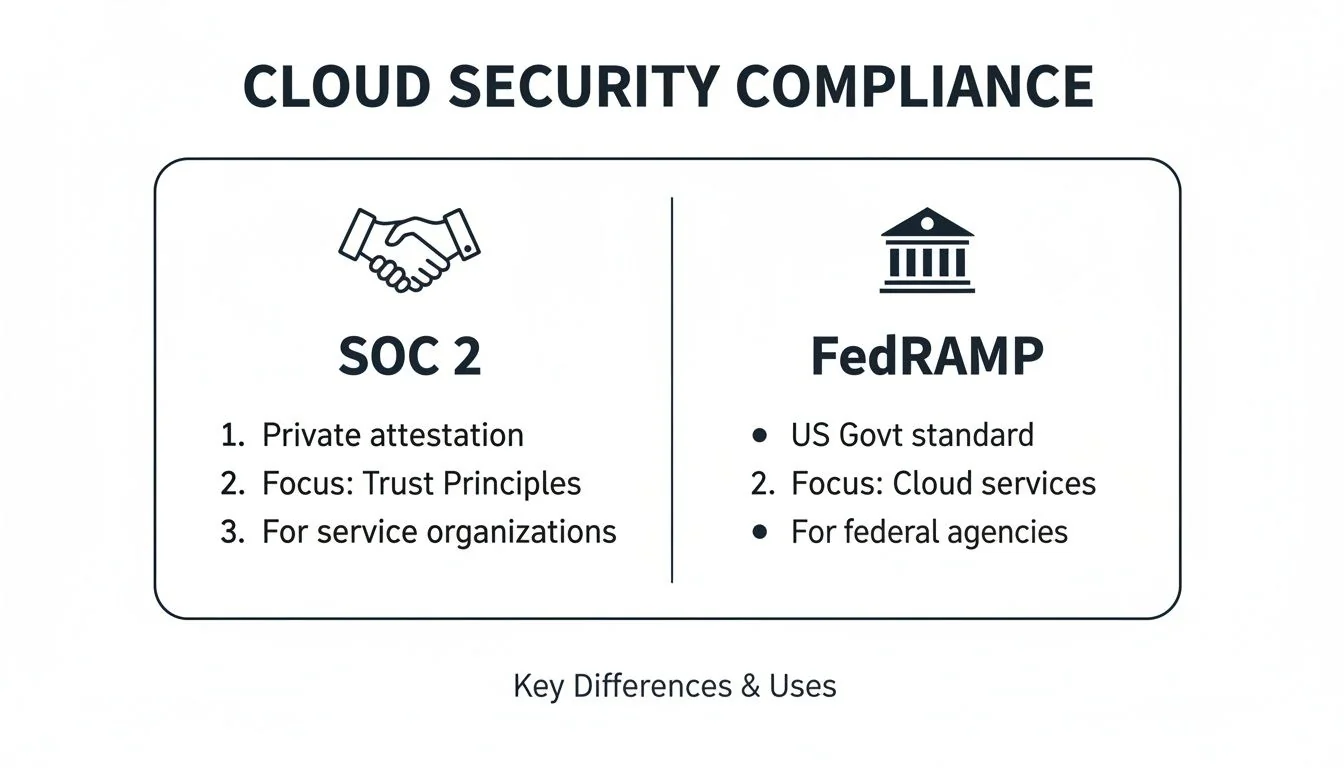
From a SOC 2 perspective, the difference in rigor is significant. FedRAMP’s moderate baseline requires the implementation and assessment of over 325 specific controls, a substantial increase from the 64+ criteria in a SOC 2 audit focusing on the Security TSC. This directly impacts the required investment. A typical SOC 2 audit may take 3-6 months and cost between $15,000 and $100,000. FedRAMP authorization is a multi-year strategic initiative, often taking 12-24 months and costing $250,000 to over $1,000,000.
SOC 2 vs FedRAMP High-Level Comparison
This table provides a side-by-side comparison of the fundamental differences between the two security frameworks, highlighting why they serve distinct business objectives.
| Attribute | SOC 2 | FedRAMP |
|---|---|---|
| Governing Body | AICPA (American Institute of CPAs) | U.S. Federal Government (GSA, DoD, DHS) |
| Primary Audience | Commercial Customers, Partners, Enterprises | U.S. Federal Agencies |
| Framework Basis | Trust Services Criteria (TSCs) | NIST SP 800-53 |
| Outcome | Attestation Report (Opinion) | Authorization to Operate (ATO) |
| Flexibility | High (Selectable TSCs) | Low (Prescriptive Baselines) |
| Typical Cost | $15,000 - $100,000 | $250,000 - $1,000,000+ |
Why does this matter for someone pursuing SOC 2? Understanding these differences is crucial for strategic planning. The controls and evidence developed for a SOC 2 audit serve as a foundational layer for a future FedRAMP effort. For instance, the risk assessment processes required by SOC 2 Common Criteria CC3.1 can be designed and documented to align with the more prescriptive requirements of FedRAMP’s Risk Assessment (RA) control family. This approach maximizes the ROI of the initial SOC 2 investment if federal market entry is a long-term goal.
You can learn more about SOC 2 compliance in our detailed guide.
Comparing Strategic Purpose and Market Applicability
The strategic purpose of SOC 2 and FedRAMP is dictated entirely by the target market. SOC 2 is designed to build trust and accelerate sales in the commercial sector, while FedRAMP is a mandatory access requirement for the U.S. federal government market.
SOC 2 is an attestation framework governed by the AICPA, designed to demonstrate a service organization’s commitment to protecting customer data against its self-defined service commitments. Its market applicability is broad, covering SaaS providers, data centers, and managed service providers selling to other businesses.
FedRAMP is a U.S. government program with the sole purpose of standardizing security for cloud products sold to federal agencies. It is not about building general market trust; it is a prerequisite for entry into the federal marketplace. Any Cloud Service Provider (CSP) intending to sell to the U.S. government must achieve FedRAMP authorization.
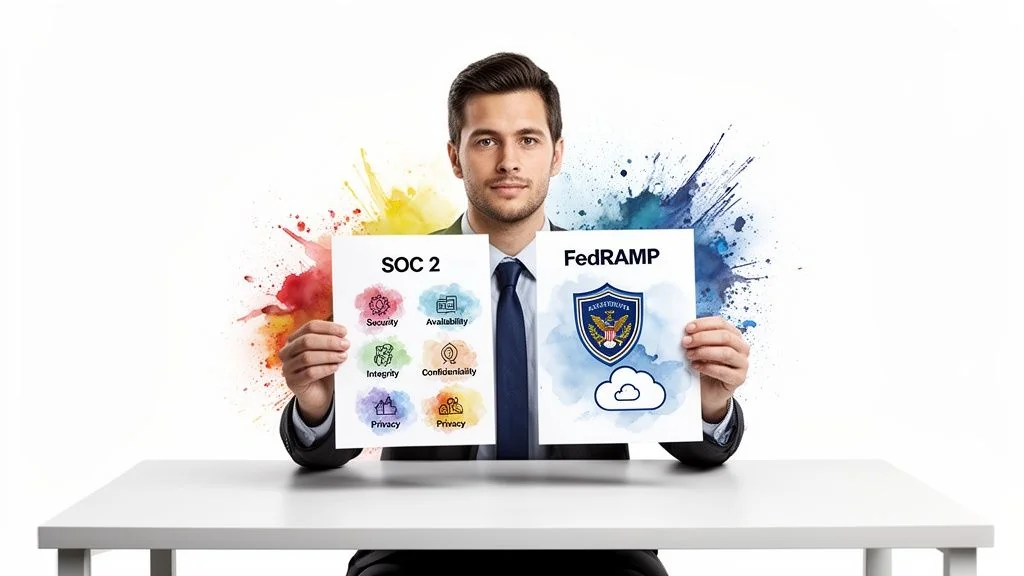
SOC 2: A Market-Driven Tool for Commercial Trust
For a B2B SaaS company, a SOC 2 report is a critical sales enablement asset. It provides a proactive, third-party validated answer to customer security questionnaires and due diligence processes, reducing friction in vendor security reviews and shortening sales cycles. The framework’s flexibility allows an organization to align its audit scope with customer expectations.
Why does this matter for someone pursuing SOC 2? The framework itself reinforces strong security practices that are foundational to any compliance program. For example, Common Criteria CC9.2 requires the organization to assess its own vendors. This principle of supply chain security is exactly what a SOC 2 report helps your customers accomplish, creating a defensible and consistent ecosystem of trust.
FedRAMP: A Government-Mandated License to Sell
FedRAMP’s purpose is to provide a standardized security baseline, not to build commercial trust. It serves as a license to sell into the highly regulated U.S. federal market. Compliance is the mandatory key to unlocking this specific revenue stream.
The most significant distinction is that SOC 2 is a market-driven attestation of best practices, while FedRAMP is a government-mandated Authorization to Operate (ATO). One builds trust with many; the other grants access to a select few.
This distinction is vital for resource allocation. FedRAMP is a prerequisite, not a sales accelerator in the commercial sense. Unlike SOC 2, where the scope can be tailored via optional Trust Services Criteria, FedRAMP’s requirements are prescriptive and defined by Low, Moderate, or High baselines with no room for negotiation.
Strategic Applicability: A Comparison
The decision to pursue SOC 2 or FedRAMP depends entirely on the target customer. This table clarifies the strategic drivers for each framework.
| Factor | SOC 2 Strategic Focus | FedRAMP Strategic Focus |
|---|---|---|
| Primary Driver | Market demand and customer trust | Government regulation and market access |
| Target Audience | Commercial enterprises of all sizes | U.S. federal government agencies |
| Business Value | Accelerates commercial sales cycles | Unlocks federal revenue opportunities |
| Compliance Nature | Attestation of best practices | Mandatory Authorization to Operate (ATO) |
| Scope Flexibility | High (optional TSCs) | Low (prescriptive control baselines) |
Why does this matter for someone pursuing SOC 2? A well-executed SOC 2 audit establishes the core security program required by virtually any other framework. The documented processes for incident response (CC7.3) and risk assessments (CC3.1) are not just for the SOC 2 report; they are reusable assets that form the foundation for more stringent compliance obligations like FedRAMP. A strategic SOC 2 implementation is an investment in future compliance readiness.
Analyzing the Underlying Control Frameworks
The foundational control sets for SOC 2 and FedRAMP reflect their different origins and purposes. SOC 2 is built upon the principle-based Trust Services Criteria (TSCs) developed by the AICPA, allowing for flexibility in implementation. The Security TSC, also known as the Common Criteria, is the mandatory baseline for all SOC 2 audits.
FedRAMP is based on the prescriptive and detailed NIST Special Publication 800-53, a catalog of security and privacy controls for federal information systems. This framework is not flexible; it provides specific controls that must be implemented as defined.
While their structures differ, both are designed around the foundational elements of security, trust, and accountability, which are essential for protecting sensitive data.
The SOC 2 Approach: Flexibility and Business Alignment
The primary advantage of the SOC 2 framework is its adaptability. After satisfying the mandatory Security criteria, an organization can voluntarily add up to four additional TSCs to its audit scope:
- Availability: Addresses whether the system is available for operation and use as committed or agreed.
- Processing Integrity: Addresses whether system processing is complete, valid, accurate, timely, and authorized.
- Confidentiality: Addresses whether information designated as confidential is protected as committed or agreed.
- Privacy: Addresses whether personal information is collected, used, retained, disclosed, and disposed of in conformity with the commitments in the entity’s privacy notice.
Why does this matter for someone pursuing SOC 2? This flexibility allows you to tailor the audit’s scope, cost, and complexity directly to your service commitments and customer requirements. A data analytics platform might focus on Security, Availability, and Confidentiality, while a financial transaction processor would likely require Processing Integrity. This alignment makes SOC 2 a practical, business-driven compliance tool. You can learn more about the SOC 2 Trust Services Criteria to determine the appropriate scope.
The FedRAMP Approach: Prescriptive and Standardized
FedRAMP offers no such choice. It mandates predefined control baselines—Low, Moderate, and High—which dictate the exact number and rigor of controls to be implemented. The scope is not negotiable. This prescriptive nature ensures a consistent security posture across all cloud services used by the federal government.
Where SOC 2’s CC7.1 generally requires procedures for monitoring systems, the corresponding FedRAMP control family (AU - Audit and Accountability) is highly specific, detailing requirements from audit log content (AU-2) to log review frequency and storage capacity.
The key takeaway is this: SOC 2 asks you to define and justify your controls against its criteria, while FedRAMP tells you exactly which controls to implement and how.
Comparing Control Specificity: SOC 2 vs. FedRAMP
The difference in prescriptive detail is clear when comparing specific control areas.
| Control Area | SOC 2 (Security TSC / Common Criteria) | FedRAMP (NIST SP 800-53 / Moderate Baseline) |
|---|---|---|
| Risk Management | CC3.1: The entity identifies, selects, and develops risk mitigation activities for risks arising from potential business disruptions. | RA-3: The organization conducts risk assessments, documents the results, reviews them at a defined frequency, and disseminates them to designated personnel. |
| Logical Access | CC6.1: The entity implements logical access security measures to protect against threats from sources outside its system boundaries. | AC-2: The organization manages system accounts, including establishing, activating, modifying, disabling, and removing accounts based on specific documented procedures. |
| Change Management | CC8.1: The entity authorizes, designs, develops or acquires, configures, documents, tests, approves, and implements changes to infrastructure. | CM-3: The organization develops, documents, and implements a configuration change control process that includes a change control board and automated mechanisms. |
Why does this matter for someone pursuing SOC 2? Viewing SOC 2 controls through a FedRAMP lens is a strategic advantage. While satisfying CC8.1, an organization can create change management documentation and processes that are robust enough to meet the more granular demands of CM-3. This foresight ensures the work done for SOC 2 is not just for the current audit but is a durable asset for future, more demanding compliance initiatives.
Understanding Attestation Versus Authorization
The outputs of a SOC 2 audit and a FedRAMP assessment are fundamentally different. A SOC 2 engagement results in an attestation report, which is an independent CPA firm’s opinion on a company’s controls. A FedRAMP engagement results in a government-issued Authorization to Operate (ATO), which is a formal license to provide cloud services to federal agencies.
A SOC 2 report is an asset owned and controlled by the service organization, used to build trust with commercial customers. A FedRAMP ATO is a permission granted by the government, which retains ultimate oversight and control.
SOC 2: The Attestation of Trust
A SOC 2 report is a third-party attestation that validates a company’s security program. The service organization is in control of the process: it selects the audit firm, defines the audit scope by choosing the relevant Trust Services Criteria, and controls the distribution of the final report, typically under an NDA. The relationship is between the organization, its auditor, and its customers. The auditor’s role is to test controls and provide an expert opinion; the organization’s role is to design and operate those controls effectively.
FedRAMP: The Authorization to Operate
Pursuing FedRAMP involves seeking a government-granted authorization. The dynamic shifts from a commercial engagement to a regulated government process. An organization must hire a certified Third Party Assessment Organization (3PAO) to conduct the assessment, but the final decision to grant an ATO rests with a federal agency sponsor or the Joint Authorization Board (JAB). The oversight is continuous and intense.
- Continuous Monitoring: Unlike a point-in-time SOC 2 audit, FedRAMP requires continuous monitoring, including monthly security deliverable submissions to the government.
- Government Oversight: The sponsoring federal agency maintains direct and ongoing insight into the service’s security posture, including a formal Plan of Action and Milestones (POA&M) that tracks all identified weaknesses.
- Prescriptive Assessments: 3PAOs follow rigid NIST assessment guidelines, leaving no room for the interpretation or flexibility common in SOC 2 audits.
The core difference is control and ownership. A SOC 2 attestation is your report, validated by an auditor, that you use to build trust. A FedRAMP authorization is the government’s permission slip, which you must earn and maintain under their rules.
Connecting Attestation and Authorization to SOC 2 Readiness
Why does this matter for someone pursuing SOC 2? If the federal market is a future goal, the SOC 2 audit should be treated as a strategic dry run for a FedRAMP assessment. The evidence collected for SOC 2 controls must be documented with a level of rigor sufficient to withstand the scrutiny of a 3PAO. For example, the evidence gathered for SOC 2 Common Criteria CC3.1 (Risk Identification) should be documented with the same meticulous detail required for FedRAMP’s RA-3 (Risk Assessment). By building the SOC 2 evidence library with an eye toward future authorization, the attestation process becomes the foundational work for a more complex and lucrative federal compliance effort.
Comparing Timelines, Costs, and Resource Commitments
The resource investment required for SOC 2 and FedRAMP differs by an order of magnitude, making it a critical factor in strategic planning. A first-time SOC 2 Type 2 audit typically requires 6 to 12 months and costs between $20,000 and $80,000, depending on scope and system complexity.
In contrast, achieving a FedRAMP Authorization to Operate (ATO) is a major strategic and financial undertaking. The process typically takes 12 to 24 months, with initial costs starting at $250,000 and often exceeding $1,000,000. The internal resource commitment is also substantially higher. A SOC 2 audit can often be managed by a compliance lead with support from engineering, while FedRAMP requires a dedicated team of several full-time employees focused on compliance, documentation, and continuous monitoring.
Unpacking the Initial Investment
For SOC 2, initial costs primarily consist of auditor fees, readiness consulting, and potential investment in a GRC platform like Vanta or Drata. The audit fee is directly proportional to the scope—an audit limited to the Security TSC will be less expensive than one that includes all five TSCs.
FedRAMP’s initial costs include several items not present in the SOC 2 process:
- 3PAO Assessment Fees: These fees are significantly higher than SOC 2 auditor costs due to the volume and prescriptive nature of the NIST 800-53 controls.
- Specialized Tooling: FedRAMP requires government-approved tools for continuous monitoring, vulnerability scanning, and reporting.
- Extensive Documentation: The System Security Plan (SSP) alone can be several hundred pages and requires significant internal resources or specialized consultants to create.
Why does this matter for someone pursuing SOC 2? Understanding the ten-fold (or greater) increase in investment is crucial. SOC 2 is a manageable, operational expense for most SaaS companies; FedRAMP is a major strategic and financial commitment that requires board-level buy-in and multi-year budgeting.
Comparing Ongoing Maintenance Costs
For SOC 2, annual renewal audits typically cost about the same as the initial audit. FedRAMP maintenance, however, is driven by the continuous monitoring mandate. Annual costs to maintain a FedRAMP ATO typically range from $100,000 to $250,000, covering recurring 3PAO assessments, continuous monitoring services, and the internal team required for monthly government reporting. This represents a significant ongoing operational expense compared to the predictable cost of an annual SOC 2 renewal.
Cost and Timeline Investment SOC 2 vs FedRAMP
The financial and operational commitments for SOC 2 and FedRAMP are worlds apart. This table breaks down the typical investment, showing why one is a common step for growing companies while the other is a strategic leap for those targeting the public sector.
| Factor | SOC 2 (Type 2) | FedRAMP (Moderate ATO) |
|---|---|---|
| Initial Timeline | 6 - 12 Months | 12 - 24 Months |
| Initial Cost | $20,000 - $80,000 | $250,000 - $1,000,000+ |
| Annual Maintenance Cost | $15,000 - $70,000 | $100,000 - $250,000 |
| Internal Resources | 1 Part-Time Lead, Engineering Support | Multiple Full-Time Employees |
| Primary Cost Drivers | Audit Scope (TSCs), System Complexity | 3PAO Fees, Tooling, Continuous Monitoring |
Why does this matter for someone pursuing SOC 2? Viewing the SOC 2 audit as a down payment on a potential future FedRAMP authorization is a smart financial strategy. By implementing and documenting SOC 2 controls, such as those under CC3.0 (Risk Management), with the rigor required for FedRAMP, the initial investment becomes more valuable. This approach de-risks the significant financial commitment of a future federal authorization initiative by building a reusable foundation of compliance evidence.
Building a Strategic Pathway from SOC 2 to FedRAMP
For organizations targeting the federal market, a SOC 2 audit should not be viewed as a standalone commercial compliance activity. Instead, it is the most effective preparatory step for a future FedRAMP initiative. A significant portion of SOC 2 controls—up to 80%—has a direct correlation to the NIST SP 800-53 controls required by FedRAMP.
This overlap is most pronounced in the mandatory Security (Common Criteria) TSC, which addresses foundational security principles like access control, risk management, and change management. By approaching a SOC 2 audit with a “FedRAMP-ready” mindset, an organization can transform the project from a compliance exercise into a strategic investment, creating a reusable evidence library that significantly reduces the time and cost of a future FedRAMP pursuit.
Leverage Your SOC 2 Scope for FedRAMP
The selection of Trust Services Criteria (TSCs) for a SOC 2 audit is a critical strategic decision. While only the Security TSC is mandatory, proactively including Availability and Confidentiality creates a much stronger foundation for meeting federal requirements.
- Availability: The controls supporting this TSC, such as system uptime monitoring, backup procedures, and disaster recovery plans, align closely with FedRAMP’s Contingency Planning (CP) and System and Information Integrity (SI) control families.
- Confidentiality: This criterion focuses on protecting sensitive information and directly supports FedRAMP’s stringent requirements for data-at-rest encryption, access control policies, and secure data disposal, which are detailed in the Access Control (AC) and Media Protection (MP) families.
Why does this matter for someone pursuing SOC 2? Including these TSCs forces the implementation and documentation of controls that are non-negotiable in a FedRAMP environment. This proactive work builds a substantial portion of the evidence a 3PAO will require, creating significant time and cost savings for a future FedRAMP project.
Elevate Documentation Beyond Commercial Standards
A primary difference between SOC 2 and FedRAMP lies in the required level of documentation. A commercial SOC 2 audit may accept high-level policies and screenshots as evidence. FedRAMP, however, requires an exhaustive System Security Plan (SSP) that can span hundreds of pages and demands granular detail on every control implementation.
To bridge this gap, SOC 2 documentation must be intentionally rigorous. When addressing a SOC 2 criterion like CC3.2 (The entity identifies and assesses risks), the documentation should extend beyond a simple risk list to include the entire risk assessment methodology, scoring criteria, and a formal risk register that mirrors the requirements of FedRAMP’s RA-3 (Risk Assessment).
Adopting a “FedRAMP-ready” documentation mindset during your SOC 2 audit is one of the highest-impact strategies for maximizing your compliance ROI. It transforms evidence collection from a reactive task into a proactive asset-building process.
This means every policy and procedure should be written with sufficient detail to be largely transferable to a future SSP. This makes the SOC 2 evidence library a living asset that accelerates the path to a FedRAMP ATO.
Choose Partners with Federal Expertise
The selection of tools and audit partners for a SOC 2 engagement has significant long-term implications for federal market ambitions. Not all compliance automation platforms or audit firms are equipped to handle the complexities of government compliance.
When selecting a GRC platform, inquire about its capability to map SOC 2 controls to the NIST 800-53 framework. A platform with pre-built mappings provides a clear roadmap, identifying where existing SOC 2 evidence satisfies FedRAMP requirements and where gaps exist.
Similarly, it is advantageous to partner with a SOC 2 audit firm that also has a 3PAO practice or demonstrable FedRAMP experience. Such auditors understand the nuances of federal documentation standards and can provide guidance during the SOC 2 audit to ensure controls and evidence are built to a higher standard, mitigating the need for costly remediation and re-engineering later.
Achieving SOC 2 compliance is a critical milestone for any B2B SaaS company, establishing a strong security baseline and enabling commercial growth. For organizations with federal market aspirations, a strategically planned SOC 2 audit is more than a report—it is the foundational investment in a scalable compliance program. By selecting the right scope, elevating documentation standards, and choosing experienced partners, an organization can ensure its SOC 2 program is not just a response to current customer demands but a robust and reusable asset that prepares it for the rigors of FedRAMP audit readiness.