Your Ultimate Guide to soc complaiance software
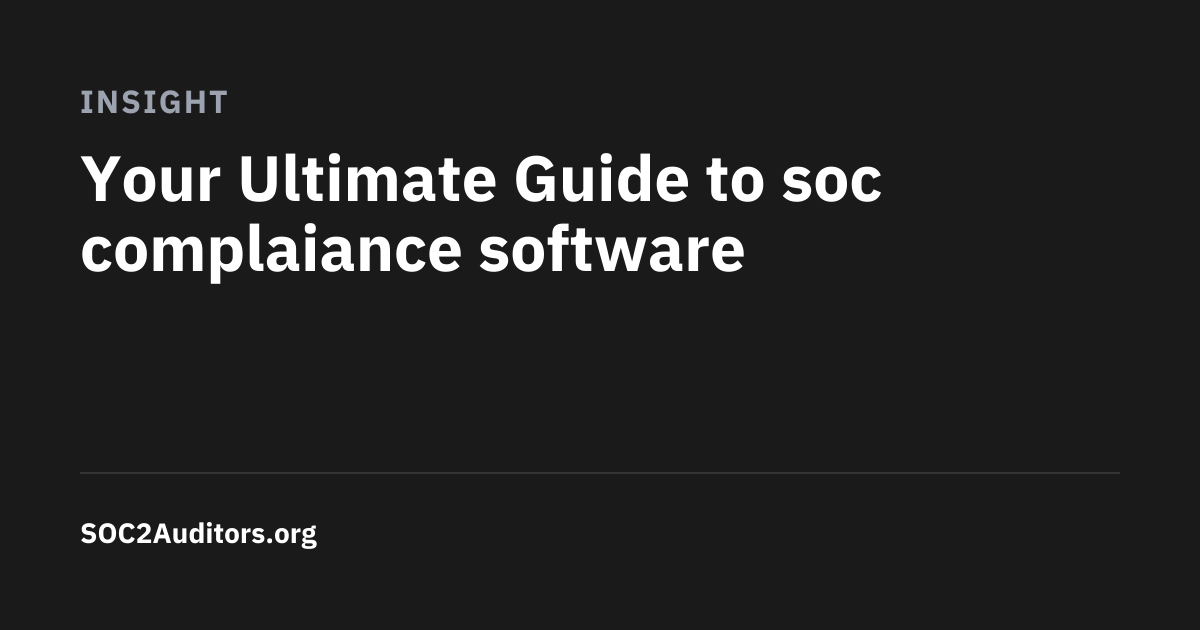
Think of SOC compliance software as your company’s central command center for navigating a complex security audit. It’s a specialized platform built to automate evidence collection, monitor your security controls in real-time, and manage the entire project from start to finish. It turns a chaotic, manual mess into a structured, manageable process.
What Is SOC Compliance Software and Why Is It Essential?
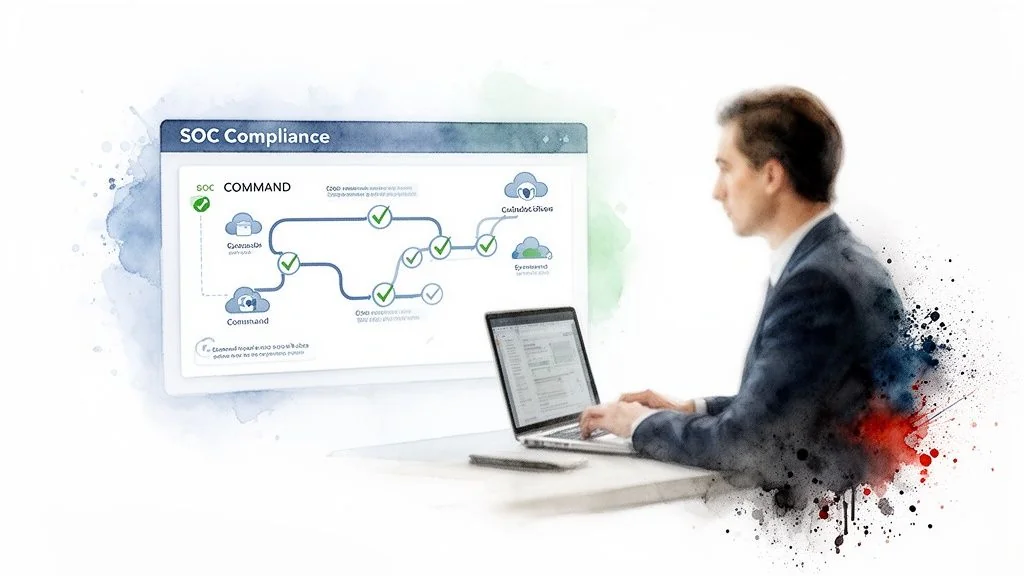
Imagine trying to manage a major shipping operation using only a paper map, a rolodex, and a landline. That’s exactly what handling SOC 2 with spreadsheets, shared drives, and endless email chains feels like—inefficient, stressful, and an open invitation for things to go wrong. SOC compliance software is the modern logistics dashboard with GPS built-in.
This software becomes the single source of truth for your security program. Instead of manually chasing down screenshots or bugging engineers for logs, these platforms plug directly into your tech stack. They connect to your cloud infrastructure (like AWS or Azure), development tools (Jira, GitHub), and HR systems, automatically pulling the exact evidence needed to prove your security controls are actually working.
The Shift from Manual Scramble to Continuous Readiness
The old way of preparing for a SOC 2 audit was a frantic, months-long scramble. Teams would drop everything to manually dig up hundreds of pieces of evidence, dump them in folders, and just hope they had everything right when the auditor showed up. This isn’t just a massive time sink; it only gives you a “point-in-time” snapshot of your security posture.
SOC compliance software completely flips this model on its head. It shifts your company from a once-a-year fire drill to a state of continuous compliance. By constantly monitoring your systems, the software flags potential issues the moment they happen, letting you fix them long before they become a problem in an audit.
A key advantage of compliance automation is its ability to create a living, breathing security program. It’s not just about passing an audit; it’s about building a provably secure environment that operates correctly every day, giving both your team and your customers genuine peace of mind.
Why Software Is a Necessity, Not a Luxury
In today’s market, enterprise customers demand proof of security. A SOC 2 report is often a non-negotiable ticket to even get in the door, let alone close a deal. Using dedicated software to get there provides some huge business advantages:
- Accelerated Timelines: Automation drastically cuts down the time spent digging for evidence. This can shrink the audit readiness phase from many months down to just a few weeks.
- Reduced Engineering Overhead: It frees up your most valuable engineers from soul-crushing administrative tasks, letting them focus on building your product instead of hunting for compliance paperwork.
- Enhanced Audit-Readiness: By giving auditors a clean, organized, and centrally managed library of evidence, the software makes their job easier. This almost always leads to a smoother and faster audit.
- Stronger Security Posture: Continuous monitoring helps you find and fix security gaps in real-time, improving your overall defenses far beyond what’s needed to simply check a box for an audit.
The Manual Grind Versus Automated Compliance
To really get what SOC compliance software brings to the table, let’s walk through two completely different ways to get a SOC 2 report. First up is what I call the “manual grind”—a painful journey paved with sprawling spreadsheets, messy shared drives, and the soul-crushing task of chasing down engineers for evidence.
This old-school way of doing things is a massive time sink. It turns your sharpest technical minds into glorified paper pushers, forcing them to spend hours taking screenshots of system settings and hunting for log files. It’s not just slow; it’s a recipe for human error, version control disasters, and almost certain audit delays.
Now, picture another path. This is the automated route, powered by SOC compliance software. Think of this software as your dedicated compliance robot, working 24/7. It tirelessly connects to your tech stack, pulling exactly the evidence your auditor needs, right on schedule.

The World of Manual Evidence Collection
The manual process is a tangled mess of disconnected tools and mind-numbing repetition. Teams usually try to stitch together spreadsheets for tracking controls, Google Drive for storing evidence, and a project management tool for nagging people. On the surface, it sounds workable. In reality, it falls apart fast.
Engineers burn through precious time—often 40 to 80 hours for a first-time audit—manually grabbing evidence that a platform could collect in minutes. And this isn’t a one-and-done deal. For a SOC 2 Type 2 report, you have to collect this evidence over and over again throughout the audit period, which just multiplies the pain.
The real damage here is the opportunity cost. Every single hour an engineer wastes hunting for a screenshot of a firewall rule is an hour they aren’t shipping features, squashing bugs, or making your product better for customers.
On top of that, this method is just plain risky. Evidence gets lost, mislabeled, or becomes stale. The auditor then has to waste their time (and your money) trying to make sense of the chaos, leading to more questions, painful delays, and a rocky audit experience.
How Automation Changes The Game
SOC compliance software completely wipes out this friction. Instead of manual labor, the platform uses direct API integrations to plug right into the tools you already use.
- Cloud Providers: It connects to AWS, Google Cloud, and Azure to automatically verify things like properly configured security groups, MFA on root accounts, and enabled logging.
- Development Tools: It integrates with Jira and GitHub to prove that code changes follow your approval workflow and that access permissions are locked down.
- HR Systems: It links to platforms like Gusto or Rippling to confirm that your employee onboarding and offboarding procedures are actually being followed.
Let’s break down the difference in a head-to-head comparison.
Manual Evidence Collection vs SOC Compliance Software
| Aspect | Manual Process (Spreadsheets & Drives) | Automated SOC Compliance Software |
|---|---|---|
| Evidence Collection | Manual screenshots, log exports, and file uploads by engineers. | Continuous, automated data collection via API integrations. |
| Time Investment | 40-80+ hours of engineering time per audit cycle. | <5 hours of engineering time for initial setup and maintenance. |
| Accuracy & Consistency | High risk of human error, missed evidence, and inconsistent formatting. | Standardized, timestamped, and error-free evidence collection. |
| Audit Readiness | Constant scramble before the audit; evidence is often disorganized. | Always audit-ready with a centralized, real-time dashboard. |
| Control Monitoring | Point-in-time checks; no real-time visibility into control failures. | Continuous monitoring with alerts for misconfigurations or gaps. |
| Auditor Experience | Auditor sifts through chaotic folders, leading to delays and frustration. | Auditor gets direct access to a clean, organized evidence portal. |
The bottom line is clear. One of the biggest wins you get from SOC compliance software is the ability to automate repetitive tasks that plague the audit process, which saves a ton of time and cuts down on mistakes. This frees up your best people to focus on growing the business, not prepping for an audit.
This automated approach creates a single, reliable source of truth for your compliance. Everything is timestamped, standardized, and mapped directly back to the SOC 2 controls. When your auditor shows up, they see a clean, professional dashboard instead of a messy folder full of random files.
The difference is night and day. Automation turns compliance from a dreaded, disruptive event into a smooth, continuous process that just hums along in the background. You can dive deeper into how this works in our guide to SOC 2 automation. This shift doesn’t just get you through the audit faster—it builds a genuinely stronger, more secure foundation for your entire company.
Must-Have Features in Your SOC Compliance Software
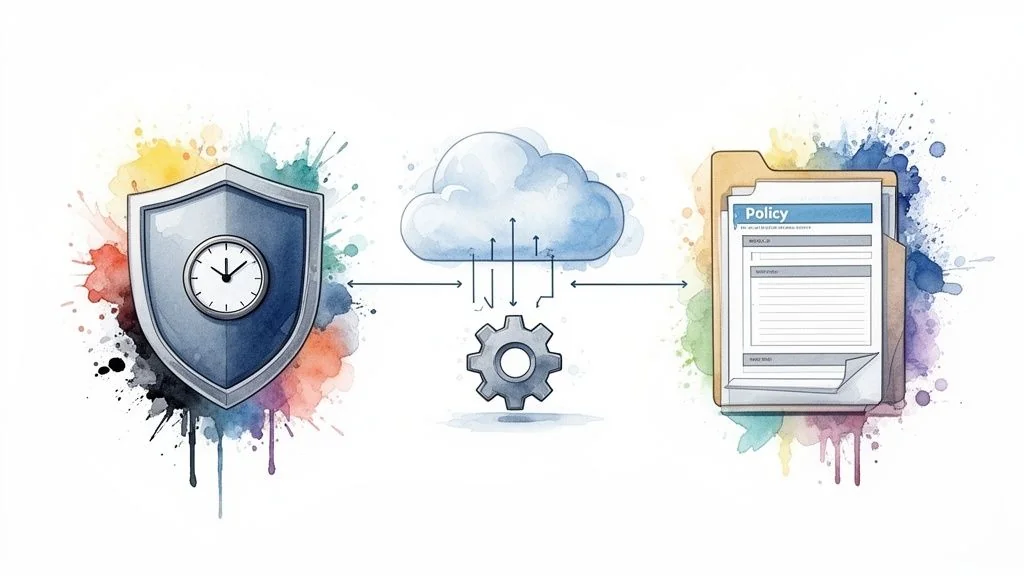
When you start shopping for a compliance platform, it’s easy to get buried in marketing jargon. To pick the right tool, you have to cut through the noise and focus on the core features that will actually get you through an audit. These are the non-negotiables that make SOC compliance software a real asset instead of just another monthly subscription.
Think about it like buying a car. The sunroof and the premium sound system are nice, but it’s the engine, transmission, and safety features that actually get you where you need to go. For compliance software, the same principle applies. Get the fundamentals right, and you’ll have a smooth ride to your SOC 2 report.
Continuous Controls Monitoring
This is your 24/7 security guard. Continuous controls monitoring (CCM) is the single most important feature, automatically checking your systems against your security policies and the SOC 2 criteria around the clock.
Instead of finding out during your annual audit that a critical security setting was misconfigured three months ago, CCM alerts you almost instantly. It can flag an AWS S3 bucket that was accidentally made public or an admin account that’s missing multi-factor authentication (MFA).
This feature is what shifts compliance from a painful, once-a-year scramble into a proactive, everyday process. It lets you find and fix security gaps the moment they happen—long before an auditor ever sees them.
Automated Evidence Collection
Let’s be honest, the worst part of a manual audit is the mind-numbing task of gathering proof. Automated evidence collection solves this by creating digital pipelines that plug directly into your entire tech stack.
Any platform worth its salt will have a deep library of integrations with the tools you already use. This isn’t just a nice-to-have; it’s the entire foundation of the software’s value.
- Cloud Infrastructure: It should connect to AWS, Google Cloud, and Azure to pull configurations, access logs, and security settings automatically.
- Version Control & CI/CD: Look for integrations with GitHub, GitLab, and Jira to prove you have a solid code review process and secure deployment workflows.
- Identity & Access Management: It must link to providers like Okta or Azure AD to verify user access reviews, role-based permissions, and proper offboarding.
- HR & People Ops: It needs to sync with platforms like Gusto or Rippling to confirm that every employee has passed a background check and completed security training.
This level of automation frees your engineering team from the drudgery of taking endless screenshots so they can get back to building your product.
Policy and Procedure Templates
Trying to write a full set of security policies from scratch is a massive undertaking, especially if you don’t have a compliance expert on staff. Good SOC compliance software comes with a library of pre-built, auditor-approved policy templates.
These aren’t just generic Word documents. They’re specifically designed to map directly to the SOC 2 Trust Services Criteria, giving you a huge head start on everything from your Acceptable Use Policy to your Incident Response Plan. This feature alone can save you dozens of hours and thousands in legal fees. Make sure the templates are also easily customizable to fit how your business actually operates.
Integrated Vendor and Risk Management
Your security is only as strong as your weakest link, and that link is often a third-party vendor. A solid compliance platform will include a vendor risk management (VRM) module. This lets you track the security of your key suppliers, manage contracts, and run security reviews all in one place.
Likewise, an integrated risk assessment feature helps you identify, track, and mitigate risks across your entire company. By linking those risks directly to your security controls, the software gives auditors a crystal-clear view of how you’re managing threats. This shows you’re not just checking boxes but are running a mature security program—something every auditor loves to see.
How Automation Impacts Your Audit Timeline and Budget
For any company chasing a SOC 2 report, two questions always pop up first: how long is this going to take, and how much will it cost? The answers can feel pretty discouraging, with manual processes often turning audits into a year-long marathon. But this is exactly where automation completely flips the script on the financial and operational calculus of compliance.
Using SOC compliance software isn’t just about making things easier; it’s a direct investment in speed and efficiency. The single biggest impact is on the audit readiness phase. A manual approach often demands hundreds of hours from your highest-paid engineers, pulling them away from building your product to go hunt for evidence. For a first-time audit, this can easily drag on for six to twelve months.
With an automation platform, that timeline shrinks dramatically. By connecting directly to your tech stack, the software gathers evidence in minutes, not months. This compresses the readiness journey into just a few weeks, getting you to your audit—and your report—massively faster.
Calculating the True Cost of Compliance
When teams budget for SOC 2, they often just look at the auditor’s price tag and the software subscription. This misses the biggest expense by a mile: the hidden cost of manual labor.
Think about the total cost of ownership (TCO) for a manual audit. You’re not just paying your auditor; you’re paying for the internal resources you burn through in the process.
- Engineering Hours: Manually prepping for a first-time SOC 2 can easily eat up 80-100 hours of senior engineering time. At a conservative blended rate, that’s thousands of dollars in salary spent on what are essentially administrative tasks.
- Opportunity Cost: Every hour an engineer spends grabbing screenshots is an hour they aren’t shipping features or squashing bugs. This lost productivity is a massive, untracked expense that directly kneecaps your roadmap and revenue.
- Audit Fees: A messy, manual evidence collection process makes the auditor’s job harder and longer. This can easily lead to higher audit fees and a much greater chance of expensive re-testing.
The real return on investment from SOC compliance software comes from reclaiming your team’s most valuable asset: their time. The platform’s subscription cost is often just a fraction of the salary and opportunity costs you save by cutting out manual compliance grunt work.
Navigating an In-Demand Audit Market
The pressure to be efficient is only getting worse. The global SOC Reporting Services Market, which includes the audit firms you’ll be hiring, hit USD 5,392 million in 2024 and is projected to nearly double by 2030. For growing tech companies, this means auditors are in high demand. Timelines are stretching from 3 to 20 months, and costs can range anywhere from $15,000 to over $400,000.
In this kind of competitive environment, showing up with your evidence already organized in a professional platform makes you a much more attractive client. Auditors who work with automation platforms can get their work done faster and with more confidence, which often leads to a smoother, more collaborative, and less expensive engagement for you.
Ultimately, automation gives you a clear financial and strategic edge. It minimizes disruption to your operations, lowers the risk of audit delays, and delivers a faster, cheaper path to the SOC 2 report your business needs to grow. To get a better sense of how these factors play out, check out our deep dive into how long a SOC 2 audit takes.
Using Software to Collaborate with Your Auditor
Getting your hands on SOC compliance software is just the start. The real magic happens when you and your auditor actually use it together. This tech can completely change the dynamic, turning what often feels like a tense interrogation into a collaborative, structured project.
Think of the platform as a central hub—a single source of truth where your team and the auditors can work in sync.
The process usually kicks off by connecting your key systems and mapping your internal controls. Instead of playing email tag and chasing down engineers for evidence, the software becomes your command center. You can assign specific controls to their owners, track tasks in real-time, and build a clear trail of accountability. Auditors love that kind of clarity.
This structured workflow cuts right through the typical audit chaos. The infographic below highlights the classic pain points that modern software is designed to fix.
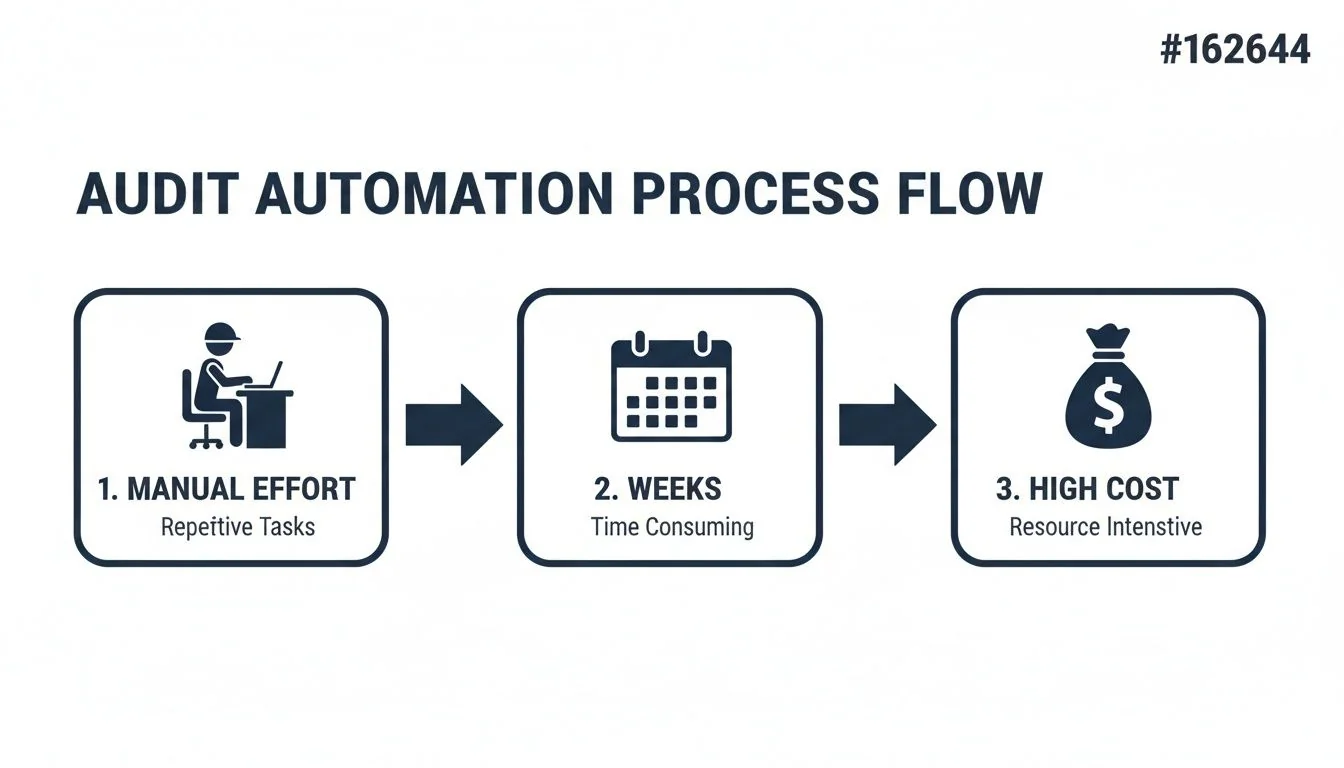
As you can see, the old way is a grind. It burns through engineering hours, stretches timelines for weeks or months, and inflates costs. Automation tackles these bottlenecks head-on, making the whole audit cycle much more predictable and efficient.
Granting Secure Auditor Access
One of the most powerful features here is giving auditors secure, read-only access to the platform. It’s like handing them a key to a perfectly organized library where every piece of evidence is already cataloged and waiting. This one move fundamentally changes the audit game.
Instead of your team spending weeks taking screenshots and exporting logs, auditors can pull much of what they need themselves. They can log in, review how a control is implemented, check automated test results, and sample evidence without constant hand-holding. This transparency builds trust and can dramatically shorten the fieldwork phase.
By giving auditors a clean, self-service evidence portal, you eliminate endless email chains and requests for clarification. This frees them up to focus on actual testing instead of administrative headaches, leading to a faster, less disruptive audit for everyone.
Of course, this only works if your auditor is on board with using modern tools. Some old-school firms still live in spreadsheets and shared folders, which can wipe out many of the efficiency gains you paid for.
Finding a Tech-Savvy Audit Firm
When you’re picking an auditor, it’s critical to find a firm that embraces technology and values efficiency as much as you do. A tech-savvy auditor sees your compliance platform not as a hurdle, but as an asset that makes their job easier and their findings more reliable. You can get a better handle on what you’ll need to prepare by reading our guide on SOC 2 documentation.
Be direct when interviewing potential audit partners. Ask them about their experience with compliance automation software. Do they have set workflows for using them? Are they willing to treat the platform as the primary source of evidence?
The goal is to find a partner who views the audit as a team effort to validate your security, not an adversarial process. Embracing new approaches like building audit-proof AI systems can take this even further by embedding compliance right into your operations.
This is where a service like SOC2Auditors.org really shines. We can connect you with audit firms that are known for their modern, tech-forward approach, ensuring your software investment actually pays off.
Expanding Your Compliance Program Beyond SOC 2
Let’s be real: your compliance journey doesn’t stop with a SOC 2 report. Think of it like getting your driver’s license—it’s the critical first step that gets you on the road, but it doesn’t prepare you for every highway, backroad, or international trip you’ll ever take. As your business grows and you push into new markets, frameworks like ISO 27001, HIPAA, or GDPR are going to pop up on your radar.
This is where the strategic value of your initial software investment really starts to pay off. Modern SOC compliance software isn’t built as a one-trick pony. It’s designed to be a scalable foundation for a mature security program that can handle multiple frameworks.
The Power of Control Mapping
The single most powerful feature for this kind of expansion is control mapping. Imagine you spent weeks meticulously gathering evidence to prove you have a solid employee offboarding process for SOC 2. A few months down the line, you decide to go for ISO 27001, which has a nearly identical requirement.
Without a smart platform, you’d be starting that whole evidence collection grind over from scratch. With control mapping, the software instantly recognizes the overlap.
Control mapping automatically applies the evidence you collected for one framework to satisfy the requirements of another. It’s a “collect once, use many” model that saves you from redoing hundreds of hours of mind-numbing work.
This means all the effort you poured into your SOC 2 audit directly accelerates your next compliance project. Instead of starting from zero, you’re already halfway to the finish line for ISO 27001, GDPR, or any other standard on your list.
From a Single Report to a Full Compliance Portfolio
This capability transforms your software from a short-term audit tool into the central nervous system for your entire governance, risk, and compliance (GRC) program. It gives you a single dashboard to manage multiple frameworks side-by-side, offering a unified, real-time view of your security posture.
And this is becoming more important every day. The market for this kind of software is exploding, with a projected 11.20% CAGR from 2025 to 2034. While SOC 2 is the top priority for 91% of mid-market tech companies, a staggering 81% are now planning for ISO 27001 certification. Ambitious companies are getting wise to the efficiency gains, with 23% now pursuing dual SOC 2 and ISO 27001 certifications at the same time. You can dig into more of these trends and the growing adoption of versatile compliance software.
By choosing a platform with multi-framework support from the get-go, you can:
- Enter New Markets Faster: Need to sell into healthcare? Add HIPAA. Expanding to Europe? Flip on GDPR.
- Crush Enterprise RFPs: Confidently answer complex security questionnaires that reference a dozen different standards.
- Demonstrate True Security Maturity: Show customers and investors that you have a proactive, comprehensive security program, not just a one-off report.
Ultimately, picking the right SOC compliance software is a strategic decision that pays dividends long after that first audit is done. It positions your company to scale efficiently, turning compliance from a series of painful, one-off projects into a sustainable competitive advantage.
Questions We Hear All The Time
When you’re diving into the world of security audits, a lot of questions pop up, especially when you’re trying to figure out if a tool can actually make your life easier. Here are the straight answers to the most common questions we get about SOC compliance software.
Is SOC 2 Compliance Software the Same as a SOC 2 Certification?
Nope, and this is a really important distinction to get right. SOC 2 isn’t a “certification” you can buy; it’s an attestation report that a licensed CPA firm gives you after a formal audit.
Think of the software as your personal trainer. It gets you in shape for the big race by automating evidence collection, keeping an eye on your security controls, and getting your whole program organized. But it can’t run the race for you. Only a licensed auditor can issue the official SOC 2 report that proves you crossed the finish line.
Do I Still Need an Auditor If I Use This Software?
One hundred percent, yes. The software is an incredible readiness tool, but it will never replace the independent auditor. The whole point of a SOC 2 report is to have an unbiased, third-party expert give their professional opinion on how well your security controls are working.
Here’s an analogy: the software helps you write and rehearse a rock-solid legal case for your security program. The auditor is the judge who listens to the case, reviews the evidence, and delivers the final verdict—your SOC 2 report.
Can Startups on a Tight Budget Really Benefit From This?
Yes, absolutely. In fact, startups often see the biggest return. I know it seems counterintuitive to add a subscription cost when you’re bootstrapping, but hear me out.
- It stops the engineering drain. Without software, you’re asking your expensive engineers to spend dozens, if not hundreds, of hours digging up screenshots and logs. That’s time they’re not building your product.
- It makes you “sales-ready” way faster. A SOC 2 report is the ticket to closing bigger, enterprise deals. Software dramatically cuts down the time it takes to get that report in hand.
- You avoid nasty audit surprises. Continuous monitoring means you find and fix issues as they happen, not weeks before your audit when it’s a mad scramble. This prevents costly delays and re-testing fees.
For a startup, the cost of not using software is often hidden in lost engineering productivity and delayed revenue. The right platform flips the script, turning compliance from a painful roadblock into something that actually helps you grow faster.
Ready to connect with an auditor who gets it? SOC2Auditors matches you with top-rated, tech-savvy firms that work perfectly with modern compliance tools. Get your free, personalized auditor matches and find the right partner for your journey.