 Menu
Menu
When you’re looking at Vanta vs Sprinto, the decision really boils down to your company’s maturity and how much hand-holding you need. Vanta has become the go-to for fast-growing startups and established mid-market tech companies that just need a powerful, scalable platform with a massive integration library.
On the other hand, Sprinto is often the better fit for early-stage teams. They shine when a company wants a more guided, high-touch experience with dedicated experts to walk them through the process.
Quick Comparison Vanta vs Sprinto
Choosing between these two isn’t just about comparing feature lists; it’s about understanding their core philosophies. Vanta acts like a powerful, self-serve compliance engine you can drive yourself. Sprinto operates more like a hands-on partner who sits in the passenger seat with you. Picking the right one will make a huge difference in your team’s workload and how fast you get audit-ready.
This side-by-side view breaks down the key differences in their approach and who they’re built for.
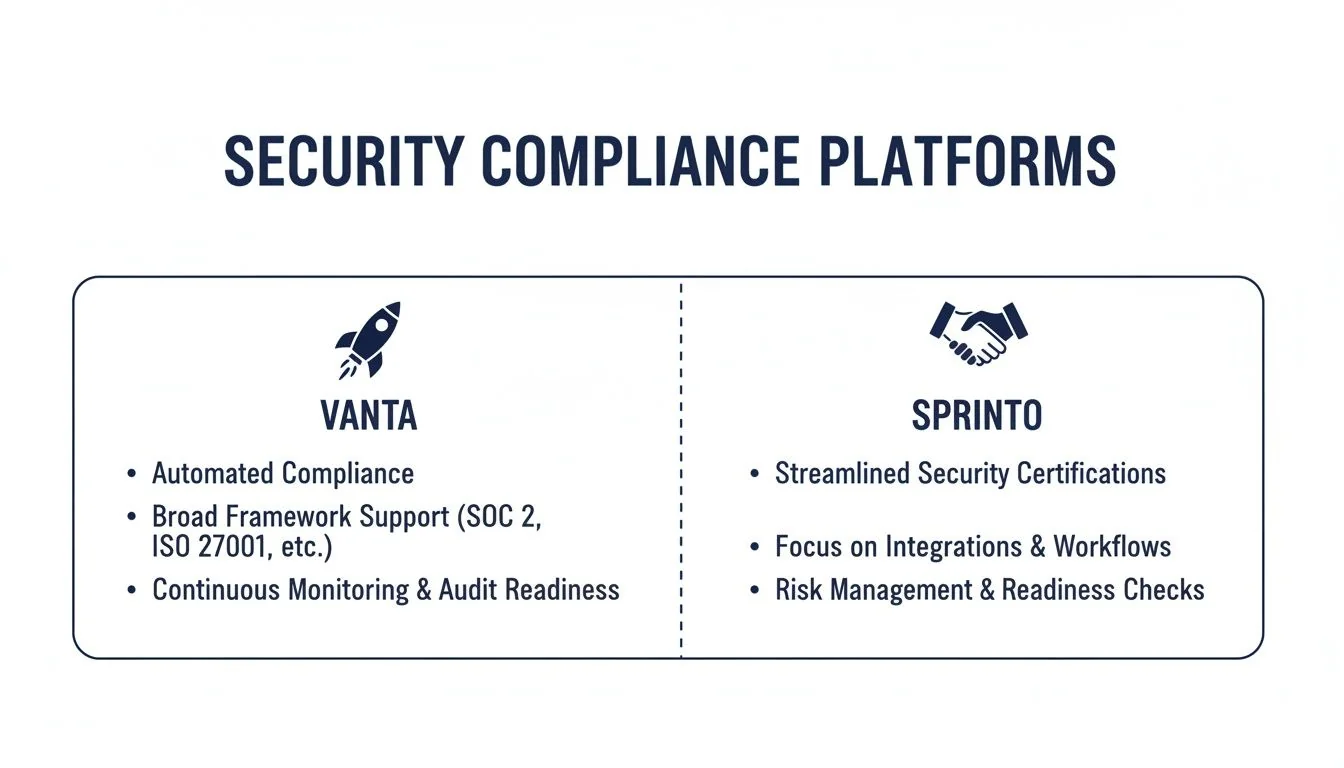
As you can see, the graphic really highlights Vanta’s focus on scale (the rocket icon) versus Sprinto’s partnership-driven model (the handshake icon). It’s a simple way to frame which platform best matches your company’s operating style.
High-Level Verdict
For a lot of buyers, the decision comes down to market presence and a proven track record. Vanta has cemented itself as a dominant player, capturing an impressive 11.3% market share in the Compliance Management space and serving over 7,000 customers globally.
That kind of scale typically means a more mature product with broader support for different frameworks, which is critical if your compliance roadmap extends beyond just SOC 2.
The table below gives you a quick, scannable breakdown of the core differences. For a much deeper analysis of all the top players, check out our guide on the best SOC 2 software solutions.
| Criterion | Vanta | Sprinto |
|---|---|---|
| Ideal Customer | Tech startups & mid-market companies needing scale. | Early-stage teams needing hands-on support. |
| Approach | Powerful, self-service trust management platform. | Guided, high-touch ‘compliance-as-a-service’. |
| Strengths | Extensive integration library and framework coverage. | Dedicated compliance experts and managed onboarding. |
| Pricing Model | Scales with employee count and frameworks. | Often bundled with personalized support services. |
The Core Philosophies: Platform vs. Partner

To really get to the bottom of the Vanta vs. Sprinto debate, you have to look beyond feature lists. At their core, these two companies have fundamentally different beliefs about how to get a company through an audit. This shapes everything from the user interface and pricing to the kind of company that will succeed with their product.
Vanta is built on the philosophy of being a powerful, scalable platform. Think of it as a comprehensive toolkit for companies that already have some security know-how or are committed to building a dedicated compliance team. The entire experience is centered around its robust, self-service engine and a massive library of integrations.
This approach puts you in the driver’s seat. Vanta gives your team the power to connect every part of your tech stack, automate evidence collection across dozens of systems, and manage multiple frameworks like ISO 27001 or GDPR right from one dashboard. It’s built for organizations that see compliance not just as a one-off project, but as a long-term function that will grow with the business.
Sprinto: The Guided Compliance Partner
Sprinto, on the other hand, operates more like “compliance-as-a-service.” They don’t just sell you software; they position themselves as a hands-on partner who will guide you through the finish line. They know that most early-stage companies don’t have a GRC expert on staff and need someone to show them the ropes.
This makes the Sprinto experience feel less like using a tool and more like a managed project. You get a dedicated compliance expert to help with everything from implementation and policy writing to checking your work before the auditor ever sees it. This high-touch model is a huge draw for seed-stage startups or non-technical teams who just want an expert to tell them exactly what to do.
Sprinto’s real value proposition is its concierge-style service. For a resource-strapped team facing their first audit, that kind of hand-holding is invaluable. They aim to take the guesswork out of compliance and drastically reduce the internal workload required to get audit-ready.
How These Philosophies Shape the Product
You can see these competing philosophies in the way each product is designed and delivered.
-
Vanta’s Platform-First Approach: Vanta pours resources into its integration marketplace and API, empowering technical teams to customize automation. The platform is designed for users who are comfortable exploring, configuring, and managing their compliance posture on their own, supported by a deep knowledge base and extensive documentation.
-
Sprinto’s Service-First Approach: Sprinto’s product is all about clarity and guidance. It uses step-by-step workflows and makes it easy to get a human on the line when you’re stuck. The focus is less on endless customization and more on ensuring you complete the required tasks correctly and pass your audit with minimal friction.
These two models represent different ends of the spectrum in the world of compliance automation. Seeing how they fit into the broader landscape of GRC governance risk compliance software can provide even more context.
Ultimately, choosing between them comes down to a simple question: Do you need a powerful car you can drive yourself, or do you need an expert chauffeur to get you to your destination?
Analyzing Control Automation And Evidence Collection
When you get down to brass tacks in the Vanta vs. Sprinto debate, the real differences show up in how they handle control automation and evidence collection. These aren’t just features; they’re the core engines that determine how much manual work your team gets stuck with. A great platform doesn’t just tick boxes—it intelligently pulls proof, cuts down on the noise from false positives, and gives you a clear, actionable game plan when a control breaks.
At a high level, both tools plug into your tech stack to continuously test your security controls against standards like SOC 2. But how deep and reliable that automation goes varies quite a bit. This is the difference between saving hundreds of engineering hours and burning them.
Vanta’s Breadth And Scale In Automation
Vanta’s whole game is built on massive scale and a staggering number of integrations. The platform is designed to cast the widest possible net across hundreds of services, from giants like AWS and GCP to identity providers like Okta and HR systems like Rippling. Honestly, this reach is one of its biggest selling points.
The numbers are pretty impressive: Vanta runs over 1,200 automated tests every hour, pulling data from 375+ tools. They claim this slashes manual audit prep by 82% and lets companies get 142% more attestations done. This huge integration network is what sets its evidence collection apart.
Simply put, Vanta excels at quickly scanning your entire environment to find compliance gaps across a massive surface area. If you’re a fast-growing company with a messy, ever-expanding tech stack, this is huge for getting a quick baseline of your security posture.
Sprinto’s Focus On Depth And Accuracy
Sprinto takes a different approach. It tends to prioritize the depth and accuracy of its automated tests over just racking up the highest integration count. While its library of connectors is smaller than Vanta’s, Sprinto puts its energy into creating more nuanced and validated checks for the systems it does support. The result? Fewer false positives and alerts that actually matter.
The platform is built to automate both the technical stuff (like cloud configurations) and the operational controls (like employee offboarding). A critical piece of any solid security program is strong Role Based Access Control (RBAC), and this is where Sprinto’s engine shines. It’s engineered to meticulously check configurations tied to these controls, making sure the evidence isn’t just collected, but is actually audit-ready.
This philosophy is perfect for teams that need to be highly confident in their automated evidence before an auditor ever sees it. Sprinto works to deliver a “cleaner” evidence package, which fits its more guided, hands-on style. For a closer look at what it can do, check out this detailed Sprinto review.
Key Differentiator: Vanta’s automation is built for sweeping coverage across a vast tech stack, making it perfect for rapid, comprehensive assessments. Sprinto’s automation is engineered for validated depth, aiming to deliver higher-quality, audit-ready evidence with less noise.
Evidence Collection Workflow: A Practical Comparison
Let’s walk through a real-world example. A classic SOC 2 control is making sure multi-factor authentication (MFA) is turned on for everyone with access to production systems.
- Vanta’s Workflow: Vanta connects to your identity provider (like Okta) and your cloud provider (like AWS). It runs its hourly tests to see if MFA is enforced at both layers. If it finds a user without MFA, it flags the issue on your dashboard, creates a remediation task, and links you directly to the user account and relevant policies. It’s fast, it’s comprehensive, and it’s highly visible.
- Sprinto’s Workflow: Sprinto runs a similar check but often goes a step further with validation. It might cross-reference user lists from your HR system to make sure no ex-employees still have access and that everyone’s roles are mapped correctly. The alert you get is usually more contextual, telling you not just that a user is missing MFA, but why it’s a specific risk based on their role and what they can access.
Here’s a quick breakdown of how their philosophies compare in the real world.
| Capability | Vanta | Sprinto |
|---|---|---|
| Automation Scope | Wide and broad, covering 375+ integrations. | Deep and validated, focused on accuracy. |
| Evidence Quality | Comprehensive, but might need more manual review. | Pre-validated to reduce false positives and auditor friction. |
| Alerting Style | Direct and task-oriented; flags non-compliance. | Contextual; explains the risk tied to the finding. |
| Ideal For | Teams needing rapid, wide coverage of a diverse tech stack. | Teams needing high-confidence, audit-ready evidence from day one. |
Ultimately, the right choice really boils down to your team’s priorities. If you value speed and getting the big picture fast, Vanta’s massive automation network is a serious advantage. But if your main goal is to minimize manual review and ensure every piece of evidence is rock-solid, Sprinto’s focus on depth offers a compelling edge in the Vanta vs Sprinto showdown.
Evaluating The Integration Ecosystem And Scalability
A compliance platform is only as good as its connections to your tech stack. That integration ecosystem is the engine that drives real automation, freeing your team from the soul-crushing work of manual evidence uploads. When you’re looking at Vanta vs Sprinto, you have to look past the number of logos on their websites and dig into how deep and reliable those connections really are.
Even more, the choice you make today will echo for years. Pick a platform that can’t grow with your business, and you’re signing up for a painful migration down the road. Let’s break down how each platform handles integrations and sets you up for long-term growth.
The Depth Of The Vanta Integration Marketplace
Vanta’s core strength is its massive and mature integration marketplace. With connections to over 375 tools, its ecosystem is built for sheer breadth, covering just about every popular service a modern tech company could use. From cloud giants like AWS and GCP to identity providers like Okta and HR platforms like Rippling, Vanta’s library is truly extensive.
This wide net makes the initial setup incredibly fast and gives you a comprehensive first scan of your entire environment. For companies with a diverse, sometimes messy tech stack, Vanta can plug into almost everything and give you an immediate picture of your compliance posture. The platform’s ability to pull data from so many sources is a huge part of its speed.
Key Insight: Vanta’s strategy is all about casting the widest net possible. Its value lies in connecting to hundreds of services, which is perfect for fast-growing companies that need to automate evidence collection across a sprawling set of tools without having to wonder if a connector even exists.
This approach dramatically cuts down the time to audit readiness. In fact, auditors from A-LIGN confirm that Vanta’s deep integrations can slice SOC 2 completion times by 50%. A months-long slog becomes a matter of weeks—a game-changing advantage for any fast-moving company. You can dig into some additional analysis on these time-saving capabilities to see how it works in practice.
Sprinto’s Approach To Curated And Reliable Integrations
Sprinto, on the other hand, takes a more curated approach. While its library is smaller, Sprinto focuses on making sure every connection is deep, reliable, and generates high-quality, audit-ready evidence with minimal false positives. The goal isn’t just to connect; it’s to connect intelligently.
This means Sprinto’s integrations are often built to perform more nuanced checks. Instead of just seeing if a setting is toggled on, Sprinto’s connectors might cross-reference data between systems. For instance, it can automatically match your HRIS employee list against your GitHub user roster to flag orphaned accounts. This focus on depth over breadth cuts down the manual review burden on your team.
For teams that value accuracy above all else and want to spend less time chasing down noisy alerts, this distinction is critical.
Comparing Long-Term Scalability
Scalability isn’t just about handling more employees. It’s about how easily you can add new compliance frameworks as you grow and move into new markets. This is where the architectural differences between Vanta and Sprinto really show.
Vanta Scalability: Vanta was built for multi-framework management from the ground up. Its “Workspaces” feature lets you manage compliance for different business units or regions separately, all from a single account. The platform’s control mapping is a major strength; evidence you collect for SOC 2 can be automatically reused for ISO 27001 or GDPR, which saves a ton of time.
Sprinto Scalability: Sprinto’s “smart entity-based architecture” is its answer to scalability. It maps all your systems, users, and assets as individual entities, creating a connected compliance graph. This allows controls to be automatically mapped across its 35+ supported frameworks, promising that you won’t have to redo work for every new audit.
Here’s a head-to-head comparison for a growing company:
| Scalability Factor | Vanta | Sprinto |
|---|---|---|
| Framework Expansion | Strong cross-mapping and reuse of controls. | Smart architecture auto-maps controls to new frameworks. |
| Integration Philosophy | Extensive breadth for diverse, fast-growing tech stacks. | Curated depth for higher-quality evidence and less noise. |
| Ideal Growth Scenario | Companies rapidly adding new tools and frameworks. | Companies methodically expanding compliance with a focus on accuracy. |
At the end of the day, Vanta’s massive ecosystem offers unmatched speed and coverage for complex environments. Sprinto provides a more focused but deeper set of integrations, aiming for higher-fidelity automation. Your choice really boils down to whether your top priority is casting a wide net quickly or making sure every piece of automated evidence is meticulously validated from the get-go.
Comparing Pricing Models And Total Cost Of Ownership

The sticker price for a compliance platform rarely tells the whole story. To really figure out the investment in the Vanta vs. Sprinto decision, you have to look at the total cost of ownership (TCO). This means adding up the annual subscription, the separate audit fees, and—most importantly—the internal engineering hours needed to get it all running and keep it that way.
Both Vanta and Sprinto use a quote-based model, so you won’t find a pricing page on their websites. Their quotes are shaped by the usual suspects: your company’s employee count, how many compliance frameworks you need (like SOC 2, ISO 27001, etc.), and the complexity of your tech stack.
Vanta Pricing Structure
Vanta’s pricing is designed to grow with your company. The model usually starts with a base platform fee, then adds costs based on your number of employees and the frameworks you choose. For an early-stage startup just getting started with SOC 2, this can fall anywhere from $7,500 to $15,000 a year.
As you scale, so does the price. Vanta has been moving upmarket, and its average revenue per customer jumped from $14K to $18K. This tells you the pricing scales significantly with company size and complexity. If you’re planning for the long haul, this is a crucial data point for forecasting future compliance costs. For a deeper look at the platform, this comprehensive Vanta review offers additional insights.
Key Takeaway: Vanta’s TCO often trends higher for larger companies or those juggling multiple frameworks. The initial cost gives you access to its massive integration library, which can save a lot of engineering time by automating evidence collection from the get-go.
Sprinto Pricing Approach
Sprinto’s pricing strategy often mirrors its high-touch, partnership-style service. While the quote is still based on employee count and frameworks, it frequently includes more hands-on support and guided onboarding. This might make the initial sticker price seem higher for a smaller company, but it can seriously lower your indirect costs by reducing the need for expensive external consultants.
For startups, Sprinto’s pricing is very competitive and often lands in a similar ballpark to Vanta. The key difference is their emphasis on the value delivered by their dedicated compliance experts. Their whole goal is to take the load off your internal team, which is a huge part of the TCO for any company that doesn’t have in-house security pros.
Uncovering The Hidden Costs
The real financial comparison lives in the costs beyond the annual subscription. You have to factor in these indirect expenses that will hit your budget:
- Engineering Hours: Vanta’s self-service nature might demand more upfront engineering work for setup and configuration. Sprinto’s guided onboarding is specifically designed to minimize this.
- Audit Fees: This is a big one—neither platform includes the cost of the actual audit. Depending on your auditor and scope, this can run you anywhere from $10,000 to $30,000+.
- External Consultants: If your team is new to GRC, Sprinto’s built-in support might mean you don’t need a consultant, saving you $5,000 to $20,000. With Vanta, you might need to budget for that help separately.
- Add-On Features: Always ask what’s included in the base price. Some platforms will charge extra for modules like advanced risk management or user access reviews, which can lead to unexpected cost increases as your needs change.
Choosing The Right Platform For Your Business
Making the final call in the Vanta vs Sprinto debate really boils down to your company’s DNA—your immediate needs, your long-term goals, and how much hands-on help you need. The right tool isn’t just about getting a SOC 2 report; it’s about weaving security into your company’s fabric without bogging down your engineers.
We’ve torn down the features and pricing. Now, let’s put that data to work with some clear, real-world recommendations for a few common scenarios. This should make it obvious which platform is the better fit for you.
The Seed-Stage Startup Seeking Its First SOC 2
If you’re a small, scrappy team staring down your first audit, the whole process feels like a mountain. You probably don’t have a dedicated compliance expert on staff, and you need a tool that eliminates the guesswork and doesn’t demand a ton of engineering time.
- Recommendation: Sprinto
- Justification: Sprinto’s high-touch, partnership approach was practically built for this. Their compliance experts essentially join your team, giving you the step-by-step guidance needed to navigate SOC 2 for the first time. Their intense focus on audit-ready evidence also cuts down the risk of nasty surprises from your auditor, leading to a much smoother, more predictable path to your report.
The High-Growth Company Scaling Compliance
You’ve hit product-market fit, your tech stack is growing like a weed, and you’re already thinking beyond SOC 2 to other frameworks like ISO 27001 or GDPR. You need a platform that scales with you, plugs into everything, and lets you manage multiple compliance programs without doing the same work over and over.
Recommendation: Vanta Justification: Vanta’s massive integration library—over 375 tools—and platform-first philosophy are tailor-made for scale. Its ability to connect to almost anything gives you automation coverage that’s hard to beat in a complex environment. More importantly, Vanta excels at mapping controls, letting you reuse evidence across multiple frameworks. For a growing company where engineering time is gold, that’s a game-changer.
The financial upside of this kind of scalability is huge. We see companies boost productivity by 129% and achieve a 526% ROI over three years. A powerful platform often pays for itself in just three months. To really grasp this long-term value, you can dig deeper into the business impact of compliance automation.
Before you make a final decision, here’s a quick summary to help you map your company profile to the right platform.
Decision Matrix: Vanta vs Sprinto
| Company Profile | Recommended Platform | Key Justification |
|---|---|---|
| Seed-stage, first audit, limited GRC expertise | Sprinto | High-touch, expert-led guidance is invaluable. They act as an extension of your team. |
| Series A/B, complex stack, scaling multiple frameworks | Vanta | Unmatched integrations and strong control mapping save massive amounts of engineering time. |
| Regulated industries (FinTech, HealthTech) | Sprinto | Their rigorous, auditor-vetted evidence collection provides higher assurance for sensitive data. |
| Platform-first, self-service culture | Vanta | The powerful, intuitive platform is designed for teams that want to own and manage the process. |
| Cost-conscious, need predictable pricing | Sprinto | All-inclusive pricing with no hidden fees for support or modules simplifies budgeting. |
Ultimately, both platforms can get you a SOC 2 report. The choice depends on how you want to get there. Do you need a co-pilot, or do you just need the best possible car?
Buyer’s Checklist For Your Demo
Don’t let the sales pitch sweep you away. Use your demo time to get real answers to questions that matter. Here’s what you should ask to validate which platform is truly the right one for you:
- Integration Depth: “Can you show me a live demo of the integration with
[Your Core Tool, e.g., Jira, Okta]? How does it handle our custom fields or non-standard configurations?” - Audit Support: “What is your exact process if an auditor challenges a piece of evidence your platform collected? Who from your team is on the hook to help us respond?”
- Scalability: “If we add ISO 27001 next year, what percentage of our existing SOC 2 controls and evidence will automatically map over? Can you actually show me what that workflow looks like in the platform?”
- Total Cost of Ownership: “Be specific—what is not included in this quote? Are there extra fees for user access reviews, the risk management module, or premium support tiers?”
Common Questions
Even after a side-by-side comparison, a few practical questions always come up. Here are the straight answers to the most common queries we hear from teams trying to make that final Vanta vs. Sprinto decision.
Can I Use My Own Auditor With Vanta Or Sprinto?
Yes. Full stop.
Both Vanta and Sprinto operate on a “bring your own auditor” (BYOA) model. You are never, ever locked into using a specific audit firm, which is a critical piece of flexibility. This lets you pick an auditor that gets your industry, fits your budget, and can work on your timeline.
The platforms are built for this. You can grant your auditor secure, read-only access to the dashboard. They can see your controls, review evidence, and pull what they need directly. It’s a huge time-saver that makes the entire audit process less painful.
How Much Engineering Time Will This Actually Take?
This is one of the most important questions when comparing Vanta vs Sprinto. While it always depends on your starting point, a realistic budget is 2-4 weeks of focused time from a lead engineer or a small pod.
The main lifts are connecting all your systems via API, deploying agents where needed, and knocking out the first batch of security gaps the software finds.
Sprinto’s hands-on, guided onboarding often feels like it requires less upfront work from your team because their experts are steering the ship. Vanta, with its massive library of integrations, might need a bit more initial setup to get everything talking, but that investment usually translates to deeper automation across your entire tech stack later on.
The biggest mistake we see is thinking these tools are pure “plug and play.” They automate a ton, but they absolutely require dedicated engineering time to integrate them correctly and fix the compliance issues they uncover.
Which Platform Is Better For Non-Technical Users?
Sprinto gets the nod here, especially for teams without in-house security pros. Its service model—which includes a dedicated compliance expert—is the key differentiator. They effectively become an extension of your team, walking you through requirements that would otherwise feel overwhelming.
Vanta is plenty user-friendly, but it’s a more powerful self-service tool at its core. It’s a better fit for teams with some existing technical or security knowledge who are comfortable navigating a deep platform with the help of documentation.
If your team has strong engineers, Vanta gives you more control. If not, Sprinto’s partnership approach provides a much-needed safety net.
Choosing the right compliance platform is just step one. The next make-or-break decision is picking an auditor who understands your business and won’t drag out the process. At SOC2Auditors, we replace the guesswork with a data-driven matching process. Get three tailored auditor proposals from our network of 100+ verified firms in just 24 hours. Find your perfect auditor match at https://soc2auditors.org.
Comparing SOC 2 software? See our side-by-side breakdown of all 12 compliance platforms — pricing, best-for, and what each one gets wrong. Independent editorial, no pay-to-rank.