 Menu
Menu
An ISO certification consultant is an external specialist contracted to prepare an organization for an official audit against a standard from the International Organization for Standardization (ISO). Their function is to analyze existing processes, identify gaps against the standard’s requirements, and guide the implementation of a compliant management system. They provide the project management, technical expertise, and strategic guidance necessary to build the auditable evidence required for certification.
Understanding the Role of an ISO Certification Consultant from a SOC 2 Perspective
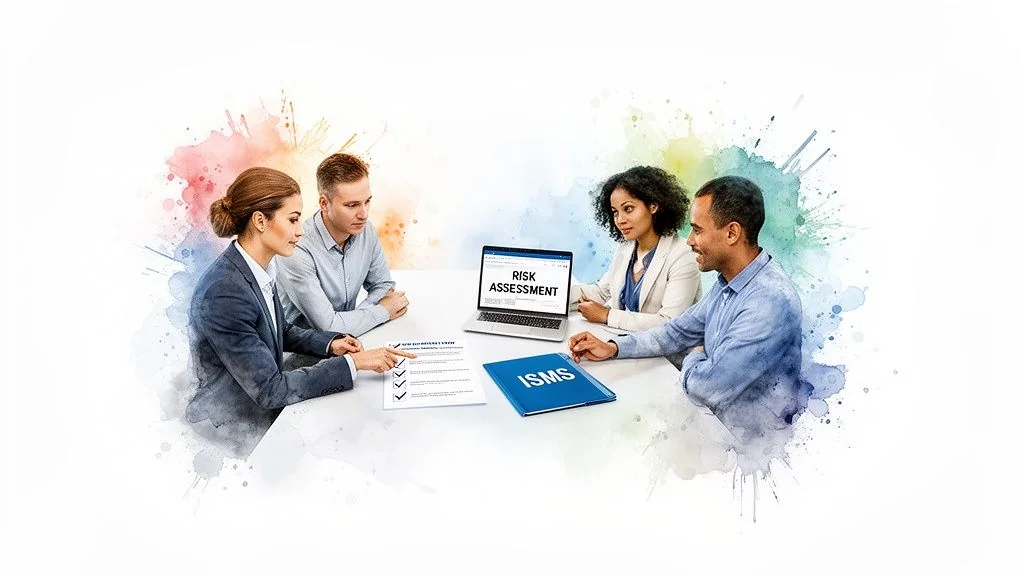
An ISO consultant functions as a specialized project manager and subject matter expert whose primary objective is to implement a management system that meets a specific ISO standard and prepare the organization for a successful certification audit. For a company pursuing a SOC 2 report, the value of an ISO consultant, particularly one specializing in ISO 27001, is their ability to build a formal Information Security Management System (ISMS). An ISMS is the documented framework of policies, procedures, and controls that manage information security. This ISMS provides the foundational evidence required to satisfy many of the AICPA’s Trust Services Criteria, significantly streamlining the SOC 2 audit process.

Core Services of ISO Certification Consultants
A typical engagement with an ISO consultant follows a structured methodology, with each phase designed to produce auditable evidence that directly supports both ISO certification and SOC 2 compliance.
- Gap Analysis: This is the initial diagnostic phase. The consultant assesses your current security posture against the specific clauses and controls of the ISO standard. For a SOC 2-focused organization, this analysis immediately highlights control deficiencies that would likely lead to findings in a SOC 2 audit, such as inadequate risk assessment processes (violating CC3.1) or missing change management procedures (violating CC8.1).
- Risk Assessment and Treatment: Risk management is the cornerstone of ISO 27001. A consultant guides you through the formal process of identifying information assets, analyzing threats and vulnerabilities, and developing a risk treatment plan. This entire process directly generates the evidence needed to satisfy the SOC 2 Trust Services Criteria CC3.1 (Risk Identification and Assessment) and CC3.4 (Risk Response).
- Documentation Development: The consultant assists in creating the extensive documentation required by the standard. This includes drafting the high-level ISMS scope, the information security policy, and operational procedures for controls like access management and incident response. This documentation serves as the primary evidence set for a SOC 2 auditor to review.
- Internal Audits: Before the certification audit, the consultant conducts an internal audit to simulate the real event. This process identifies non-conformities and areas of weakness, providing an opportunity for remediation. This serves the exact same function as a SOC 2 readiness assessment, de-risking the formal audit by uncovering issues before the external auditor arrives.
Why this matters for SOC 2: An ISO consultant’s role is to build a demonstrably effective security program. By conducting a pre-assessment internal audit, they identify and help fix control failures that would otherwise become exceptions or qualifications in a SOC 2 report, saving significant time and remediation costs.
The Consultant vs. The Registrar: A Critical Distinction for Audit Integrity
It is crucial to understand the strict division of duties between the consultant and the registrar (also known as a Certification Body). This separation is mandated to prevent conflicts of interest and maintain the integrity of the certification process.
| Role | ISO Certification Consultant | ISO Registrar (Certification Body) |
|---|---|---|
| Function | Advisory & Implementation: Guides the design, build, and implementation of the management system. | Audit & Certification: Independently tests the management system against the standard and issues the certificate. |
| Goal | To ensure your management system is ready for and successfully passes the audit. | To provide an objective, impartial verification that the system conforms to the standard. |
| Relationship | A collaborative partner and subject matter expert embedded with your team. | An independent, third-party assessor. |
This separation is a significant advantage for a company preparing for SOC 2 audit readiness. The structured, documented ISMS built with the consultant provides a robust evidence base for the SOC 2 audit. For instance, the formal risk assessment report and Statement of Applicability (SoA) developed for ISO 27001 directly satisfy the requirements of SOC 2’s CC3.2, which mandates that “The entity analyzes risks to the achievement of its objectives.” By using an ISO consultant to build the ISMS, you are concurrently generating the validated control evidence a CPA firm will require for your SOC 2 examination, dramatically improving efficiency.
How ISO 27001 Accelerates Your SOC 2 Journey
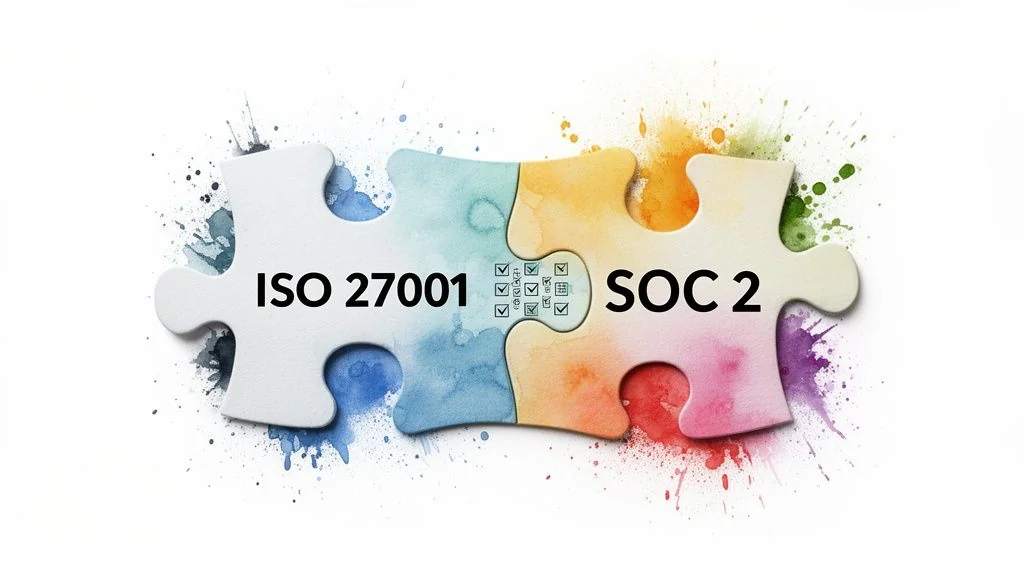
Pursuing ISO 27001 certification before a SOC 2 audit is a strategic approach to compliance, not a duplication of effort. The Information Security Management System (ISMS) required for ISO 27001 provides the policies, procedures, technical controls, and auditable evidence that form the bedrock of a successful SOC 2 examination. Instead of preparing for two separate audits, you are building a single, unified security program that satisfies the requirements of both.
This integrated strategy is driving significant market growth. The demand for ISO certification consultants is rapidly increasing as organizations recognize this efficiency. The global ISO 27001 Certification Market is expected to grow from USD 21.42 billion in 2026 to USD 74.56 billion by 2035, with North America representing 42% of that market. Verifiable security is no longer optional—it is a prerequisite for enterprise contracts.
Mapping Core Controls Between Frameworks
The most significant overlap exists between the ISO 27001 Annex A controls and the SOC 2 Trust Services Criteria, particularly the Security criterion (Common Criteria). As the Common Criteria are mandatory for all SOC 2 reports, achieving ISO 27001 certification first provides a substantial head start. The risk management process central to ISO 27001—which involves identifying assets, threats, vulnerabilities, and creating a risk treatment plan—is a direct implementation of the principles outlined in the SOC 2 CC3 series on Risk Assessment.
Why this matters for SOC 2: When an ISO consultant helps you develop a formal risk assessment methodology, a risk register, and a Statement of Applicability (SoA) for ISO 27001, you are simultaneously creating the exact evidence needed by a SOC 2 auditor to test controls like CC3.1 (Risk Identification) and CC3.4 (Risk Response). This eliminates the need to perform and document a separate risk assessment for your SOC 2 audit. This is a core concept in understanding how Global Standards ISO 27001 align with broader compliance frameworks.
Practical Overlaps That Save Time and Money
The alignment extends far beyond risk management. Nearly every control domain in ISO 27001’s Annex A corresponds to specific requirements within the SOC 2 Common Criteria, enabling a one-to-many mapping that significantly reduces redundant evidence collection and control implementation.
This table highlights how implementing ISO 27001 Annex A controls generates direct evidence for a SOC 2 audit, covering substantial portions of the Trust Services Criteria.
Mapping ISO 27001 Controls to SOC 2 Criteria
| ISO 27001 Annex A Control Domain | Relevant SOC 2 Trust Services Criteria | SOC 2 Relevance Explained |
|---|---|---|
| A.5 Organizational Controls | CC1 (Control Environment), CC2 (Communication) | The policies, defined roles, and responsibilities required by A.5 directly demonstrate the “tone at the top” and commitment to integrity and ethical values that form the basis of CC1.1. |
| A.6 People Controls | CC1.2 (Board Oversight), CC2.2 (Internal Communication) | Controls for screening, onboarding (A.6.3), and security awareness training (A.6.4) provide the exact evidence needed to satisfy SOC 2 criteria related to HR security and demonstrating a competent workforce. |
| A.7 Physical Controls | CC6.3 (Physical Access), CC7.3 (Environmental Protection) | Requirements for secure areas, entry controls, and protection against environmental threats directly map to SOC 2 criteria for restricting physical access to facilities and protecting against environmental hazards. |
| A.8 Technological Controls | CC6 (Logical Access), CC7 (System Operations) | Controls for access control (A.8.2), cryptography (A.8.24), and change management (A.8.32) satisfy a large portion of the technical controls audited in SOC 2, including CC6.1, CC7.1, and CC8.1. |
The work performed with ISO certification consultants to define, document, and implement these Annex A controls provides a dual benefit during a SOC 2 examination. These services build a comprehensive, auditable security program that serves as the foundation for multiple compliance objectives, saving time, reducing costs, and demonstrating a mature security posture.
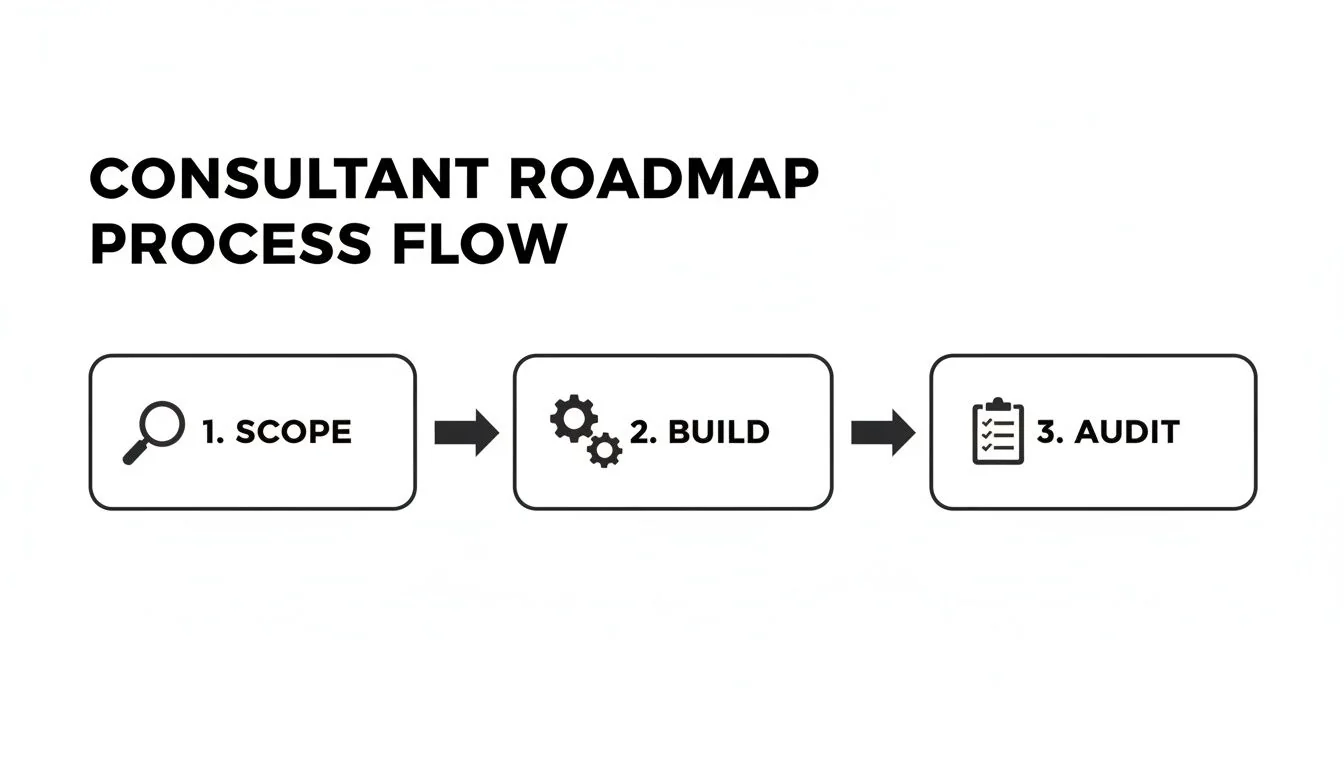
The Consultant Engagement Roadmap: From Gap Analysis to Audit Success
Engaging an ISO consultant initiates a structured project designed to build a compliant Information Security Management System (ISMS) capable of passing a formal audit. The process is methodical, moving through distinct phases that are critical for achieving both ISO 27001 certification and laying the groundwork for a SOC 2 report.
The global ISO certification market, valued at USD 30,931.2 million in 2026 and projected to reach USD 80,786.9 million by 2033 with a 14.7% CAGR, reflects the growing recognition that expert guidance is essential for navigating this complexity. More details on these trends are available at BrandEssenceResearch.com.
Phase 1: Scoping and Gap Analysis
The initial phase focuses on defining the project’s boundaries. The consultant works with key stakeholders to establish the scope of the ISMS—clarifying which people, processes, systems, and locations will be included in the audit. A poorly defined scope can lead to audit failures or unnecessary work. Following scoping, the consultant performs a gap analysis, meticulously comparing your current security practices against each requirement of the ISO 27001 standard. The deliverable is a detailed, prioritized action plan that becomes the project roadmap.
Why this matters for SOC 2: The ISMS scope definition directly informs the “system description” for your future SOC 2 report, a critical component that defines what the auditor will examine. The gap analysis identifies control weaknesses that would manifest as exceptions in a SOC 2 audit, such as a lack of formal vendor risk management (CC9.2) or insufficient incident response testing (CC7.3), allowing you to remediate them proactively.
Phase 2: Implementation and Remediation
This is the execution phase. Using the gap analysis as a guide, the consultant provides actionable guidance to build missing components and remediate identified weaknesses. This involves a combination of policy writing, process design, and advising on technical control implementation.
Key activities include:
- Developing Core Documentation: Creating the foundational ISMS documents, such as the Information Security Policy, Risk Assessment Methodology, and the Statement of Applicability (SoA).
- Guiding Control Implementation: Providing best-practice advice as your teams implement technical and procedural controls, from access control workflows to backup and recovery procedures.
- Systematic Remediation: Addressing each gap identified in Phase 1, with the consultant providing templates and expertise to ensure solutions are both compliant and practical for your business.
For example, when a consultant helps your engineering team formalize a change management process, they ensure it meets ISO 27001 Annex A.8.32 (Change Management). This work simultaneously generates the evidence—such as change request logs and testing approvals—needed to satisfy SOC 2’s CC8.1, which requires changes to be authorized, designed, tested, and implemented to meet the entity’s objectives.
Phase 3: Internal Audit and Management Review
Before the external certification audit, a full dress rehearsal is essential. The consultant performs a comprehensive internal audit of the newly implemented ISMS, rigorously testing controls and reviewing documentation to identify any non-conformities or areas for improvement. This is followed by a formal management review meeting, where the consultant presents the internal audit findings, ISMS performance metrics, and any residual risks to the leadership team for discussion and action.
Why this matters for SOC 2: This phase is the direct equivalent of a SOC 2 readiness assessment. The internal audit is designed to find and fix the same types of issues a SOC 2 auditor would, such as inconsistent application of a policy or failure to produce evidence for a specific control. It provides a critical opportunity to remediate issues before they can impact the outcome of your formal SOC 2 examination.
Phase 4: Certification Audit Support
With the ISMS built, tested, and refined, the final step is the two-stage certification audit conducted by an independent, accredited registrar. The consultant’s role shifts from implementer to advocate and guide. They prepare your team for auditor interviews, ensure all required evidence is organized and accessible, and assist in formulating responses to any auditor inquiries or findings.
Why this matters for SOC 2: Successfully navigating an ISO 27001 certification audit builds “audit muscle” within your organization. The process of preparing for, participating in, and responding to auditor requests provides invaluable experience. This disciplined approach systematically creates the mature controls, robust documentation, and auditable evidence that form the foundation of a strong SOC 2 report, ensuring your team is prepared for any audit scrutiny.
Common Pitfalls to Avoid in Your ISO 27001 Project
Successfully navigating an ISO 27001 project, especially with a parallel SOC 2 goal, requires avoiding common pitfalls that derail even well-resourced organizations.
The “Shelfware ISMS” Trap. The most frequent error is treating ISO 27001 as a documentation exercise, creating an ISMS that exists only on paper and is disconnected from actual operations. This guarantees a failed Stage 2 audit and provides zero value for a SOC 2 Type 2 report, which requires evidence of controls operating effectively over time. Under ISO 27001:2022, auditors are laser-focused on genuine operational integration—demanding proof that your ISMS is embedded in how you operate every day, not just a binder on a shelf.
Improper Scoping. Narrowing the ISMS boundary to exclude key systems or departments to simplify the ISO audit can render a subsequent SOC 2 report incomplete or irrelevant to key customers. From a SOC 2 perspective, the system in scope must align with the services being reported on. Scope decisions made purely to ease the ISO certification process can create significant problems when the SOC 2 audit begins.
Underestimating Internal Ownership. An ISMS that belongs entirely to the consultant will fail its first surveillance audit. The standard requires continual improvement and ongoing management—activities that must be owned internally. Organizations that treat the engagement as a handoff rather than a knowledge transfer end up unable to maintain the ISMS after the consultant departs.
Why this matters for SOC 2: A SOC 2 Type 2 report specifically attests to the operating effectiveness of controls over a period. By building an operationally integrated ISMS to satisfy ISO 27001:2022 auditors, you are simultaneously generating the exact evidence required for a SOC 2 Type 2 audit. The artifacts from a well-run ISMS—risk assessments, internal audit reports, and management review minutes—prove that your security program is a living, managed process.
How ISO 27001:2022 Impacts Your SOC 2 Readiness
The ISO 27001:2022 revision significantly impacts ISMS implementation and its alignment with SOC 2. The Annex A controls were consolidated from 114 to 93 and reorganized into four themes. The mandatory transition deadline for all existing certifications was October 31, 2025—organizations still operating under the 2013 standard must treat re-certification to ISO 27001:2022 as an immediate priority. You can get a full rundown on what changed in the 2022 revision to understand how it affects your program.
For an organization pursuing SOC 2, this new structure simplifies the control mapping process. The four themes align more intuitively with the Trust Services Criteria than the previous structure did.
- Organizational Controls (37): Cover governance, policies, and roles, providing direct evidence for the SOC 2 control environment (CC1 series) and risk assessment (CC3 series).
- People Controls (8): Address HR security throughout the employee lifecycle, mapping directly to logical access and HR-related controls within the CC2 and CC6 series.
- Physical Controls (14): Govern physical security and environmental protections, aligning with physical access controls in CC6.4.
- Technological Controls (34): Encompass technical measures like access control, cryptography, and network security, mapping to the bulk of technical controls in CC6 and CC7 (e.g., CC6.1, CC6.3, CC7.1).
This reorganization benefits dual-framework programs in a practical way: when your consultant implements controls under the 2022 structure, the mapping artifacts they produce translate more cleanly to SOC 2 criteria categories. Evidence collected for Organizational Controls slots directly into CC1 and CC3 testing; evidence collected for Technological Controls covers the majority of CC6 and CC7 requirements. The net effect is fewer custom cross-references and less rework when the SOC 2 audit begins.
The 2022 auditor mindset shift: Auditors under the revised standard are demanding proof that your ISMS is operationally integrated—not just designed on paper. A SOC 2 Type 2 report requires the same proof of operating effectiveness over time. Building to the 2022 standard means you are producing exactly the right evidence for both audits simultaneously.
How to Select the Right ISO Certification Consultant
Choosing the right ISO consultant when SOC 2 is also a goal is a critical strategic decision. You are not merely hiring a resource to achieve a single certification; you are selecting a partner who will build the foundation for your entire compliance program. A consultant with integrated expertise will construct an ISMS that makes your future SOC 2 audit significantly more efficient and less costly. The engagement is a structured project moving from scoping and gap analysis to implementation and audit support.
Vetting for Integrated Compliance Expertise
Your primary objective is a streamlined path to both ISO 27001 and SOC 2 compliance. Therefore, your vetting process must focus on identifying consultants who can demonstrate deep expertise in harmonizing these two frameworks, not just treating them as separate projects.
Use specific, evidence-based questions to validate their capabilities:
Actionable RFP Questions to Ask:
- “Describe your methodology for mapping ISO 27001 Annex A controls to the SOC 2 Trust Services Criteria to minimize redundant evidence collection.”
- “Provide a sanitized example of a risk assessment report you have prepared that was successfully used for both an ISO 27001 and a SOC 2 audit.”
- “What is your strategy for evidence collection in a cloud-native environment (e.g., AWS, Azure) to simultaneously satisfy both ISO 27001 and SOC 2 requirements?”
- “Walk us through a project where you guided a company of our size and industry through ISO 27001 certification, followed by a successful SOC 2 Type 2 attestation. What were the key challenges and how did you address them?”
These questions demand concrete proof of experience. Starting with expert consultation services can help you refine your requirements for this dual-purpose engagement.
ISO 27001 Service Provider Comparison
Not all providers are created equal. The type of firm you choose will dictate your cost, speed, and how easily you can achieve SOC 2 in parallel. Here is how the three primary provider types compare.
| Provider Type | Typical Cost Range | Approach | Best For SOC 2 Readiness |
|---|---|---|---|
| Big Four Audit Firm | $70K - $150K+ | Formal, siloed teams. ISO and SOC 2 groups often don’t communicate with each other. | Poor. High cost, slow, and you will likely work with two separate teams, negating any efficiency gains. |
| Boutique Cybersecurity Consultancy | $40K - $80K | Hands-on, specialized. Can be excellent but may lack a licensed CPA arm for the SOC 2 attestation. | Good, but limited. Great for ISO 27001 prep, but you will still need to hire a separate CPA firm for the SOC 2 audit itself. |
| Integrated Audit Firm (CPA + ISO) | $50K - $90K | Unified. A single team of cross-trained auditors handles both frameworks under one SOW. | Excellent. This is the gold standard: one team, one process, one streamlined audit with maximum efficiency. |
A partner who specializes in integrated audits finds efficiencies at every step—from scoping through certification. By mapping controls once and collecting evidence once, organizations can reduce the engineering and GRC team effort by as much as 40% compared to running separate audits.
Critical Red Flags to Watch For
Identifying warning signs is as important as recognizing positive attributes. Certain indicators can reveal a consultant who lacks the depth required for an integrated audit strategy.
Why this matters for SOC 2: A consultant who guarantees certification is an immediate red flag. Ethical consultants and auditors understand that certification is the outcome of an independent audit and cannot be guaranteed. This promise suggests a misunderstanding of the process or a focus on sales over professional integrity, which is counter to the principles of both ISO and SOC 2.
Other warning signs include:
- The “Template Dump” Approach: If their proposal involves providing a generic set of document templates with minimal customization, they are not a true consultant. A valuable consultant tailors the ISMS to your specific business processes, technology stack, and risk profile.
- Lack of Technical Fluency: If they cannot discuss the security features and configuration of your core technology stack (e.g., AWS IAM, Azure Active Directory, GitHub branch protection rules), they cannot provide practical, actionable advice for implementing technical controls.
- No Relevant Client Experience: A consultant whose experience is primarily with large, non-tech enterprises will struggle to adapt to the agile environment of a SaaS company. Their client history should include organizations similar to yours in size, industry, and technical maturity.
For additional insights on choosing a compliance partner, refer to our guide on selecting SOC 2 compliance consultants.
Why this matters for SOC 2: An effective ISO consultant is a strategic asset for your SOC 2 readiness. Their primary function is to build a security program that satisfies the detailed requirements of the SOC 2 Common Criteria (CC), such as CC3.2 (Risk Analysis) and CC6.1 (Logical Access Control), using the ISO 27001 standard as the implementation framework. The policies, risk assessments, and control evidence created for the ISMS are the precise artifacts your SOC 2 auditor will demand. A skilled consultant understands this dual purpose and builds a program that efficiently serves both audits from the outset.
Budgeting for Your ISO Consulting Engagement
Budgeting for an ISO certification project requires accounting for consultant fees, certification body charges, and the significant internal resources required. A common pitfall is underestimating the internal effort needed to build a certifiable Information Security Management System (ISMS), especially if starting from a low-maturity security posture. The process involves extensive documentation, potential technology implementation, employee training, and internal audits that must be completed before the formal certification audit begins.
Breaking Down the Costs and Timelines
A comprehensive budget must account for three distinct cost categories. Overlooking any one of these can lead to project delays and budget overruns.
- Consulting and Readiness Fees: This covers the expert guidance from a firm to perform a gap analysis, assist with risk assessment, develop ISMS documentation (policies, procedures), and prepare your team for the certification audit. This phase is where the foundation for SOC 2 evidence is built.
- Certification Body Audit Fees: These are paid to the separate, accredited registrar that conducts the official Stage 1 (documentation review) and Stage 2 (substantive testing) audits and issues the ISO 27001 certificate.
- Ongoing Surveillance Audit Fees: ISO 27001 certification is valid for three years, contingent upon successful annual surveillance audits in years two and three. These audits ensure the ISMS remains effective and are a non-negotiable cost to maintain certification.
Market alert: We are seeing serious inflationary pressure in the certification market. In 2026, expect certification costs to increase by approximately 20% compared to 2025, driven almost entirely by a growing shortage of qualified auditors. Budget for this now rather than being surprised mid-project. You can read the full briefing on these trends in ISO 27001 certification costs.
Why this matters for SOC 2: The most frequent cause of failure in an ISO project is not a failed audit but a project that stalls due to inadequate resource planning. Budgeting for your team’s time is as critical as budgeting for external fees. This internal resource investment directly builds the operational security discipline and evidence base you will need for your SOC 2 audit.
The following benchmarks provide a realistic estimate for an ISO 27001 project. A consultant with deep SOC 2 expertise may command a premium, but the investment is often justified by the significant reduction in redundant work for both audits.
Estimated ISO 27001 Consulting Costs and Timelines by Company Size (2026)
| Company Profile | Estimated Consulting Fees | Estimated Timeline to Certification | Key Influencing Factors |
|---|---|---|---|
| SaaS Startup (15-50 Employees) | $25,000 - $50,000+ | 6 - 9 Months | Low initial security maturity, limited internal resources, and a narrowly defined ISMS scope. |
| Mid-Market Tech (50-250 Employees) | $50,000 - $90,000+ | 9 - 12 Months | Moderate existing security controls but requires significant documentation and process formalization. |
| Enterprise (250+ Employees) | $90,000 - $150,000+ | 12 - 18+ Months | Complex environment with multiple business units, legacy systems, and a broader ISMS scope. |
Aligning Timelines for Maximum Efficiency
For organizations pursuing both ISO 27001 and SOC 2, strategic scheduling is paramount to eliminating redundant testing and evidence collection. The most effective strategy is to schedule your ISO 27001 Stage 2 certification audit to conclude immediately before your SOC 2 Type 2 observation period begins.
This timing allows the ISO 27001 audit report and its underlying evidence—including the risk assessment, Statement of Applicability, and internal audit reports—to serve as the baseline for the SOC 2 audit. It directly supports SOC 2 requirements like CC3.2 (Risk Assessment) and CC5.1 (Monitoring Activities). This approach transforms two separate projects into a sequential, unified effort, significantly accelerating the timeline to achieving both certifications while minimizing the burden on internal teams.
Why this matters for SOC 2: This investment serves as a strategic accelerator for SOC 2 compliance. The ISMS you build for ISO 27001 produces the tangible evidence required for the SOC 2 Common Criteria. For example, the risk assessment activities conducted to satisfy ISO 27001 clauses 6.1.2 & 8.2 generate the precise risk register and treatment plan needed to address SOC 2’s CC3 series on Risk Assessment. By engaging a consultant who understands both frameworks, you consolidate efforts and accelerate the timeline to achieving both certifications.
How to Onboard Your Consultant for a Successful Partnership
The value of a skilled ISO consultant is realized through a well-executed onboarding process that establishes a strong partnership. Effective onboarding is a deliberate strategy to align expectations, grant necessary authority, and integrate the consultant into your operational workflow. A flawed onboarding process leads to project friction, delays, and a weaker audit outcome. The first critical step is to assign a dedicated internal project lead to serve as the consultant’s primary point of contact and internal advocate, responsible for clearing roadblocks and facilitating access to stakeholders.
Setting Up for Success From Day One
Once the project lead is designated, establish a clear operational framework to ensure accountability and maintain project momentum.
Your initial onboarding checklist should include these fundamental actions:
- Grant System Access: Provide the consultant with role-based, least-privilege access to necessary systems, such as your cloud console (read-only), source code repositories, and HRIS platform.
- Establish Communication Channels: Create a dedicated project management space in a tool like Asana or Jira for task tracking and a shared channel in Slack or Teams for real-time communication.
- Schedule Stakeholder Kick-Offs: Arrange initial meetings between the consultant and key department heads (e.g., Engineering, IT, HR, Legal) to establish rapport and provide organizational context.
Preparing Your Internal Teams
A common failure point is not preparing internal teams for the consultant’s arrival. Employees may view the consultant as an external auditor, leading to defensive and uncooperative interactions. Frame the consultant’s role as a collaborative partner whose goal is to strengthen the company’s security posture and ensure a successful audit.
Why this matters for SOC 2: Set clear expectations regarding the time commitment required from your teams. Communicate that the project is a company-wide priority and that prompt participation in interviews and evidence provision is expected. This prevents the consultant from becoming an administrative bottleneck and builds the cross-functional collaboration muscle essential for a SOC 2 audit.
For instance, when the consultant needs to review the employee onboarding process, explain to HR that the objective is to ensure alignment with ISO 27001 Annex A.6.3 (Information security in the onboarding process), which also provides evidence for SOC 2 controls related to workforce conduct. This context transforms a potential interrogation into a collaborative process review. The stakeholders involved in the ISO 27001 project—from engineers managing cloud access to HR overseeing background checks—are the same individuals who will be central to your future SOC 2 audit. Onboarding the consultant effectively serves as a dry run for the SOC 2 examination, instilling the security discipline and preparing the exact evidence you will need to provide to your SOC 2 auditor.
ISO 27001 vs. SOC 2: Build Once, Report Twice
Organizations often mistakenly view ISO 27001 and SOC 2 as two independent, burdensome compliance obligations. This is an inefficient and costly perspective. While the deliverables differ—ISO 27001 is a certification of a management system, while SOC 2 is an attestation report on controls—they are built upon the same foundational security principles and control activities.
The most effective approach is to view ISO 27001 as the process of building and formalizing the security program (the ISMS), and SOC 2 as the process of having an independent auditor report on the effectiveness of that program’s controls. By building the ISMS correctly for ISO 27001, the SOC 2 audit becomes a validation of work already completed—not a separate project.
How ISO 27001 Work Directly Feeds Your SOC 2 Audit
The work performed to establish an ISO 27001-compliant ISMS produces the exact evidence required by SOC 2 auditors. This overlap is substantial and provides a strategic shortcut, preventing redundant evidence collection and audit fatigue.
Key areas of direct synergy include:
| ISO 27001 Work Product | SOC 2 Criteria Satisfied | How It Maps |
|---|---|---|
| Risk Assessment & Treatment Plan (Clause 6) | CC3.1, CC3.2 | The formal risk assessment methodology and Risk Treatment Plan directly satisfy the requirements for risk identification and analysis. This is a one-to-one mapping of a major compliance task. |
| Policies and Procedures (Annex A) | CC1 series | The comprehensive set of policies developed for the ISMS—access control policy, incident response plan, data classification policy—serve as primary documentary evidence for the SOC 2 auditor to evaluate control design. |
| Internal Audit Program (Clause 9.2) | CC5.1 | The mandatory ISO 27001 internal audit program and subsequent corrective actions provide tangible evidence of ongoing monitoring activities, directly supporting the Monitoring Activities criterion. |
Getting an ISO 27001 certification isn’t just about the certificate. It’s a strategic move that builds the entire foundation you need to succeed in a SOC 2 audit. It’s how you prove your program isn’t just designed well, but works in the real world.
This two-for-one approach is how companies like Chainlink achieved both ISO 27001 certification and a SOC 2 attestation, cementing their status as an enterprise-ready platform. Their ISMS became the single source of truth for their compliance program—the evidence generated for ISO 27001 internal audits and management reviews was the same evidence the SOC 2 auditor requested and tested. This integrated strategy transforms compliance from a series of disconnected, high-effort projects into a single, sustainable, and efficient security program.
The Strategic Connection Between ISO 27001 and SOC 2 Readiness
Achieving ISO 27001 certification with the guidance of a knowledgeable consultant is a direct and strategic accelerator for attaining a clean SOC 2 report. The Information Security Management System (ISMS) you are required to build is not merely a set of documents; it is a functioning, auditable security program. This program and its associated evidence—the policies, procedures, risk assessments, and internal audit reports—are precisely what a SOC 2 auditor will examine to test the controls described in your system description. An ISO certification consultant with expertise in both frameworks ensures that every control implemented for ISO 27001 is designed to concurrently satisfy a corresponding SOC 2 requirement.
For example, the procedures developed to manage user access rights under ISO 27001’s Annex A.5.15 (Access control) and A.5.18 (Access rights) directly generate the evidence needed to demonstrate compliance with SOC 2’s CC6.2 and CC6.3, which cover the authorization, modification, and periodic review of access to data and systems. By leveraging the ISO 27001 framework, you are not performing redundant work; you are systematically building the control environment and evidence library required for SOC 2 audit readiness. This integrated approach transforms two seemingly separate compliance obligations into a single, efficient project, drastically reducing the time, cost, and organizational friction involved in preparing for a SOC 2 audit.
Finding the right auditor is as critical as building the right controls. SOC2Auditors is a comparison platform that provides verified pricing, timelines, and satisfaction scores from 100+ audit firms, helping you find the perfect partner for your SOC 2 audit without the sales calls. Get three tailored matches.