 Menu
Menu
When you’re starting a SOC 2 project, you’ll hear two terms thrown around constantly: consultant and auditor. Getting them mixed up is a classic rookie mistake, and it can cost you months of work and lead straight to a failed audit.
They are not interchangeable. Think of it this way: one helps you get ready for the test, and the other grades it.
Consultant vs. Auditor: Defining the Core Roles in SOC 2
Your SOC 2 compliance consultant is your guide, your strategic partner who gets you ready for the main event. They’re the coach who helps you design the game plan (your security controls) and run the drills (gathering evidence).
On the other hand, the SOC 2 auditor is the independent referee who shows up on game day to make the official calls. They have one job: to objectively evaluate whether your controls are designed and operating effectively according to the rules set by the AICPA.
This strict separation of duties isn’t just good practice; it’s a mandatory rule for a valid SOC 2 report.

The Advisor vs. The Assessor
Here’s a simple analogy: building a house.
- The consultant is your architect. They work with you to draw up the blueprints (your control framework), help you pick the right materials (security tools and policies), and make sure the construction crew is doing things correctly along the way.
- The auditor is the city inspector. They show up after the work is done to verify that everything is built to code. They don’t help you build; they just assess the final product.
The most critical rule in the SOC 2 process is the mandatory separation of duties. The firm that consults on implementing your controls cannot be the same firm that audits them. This ensures the auditor’s independence and the integrity of the final report.
If you hire the same firm for both, you’ve created a massive conflict of interest. The resulting SOC 2 report would be invalid because it lacks the required third-party objectivity that gives it any real meaning.
Comparing Key Functions
Let’s break down exactly what each role does. Understanding these differences is key to budgeting correctly and hiring the right expert at the right time.
| Aspect | SOC 2 Compliance Consultant (The Guide) | SOC 2 Auditor (The Judge) |
|---|---|---|
| Primary Goal | Audit Readiness and Preparation | Independent Attestation and Evaluation |
| Key Activities | Gap analysis, control design, policy writing, evidence collection guidance | Control testing, fieldwork, interviewing staff, report issuance |
| Timing of Engagement | Pre-audit (months or even a year before) | During the formal audit period |
| Relationship | Collaborative partner and advisor | Objective and independent evaluator |
A Detailed Comparison of Consultants and Auditors
We’ve established the basic difference: consultants are your guide, auditors are the judge. Now, let’s get into the specifics of who does what, day-to-day. This isn’t just theory—understanding their distinct roles is critical for budgeting your time and money correctly.
A consultant’s work is all proactive. They’re in the trenches with you, building and refining your security program to make sure it can actually pass an audit. Their entire goal is to get you ready, minimize nasty surprises, and help you earn a clean report.
On the other hand, an auditor’s role is purely evaluative. They show up only when you say you’re ready, and they maintain strict, professional distance. Their job isn’t to help you fix things; it’s to test what you’ve built and give an unbiased opinion.
Scope of Work and Involvement
The way each one engages with your team couldn’t be more different. Consultants are hands-on partners, often feeling like an extension of your team for months. They’ll run workshops to write policies, help configure your security tools, or sit with your engineers to pull the right evidence. Their scope is wide, touching everything from the initial risk assessment to the final control implementation.
Auditors, however, have a very narrow scope focused entirely on testing. Their interactions are formal and structured, limited to evidence requests, interviews, and system walkthroughs. They are not there to give advice. They are there to assess.
Key Takeaway: A consultant’s value is measured by how well they prepare you for a successful audit. An auditor’s value is measured by the integrity and objectivity of their final report. One builds your defense, the other tests its strength.
The need for this kind of expertise is skyrocketing. The cybersecurity consulting market is projected to grow from $20.34 billion in 2026 to a massive $48.33 billion by 2031. This is fueled by a global talent shortage of nearly 4.8 million security professionals. For startups and growth-stage companies, this gap makes a good consultant an absolute necessity. You can dig into the cybersecurity consulting market trends on mordorintelligence.com.
Core Responsibilities and Key Deliverables
Let’s talk about what you actually get from each. A consultant delivers the foundational documents and strategic roadmaps. An auditor delivers the official, signed attestation report that you’ll share with your customers.
To make this crystal clear, the table below breaks down their distinct responsibilities. It’s the simplest way to see how their complementary roles are designed to never overlap.
Consultant vs Auditor Key Responsibilities and Deliverables
| Area of Focus | SOC 2 Compliance Consultant (The Guide) | SOC 2 Auditor (The Judge) |
|---|---|---|
| Primary Objective | To achieve audit readiness by identifying and remediating gaps in your security controls. | To perform an independent evaluation of existing controls and issue a formal attestation. |
| Key Activities | - Conducting a readiness assessment and gap analysis. - Designing and documenting controls. - Writing security policies and procedures. - Guiding evidence collection and organization. | - Reviewing management’s assertion and system description. - Performing control testing and fieldwork. - Interviewing personnel about control operations. - Documenting test results and exceptions. |
| Primary Deliverable | A readiness assessment report, a detailed project plan with remediation tasks, completed security policies, and organized evidence. | The official SOC 2 Type 1 or Type 2 audit report, including the auditor’s opinion on the effectiveness of your controls. |
| Level of Collaboration | High. Acts as an extension of your team, providing hands-on guidance, training, and support throughout the preparation phase. | Low. Maintains strict independence and objectivity, with interactions limited to formal requests for evidence and interviews. |
| Conflict of Interest | The consultant is your advocate and is biased toward helping you succeed in the audit. | The auditor must remain unbiased and independent, with a duty to report objectively on control effectiveness. |
As you can see, hiring a consultant is an investment in preparation that has a direct line to the final outcome of your audit. One simply cannot do the other’s job.
When to Hire SOC 2 Compliance Consultants
Knowing when to bring in a SOC 2 compliance consultant can feel like a tough call. Do you need one now, later, or maybe not at all? The right answer really comes down to where your company is today—your internal expertise, your readiness, and the pressures you’re feeling from customers. Hiring a consultant isn’t just about offloading work; it’s a strategic move to get compliant faster and sidestep expensive mistakes.
For a lot of companies, the tipping point is a big client demand. A major enterprise customer makes it clear: no SOC 2 report, no deal. Suddenly, what was a long-term goal is now a fire drill. Without a clear plan, the risk of losing that revenue is what pushes them to find an expert.
This decision tree cuts right to the chase: are you preparing for an audit, or are you ready for one? It’s the simplest way to figure out which path to take.
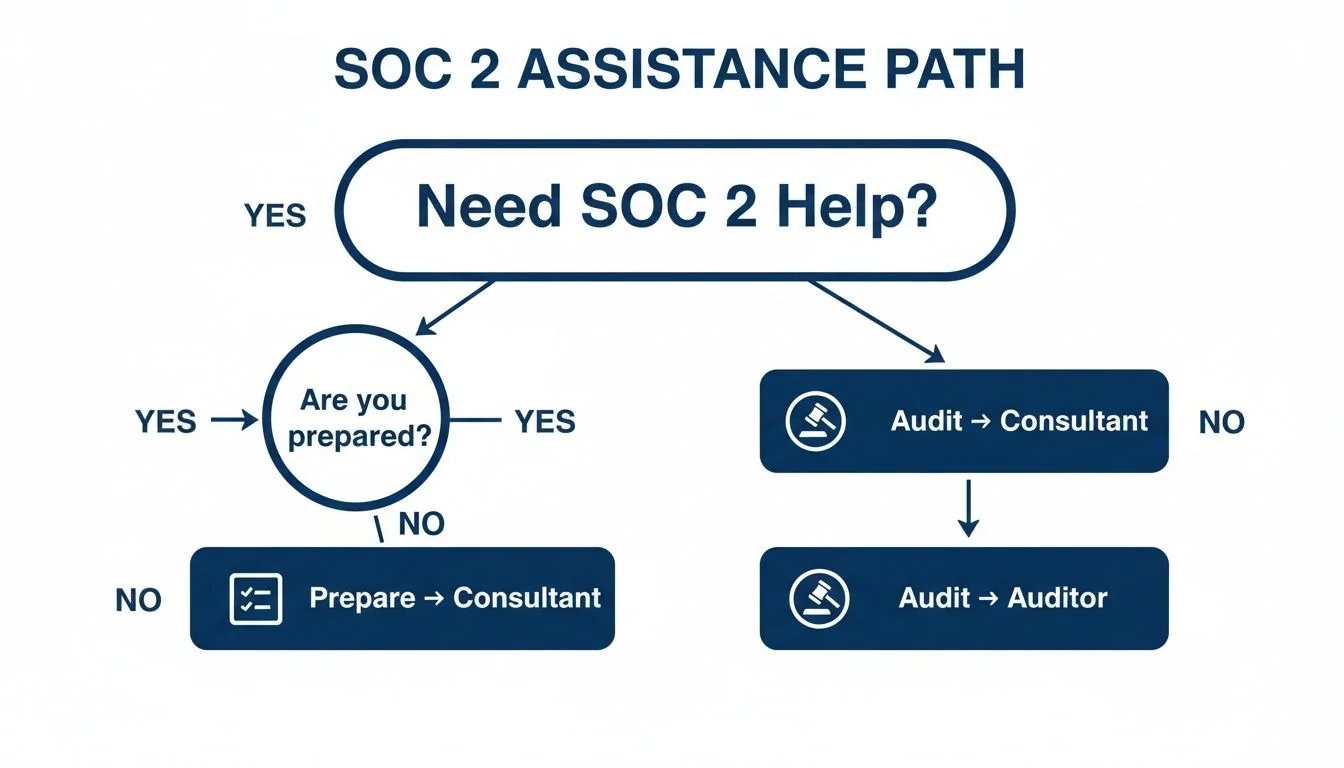
As you can see, if you’re in the preparation phase—building controls, writing policies, and gathering evidence—a consultant is your best bet. If you believe you’re ready for the final, independent evaluation, it’s time to call in the auditor.
Early-Stage Startups Building a Security Foundation
If you’re a startup with no formal security program, a consultant is basically a necessity. You aren’t just getting ready for an audit; you’re building the entire security posture of your company from the ground up. In this situation, consultants act as fractional security leaders.
They’ll help you:
- Establish a baseline: First, they run a gap analysis to see how you stack up against the SOC 2 Trust Services Criteria.
- Design practical controls: They translate the abstract SOC 2 requirements into concrete technical and policy controls that actually make sense for your tech stack and team.
- Write foundational policies: They create the core documentation, like an Information Security Policy, that you probably don’t have yet.
Going it alone without experience often means building controls that either won’t pass the audit or are so clunky they slow down your growth. A good consultant helps you build a security program that is both compliant and practical.
Established Companies Lacking SOC 2 Experience
An established company might have a solid IT team and some decent security practices, but that doesn’t mean it’s ready for an audit. Your existing processes for things like access control or change management might not meet the strict documentation standards of SOC 2.
“Many companies have good security practices but fail their first audit because of poor evidence. A consultant’s greatest value is teaching you how to prove your controls are working, not just that they exist.”
For these companies, the consultant’s role shifts from a builder to a translator. They map your current operations to SOC 2 requirements, pinpoint where your documentation falls short, and help you organize evidence so auditors can easily test it. This entire prep phase is often called a SOC 2 readiness assessment, and it’s a critical step before you even think about hiring an auditor.
Organizations Facing Tight Deadlines
When a huge sales contract or a strategic partnership depends on you delivering a SOC 2 report on a tight schedule (think three to six months), a consultant becomes a non-negotiable part of the team. They bring a proven project management approach to the table, speeding up every single step.
In a time crunch, their value is clear:
- Project Acceleration: They provide templates, tools, and a clear roadmap that keeps the project moving forward without costly detours.
- Resource Augmentation: They serve as an extra pair of hands for your team, which is almost certainly stretched thin already.
- Risk Mitigation: They spot potential roadblocks weeks or months in advance, preventing last-minute panics that could derail your audit timeline.
As you weigh these scenarios, it can also be smart to look at broader solutions like managed IT services for business compliance and data privacy regulations. Ultimately, getting the right partner involved at the right time is the single biggest factor in a successful SOC 2 journey.
How to Select the Right SOC 2 Consultant
Picking the right partner for your SOC 2 journey is one of the most critical decisions you’ll make. A great consultant becomes an extension of your team, turning complex compliance jargon into a clear, actionable project plan. A bad fit, on the other hand, leads to blown budgets, missed deadlines, and a miserable audit experience. You need a structured way to evaluate them.
Don’t just compare price tags. This is a classic mistake. A cheaper consultant who doesn’t get your business or your tech stack will create far more expensive problems down the road. The real goal is finding a partner whose expertise perfectly matches your operational reality and what you’re trying to achieve.

Core Evaluation Criteria
When you start comparing consultants, focus your energy on four key areas. Think of these as the pillars that will support a successful project. Get these right, and you’ll find a partner who has the technical chops and fits how your company actually works.
- Industry and Niche Expertise: Do they have a track record in your specific world, like HealthTech or FinTech? Someone who already knows the risks and rules unique to your industry (like HIPAA or PCI DSS) will give you much sharper, more relevant advice.
- Technical and Stack Familiarity: Your consultant has to speak your language. If your entire world runs on AWS, a firm that specializes in Amazon’s cloud is going to be infinitely more helpful than a generalist.
- Approach and Methodology: How do they actually run the project? Ask them about their communication style, what project management tools they use, and how they tackle evidence collection. A hands-on, collaborative style is almost always better than a rigid, checklist-driven one.
- Team and Cultural Fit: Remember, you’re going to be in the trenches with these people for months. Make sure their team’s communication style and work ethic mesh with yours.
The demand for this kind of specialized expertise is exploding, especially in data-heavy sectors. For instance, the market for SOC 2 Compliance in Financial Services alone hit $1.92 billion in 2024 and is projected to reach $6.47 billion by 2033. This growth is fueled by fintechs and banks needing to prove they can protect customer data, with large enterprises accounting for over 61% of that market. You can dig into the financial services SOC 2 market growth on marketintelo.com.
Key Questions to Ask Potential Consultants
Once you’ve got a shortlist, the interview is where you separate the real experts from the slick salespeople. Push past the sales pitch and ask pointed, operational questions that show you how they really operate. Their answers will tell you everything.
Here are a few essential questions to get the conversation started:
- Can you share case studies or references from companies just like ours—similar in size, industry, and tech stack?
- What’s your process for evidence collection and management? What specific tools or platforms do you prefer and why?
- Walk me through your process for fixing a control that fails during the gap analysis. Give me a real example.
- What does your communication cadence look like? How will we track progress and know if we’re on schedule?
- Who from your team will be my day-to-day contact, and what’s their direct, hands-on experience?
A great consultant doesn’t just give you a list of tasks; they explain the ‘why’ behind each control and help you implement them in a way that supports your business instead of hindering it. Look for a teacher, not just a taskmaster.
A Practical Decision Checklist
Use a simple checklist to compare your candidates side-by-side. It keeps you objective, stops you from being swayed by a fancy slide deck, and keeps the focus on what actually matters for a successful audit.
Consultant Evaluation Checklist:
- Experience: Do they have 5+ years of direct SOC 2 readiness experience?
- Industry Match: Have they worked with at least two other companies in your specific industry?
- Tech Stack Fluency: Did they clearly understand your core infrastructure (e.g., AWS, GCP, Azure) without you having to explain it?
- Methodology Clarity: Was their project plan clear, with defined milestones and deliverables?
- Tooling: Do they have hands-on experience with the compliance automation tools you already use or plan to use?
- Team Dynamics: Did you meet the actual project lead, not just a salesperson?
- References: Were their client references genuinely positive and relevant to your situation?
By running a methodical evaluation, you can confidently pick the right SOC 2 compliance consultants—the ones who will not only get you audit-ready but also help you build a stronger, more resilient security program for the long haul.
Analyzing SOC 2 Timelines and Costs
Getting a handle on the time and money a SOC 2 audit will demand is non-negotiable, and hiring a consultant is one of the biggest levers you can pull to control both. It might feel like just another line item on the budget, but bringing in SOC 2 compliance consultants is a strategic investment. The goal is simple: spend money upfront to avoid catastrophic costs from delays and failed audits later.
Going it alone is a recipe for unpredictability. Your internal team is forced to become SOC 2 experts overnight, trying to interpret the Trust Services Criteria, build controls from the ground up, and wrangle evidence without a clear roadmap. This DIY path often drags a three-month project into a year-long saga, burning through engineering hours and executive patience.
Breaking Down the Financial Investment
When you map out your SOC 2 budget, you’re really planning for two distinct projects: the readiness phase (where a consultant shines) and the attestation phase (the formal audit). Each has its own price, driven by your company’s size, the complexity of your tech stack, and the audit’s scope—meaning, how many Trust Services Criteria you’re including.
Here’s what you can realistically expect to pay:
- SOC 2 Readiness Consulting: This typically runs between $15,000 and $70,000+. This fee pays for the heavy lifting: gap analysis, control design, policy drafting, and hands-on guidance for preparing your evidence.
- SOC 2 Audit Services: The formal audit from a CPA firm will cost anywhere from $15,000 to $400,000+. The final number is heavily influenced by the auditor’s brand, the scope of work, and whether you’re getting a point-in-time Type 1 or the more rigorous Type 2 report.
These numbers might seem steep, but they reflect the intense demand for security assurance in the market. The global market for SOC reporting services hit $5.392 billion in 2024 and is on track to nearly double to $10.47 billion by 2030. Audit and Compliance Services make up the lion’s share of this market at 44.99%, a direct result of escalating cybersecurity threats. You can find more data on the SOC reporting services market on marksparksolutions.com.
The True ROI of Hiring a Consultant
The real value of a good consultant isn’t just the work they complete; it’s the expensive headaches they prevent. A failed audit is a massive financial blow. It often means starting the entire process over and paying the full audit fee a second time.
Investing in a readiness consultant is like buying an insurance policy against a failed audit. It shifts the cost from a potential reactive disaster to a predictable, proactive investment that accelerates your timeline and dramatically increases your chance of success on the first attempt.
And don’t forget the cost of delays. Every month your SOC 2 report is pushed back could mean lost enterprise deals, stalled partnerships, and competitors getting an edge. A consultant’s job is to carve a direct and efficient path to compliance, cutting out the guesswork that cripples internal-only efforts. You can learn more about how all these factors add up by reading our detailed guide on how much a SOC 2 audit costs.
Comparing Timelines With and Without an Expert
Time is money, and that’s never truer than in a SOC 2 project. A tight, well-managed timeline keeps your team focused and ensures you hit critical deadlines for customers. The difference a consultant makes here is night and day.
| Project Phase | Timeline Without a Consultant | Timeline With a Consultant |
|---|---|---|
| Scoping & Planning | 1-3 months of research and internal debate. | 1-2 weeks with expert guidance. |
| Gap Analysis | 2-4 months of self-assessment, often missing key gaps. | 2-4 weeks for a thorough, expert-led assessment. |
| Remediation | 4-8+ months of trial-and-error fixes. | 2-5 months of targeted, efficient remediation. |
| Evidence Collection | 2-3 months of disorganized, manual effort. | 1-2 months using a structured, tool-assisted approach. |
| Total Readiness Time | 9-18+ months | 4-9 months |
The table tells the story. SOC 2 compliance consultants can literally cut your prep time in half. They don’t just bring expertise; they bring a proven methodology and project management rigor that stops the project from losing momentum. The result is a faster, more predictable—and ultimately cheaper—path to compliance.
How to Find the Best Auditor After Readiness
So, you’ve finished your readiness assessment. The heavy lifting of designing controls, implementing them, and gathering evidence is finally done. Now it’s time for the main event: the formal audit with an independent CPA firm.
If your readiness work was thorough, this transition should feel pretty smooth. But choosing the right auditor is a critical decision that can make or break your timeline and budget.
The old way of finding an auditor was a painful grind of endless sales calls, confusing proposals, and murky pricing. Thankfully, that’s no longer the only option. Data-driven platforms have completely changed the game, letting you find the perfect firm without the friction and guesswork.
Using Data to Select the Right Firm
Instead of sitting through marketing pitches, you can now use comparison tools to filter auditors based on what actually matters. This puts you in the driver’s seat.
Key criteria you can filter by include:
- Budget: See real, verified price ranges for Type 1 and Type 2 audits. No more sticker shock.
- Industry Focus: Find auditors who get your business. Whether you’re in FinTech, HealthTech, or another niche, specialized experience is a huge advantage.
- Timeline: Identify firms with the bandwidth to hit your deadlines, so you’re not left waiting for a report when a big deal is on the line.
This approach lets you evaluate potential partners on verified client reviews and performance data, not just a slick sales deck.
By using a data-driven matching tool, you transform the high-stakes, time-consuming search for an auditor into a structured, efficient process. This ensures you find a firm that truly fits your company’s needs and budget.
Ultimately, this modern approach de-risks the final stage of your SOC 2 journey. You can confidently select an auditor knowing their capabilities, costs, and timelines are aligned with your expectations. If you’re ready to see who the top players are, our guide to the best SOC 2 audit firms provides a detailed breakdown.
Common Questions About SOC 2 Experts
Getting into the weeds of SOC 2 can bring up a lot of questions, especially around who to hire and when. Let’s clear up some of the most common ones we hear from companies navigating the process.
Can My Auditor Also Be My Consultant?
Absolutely not. This is probably the most important rule in the SOC 2 world. The AICPA demands strict independence from the auditing firm to make sure their final opinion is objective and can be trusted.
The firm that helps you with your readiness assessment, control design, or implementation can never be the same firm that performs your official audit. It’s a massive conflict of interest that would instantly invalidate your report. No exceptions.
Do I Always Need a Consultant Before an Audit?
Not always, but it’s a very good idea for most companies, especially if it’s your first time. If your team has deep, hands-on SOC 2 experience, a mature security program, and killer documentation practices, you might be able to go straight to an audit.
But for startups, teams without a dedicated compliance person, or companies on a tight deadline, a consultant is a strategic move. They help you sidestep the common mistakes that lead to failed audits and painful delays, making the whole process faster and way more predictable.
A classic mistake is underestimating the sheer effort of evidence collection. You can have the best security controls in the world, but if you can’t prove they’re working effectively to an auditor, they might as well not exist. Consultants are experts at closing this critical gap.
How Long Does a SOC 2 Readiness Project Take?
With a consultant, a typical readiness project takes anywhere from four to nine months. The timeline really depends on a few key things:
- Your Starting Point: A company building a security program from the ground up will take longer than one that already has solid controls in place.
- Company Size and Complexity: More people, more systems, more complexity—it all adds time to the assessment and remediation phases.
- Scope: The number of Trust Services Criteria you include directly affects the workload. A “Security only” audit is much faster than one that also includes Availability and Confidentiality.
Working with experienced SOC 2 compliance consultants is the single best way to shrink this timeline. They bring a proven playbook that cuts out the guesswork, keeps the project moving, and gets you ready for your audit as efficiently as possible.
Ready to find the perfect auditor without the guesswork? SOC2Auditors provides a data-driven matching platform to connect you with the right CPA firm based on your specific needs, budget, and timeline. Get three tailored matches in 24 hours at https://soc2auditors.org.