 Menu
Menu
Picking the right SOC 2 audit firm isn’t just a compliance task—it’s a critical business decision that can make or break enterprise deals, build customer trust, and seriously level up your security posture. These specialized CPA firms are the ones who evaluate your security controls and give you the stamp of approval that big customers demand before they’ll even consider signing a contract.
Firm selection directly impacts cost—see our SOC 2 Audit Cost Guide for pricing benchmarks.
A successful audit is way more than a checkbox. It’s a powerful market differentiator.
Navigating The SOC 2 Audit Firm Landscape
Choosing a partner for your SOC 2 audit is one of the most important compliance decisions you’ll make. This isn’t just about getting a report; it’s about finding a strategic partner who can validate your commitment to security. The right firm makes the process smoother, offers insights that actually strengthen your security program, and helps you get a report you can be proud of. The wrong choice? Think delays, surprise costs, and a report that falls flat with your prospects.
The market for SOC 2 services is exploding for a reason. Valued at USD 5,392 Million in 2024, the global SOC Reporting Services Market is on track to nearly double to USD 10,470 Million by 2030. That’s a loud and clear signal that third-party assurance is no longer optional. You can dig into the market trends in this detailed report on SOC reporting services.
Key Considerations Before Starting Your Search
Before you even think about comparing vendors, you need to get your own house in order. A great selection process starts with internal alignment and knowing exactly what you’re trying to achieve.
- Audit Scope: Do you need a Type 1 report (a snapshot of your controls’ design on a specific day) or a Type 2 (proof that your controls actually worked over a period of time)? Spoiler: most customers will demand a Type 2.
- Trust Services Criteria (TSC): Security is the mandatory starting point. But what about the others—Availability, Confidentiality, Processing Integrity, or Privacy? Which ones align with the promises you make to your customers?
- Business Needs: Why are you really doing this? Is it to unblock a huge enterprise deal? To get your internal security governance in shape? Or to meet general market expectations? Your “why” will dictate your priorities.
Your SOC 2 audit is an investment in trust. The goal isn’t just to pass, but to emerge with stronger controls and a clear, defensible report that accelerates your business growth.
Finding The Right Fit For Your Organization
Once you’ve defined your objectives, you can start sizing up the different types of SOC 2 audit firms. The landscape is broad, from global giants to nimble, specialized boutiques. Each type offers different strengths depending on your company’s size, industry, and budget.
This guide will walk you through a detailed comparison to help you make a smart choice. Or, if you’re ready to jump in, you can explore our comprehensive directory of SOC 2 auditors to start filtering your options right now.
Comparing The Different Types Of SOC 2 Audit Firms
Picking the right type of SOC 2 audit firm is the first big decision you’ll make, and it sets the tone for your entire compliance journey. The market is really split into three main buckets: the massive global players, well-rounded regional firms, and hyper-focused boutique specialists.
Each one serves a completely different kind of client. The right choice has nothing to do with brand names and everything to do with your company’s size, budget, industry, and what you’re trying to achieve.
A great audit delivers way more than just a report—it builds trust with customers, helps your sales team close bigger deals, and genuinely improves your security posture.
This is a quick summary of what a successful audit brings to the table.
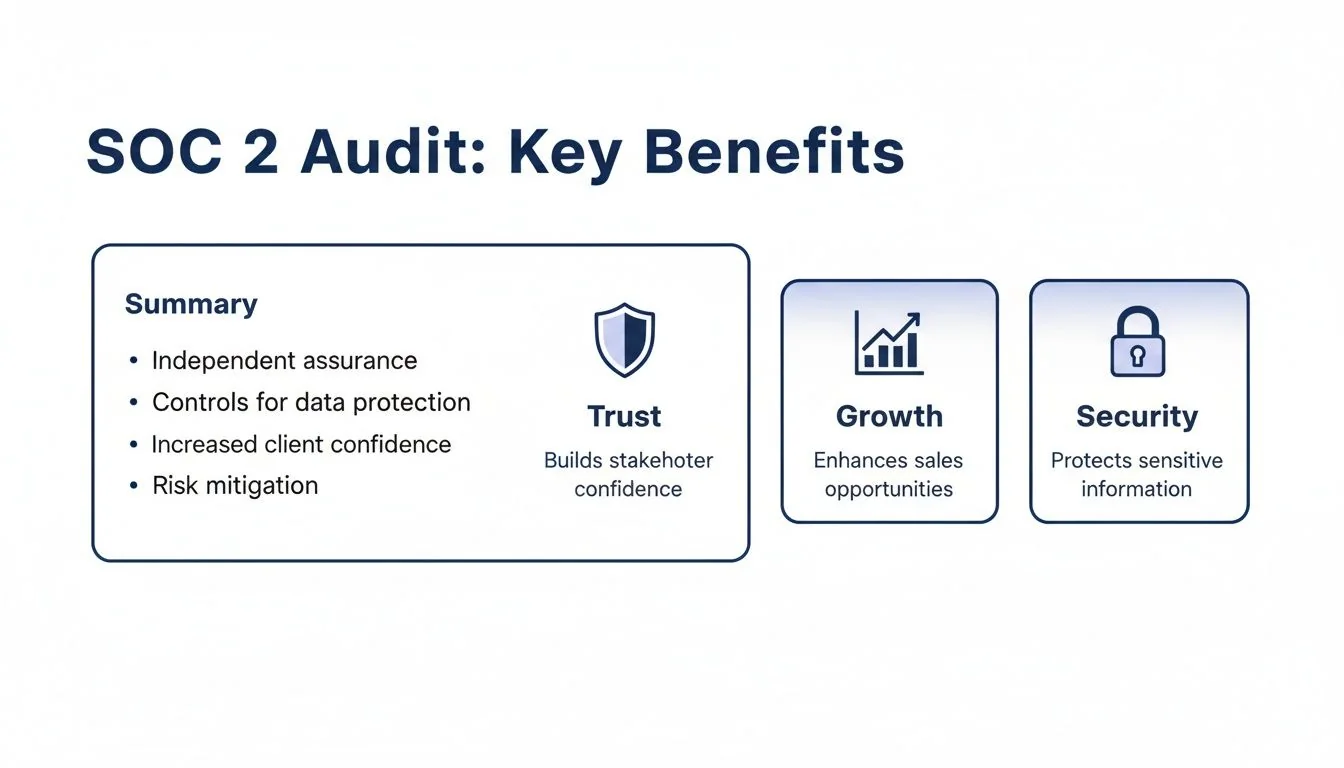
Ultimately, getting SOC 2 compliant is an investment in these areas. It’s tangible proof that you’re serious about protecting customer data.
The Big Four Audit Firms
Everyone knows the Big Four—Deloitte, PwC, EY, and KPMG. They are the giants of the accounting and auditing world. Their global footprint and massive resource pool make them the default choice for Fortune 500 companies and huge enterprises that need instant brand recognition to satisfy international stakeholders.
You go with a Big Four firm when you need to bundle multiple compliance audits, like ISO 27001, PCI DSS, and SOC 2, under one giant contract. Their sheer size means they can throw large, diverse teams at complex, multi-framework projects spanning different countries.
But that scale has its downsides. The process can feel cold and impersonal. You’ll often be managed by junior associates, with a senior partner you rarely speak to just signing off at the end. Timelines are almost always longer, and the cost is significantly higher, reflecting their brand premium and massive overhead.
- Best For: Large, publicly-traded enterprises with complex, global compliance needs.
- Common Scenario: A multinational corporation needs a SOC 2 report for its US operations and an ISO 27001 certification for its EU division, and they want a single firm with global reach to handle both.
- Key Consideration: Be ready for a formal, rigid process with very little flexibility and a much higher price tag.
Regional Audit Firms
Sitting comfortably in the middle, regional firms like Grant Thornton or BDO strike a nice balance between resources and personal service. They’re big enough to have dedicated cybersecurity and compliance teams but small enough that you still get a hands-on client experience.
These firms are a fantastic fit for mid-market companies that have outgrown the smaller shops but don’t need the global scale (or the bill) of a Big Four auditor. You’re far more likely to work directly with senior-level auditors and partners who actually take the time to understand your business.
Regional firms often have deep expertise in specific local industries, whether it’s manufacturing, healthcare, or regional banking. Their pricing is competitive, and their processes are generally more collaborative and less rigid than their larger competitors.
Boutique Specialist Firms
Boutique SOC 2 audit firms are the specialists. They live and breathe information security and compliance frameworks like SOC 2, ISO 27001, and HITRUST. This intense focus breeds deep expertise and highly efficient, repeatable audit methods.
This is why startups, SaaS companies, and other tech-focused businesses flock to boutique firms. They love the agility, direct access to expert partners, and predictable pricing. Many offer fixed-fee engagements, which is a lifesaver—it kills the risk of scope creep and surprise bills that often come with hourly models.
The SOC 2 audit market is largely a battle between the Big Four and these specialists, each offering a different value proposition. Boutique auditors like Schellman & Company have built their entire reputation on speed and expertise, often delivering draft SOC reports within three weeks and final reports in under 30 days. This is a world away from the six to twelve-month timelines you frequently see with Big Four projects. You can find a deeper dive into these market dynamics and auditor timelines on BrightDefense.com.
The defining advantage of a boutique firm is focus. They aren’t trying to be everything to everyone. Their entire business is built around performing efficient, high-quality security attestations for technology companies.
This singular focus means they just get the tools, environments, and challenges that are unique to tech companies.
- Best For: Startups, mid-market SaaS companies, and any organization where speed, expertise, and cost-effectiveness are top priorities.
- Common Scenario: A fast-growing fintech startup needs its first SOC 2 Type 2 report to close a huge enterprise deal and needs a firm that moves fast and provides real, hands-on guidance.
- Key Consideration: Make sure the boutique firm has experience in your specific industry and with a tech stack as complex as yours.
Comparing Audit Firm Types At A Glance
To make the choice clearer, here’s a side-by-side look at how these three firm types stack up against each other. Think of this as your cheat sheet for matching a firm’s DNA to your company’s needs.
| Attribute | Big Four Firms | Regional Firms | Boutique Specialist Firms |
|---|---|---|---|
| Ideal Client | Fortune 500, public companies, global enterprises | Mid-market companies, PE-backed firms | Startups, SaaS, and tech-focused companies |
| Pricing | Very high ($60k - $450k+) | Moderate ($30k - $120k) | Lower ($15k - $75k, often fixed-fee) |
| Timelines | Long (6-12+ months) | Moderate (4-10 months) | Fast (3-8 months) |
| Service Model | Formal, structured, often junior-led teams | Balanced, partner involvement | Agile, partner-led, high-touch |
| Strengths | Global brand recognition, bundled services | Industry/regional expertise, personalized service | Deep specialization, speed, cost-effectiveness |
| Weaknesses | Impersonal, slow, inflexible, expensive | Limited global reach vs. Big Four | Less brand recognition, smaller teams |
Choosing the right partner is less about picking the “best” firm and more about finding the best fit. A boutique firm might be a disaster for a global bank, just as a Big Four firm is often expensive overkill for a 50-person SaaS company. Use this breakdown to align your decision with what will actually drive your business forward.
Key Criteria For Evaluating SOC 2 Audit Firms

You have to look past the polished sales pitch to really vet potential SOC 2 audit firms. The goal here is to find a genuine partner whose expertise, methods, and even culture click with your business. A great auditor does way more than just check boxes; they become a trusted advisor who actively strengthens your security.
This means you need to ask sharp, specific questions that reveal what a firm is truly capable of. It’s the difference between a painful, bureaucratic audit and a collaborative partnership that actually helps you build a more secure, trustworthy company.
Industry and Technical Expertise
Not all auditors are created equal, especially when it comes to understanding your business. An auditor with deep experience in your specific vertical—be it SaaS, fintech, or healthcare—will grasp your unique operational risks and customer expectations in a fraction of the time.
This specialized knowledge translates directly into a more efficient audit. They already speak your language and know the tools you use, which means less time wasted explaining your business model and more time focused on the controls that actually matter.
When you’re interviewing firms, get right to the point:
- Industry Verticals: “How many SaaS/healthcare/fintech clients have you audited in the last year?”
- Technology Stack: “What’s your team’s experience with cloud-native environments like AWS, GCP, or Azure?”
- Trust Services Criteria: “Walk me through a time you helped a client scope the Availability or Privacy criteria for their particular service.”
A firm that gives clear, confident answers backed by real examples is infinitely more valuable than one offering vague assurances. Their ability to understand your environment has a direct impact on the quality and relevance of your final report.
Auditor Qualifications and Team Composition
The credentials and structure of the audit team are critical. While any SOC 2 report must be issued by a licensed CPA firm, you need to dig deeper. Look for additional certifications that prove they have serious technical security chops.
The most effective audit teams combine the rigor of financial attestation with hands-on cybersecurity knowledge. You want to see a blend of CPAs and security pros with certifications like CISA (Certified Information Systems Auditor) or CISSP (Certified Information Systems Security Professional).
This mix ensures the audit isn’t just a compliance exercise but a meaningful security assessment. You should also get clarity on who you’ll be working with day-to-day. Will you have a direct line to a senior partner, or will you be handed off to a junior associate once the ink is dry? For a deeper dive, check out our guide on SOC 2 auditor requirements.
Audit Methodology and Communication Style
A firm’s audit methodology dictates the entire experience. Some firms follow a rigid, checklist-driven process that can feel adversarial from day one. Others take a more collaborative approach, working with your team to understand controls and offer guidance along the way.
The best SOC 2 audit firms use technology to make the process less painful. Ask them about their evidence collection platform. A modern portal for uploading and tracking requests is a world away from managing hundreds of emails and spreadsheets.
Think about the difference in their approach:
| Aspect | Collaborative Approach | Rigid Approach |
|---|---|---|
| Communication | Proactive, frequent check-ins and guidance | Reactive, formal requests for information |
| Evidence | Centralized platform, clear instructions | Manual collection via email and spreadsheets |
| Goal | Partnership to achieve compliance and improve security | Validation against a strict checklist |
| Outcome | A smoother process and a stronger security posture | A potentially frustrating, purely transactional experience |
Ultimately, you’re looking for a partner who wants you to succeed. Their communication style, project management skills, and willingness to be an advisor are just as important as their technical qualifications. Choose a firm that feels like an extension of your team, not an opponent you have to beat.
Understanding SOC 2 Audit Costs And Timelines
Trying to budget for a SOC 2 audit can feel like hitting a moving target. Costs and timelines aren’t one-size-fits-all; they hinge entirely on your company’s size, the complexity of your systems, and the audit’s scope. Getting a handle on these variables is the first step to setting realistic expectations and avoiding sticker shock.
The two biggest factors driving your investment are the type of report you need and which Trust Services Criteria (TSCs) you include. A Type 1 report is a point-in-time snapshot of your controls’ design—less intensive and therefore less expensive. A Type 2 report, which tests how well those controls actually work over several months, demands a lot more from both your team and the auditors, pushing the cost up.
Breaking Down SOC 2 Audit Costs
The firm’s pricing model is another huge piece of the puzzle. While some auditors still bill by the hour, many modern SOC 2 audit firms—especially the boutique specialists—have shifted to a fixed-fee model. This is a game-changer for budgeting, as it gives you cost certainty and kills the risk of surprise overages.
Here are some real-world cost ranges to help frame your budget:
- SOC 2 Readiness Assessment: This is the prep phase where an auditor finds your control gaps. It typically runs between $10,000 and $25,000.
- SOC 2 Type 1 Audit: For a report covering only the mandatory Security TSC, plan on spending between $15,000 and $30,000.
- SOC 2 Type 2 Audit: The more comprehensive audit usually falls between $25,000 and $60,000+ for the Security TSC. Each extra TSC (like Availability or Confidentiality) can tack on another $5,000 to $15,000.
The final price tag reflects more than just the report. It includes the auditor’s expertise, the efficiency of their process, and the value of their brand. While a low bid might seem attractive, an inexperienced auditor can lead to a weak report that enterprise customers reject, costing you more in the long run.
For a more granular look, our guide to understanding the true SOC 2 Type 2 audit cost dives deep into how scope and firm selection impact your final bill.
Mapping Out A Realistic Audit Timeline
Time is just as critical as money when you’re planning a SOC 2 audit. A rushed timeline often leads to mistakes, a qualified opinion, or the whole project stalling out. On the flip side, a well-paced project ensures a smooth process and a high-quality report you can actually use to close deals.
A typical first-time SOC 2 project follows a pretty clear path:
- Readiness Assessment (2-6 weeks): The auditor dives into your current setup and hands you a detailed gap analysis, which becomes your remediation roadmap.
- Remediation (1-6 months): Your team gets to work implementing missing controls, updating documents, and gathering initial evidence. How long this takes depends entirely on your starting security posture.
- Type 2 Observation Period (3-12 months): This is the window where your controls have to be operating effectively. For a first audit, a six-month period is the standard and widely accepted.
- Fieldwork and Reporting (4-8 weeks): Once the observation period closes, the auditors start their testing, review all the evidence, and write the final report.
The most common delays almost always come from disorganized evidence gathering or discovering a major control gap way too late in the game. A thorough readiness assessment is your best defense against these pitfalls, helping you streamline the entire process from the get-go.
Your Step-by-Step Checklist for Selecting a Firm

Trying to pick one firm out of dozens can feel overwhelming. The key is turning that chaos into a structured project. This checklist breaks the selection process down into a clear plan, guiding you from internal alignment all the way to signing the contract.
Phase 1: Define Scope and Align Stakeholders
Before you even think about looking at auditors, you need to get your own house in order. Pull your key stakeholders—from the CISO to the Head of Sales—into a room and get everyone on the same page.
- Clarify Your “Why”: What’s the real driver here? Are you trying to unblock a massive enterprise deal? Fulfill a contract requirement? Or are you just trying to build trust in the market? Your main goal will dictate your priorities.
- Define Audit Scope: First, decide if you need a Type 1 or a Type 2 report. Then, figure out which Trust Services Criteria you need beyond the mandatory Security principle. Do your service commitments require you to include Availability or Confidentiality?
- Set a Realistic Budget and Timeline: You need a firm budget range and a target completion date. This isn’t just about money; it prevents scope creep and instantly filters out firms that don’t fit your operational or financial reality.
Phase 2: Research and Shortlist Potential Firms
With your internal game plan set, it’s time to see who’s out there. The goal here is to go from a massive list of potential auditors to a tight shortlist of three to five serious contenders.
- Create a Longlist: Start by identifying 10-15 potential firms using directories, industry recommendations, or platforms like SOC2Auditors. Make sure to include a mix of firm types—boutique, regional, etc.—to give yourself options.
- Draft a Request for Proposal (RFP): Put together a concise RFP that covers your company background, the audit scope and TSCs you decided on, your tech stack, and your desired timeline. A clear RFP gets you better, more comparable proposals back.
- Send the RFP and Shortlist: Send your RFP to the firms on your longlist. As the proposals roll in, start cutting. Immediately eliminate any that are way outside your budget, can’t meet your timeline, or clearly lack experience in your industry. Your goal is a shortlist of 3-5 top contenders.
And you need this process to be efficient. SOC 2 isn’t a one-and-done project anymore; recent data shows 92% of companies now conduct two or more audits annually, and a surprising 58% run four or more. You can dig into this trend in the latest compliance statistics report from Sprinto.
Phase 3: Conduct Interviews and Make Your Selection
This is where you go deep. It’s about finding a partner, not just a vendor, through structured interviews and serious due diligence.
- Conduct Structured Interviews: Set up calls with each firm on your shortlist. Have targeted questions ready about their audit methodology, their team’s real-world experience, their communication style, and what tech they use for collecting evidence.
- Probe for Cultural Fit: Remember, this is a partnership. Ask questions that reveal how they operate under pressure, like, “Describe a time an audit went off the rails and how you handled it.” Their answer tells you everything about their problem-solving skills and whether they’re collaborative or just rigid.
Pay close attention to who is on the call from their side. If you’re talking directly with a senior partner who will actually be involved in your audit, that’s a huge positive sign. If you only get a sales rep, push for specifics on who your day-to-day contact will really be.
- Check References: Don’t skip this. Ask for 2-3 recent client references, ideally from companies in your industry and of a similar size. Ask them the tough questions about the firm’s responsiveness, actual expertise, and the overall experience.
- Perform an Apples-to-Apples Proposal Review: Once the proposals and Statements of Work (SOWs) roll in, lay them side by side and compare line by line. Don’t just flip to the price. Check that the scope confirmation explicitly lists the TSCs and observation period you agreed to. Verify what’s actually included in deliverables—is readiness covered? What about re-testing fees if something goes wrong? Look for firm milestone dates, not vague quarterly estimates. And pay close attention to the “What’s Not Included” section—this is where hidden costs like to hide.
- Negotiate and Sign: Once you’ve made your choice, review the final Statement of Work (SOW) with a fine-tooth comb. Make sure it clearly spells out the deliverables, timelines, all fees, and responsibilities before you sign anything. A solid SOW prevents headaches later and sets you up for a successful audit.
A Few Common Questions About SOC 2 Audits
If you’re sorting through SOC 2 audit firms, you’ve probably got questions. The world of compliance is filled with nuance, so let’s clear up a few of the most common things people ask.
Getting these details right is the key to a smooth audit.
What’s the Real Difference Between a SOC 2 Type 1 and Type 2 Audit?
This is easily the most fundamental question, and it directly shapes your audit’s scope, cost, and how seriously customers will take the final report.
A SOC 2 Type 1 report is just a snapshot in time. An auditor looks at the design of your security controls on one specific day to see if you have the right policies and procedures documented. It answers the question, “Do your controls look right on paper?”
A SOC 2 Type 2 report, on the other hand, is a video, not a snapshot. It tests the operational effectiveness of those controls over a longer period, usually six to twelve months. This is the one that really matters because it proves your controls don’t just exist—they actually work, day in and day out.
For almost any enterprise customer, a Type 2 report is non-negotiable. They need to see proof of sustained security, not just a promise made on a single Tuesday.
Can We Switch SOC 2 Audit Firms After Our First Audit?
Yes, and you absolutely should if it makes sense. Switching SOC 2 audit firms is common. Companies often use their first audit as a learning experience and then re-evaluate their needs.
You might find yourself looking for:
- Better pricing: Your first firm’s renewal quote might not feel as competitive a year later.
- Deeper industry expertise: As you move upmarket, you might need an auditor who lives and breathes fintech or healthcare compliance.
- A better partnership: Maybe the first audit felt like a rigid, box-checking exercise. Now you want a firm that feels more like an extension of your team.
Making the switch is straightforward. The key is to provide your new firm with your previous SOC 2 report and all the supporting documentation. A good auditor won’t make you start from square one; they’ll build on the foundation you’ve already established, making the whole process far more efficient.
How Long Is a SOC 2 Report Actually Good For?
While there’s no official expiration date stamped on the cover, a SOC 2 report’s relevance in the business world is about 12 months. The security landscape, your team, and your own systems are constantly in motion, so an old report loses its value fast.
Your customers, partners, and even serious prospects will ask for a fresh report every year. This reality turns SOC 2 into an ongoing program, not a one-and-done project you can check off a list. Sticking to an annual audit cycle shows everyone that your security posture is keeping pace with new threats and your own growth.
It’s also why finding a long-term partner you actually like working with is so critical.
What Is the Difference Between a Readiness Assessment and the Audit?
This is a critical distinction, and mixing them up is a common mistake. Think of a readiness assessment as a dress rehearsal. It’s a consultative project where a security professional finds all the gaps between your current setup and what SOC 2 actually requires. Its only goal is to give you a clear, actionable roadmap for what to fix before the real audit starts.
The audit, on the other hand, is the official, formal examination by an independent, licensed CPA firm. This is the main event that results in your final SOC 2 report. While the same firm can do both the readiness and the audit, many companies prefer to hire a consultant for the readiness phase and a separate CPA firm for the audit to ensure total independence.
How Important Is a Big Four Brand Name to My Customers?
This question comes up constantly, especially from companies targeting the Fortune 500. While a Big Four brand (Deloitte, PwC, EY, KPMG) carries undeniable name recognition, it’s not the magic bullet it used to be. Sophisticated enterprise buyers today care far more about the substance of the report than the logo on the cover.
A clear, thorough, and well-written report from a reputable, accredited boutique or national firm that demonstrates strong controls is just as valuable as one from a Big Four auditor. Unless a key customer or investor has contractually mandated a Big Four auditor—which is rare—you’re often better off choosing a specialized firm known for quality and efficiency.
What Red Flags Should I Watch for When Vetting Firms?
Knowing what to avoid is just as important as knowing what you want. Keep an eye out for these warning signs as you talk to potential firms:
- Vague Pricing: If the proposal or SOW is fuzzy on what’s included (and what’s not), you’re setting yourself up for surprise fees.
- Poor Communication: A firm that’s slow to respond or unclear during the sales process will be a nightmare to work with when you’re on a tight deadline.
- Lack of Specific Industry Experience: Vague claims like “we work with tech companies” aren’t good enough. Push them to talk about your specific vertical and its common challenges.
- Outdated Audit Approach: If their process relies on endless email chains and manual spreadsheets for evidence collection, they’re going to create a massive time suck for your team.
- High-Pressure Sales Tactics: A good partner wants to understand your environment and help you succeed. A bad one just wants to close the deal fast.
Do We Really Need a Readiness Assessment Before the Audit?
It’s not technically required by the AICPA, but a readiness assessment is highly recommended. I can’t stress this enough, especially for your first audit. Think of it as a dress rehearsal before opening night.
During a readiness assessment, an auditor does a full review of your current setup and points out every single gap between where you are and what SOC 2 requires. You get a clear, actionable roadmap telling you exactly what to fix before the official audit clock starts ticking.
The payoff is huge:
- It massively increases your odds of getting a clean, successful audit opinion.
- It helps you avoid last-minute surprises and costly delays that can kill your timeline.
- It organizes all your remediation work upfront, making the actual audit much smoother.
Investing in a readiness assessment is probably the single smartest move you can make to ensure your official audit is as painless and efficient as possible. It sets everyone up for success right from the start.
Finding the right auditor shouldn’t be a shot in the dark. At SOC2Auditors, we replace guesswork with data. Get three tailored, no-spam matches from 100+ vetted firms based on your specific industry, budget, and timeline. Start your search with confidence at https://soc2auditors.org.