 Menu
Menu

On this page
A SOC 2 incident response plan documents how an organization identifies, responds to, contains, and recovers from security incidents. Its purpose is to coordinate action and limit harm. Auditors use the plan and relevant operating evidence to evaluate controls supporting the AICPA’s Trust Services Criteria.
A documented response program and evidence of its operation help the auditor evaluate CC7.4. A missing or ineffective control can lead to a finding; its effect on the opinion depends on materiality, pervasiveness, and the evidence available.
What Is an Incident Response Plan For SOC 2 Audits?
From a SOC 2 compliance perspective, an Incident Response Plan (IRP) is the formalized policy and set of procedures that govern an organization’s response to a security incident. It details the entire incident lifecycle, from initial detection and analysis through containment, eradication, and post-incident recovery. The IRP is evidence for auditors that the organization has a defined, repeatable process for managing security events in accordance with the Trust Services Criteria, particularly those under the Security (Common Criteria) principle.
An IRP supports CC7.4, which addresses execution of an incident-response program. CC7.2 covers anomaly monitoring, CC7.3 event evaluation, and CC7.5 recovery. Auditors examine the relevant controls and evidence rather than treating the existence of a plan as sufficient.
The Auditor’s Perspective on Your Plan
Auditors look for a plan tailored to the organization’s environment, not a generic template.
They look for the following:
- Defined Roles and Responsibilities: Under CC7.4 (Incident Response), the plan must clearly designate individuals and teams responsible for executing response procedures. Auditors need to see a defined command structure, from technical leads to executive-level communicators.
- Incident Classification: Define how the team evaluates events and determines whether they are security incidents under CC7.3. A severity matrix can support consistent triage; its categories and thresholds should reflect your system and risks.
- Communication Protocols: The plan must outline communication procedures for internal stakeholders, customers, and potentially regulatory bodies, supporting CC7.4. This includes who communicates, when, and what information is shared.
- Lifecycle Procedures: Auditors verify that the plan includes detailed, step-by-step procedures for each phase of the incident response lifecycle: preparation, identification, containment, eradication, recovery, and post-incident analysis.
A generic IRP template is a common failure point in SOC 2 audits. An auditor can test it by asking how it applies to your specific technology stack (e.g., AWS, Azure, GCP) and the top risks identified in your risk assessment. For example, a cloud-native SaaS company’s plan must address threats like API key exposure or a cloud provider outage.
Your IRP documents how you detect, analyze, and respond to security events. Exercises, training, and incident records can support its implementation and operation. A tested plan does not, by itself, establish that all relevant controls are effective.
Building The Core Components Of Your SOC 2 IRP
A SOC 2 incident response plan is a structured playbook for managing a security event. Each component should be clearly defined and tailored to your organization’s risks and operations.
Auditors examine the response program and how it is implemented. A plan can describe controls supporting CC7.2–CC7.5; records of relevant activities help establish how those controls operated during a Type 2 reporting period. A well-written plan alone does not prove operating effectiveness.
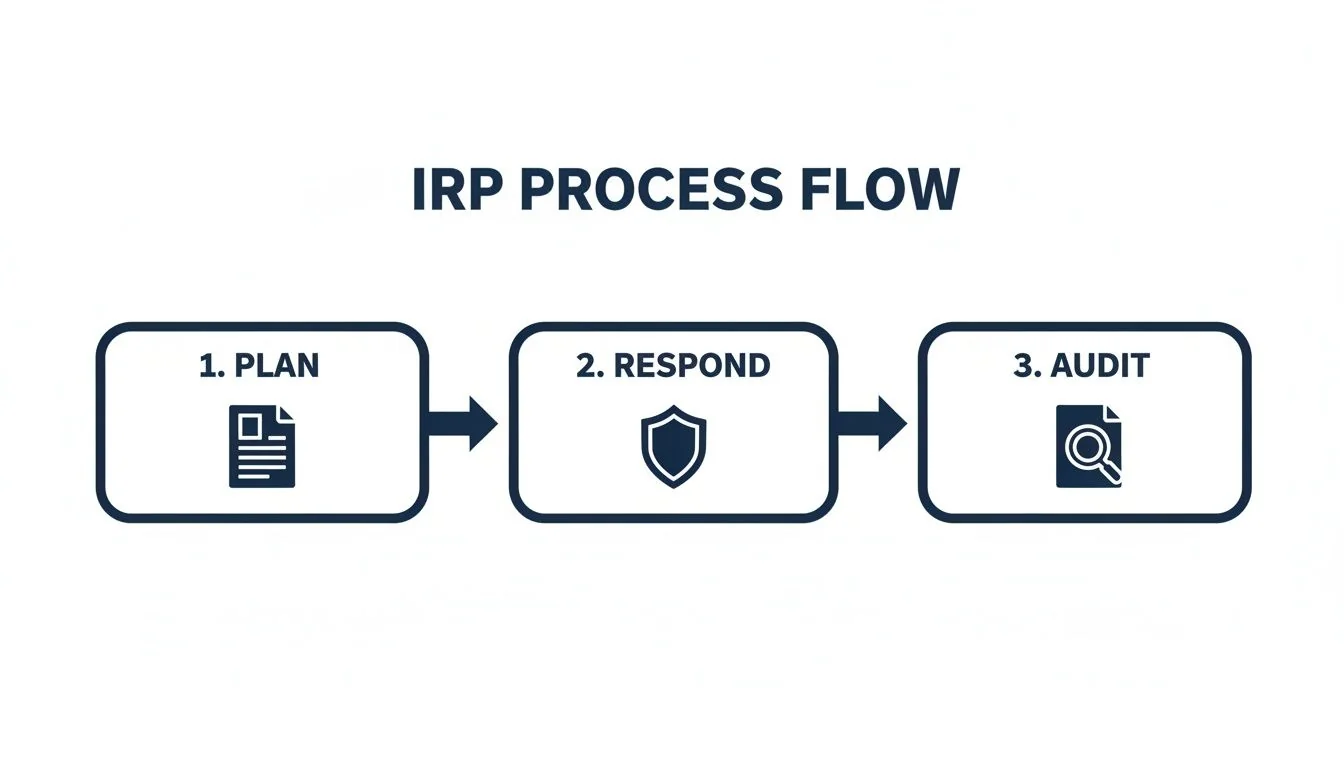
The cycle is plan, respond, audit, so the program is maintained rather than written once and filed.
Defining Roles And Responsibilities
Ambiguity delays response during an incident. For SOC 2, an auditor must see a predefined command structure with explicitly assigned roles and responsibilities.
Defined roles help make the CC7.4 response program executable. Document who investigates, contains, remediates, and communicates incidents, and retain evidence that those responsibilities are understood.
The following role model is an example. Assign responsibilities appropriate to your size and risks; SOC 2 does not prescribe these job titles or require a separate person for each role:
- Incident Commander: The designated leader with overall authority and responsibility for managing the incident, coordinating resources, and making critical decisions.
- Technical Lead: The subject matter expert responsible for leading the technical investigation, containment, and eradication efforts.
- Communications Lead: The individual responsible for managing all internal and external communications, ensuring stakeholders, customers, and executives receive timely and accurate information.
- Legal Counsel: The advisor on legal and regulatory obligations, including breach notification requirements and potential liabilities.
Establishing Severity Levels And Thresholds
Document how your team evaluates security events and prioritizes incidents. A severity matrix can make decisions more consistent, while still allowing judgment when information is incomplete.
Incident classification supports CC7.3 event evaluation and escalation into the CC7.4 response program. Use clear thresholds based on the affected data, systems, commitments, and business impact; document how the team applies them.
An example severity level matrix:
- Severity 1 (Critical): Unauthorized access to or exfiltration of sensitive customer data; a system-wide outage affecting all users for more than 30 minutes. Requires immediate executive notification.
- Severity 2 (High): A partial service degradation affecting a core feature for a significant subset of users; a publicly disclosed vulnerability in a core application component with a known exploit.
- Severity 3 (Medium): A localized issue affecting a non-critical system or a small number of users with a known workaround; a malware infection on a single non-privileged employee workstation.
- Severity 4 (Low): A security event with no immediate impact on production services or data, such as failed brute-force login attempts from a single IP address.
Mapping IRP Components To SOC 2 Trust Services Criteria
| IRP Component | SOC 2 Common Criteria (CC) | Auditor Expectation And Evidence Example |
|---|---|---|
| Roles and Responsibilities | CC7.4 (Incident Response) | The auditor will verify that the IRP contains a documented roster of roles and responsibilities. Evidence: Your IRP document’s roles and responsibilities section, supplemented by training records confirming personnel understand their duties. |
| Severity Level Matrix | CC7.3 (Security Event Evaluation) | Define incident-classification thresholds and retain tickets showing how the team evaluated events. |
| Incident Lifecycle Phases | CC7.4 (Incident Response), CC7.5 (Recovery) | Document containment, remediation, communication, and recovery steps; retain incident records and follow-up actions. |
| Post-Mortem Process | CC7.4, CC7.5 | Lessons learned and corrective actions can support improvements to response and recovery. Retain assigned actions and evidence of completion. |
The Incident Response Lifecycle
Your IRP must outline a systematic, phased approach to incident management. This shows auditors that your response is repeatable, not ad hoc.
The lifecycle spans CC7.2–CC7.5: anomaly monitoring, event evaluation, incident response, and recovery. Document the activities relevant to your system and retain evidence of how they operate.
- Preparation: Actions taken before an incident occurs, including team training, tool deployment, and conducting tabletop exercises.
- Identification & Triage: The process of detecting a potential incident via monitoring tools (e.g., SIEM, EDR), validating alerts, and classifying the incident according to the severity matrix.
- Containment: Immediate actions taken to prevent further damage, such as isolating affected systems from the network, blocking malicious IP addresses, or disabling compromised accounts.
- Eradication: The process of removing the root cause of the incident from the environment, such as patching the exploited vulnerability or removing malware.
- Recovery: The process of restoring affected systems to normal operation, including restoring data from backups, validating system integrity, and monitoring for any recurrence.
- Post-Mortem & Lessons Learned: Review incidents according to their significance and your documented policy. Record the timeline, impact, cause, and corrective actions. SOC 2 does not prescribe a separately titled post-mortem for every event.
Weaving Your IRP into Your Other SOC 2 Controls
An incident response plan that sits in a folder, disconnected from monitoring and change management, is a deficiency waiting to happen. Auditors expect the IRP to tie into your other controls so detection, response, and recovery follow one documented path.
Integration is evidence that your controls work together. For example, connecting anomaly-monitoring alerts (CC7.2) directly to your IRP kickoff procedure shows that detection feeds response. Aligning incident response with change management (CC8.1) shows you maintain control during a crisis.
Wire Monitoring and Alerting Directly to Your IRP
Your security monitoring tools are the triggers for your IRP. For SOC 2, having these tools is not enough. You must demonstrate that their alerts are directly linked to your response procedures.
Monitoring alerts and incident tickets can support CC7.2 anomaly analysis, CC7.3 event evaluation, and CC7.4 response. Retain the path from a relevant alert to investigation, escalation, and action.
Auditor Tip: Be prepared to demonstrate the end-to-end flow. For example, show the auditor the specific alert rule in your SIEM for “impossible travel” logins, the resulting ticket automatically generated in your ticketing system, and the section in your IRP that dictates the response for such an event. This auditable trail is what they look for.
Align with Risk Assessments and Change Management
Your IRP must be informed by your organization’s formal risk assessment, a foundational element of the SOC 2 Common Criteria. The plan should prioritize responses to incidents that threaten your most critical assets or exploit your highest-identified risks.
CC3.1 concerns specifying objectives clearly enough to identify and assess related risks. CC3.2 covers both identifying and analyzing risks. Use that assessment to prioritize the response scenarios relevant to your system and commitments. Our Common Criteria guide explains how these criteria interrelate.
Your IRP must also integrate with your change management process (CC8.1). During an incident, you may need to deploy an emergency patch or firewall rule change. The IRP must reference a formal “emergency change” procedure that allows for swift action while still ensuring documentation and approval. Organizations subject to DFARS 252.204-7012 face even more prescriptive incident reporting timelines. Our SOC 2 guide for government contractors details the 72-hour reporting mandate and how it shapes your IRP.
Integrate Business Continuity and Disaster Recovery
While incident response focuses on neutralizing a security threat, Business Continuity and Disaster Recovery (BC/DR) plans focus on restoring business operations. The IRP and BC/DR plan need a clear handoff.
Define how the response team hands off to recovery, including restoration priorities, recovery objectives, and validation of restored data. CC7.5 addresses recovery from identified security incidents. Where Availability is in scope, backup and recovery infrastructure supports A1.2, and tests of recovery-plan procedures support A1.3. Retain exercise results and corrective actions; the criteria do not prescribe a separate recovery procedure for every incident type in a risk register.
Integrating your IRP with security operations functions, such as a Security Operations Center (SOC), keeps real-time threat management in the same workflow as documented response. For background, see what a Security Operations Center is and its role. That integration makes the IRP the playbook your team actually runs during an incident, which is the operational evidence auditors look for.
How To Test Your Plan With Tabletop Exercises
An untested incident response plan is a theoretical document. For a SOC 2 audit, you must provide evidence that your plan is functional and that your team is prepared to execute it. Tabletop exercises are one way to generate this evidence.
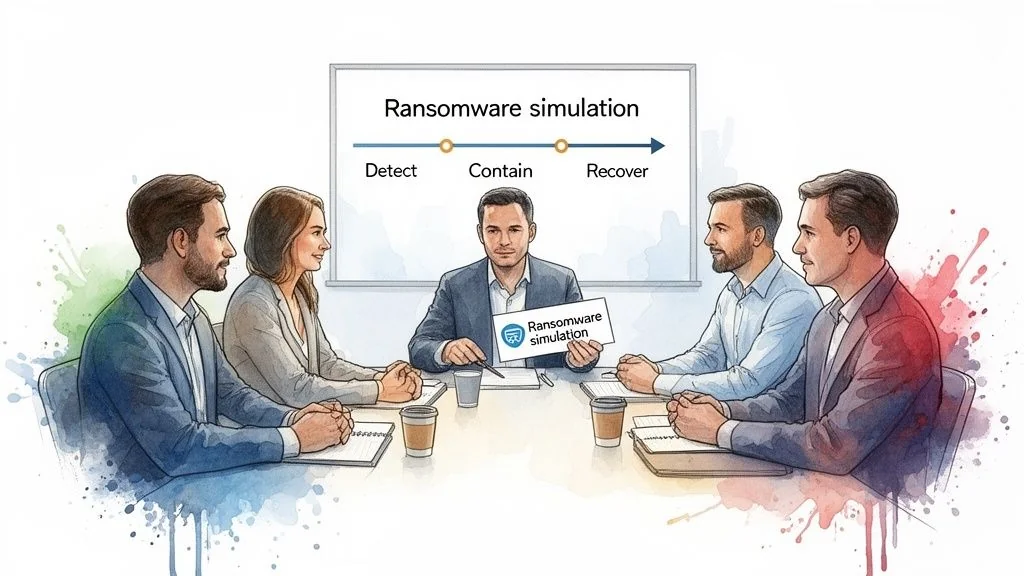
A tabletop exercise is a discussion-based session where team members walk through a simulated incident scenario to test the IRP’s procedures, roles, and communication channels in a controlled environment.
Tabletop exercises are one way to evaluate whether people understand the response program and whether its procedures work. Choose exercises and a schedule appropriate to your risks and commitments, and retain findings and corrective actions. An exercise supports the auditor’s evaluation; it does not guarantee an unmodified opinion or replace technical recovery testing where that is relevant.
Designing A Realistic Scenario
A tabletop exercise is only as useful as its scenario. Generic threats provide little value, so tailor scenarios to the specific risks identified in your risk assessment.
A realistic scenario links your exercise to the risks identified and analyzed under CC3.2. Choose scenarios based on your systems and the service commitments that an incident could disrupt.
Example scenarios:
- Ransomware with Exfiltration: A production database is encrypted, and the attacker claims data was stolen. In its 2026 Global Incident Response Report, Unit 42 reported data theft in 57% of its 2025 extortion cases, a broader category than ransomware alone. Exercise both technical containment and a legal/notification assessment, including how the team acts when exfiltration is uncertain.
- Supply Chain Compromise: A third-party SaaS integration or vendor management console is breached, and attacker access propagates into your environment through trusted connectivity. This scenario tests your vendor risk management protocols, your ability to isolate integrations without halting operations, and the contractual notification obligations you hold toward your own customers.
- Cloud Misconfiguration and Data Exposure: A misconfigured storage bucket or overly permissive IAM role exposes sensitive customer data. A third-party researcher or your monitoring stack discovers it first. This tests your validation process, the classification of the event under your severity matrix, and your legal and regulatory notification procedures.
- Key System Outage: A major outage at your primary cloud provider takes your application offline. This tests the handoff to your BC/DR plan, external communication protocols, and your ability to meet stated Recovery Time Objectives (RTOs).
Facilitating The Exercise
A successful tabletop requires a facilitator who can guide the discussion, introduce challenges (“injects”), and press the team to follow the IRP’s procedures.
The facilitator’s role is to challenge assumptions and get participants to refer to the documented plan rather than improvise. That structure makes the exercise auditable.
Key questions the facilitator should ask:
- “According to the IRP, who is the designated Incident Commander for this event?”
- “What is the first containment action specified in the plan, and who is responsible for executing it?”
- “Based on our severity matrix, how do we classify this incident?”
- “What does the plan mandate regarding the timeline for internal and external communications?”
An exercise that uncovers gaps in the plan is useful for a SOC 2 audit, because you can document the findings and the fixes.
Documenting Everything For The Audit
Without appropriate evidence, the auditor may be unable to establish that an action occurred. Retain exercise records rather than relying on participants’ recollection.
This documentation is your primary evidence that testing occurred and that you act on what it finds.
A useful evidence package includes:
- Meeting Minutes: A detailed record of the scenario, key decisions made, and any identified gaps or questions.
- Attendee List: A record of participants and their roles, proving that key personnel were involved.
- Findings and Gaps: A formal summary of weaknesses discovered in the IRP during the exercise (e.g., “The plan lacks a designated backup communication channel”).
- Action Plan: A list of corrective actions with assigned owners and due dates, tracked in a system like Jira. This shows the auditor that you are remediating identified weaknesses.
Use the findings to update the plan and close gaps before the next exercise or incident. BreachRx’s incident-response planning article recommends tailored plans, exercises, and regular refinement. Set the exercise schedule in your policy according to your risks and commitments.
Gathering Documentation And Evidence For Your Audit
Your incident response plan is only the starting point. An auditor needs evidence that the plan is implemented, maintained, and operating effectively.
Auditors need appropriate evidence that the relevant controls are implemented and, for Type 2, operated during the reporting period. Missing records can leave an evidence gap even when the plan is well written. Discuss what evidence is available and sufficient for the control being tested.
Core Plan and Maintenance Artifacts
The foundation of your evidence is the governance surrounding the IRP document itself. Auditors need to see that the plan is a formal, managed asset within your organization.
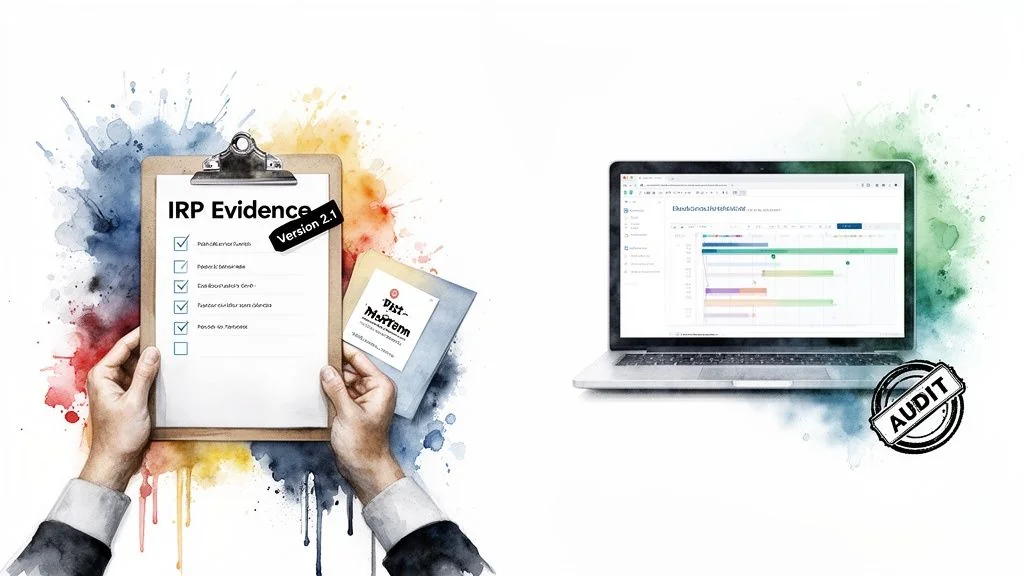
These artifacts show that the plan is a control subject to formal review, approval, and versioning.
Baseline evidence includes:
- The Approved IRP Document: The current, official version of the plan.
- Version History and Changelog: A log documenting all changes, dates, and approvers, proving the plan is regularly reviewed and updated.
- Management Approval Records: Evidence, such as meeting minutes, a signed PDF, or email approval, that leadership reviewed and approved the plan on the schedule defined in your policy.
- Training Logs: Records showing that team members have been trained on the plan, including their names, roles, and the date of training.
Evidence from Real Incidents and Tabletop Exercises
Auditors will request detailed records from any security incidents that occurred during the audit period, as well as from your proactive testing. For what a full evidence package looks like, see our guide to SOC 2 documentation best practices.
Records from real incidents are direct evidence of the plan in practice. They let an auditor trace an event from detection to resolution and check that you followed your own procedures at each step of the incident lifecycle.
For any actual incidents, you must produce:
- Incident Tickets: The complete ticket from your system (e.g., Jira, ServiceNow) showing the full event timeline, assignments, communications, and resolution.
- Communication Records: Key artifacts from communication channels (e.g., Slack threads, email summaries) that show the response team coordinating and making decisions.
- Post-Mortem Report: The formal “lessons learned” document detailing the root cause, business impact, and corrective actions.
- Remediation Evidence: Proof that corrective actions were completed, such as links to closed follow-up tickets.
Make exercise records easy to trace: connect the scenario and participants to decisions, findings, assigned actions, and evidence that those actions were completed.
Evidence from tabletop exercises matters equally and should include the scenario document, participant list, meeting minutes, and any tickets created to address identified gaps.
SOC 2 Incident Response Evidence Checklist
Use this checklist to confirm your evidence package is complete before your SOC 2 audit.
| Evidence Category | Specific Artifacts To Collect | Why It Matters To The Auditor |
|---|---|---|
| Plan Governance | Approved IRP, version history, management sign-off on the defined review schedule. | Shows how the plan is maintained and approved. |
| Team Preparedness | Training logs with dates and attendee lists, role definitions. | Demonstrates that personnel are aware of and trained on their responsibilities. |
| Incident Handling | Incident reports, post-mortems, communication logs, system tickets. | Provides direct evidence that you follow your documented procedures during an actual event. |
| Proactive Testing | Tabletop exercise scenarios, participant lists, minutes, and remediation tickets. | Shows a commitment to continuous improvement and validation of the plan’s effectiveness. |
An organized evidence package lets you walk the auditor through the response program from alert to remediation.
Connecting Your IRP To SOC 2 Audit Readiness
The IRP is part of SOC 2 audit readiness because it gives auditors evidence of how you detect, respond to, and recover from security events. The plan shows how the controls were designed. Incident and exercise records show whether they operated.
Using The IRP In Customer Security Reviews
When a prospective customer’s security team conducts due diligence, it may ask how you handle incidents. These artifacts let you answer with evidence:
- Documented Post-Mortems: Show that incidents lead to corrective action.
- Tabletop Exercise Records: Show that the plan has been tested.
- Clear Role Definitions: Show who does what during an incident.
IRP Evidence And The SOC 2 Report
A clear response program, exercise outcomes, and relevant incident records help the auditor evaluate response controls. SOC 2 does not prescribe a SIEM or guarantee a report without exceptions when this checklist is complete. The opinion depends on the description and controls across the examination’s scope.
When an auditor can trace a security alert from its source, through your documented response workflow, to a post-mortem report and its corresponding remediation tickets, they see a closed-loop control. That is evidence that your SOC 2 incident response plan is part of your daily security operations and not only a document written to meet a requirement.
Finding the right auditor matters as much as preparing your controls. At SOC2Auditors, you can compare verified audit firms based on price, timeline, and industry expertise without the sales calls. Get your free, tailored auditor matches at https://soc2auditors.org.
More in Audit Preparation