 Menu
Menu
A SOC 2 readiness assessment is a consultative project in which an external auditor or advisor evaluates an organization’s existing information security controls against the applicable American Institute of Certified Public Accountants (AICPA) Trust Services Criteria (TSC). The objective is to identify gaps, control deficiencies, and areas of non-compliance prior to a formal SOC 2 examination. The primary deliverable is a gap analysis report that provides a roadmap for remediation, enabling the organization to build and document the necessary controls to achieve SOC 2 compliance.
What Is a SOC 2 Readiness Assessment?
A readiness assessment is a proactive, consultative project that acts as a dry run for your formal SOC 2 audit. An auditor examines your existing controls and maps them against the specific Trust Services Criteria you need—like Security, Availability, or Confidentiality. For those pursuing SOC 2, this is not just a preliminary check; it is a critical risk mitigation step. The process is designed to uncover control weaknesses and documentation gaps that could lead to a qualified opinion or failure during the formal audit, allowing you to remediate them in a low-pressure, cost-effective manner.
The entire point is to uncover problems now, while they’re still easy and cheap to fix. Instead of walking into a high-stakes audit hoping for the best, you go in knowing exactly where you stand.
This entire process is a core part of a mature Governance, Risk, and Compliance (GRC) strategy. It’s about systematically de-risking the audit journey by turning unknowns into a concrete to-do list.
What Auditors Actually Look For
During the assessment, auditors will dig into your documentation, system settings, and day-to-day operations. They’re looking for real proof, not just promises. For a company pursuing SOC 2, understanding these focus areas is crucial for preparation.
- Policies and Procedures: Do you have a documented incident response plan? Are your security policies formally documented, approved, and disseminated to employees? They’ll check for documented controls to satisfy criteria like CC2.1 (Control Environment), which requires the organization to demonstrate a commitment to integrity and ethical values.
- System Configurations: Are your AWS or Azure environments configured to enforce security best practices? How are you enforcing access controls on your databases? This ties directly to criteria like CC6.1 (Logical and Physical Access Controls), which requires that logical access to systems is restricted to authorized users.
- Operational Evidence: Auditors want to see proof that your controls are operating effectively over time. They’ll request evidence such as logs from employee offboarding events to verify that access was revoked in a timely manner, or training records proving your team completed mandatory security awareness training, which supports CC2.2 (Board of Directors Oversight).
Typical SOC 2 Readiness Assessment Cost Ranges for 2026
The price for a readiness assessment varies, but here are some reliable benchmarks for 2026. For a company preparing for a SOC 2 audit, these figures help in budgeting for the complete compliance journey, not just the final audit.
| Company Profile | Typical Readiness Assessment Cost Range | Key Influencing Factors |
|---|---|---|
| Early-Stage Startup (10-50 employees) | $5,000 – $12,000 | Simple cloud environment, 1-2 Trust Services Criteria (TSCs), limited systems in scope. |
| Growth-Stage Company (51-200 employees) | $10,000 – $18,000 | Multiple cloud environments, 2-3 TSCs, more complex data flows, some legacy systems. |
| Mid-Market / Enterprise (200+ employees) | $15,000 – $25,000+ | Complex hybrid infrastructure, 3-5 TSCs, multiple business units, significant remediation needed. |
These numbers reflect the time and expertise needed to thoroughly review your environment. While a startup with a simple tech stack will be on the lower end, a mid-market company with complex data flows will naturally be closer to the $25,000 mark.
Trying to skip this step to save a few bucks almost always backfires. We’ve seen companies pay 30-50% more in total audit fees because of surprise control failures and remediation delays that a readiness assessment would have caught easily.
The deliverable isn’t just a list of problems; it’s a strategic remediation roadmap. This document prioritizes findings based on risk, so your team can focus on the most critical fixes first and create an efficient path to compliance.
Ultimately, you walk away with a concrete action plan, transforming a stressful audit into a predictable project. If you’re just getting started, our detailed SOC 2 readiness assessment checklist is an excellent resource to see what’s involved.
A readiness assessment is the single best way to ensure your SOC 2 journey is smooth, efficient, and successful. It turns the audit from a gamble into a structured, confident process.
Key Factors That Drive Your Assessment Cost
The cost of a SOC 2 readiness assessment is directly proportional to the auditor effort required to perform the evaluation. For an organization pursuing SOC 2, understanding these cost drivers is essential for accurate budgeting and for making strategic decisions about the audit’s scope. The price is a reflection of the billable hours an auditor needs to interview personnel, review documentation, and inspect system configurations against the selected Trust Services Criteria.
The single biggest cost driver is your scope. This boils down to which of the five AICPA Trust Services Criteria (TSCs) you decide to include. Why this matters for your SOC 2 journey is simple: each TSC adds a distinct set of controls that must be assessed, directly increasing the auditor’s workload and, therefore, the cost.
- Security (Common Criteria): This is the mandatory foundation for every SOC 2 report. It covers controls protecting information and systems from unauthorized access, unauthorized disclosure of information, and damage to systems.
- Availability: Relevant if you have contractual commitments to customers regarding uptime and system performance. This TSC covers controls related to performance monitoring, disaster recovery, and backup processing.
- Processing Integrity: Relevant if your system performs critical calculations or transactions (e.g., financial processing, data processing) where completeness, validity, accuracy, and timeliness are paramount.
- Confidentiality: This covers how you protect sensitive data designated as “confidential” (e.g., intellectual property, business plans, M&A documents) through its entire lifecycle.
- Privacy: This applies specifically to how you collect, use, retain, disclose, and dispose of Personal Identifiable Information (PII) in conformity with the organization’s privacy notice and with criteria set forth in the AICPA’s GAPP.
Every TSC you add beyond Security bolts on a new set of controls the auditor has to test, which directly increases the time, effort, and cost of your assessment.
How Scope Directly Impacts Assessor Effort
Don’t underestimate the impact of adding just one more TSC. It’s not a small lift; it can dramatically expand the audit work. For a SOC 2 candidate, this means a more intensive and time-consuming readiness process.
For instance, an assessment focused only on the Security criteria will have the auditor reviewing your logical access controls under CC6.1. Their job is to verify that access to data and software is restricted to authorized individuals.
But add the Availability TSC, and now they also have to test your disaster recovery plans and system backup procedures, which fall under A1.2 (The entity has a recovery plan to meet its objectives). Tack on the Confidentiality TSC, and they’ll be digging into your data encryption and specific data handling policies required by C1.1 (The entity identifies and maintains confidential information). Each addition layers on more controls to test, more documents to review, and more people to interview.
A classic mistake is over-scoping. Companies think “more is better” and include TSCs they don’t actually need, blowing up their SOC 2 readiness assessment cost for no reason. Your scope should be driven purely by customer contracts and business needs—not a desire to collect them all.
Organizational Complexity and Maturity
After scope, the next biggest factor is your organization’s complexity and control maturity. For a SOC 2 aspirant, a more complex environment means a longer, more expensive assessment because the auditor has more ground to cover.
-
Company Size: The number of employees directly impacts the effort to test HR-related controls. An assessor needs to review user access lists, interview personnel, and verify onboarding/offboarding processes. A 30-person startup is a much quicker project than a 300-person company with multiple departments.
-
Technology Stack: Is your application a simple, single-tenant SaaS application running on AWS? That’s relatively straightforward. Contrast that with a hybrid-cloud environment with on-premise servers, dozens of third-party SaaS tools, and legacy internal software. The latter is far more complex to assess, as controls must be evaluated across disparate systems.
-
Control Maturity: Are you walking into this with well-documented policies, automated security monitoring, and a history of internal reviews? If so, the auditor’s job is to verify existing controls. If you’re starting from scratch with no formal controls, they must spend significant additional time identifying foundational gaps and guiding you on how to establish controls that meet criteria like CC1.1 (Commitment to Integrity and Ethical Values).
These factors aren’t just details—they directly translate into the billable hours on your invoice. A clear, honest definition of your scope and a realistic self-assessment of your complexity are non-negotiable for getting an accurate quote that matches your actual needs.
How to Analyze Quotes and Benchmark Pricing
When you receive multiple quotes for a SOC 2 readiness assessment, the price variation can be significant. One firm might quote $8,000 while another quotes $20,000. For a company pursuing SOC 2, it is critical to understand that this disparity is not arbitrary; it reflects differences in the depth of the assessment, the level of support provided, and the experience of the assessors. A low price can often mean a superficial review, shifting the burden of remediation planning onto your internal team.
Deconstructing the Quote
To make a true apples-to-apples comparison, you must analyze the details of each proposal. For your SOC 2 journey, a more comprehensive engagement up front can prevent costly delays later.
- Professional Fees: What is the cost breakdown for the auditor’s time? How many hours are allocated for interviews, documentation review, and technical testing? Who is performing the work—a senior partner with extensive SOC 2 experience or a junior analyst?
- Deliverables: What tangible outputs will you receive? Every quote will promise a gap analysis, but a high-value proposal will also include a prioritized remediation plan with actionable guidance, an executive summary for leadership, and potentially templates for missing policies.
- Follow-Up Support: Does the engagement conclude with the delivery of the report, or does it include consultative follow-up calls to help your team translate the findings into a concrete project plan for remediation?
These are the core drivers that will shape the final price of your assessment.
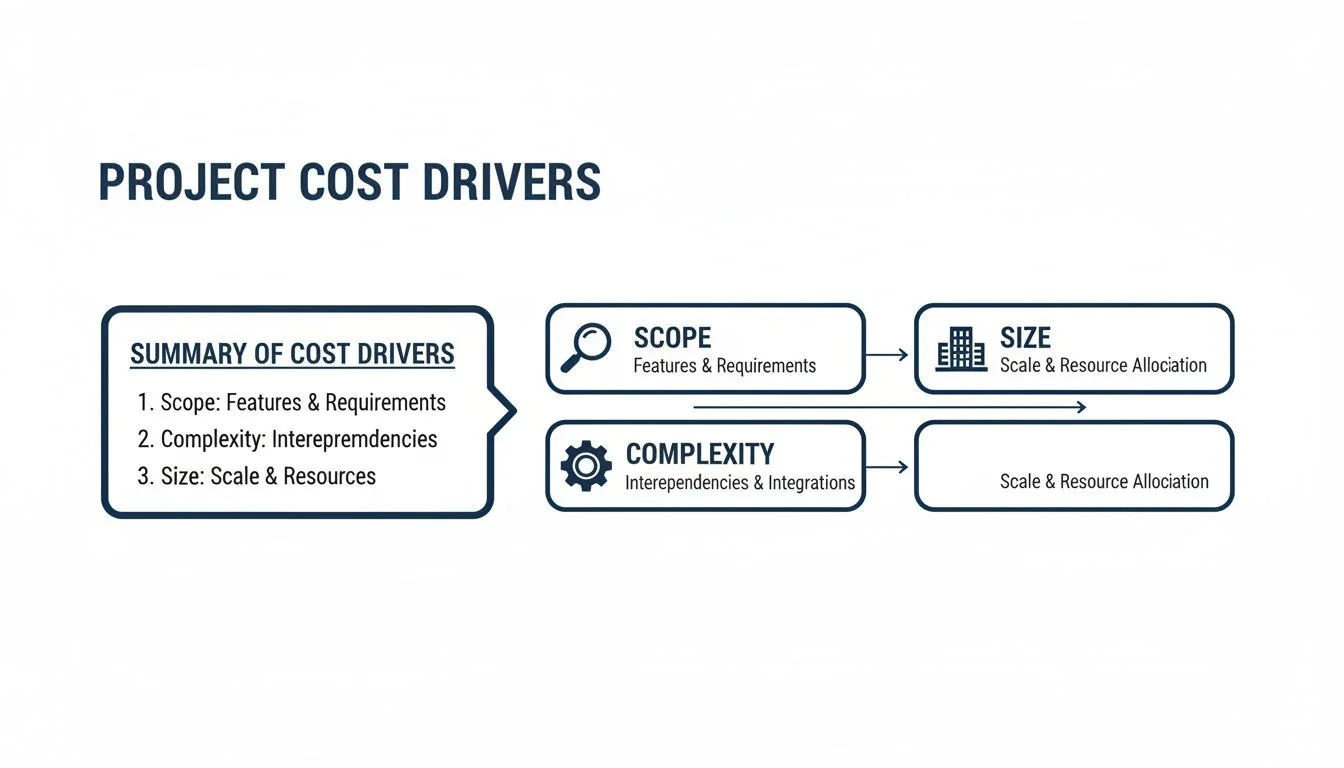
As the diagram shows, the scope (which Trust Services Criteria you choose), your company’s size, and the complexity of your environment are what really drive the cost.
Hypothetical Quote Comparison for a Readiness Assessment
To illustrate this, let’s compare two hypothetical quotes. This shows how a lower price can often mean less value, and a higher price can include critical services that save you time and money down the road.
| Quote Component | Assessor A (Boutique Firm) | Assessor B (Mid-Tier Firm) |
|---|---|---|
| Total Price | $12,000 | $18,500 |
| Professional Hours | 40 hours (Junior Analyst lead) | 75 hours (Senior Auditor lead, Partner oversight) |
| Deliverables | Standard gap analysis report listing failed controls | Detailed gap analysis, prioritized remediation plan, executive summary |
| Remediation Support | 1-hour debrief call | 5 hours of follow-up consultation, policy templates provided |
| Re-testing Fees | $2,500 for any re-testing of remediated controls | Included at no extra charge |
| Hidden Costs? | High. The re-testing fee and lack of guidance mean more internal work. | Low. The upfront cost is higher, but it’s more inclusive. |
Looking at the table, Assessor B’s quote is 54% higher, but it includes nearly double the expert hours, actionable remediation guidance, and no surprise re-testing fees. This is the kind of analysis that helps you find the true value, not just the lowest price.
Key Questions to Ask Every Potential Assessor
When you get an auditor on the phone, your job is to uncover what’s behind their numbers. Vague answers are a major red flag. Use these questions to press for specifics.
- What’s your exact methodology? Do you use a generic checklist, or is your process tailored to our tech stack and industry?
- How many hours of direct consultation are included? I need to know exactly how much access we get to your experts for questions and guidance.
- Who is actually doing the work? Will we be working with a senior partner with a decade of experience, or a junior analyst on their first few audits?
- What does your remediation support really look like? Do you just provide a list of failed controls, or do you provide actionable recommendations and policy templates?
- How do you handle complex controls like risk management (CC3.1) or vendor management (CC9.2)? Their answer will reveal their depth of expertise in applying the AICPA criteria.
A low-cost assessor might just point out that you lack a formal risk assessment process. A high-value partner will provide you with templates, guide you through creating your initial risk register, and help you establish the process—saving you from a critical gap that could derail your entire audit.
Benchmarking Against Industry Averages
Once you have detailed quotes, sanity-check them against industry data. While pricing varies, readiness assessments tend to fall within predictable ranges. For a typical growth-stage SaaS company pursuing the Security and Availability criteria, quotes between $10,000 and $18,000 are common.
If you’re getting quotes far outside this range, you need to ask why. A significantly lower quote might indicate a “check-the-box” assessment that will miss nuanced gaps, leaving you exposed during the real audit. A much higher price needs to be justified by exceptional support, deep specialization in your industry (like HealthTech or FinTech), or a far more complex scope. If you want a deeper dive, you can learn more about what a full SOC 2 audit costs in our complete guide.
This approach moves you beyond just comparing prices. It arms you to evaluate the quality and depth of the assessment itself. A cheap, shallow assessment that fails to find a major control deficiency is far more expensive in the long run than a thorough one that sets you up to pass the formal SOC 2 audit with confidence.
Budget Scenarios for Different Company Profiles
To translate cost factors into tangible budgets, it is useful to examine specific scenarios. For an organization pursuing SOC 2, these profiles provide a realistic framework for financial planning and internal discussions. The cost is not arbitrary; it is a direct function of the audit scope and organizational complexity, which determines the level of effort required by the assessor.
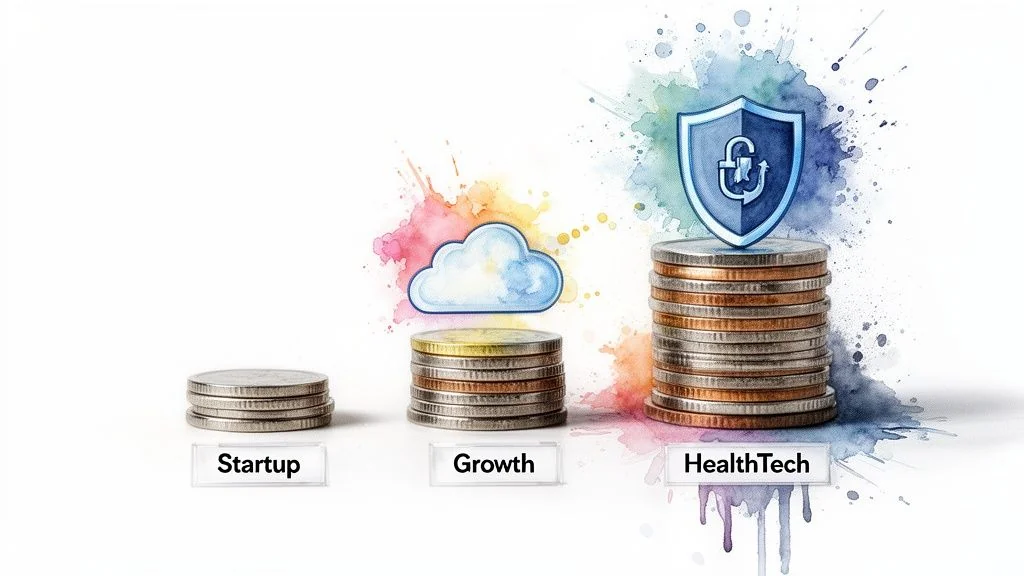
This is why a one-size-fits-all price tag just doesn’t exist for SOC 2. Each scenario presents a different set of challenges and requirements that directly influence the readiness assessment cost.
Scenario 1: Early-Stage SaaS Startup
First up is a lean SaaS startup with fewer than 50 employees. Their main goal is to land their first few big enterprise deals, and those prospects are all asking for a SOC 2 report. Their tech stack is simple—just one application, running entirely on a major cloud provider like AWS or Azure. For this startup, a readiness assessment matters because it provides the most direct and cost-effective path to meeting foundational enterprise security requirements.
- Scope: Security (Common Criteria) only. This is the standard starting point for nearly every startup to meet basic vendor security requirements.
- Complexity: Low. A small team and a clean cloud environment mean fewer systems, people, and processes for an auditor to evaluate.
- Controls in Scope: Approximately 70 controls, all focused on the foundational Common Criteria.
- Estimated Readiness Assessment Cost: ~$8,000
For this price, the assessment will cover initial scoping, interviews with key personnel, a review of existing policies, and basic technical configuration checks. The deliverable is a concise gap report flagging critical issues like the lack of a formal risk assessment process (CC3.1) or inconsistent employee offboarding procedures (CC6.4), providing an actionable list to become audit-ready.
Scenario 2: Growth-Stage FinTech Company
Next, picture a FinTech company that’s hitting its growth stride, now with 50 to 250 employees. They’re moving upmarket and facing stringent vendor security demands from large financial institutions. For this company, a readiness assessment is crucial for proving the robustness of their platform and protecting sensitive customer financial data, a key competitive differentiator.
- Scope: Security, Availability, and Confidentiality. Their enterprise customers require assurance that the platform will not go down (Availability) and that their proprietary data is protected from unauthorized disclosure (Confidentiality).
- Complexity: Medium. The company now has a more complicated infrastructure, multiple engineering teams, and much stricter data handling rules to follow.
- Controls in Scope: Around 120-150 controls. Adding these TSCs brings in controls for disaster recovery (A1.2) and data encryption in transit and at rest, a specific requirement for the Confidentiality criteria (C1.2).
- Estimated Readiness Assessment Cost: ~$15,000
The higher SOC 2 readiness assessment cost here directly reflects the auditor’s expanded workload. They must test not only baseline security but also the company’s backup and recovery plans and the specific controls used to maintain confidentiality. The resulting gap report will be far more detailed, providing remediation advice tailored to the rigorous standards of the FinTech industry.
Scenario 3: Mid-Market HealthTech Platform
Finally, let’s look at a mid-market HealthTech company with over 250 employees. This organization handles Protected Health Information (PHI) daily, so they must demonstrate compliance with both SOC 2 and HIPAA. For this organization, a readiness assessment is a mandatory step to manage the significant regulatory and reputational risk associated with handling PHI.
- Scope: Security, Availability, Confidentiality, and Privacy. Adding the Privacy TSC is non-negotiable when PHI is in the mix, as it addresses the specific requirements for handling personal information.
- Complexity: High. This involves a large employee base, multiple product lines, and a complex web of systems that process, store, and transmit sensitive health data.
- Controls in Scope: Potentially 200+ controls, including the granular requirements of the Privacy criteria, which often map to HIPAA rules.
- Estimated Readiness Assessment Cost: ~$25,000+
The high cost is driven by the sheer volume and sensitivity of the controls. For instance, the auditor must now validate compliance with criteria like P6.5 (Access for Individuals), which dictates how the company provides individuals with access to their own PHI. This involves deep dives into application logic and data access workflows.
This budget must cover a much more intense assessment, involving multiple departments (legal, compliance, engineering) and requiring a deep review of all controls that overlap with the HIPAA Security and Privacy Rules, making the readiness assessment an indispensable part of their SOC 2 journey.
Actionable Strategies to Reduce Your Assessment Bill
While a SOC 2 readiness assessment is a critical investment, its final cost is not fixed. You can significantly reduce the price tag by making the assessor’s job more efficient. For a company pursuing SOC 2, this matters because every dollar saved on the assessment can be reallocated to remediation efforts, like implementing new security tools or dedicating engineering time to fix vulnerabilities. Every minute an auditor spends on administrative tasks or identifying obvious gaps is a minute you pay for.
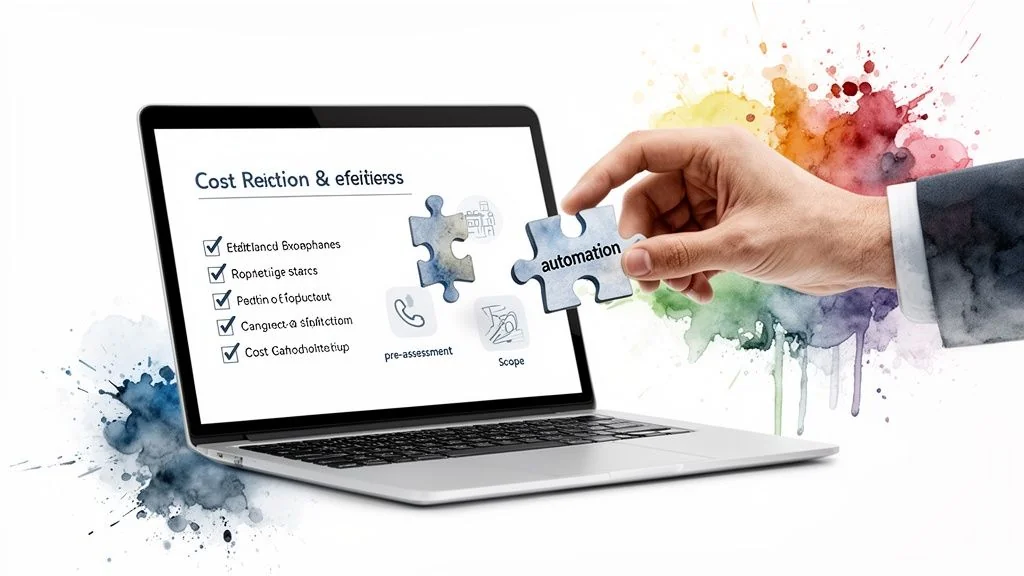
Smart preparation can cut your readiness assessment costs by 20-40%. This is a direct result of reducing the billable hours required by the audit firm.
Do a Pre-Assessment Yourself
Before engaging an external auditor, conduct an internal gap analysis using a standard SOC 2 controls checklist. This matters for your SOC 2 project because it allows you to identify and remediate low-hanging fruit yourself, presenting a more mature control environment to the auditor.
For example, you know SOC 2 requires a formal risk assessment process (CC3.1, The entity identifies, analyzes, and responds to risks). If you lack one, draft a basic risk management policy and create an initial risk register before the assessment begins. This single action saves the auditor billable hours they would have spent identifying and documenting this obvious gap, allowing them to focus on more complex, nuanced control areas.
Lock Down Your Scope and Prevent Creep
Scope creep is a primary driver of budget overruns in SOC 2 projects. Adding another system, business unit, or Trust Services Criterion after the engagement has started adds billable hours. For a successful SOC 2 journey, it is critical to define and finalize the scope before signing the engagement letter.
Nail down your scope with absolute precision:
- Systems: Explicitly list every in-scope application, database, and piece of infrastructure.
- Trust Services Criteria: Lock in your chosen TSCs (e.g., Security and Availability). Resist the urge to add more without a clear business or contractual driver.
- People: Identify the specific teams and individuals whose functions are in-scope for the audit.
Documenting this creates a clear statement of work that protects both you and the auditor from misunderstandings that lead to surprise costs and project delays.
A well-defined scope is the guardrail for your budget. It keeps the auditor’s effort—and your bill—focused squarely on what you need to achieve compliance, no expensive detours allowed.
Use a Compliance Automation Platform
Leveraging compliance automation tools like Vanta, Drata, or Secureframe is one of the most effective cost-reduction strategies. These platforms integrate with your cloud environment, HR systems, and developer tools to automate evidence collection. This is vital for your SOC 2 process because it drastically reduces the manual labor required from your team and the auditor.
Instead of your team spending weeks taking screenshots and gathering logs, the platform does it continuously. When the auditor logs in, they see a centralized dashboard where controls are pre-mapped to live, automated evidence. This efficiency means the auditor spends less time on evidence gathering and more time on substantive testing, directly translating into fewer billable hours and a lower assessment cost.
Bundle Services to Get a Discount
Most CPA firms that perform readiness assessments also conduct the formal SOC 2 audit. When vetting potential partners, always ask if they offer a discount for bundling both services. This is an important strategy for managing the overall cost of your SOC 2 compliance.
By committing to both the readiness assessment and the subsequent audit with the same firm, you create efficiencies. The firm gains deep familiarity with your systems and controls during the readiness phase, which streamlines the formal audit. Many firms pass these efficiency savings on to you as a package discount, reducing your total SOC 2-related expenditure.
These strategies are fundamental for any team serious about achieving SOC 2 compliance without overspending. By preparing internally, defining a rock-solid scope, leveraging automation, and negotiating smartly, you can significantly reduce your upfront costs and position your organization for a successful and efficient SOC 2 audit.
Connecting Readiness Assessment to Audit Success
The cost of a SOC 2 readiness assessment should be viewed as a direct investment in the success of your formal SOC 2 audit. It is the most effective mechanism for de-risking the audit process by identifying and providing a roadmap to remediate control deficiencies before they can lead to a qualified opinion or a failed audit. This is why the assessment is a foundational element of any well-planned SOC 2 initiative.
The gap analysis report produced during the readiness assessment provides a prioritized action plan. This allows your team to strategically address the most critical issues first, such as establishing a formal vendor management program required by CC9.2 or implementing a change management process that meets the criteria of CC8.1. Tackling these significant gaps well in advance of the formal audit demonstrates control maturity and significantly increases the likelihood of a clean report. The preparation involved in a readiness assessment, including addressing items like those found in accounting risk management best strategies, strengthens your overall security posture.
The biggest risk in any audit is finding a major gap halfway through. This can blow up your timeline, force a restart of your observation period, and cause months of delays. By fixing the issues you find in the readiness phase, you walk into the final audit with a mature, buttoned-up set of controls.
Ultimately, the upfront work done during the readiness phase streamlines the formal audit. Auditors can work more efficiently when controls are well-documented and operating effectively, which can lead to lower final audit fees. By undertaking a readiness assessment, you transform the SOC 2 audit from a high-stakes examination into a predictable, manageable project—a final validation of the robust control environment you have already built, ensuring you are truly ready for your SOC 2 audit.
Finding the right auditor is crucial for both your readiness assessment and your final audit. SOC2Auditors provides transparent pricing data and verified client reviews on 100+ firms, helping you select a partner that fits your budget and scope without the sales pressure. Compare your top options side-by-side at https://soc2auditors.org.