 Menu
Menu
Secureframe is a compliance automation platform designed to help organizations prepare for and maintain security and privacy certifications, primarily SOC 2. The software integrates with an organization’s technology stack—including cloud providers, identity management systems, and HR platforms—to automatically collect evidence, monitor security controls against specific framework requirements, and manage policy documentation. Its core function is to streamline the audit readiness process by translating technical configurations and operational procedures into demonstrable proof of compliance for auditors.
What Is Secureframe and How It Works for SOC 2
Secureframe is a compliance automation platform built to streamline the process of achieving and maintaining information security certifications, with a primary focus on SOC 2. The platform operates by automating evidence collection, continuously monitoring security controls, and centralizing policy management to prepare an organization for an audit. It serves as a single source of truth for a company’s compliance program, directly mapping technical and administrative activities to the requirements of the AICPA’s Trust Services Criteria.
For an organization pursuing SOC 2, this matters because the platform directly addresses the most labor-intensive aspects of audit preparation. It converts a traditionally manual and error-prone process of gathering screenshots, logs, and documentation into a structured, technology-driven workflow, significantly reducing the burden on engineering and operational teams.
Centralizing Evidence for Auditors
A core challenge in a SOC 2 audit is providing sufficient and appropriate evidence that controls are designed and operating effectively. Instead of engineers spending hundreds of hours manually collecting logs and configuration data, Secureframe integrates directly with the systems where this evidence resides.
Common integrations include:
- Cloud Providers: AWS, Google Cloud, Azure
- HR Systems: Gusto, Rippling, BambooHR
- Version Control: GitHub, GitLab
- Identity Providers: Okta, Google Workspace
This matters for a SOC 2 audit because automated, direct-from-source evidence is inherently more reliable and less susceptible to human error than manually gathered proof. For a SOC 2 Type 2 report, which covers an observation period (typically 3-12 months), this continuous collection provides a consistent and verifiable audit trail, satisfying auditors that controls have been operating effectively over time, not just at a single point in time.
Mapping Controls to Trust Services Criteria
The AICPA Trust Services Criteria (TSC) are the foundation of a SOC 2 report. Secureframe’s platform is designed to align an organization’s security posture with these specific criteria, particularly those detailed in established frameworks like cloud security best practices for regulated industries.
For example, to meet the SOC 2 criterion CC6.1, which requires that “the entity implements logical access security software, infrastructure, and architectures,” Secureframe automatically tests configurations in your identity provider to verify that policies like multi-factor authentication (MFA) are enforced. For CC7.1, which covers system monitoring, the platform scans your cloud environment to ensure that logging and alerting mechanisms are active and properly configured.
This direct mapping is critical for a successful SOC 2 audit because it removes ambiguity. It translates an organization’s technical security measures into the precise language and framework that auditors use, ensuring that every piece of collected evidence has a clear purpose and directly supports a specific SOC 2 control. This structured approach not only accelerates the audit readiness timeline but also increases the likelihood of a clean audit report with fewer exceptions.
How Secureframe Automates Evidence and Monitors Controls
At its core, Secureframe functions as an automation engine for SOC 2 compliance. Its primary purpose is to automatically collect evidence and continuously monitor the security controls required by the AICPA Trust Services Criteria. This is accomplished by integrating with an organization’s existing technology stack—such as its cloud provider, HR system, and code repositories—to extract the configurations, logs, and procedural data that auditors require for their evaluation.
This matters for a SOC 2 audit because it transforms audit preparation from a reactive, manual exercise into a proactive, automated process. Instead of engineers manually taking screenshots of AWS configurations or HR managers exporting lists of terminated employees, Secureframe performs these tasks continuously and systematically, ensuring evidence is always current and readily available.
This simple flowchart shows how you get from a mountain of manual work to a clean SOC 2 report with an automation platform.
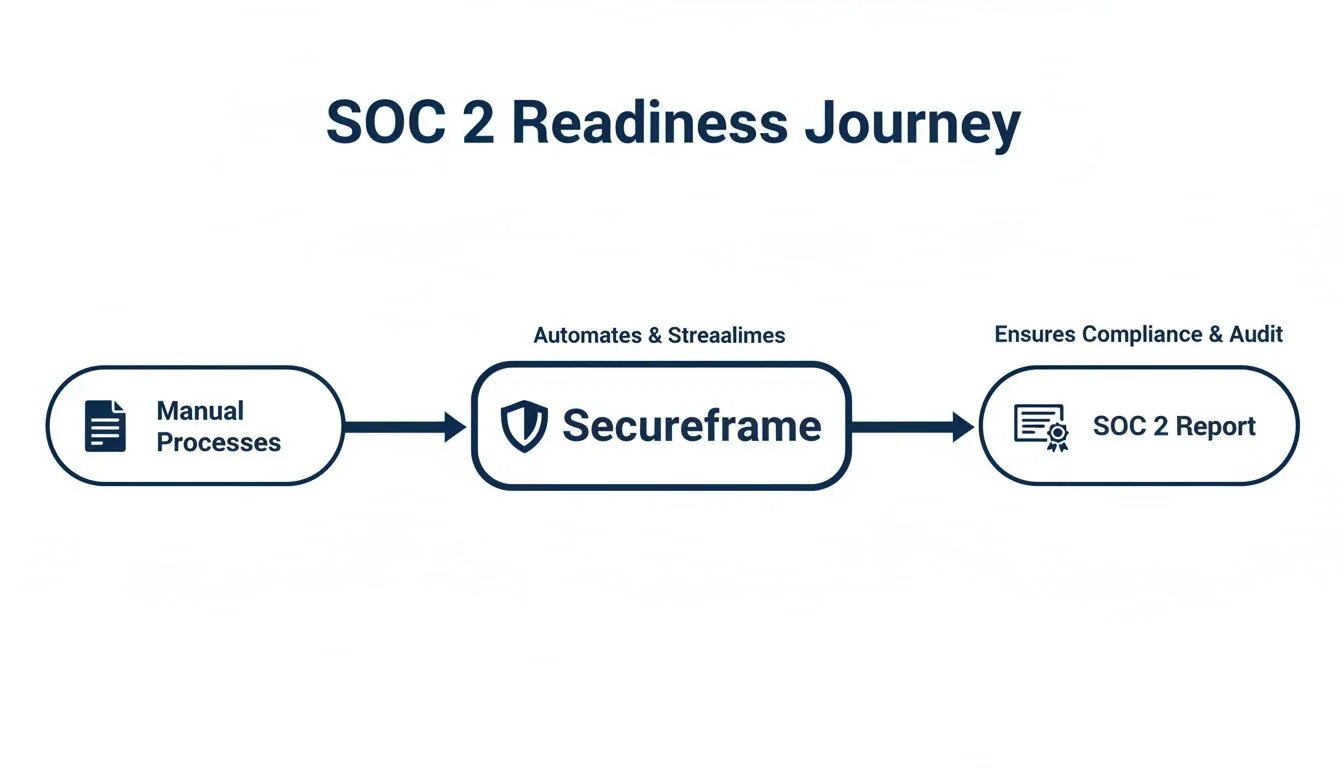
As you can see, Secureframe becomes the central hub, taking all the chaotic, manual effort and funneling it into a structured path toward a certified audit report.
Plugging Into Your Tech Stack
This automation is powered by Secureframe’s 100+ pre-built integrations, which serve as the conduits for feeding evidence directly into the platform.
Here is how this applies to specific SOC 2 requirements:
- Cloud Infrastructure: By connecting to AWS, Azure, or Google Cloud, Secureframe continuously scans for security misconfigurations. This directly supports CC7.1 (System Monitoring), which requires the entity to monitor control operations and take corrective action. The platform automates the “monitoring” and “corrective action” workflow.
- Employee Lifecycle: Integrating with HR tools like Gusto or Rippling, Secureframe automates evidence for employee onboarding (e.g., security training completion) and offboarding. When an employee is terminated, the platform generates a test to verify their access was revoked promptly, providing direct evidence for CC6.3 (Access Removal).
- Code Development: By linking to GitHub or GitLab, Secureframe can verify that all code changes follow a documented approval process. This produces auditable proof that system changes are authorized and tested, satisfying the requirements of CC8.1 (Change Management).
For a SOC 2 audit, this automated collection creates a reliable, immutable trail of evidence that auditors can trust. It minimizes the risk of human error—such as a missed screenshot or an incomplete log—and ensures the evidence accurately reflects the control’s operation throughout the audit period.
Continuous Monitoring in Action
Automation is not a one-time event; it is about continuous monitoring, which is the cornerstone of a SOC 2 Type 2 report that covers a 3- to 12-month observation period. The Secureframe dashboard provides a real-time view of compliance status, immediately flagging any control that fails.
For instance, if a developer mistakenly disables MFA on a critical system, Secureframe detects this configuration drift and can automatically generate a ticket for remediation. This proactive monitoring is essential for maintaining compliance throughout the entire audit window, not just on the day evidence is gathered. This aligns with the principles of the TSC, which emphasize ongoing risk management, not just point-in-time assessments. You can read more about these evolving trends in SOC 2 compliance.
By replacing hundreds of hours of manual evidence collection, Secureframe not only frees up engineering resources but also builds a defensible, auditable record of compliance. This makes the SOC 2 audit itself more efficient, as auditors can rely on the platform’s integrity to test controls, leading to a faster and smoother audit engagement.
What Your Implementation Timeline & Effort Actually Looks Like
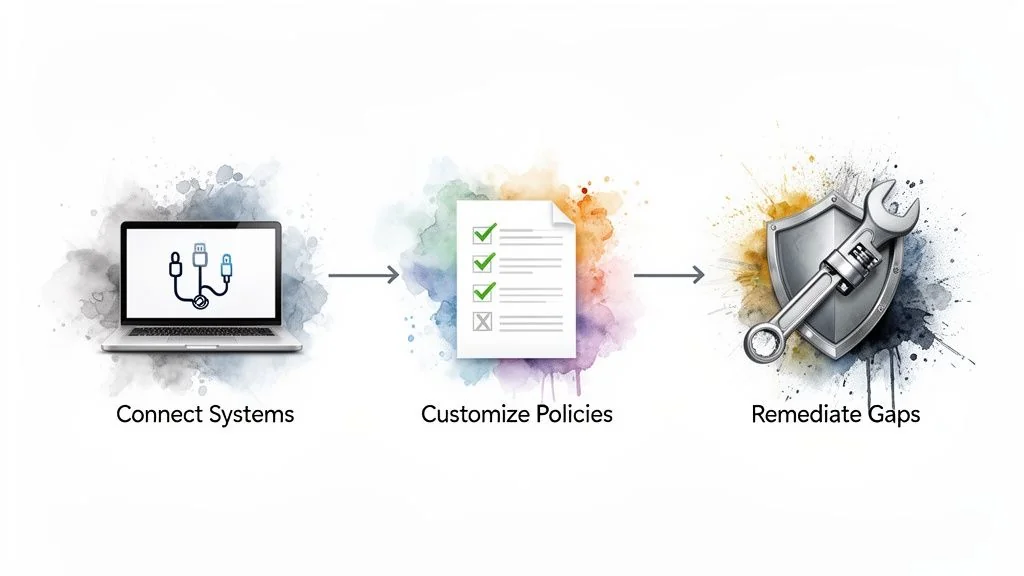
Implementing a compliance automation platform like Secureframe requires a structured effort from your team. While the “automation” component is significant, achieving SOC 2 readiness is a collaborative process between the platform and your internal personnel. A realistic understanding of this process is crucial for a successful audit outcome. The journey is typically divided into three distinct phases: system integration, policy customization, and gap remediation.
This matters for a SOC 2 audit because auditors will assess not just the final state of your controls, but also the process by which you implemented and manage them. A well-executed implementation demonstrates a mature approach to compliance, which is a key qualitative factor in an audit.
Phase 1: Onboarding and System Integration
The initial phase, typically lasting one to two weeks, focuses on connecting your company’s technology stack to the Secureframe platform. These integrations are the foundation of the automation engine, enabling Secureframe to collect evidence for controls related to the AICPA Trust Services Criteria.
This process involves:
- Connecting Your Cloud: Granting read-only access to your AWS, Google Cloud, or Azure environments.
- Integrating HR Systems: Linking tools like Gusto or Rippling to automate evidence collection for employee onboarding, termination, and background checks.
- Linking Identity Providers: Connecting Okta or Google Workspace to continuously monitor user access controls and MFA enforcement.
For a SOC 2 audit, this step is non-negotiable. It provides the initial baseline assessment of your security posture and establishes the automated data feeds that will serve as the primary source of evidence for your auditor.
Phase 2: Policy Customization and Control Ownership
Once systems are integrated, Secureframe provides a library of pre-built policy templates. These templates are a starting point, not a final product. Your team must review and customize each policy to accurately reflect your company’s specific operational procedures.
An auditor will quickly identify generic, un-customized policies, which can be a red flag. For example, your Incident Response Plan must specify the actual individuals and roles responsible for breach management within your organization, not contain placeholder text. This customization is direct evidence for CC1.2 (Policy Documentation), which requires that policies and procedures are documented and communicated.
During this phase, you will also assign ownership for each security control within the platform. This is critical for accountability. For instance, the CTO might be assigned ownership of infrastructure security controls related to CC6.6 (Infrastructure Security), while the Head of HR takes responsibility for controls concerning background checks and security awareness training as per CC2.2 (Security Awareness).
Phase 3: Remediation and Continuous Monitoring
After policies are customized and owners are assigned, Secureframe’s dashboard will highlight all failing tests—the gaps between your current state and SOC 2 requirements. This remediation phase is where your team takes action to fix these gaps, such as enforcing MFA, formalizing code review processes, or conducting vendor security reviews.
This phase is where the platform’s value becomes most apparent. Automated evidence collection and continuous monitoring drastically reduce the time to audit readiness, often by 50-70%. This is particularly important for a SOC 2 audit where a manual process can cost $15,000 to over $450,000 and take 6-20 months. You can explore detailed market reports on SOC reporting services for more context. Your implementation timeline depends on your existing security maturity, but Secureframe provides the structured framework to manage this remediation work efficiently, ensuring you are fully prepared when the SOC 2 audit begins.
Secureframe Pricing and Calculating Your ROI
Secureframe utilizes a custom-quote pricing model rather than a public price list. The cost of a subscription is determined by factors such as employee count, the complexity of the technology stack, and the specific compliance frameworks required (e.g., SOC 2, ISO 27001, HIPAA).
For a company pursuing SOC 2, this tailored pricing model requires a cost-benefit analysis that extends beyond the subscription fee. The return on investment (ROI) must be calculated by comparing the platform cost to the significant “soft costs” of a manual audit preparation process and the revenue enabled by achieving compliance faster.
Understanding the Cost-Benefit Equation
While a custom quote is necessary for an exact price, market research indicates that an annual Secureframe subscription for a small to mid-sized company pursuing SOC 2 typically falls within the $10,000 to $35,000 range. To justify this expense from a SOC 2 perspective, one must evaluate the cost of the alternative: a fully manual approach.
The manual path is dominated by the cost of internal labor, specifically the time commitment from high-value engineering and leadership personnel who must be diverted from their primary duties to focus on compliance tasks.
When calculating ROI, the primary factor is the opportunity cost of this internal labor. Every hour an engineer spends manually collecting screenshots for a SOC 2 audit is an hour not spent developing product features. Every week a CTO dedicates to managing the audit project is a week not spent on strategic initiatives. This diversion of resources has a direct, and often substantial, negative impact on revenue-generating activities.
Comparing Secureframe to Manual and Consultant Costs
The following table provides an estimated Total Cost of Ownership (TCO) comparison for a mid-market company preparing for a SOC 2 audit, contrasting a manual approach with one using Secureframe.
Cost Comparison SOC 2 Readiness With Secureframe vs Manual
| Cost Component | Manual Approach (Estimated Cost) | Secureframe Approach (Estimated Cost) |
|---|---|---|
| Internal Labor | $70,000 - $120,000+ (Based on 800-1,200 hours from engineering/management) | $15,000 - $30,000 (Based on 200-300 hours for implementation and remediation) |
| Consulting Fees | $20,000 - $60,000 (Often required for policy writing and project management) | $0 - $10,000 (May be needed for specialized guidance, but largely replaced by the platform) |
| Platform Subscription | $0 | $10,000 - $35,000 (Annual subscription fee) |
| Total Estimated Cost | $90,000 - $180,000+ | $25,000 - $75,000 |
The most compelling financial argument for a platform like Secureframe is its impact on speed to revenue. Enterprise sales cycles are frequently blocked pending a SOC 2 report. If the platform accelerates audit readiness by even three months, the company can begin closing high-value contracts sooner. A single enterprise deal unlocked by having the SOC 2 report can easily provide an ROI that exceeds the platform’s annual cost.
This financial calculation is directly tied to SOC 2 audit readiness. The platform’s cost is an investment in achieving compliance with AICPA Trust Services Criteria, such as CC1.1 (Commitments) and CC3.2 (Risk Assessment), in a manner that is not only efficient but also directly supports business growth.
Secureframe vs. Drata vs. Vanta: A Head-to-Head Comparison
Choosing a compliance automation partner is a critical decision for any organization preparing for a SOC 2 audit. While Secureframe is a leading platform, it operates in a competitive landscape alongside two other major players: Drata and Vanta. The optimal choice depends on your company’s specific technology stack, internal expertise, and desired level of support.
This matters for a SOC 2 audit because the platform you choose becomes the central repository for your evidence and the primary interface with your auditor. A platform that aligns well with your organization’s needs will streamline the audit process, while a poor fit can introduce friction and delays.
Integrations and Automation
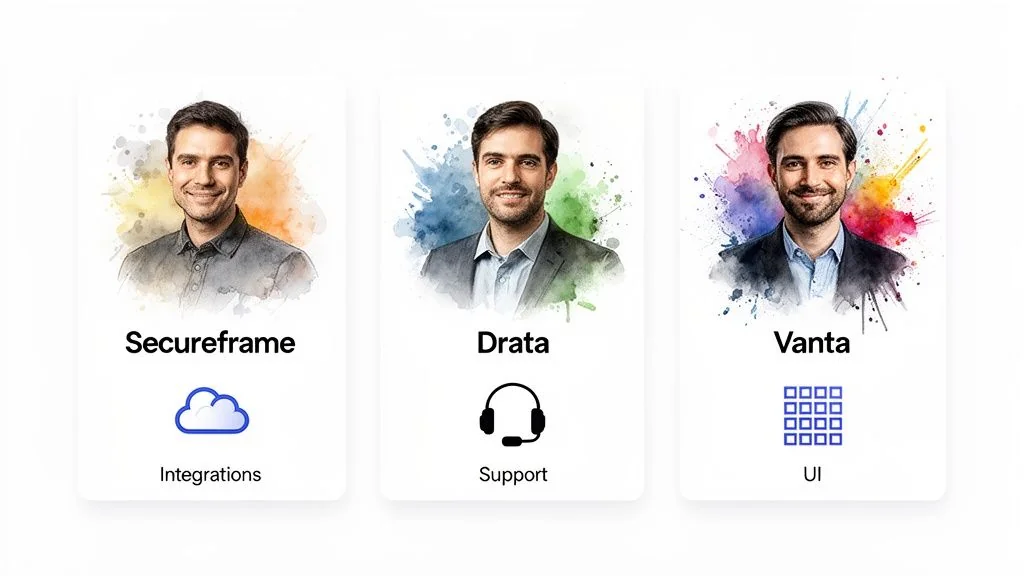
All three platforms are fundamentally built on automated evidence collection via direct integrations with an organization’s technology stack.
-
Secureframe: Excels with deep, technical integrations, particularly for complex cloud environments (e.g., custom AWS setups) and developer-centric tools. This is a significant advantage for organizations needing to prove compliance with highly technical controls under the SOC 2 Security and Availability criteria. Its flexible API is also a key differentiator for companies with bespoke internal systems.
-
Drata: Its primary advantage is the sheer breadth of its integration library. For companies utilizing a diverse or niche set of SaaS applications, Drata is more likely to have a pre-built integration, reducing the need for custom development. More details can be found in our Drata review.
-
Vanta: As a market pioneer, Vanta offers a mature and stable set of integrations for the most common technology stacks. Its strength lies in its streamlined simplicity, focusing on the core tests essential for a standard SOC 2 audit, making it highly accessible for startups and companies new to compliance.
For SOC 2, the choice here is pragmatic: if your environment is highly customized, Secureframe’s depth is beneficial. If your toolset is wide and varied, Drata’s breadth is an asset.
Customer Support and Onboarding
The level of support provided can be a decisive factor, especially for teams undertaking their first SOC 2 audit.
For many organizations, the support model is the key differentiator. The question is whether you need a dedicated compliance partner to guide the process or a self-service tool with expert support on-demand.
-
Secureframe: Is known for its high-touch, human-led support model. Customers frequently report positive experiences with dedicated compliance experts who provide hands-on guidance throughout the audit preparation process, mirroring the service level of a boutique consulting firm.
-
Drata: Also offers a structured support model with dedicated customer success managers and regular check-ins to ensure the project remains on track.
-
Vanta: Initially offered a more self-service model but has significantly expanded its support services. It provides a solid foundation for teams who prefer to lead the process internally but require access to expert advice when needed.
If your team lacks deep in-house compliance expertise, the guided, high-touch approach of Secureframe or Drata is invaluable for navigating the complexities of a SOC 2 audit.
User Interface and Policy Templates
All three platforms provide extensive libraries of policy templates, which serve as a critical starting point for documenting controls as required by SOC 2. The key difference lies in the user experience of customizing these policies and managing the remediation workflow. Secureframe’s workflow for policy tailoring and evidence review is often cited as particularly clear and intuitive.
This is critical for satisfying auditors that controls like CC1.2 (Policy Documentation) have been properly implemented, not just copied. An intuitive UI ensures that control ownership and remediation tasks can be managed effectively across different departments. Ultimately, your selection should be based on which platform’s combination of technical integration, support model, and user experience best aligns with your organization’s specific needs for achieving a successful SOC 2 audit.
Finding an Auditor That Works with Secureframe
Organizing controls and evidence within Secureframe is a critical step, but the process is incomplete without engaging a licensed CPA firm to conduct the official SOC 2 audit. The choice of auditor is paramount, as selecting a firm that is proficient with compliance automation platforms is key to a smooth, efficient, and cost-effective audit.
This matters for a SOC 2 audit because modern audit firms have adapted their methodologies to leverage platforms like Secureframe. They expect clients to use these tools and have built their workflows to integrate directly with them, which reduces audit fieldwork, minimizes redundant requests, and ultimately lowers the audit fee.
Why Auditor-Platform Alignment Matters
Choosing a “platform-native” auditor results in a fundamentally different audit experience. These firms conduct their testing within the Secureframe environment, eliminating the need for your team to manually export and transmit hundreds of evidence files. This alignment significantly reduces administrative overhead and mitigates the risk of human error in evidence management.
An auditor proficient with Secureframe can directly access the evidence library to test controls in real-time. Instead of requesting screenshots to verify access controls, they can review the automated tests and evidence trails within the platform that demonstrate compliance with SOC 2 criteria like CC6.1 (Logical Access) or CC8.1 (Change Management).
This collaborative approach is the hallmark of a modern computer security audit. The auditor relies on the platform’s integrity for evidence collection, allowing them to focus on evaluating the design and operating effectiveness of your controls, rather than managing a high volume of manual documentation. The value of Secureframe is fully realized only when paired with an auditor who understands and utilizes its capabilities.
Key Questions to Ask Potential Audit Firms
When vetting potential auditors, it is crucial to ask specific questions to determine their proficiency with compliance automation tools. This ensures they will act as a partner in efficiency rather than reverting to outdated, manual audit procedures.
Key questions to ask include:
- “How does your audit methodology differ when a client uses Secureframe for SOC 2 preparation?”
- “Do you offer preferred pricing or a reduced audit scope for clients who are fully prepared using a platform like Secureframe?”
- “Will your audit team work directly within the Secureframe platform to conduct testing, or will you require us to export and provide evidence separately?”
- “What percentage of your current SOC 2 clients utilize a compliance automation platform?”
To simplify this selection process, you can explore our database of SOC 2 audit firms to compare pricing, timelines, and client satisfaction data. This allows you to identify firms with a proven track record of working effectively with platforms like Secureframe. Choosing an auditor who embraces automation is a strategic decision that ensures the investment in Secureframe culminates in a faster, less expensive, and more streamlined SOC 2 audit engagement.
The Final Verdict: Is Secureframe Worth It For SOC 2?
Secureframe is a compliance automation platform designed to systematize the process of preparing for a SOC 2 audit. It achieves this by integrating with an organization’s technology stack to automate evidence collection, provide continuous monitoring of security controls, and centralize the management of the entire audit process.
Our analysis concludes that for most technology-driven companies, particularly in SaaS, FinTech, and HealthTech, utilizing a platform like Secureframe is a strategic imperative. It transforms the traditionally chaotic and manual SOC 2 preparation process into a structured, predictable workflow. This is particularly valuable for organizations undertaking their first audit, as it directly addresses the most time-consuming and error-prone aspects of achieving compliance.
Why It’s a Strategic Move, Not Just a Tool
The decision to invest in a platform like Secureframe is fundamentally about operationalizing security and compliance, not just passing a single audit.
- Accelerate Revenue: A SOC 2 report is a prerequisite for closing enterprise contracts. By significantly reducing the time required to become audit-ready, Secureframe directly enables faster revenue generation.
- Build Verifiable Trust: A SOC 2 report provides a point-in-time attestation of security. Secureframe’s continuous monitoring provides ongoing, verifiable proof that the security posture is maintained, which builds deeper trust with customers and partners.
- Optimize Engineering Resources: Automating the laborious task of evidence collection frees up valuable engineering and leadership resources, allowing them to focus on core product development and strategic growth initiatives rather than audit preparation.
The primary value is in shifting compliance from a reactive, annual event to a proactive, continuous function integrated into daily operations. This fosters a genuine security culture that is both auditable and visible to customers, satisfying the spirit of the SOC 2 framework.
By automating evidence collection and providing continuous visibility into your control environment, Secureframe enables your organization to demonstrate ongoing adherence to the AICPA’s Trust Services Criteria. This capability is the essence of being truly audit-ready for SOC 2. It not only prepares you for the audit itself but also strengthens your security posture year-round, positioning your company as a more trusted and competitive entity in the market.