 Menu
Menu
A SOC 2 audit is an independent examination of a service organization’s internal controls relevant to security, availability, processing integrity, confidentiality, and privacy. Governed by the American Institute of Certified Public Accountants (AICPA), the audit culminates in a SOC 2 report, which provides assurance to customers and stakeholders that the organization has established and is following effective security practices as defined by the Trust Services Criteria.
What SOC 2 Actually Costs in the First Year
The single biggest mistake startups make is thinking the SOC 2 audit cost is just the auditor’s invoice. For someone pursuing SOC 2, this is a critical misunderstanding. That fee is only a fraction of the total investment required to build a compliant security program. Budgeting solely for the auditor’s fee leads to sticker shock, failed audits, and stalled deals because it ignores the significant costs of readiness, tooling, and remediation required to meet the AICPA’s criteria.
A Realistic Financial Breakdown
Under-budgeting is the most common reason SOC 2 projects fail. To successfully pursue SOC 2, the internal conversation must shift from, “How much is the audit?” to, “What is our total investment to establish and document the controls necessary for a successful audit?” This includes factoring in all activities and purchases needed to demonstrate compliance with the Trust Services Criteria.
For startups in 2026, the auditor’s fee alone runs anywhere from $15,000 to $60,000. But when you factor in all the preparatory work, the total first-year cost balloons to $40,000 to $200,000 for companies with up to 200 employees. The audit fee is often just 30% to 40% of your total spend. The rest goes into implementing new controls, buying compliance tools, and dedicating staff time to remediation—all essential steps for passing a SOC 2 audit.
To help you build a smarter budget, here’s a breakdown of the typical all-in costs for SOC 2 compliance, separated by startup size. This gives you a much more accurate picture of the total investment, well beyond the auditor’s invoice.
Estimated Total First-Year SOC 2 Costs for Startups (2026)
| Expense Category | Seed Stage (<50 Employees) | Growth Stage (50-200 Employees) |
|---|---|---|
| Readiness Assessment | $5,000 - $15,000 | $10,000 - $25,000 |
| Compliance Automation Tools | $8,000 - $15,000 | $15,000 - $30,000 |
| Remediation & Staff Time | $10,000 - $30,000+ | $20,000 - $80,000+ |
| Audit Fee (Type 2) | $15,000 - $35,000 | $25,000 - $60,000 |
| Total Estimated Cost | $38,000 - $95,000+ | $70,000 - $195,000+ |
Understanding these costs is crucial for a startup pursuing SOC 2 because it allows you to build a realistic budget that prevents sticker shock and sets your audit project up for success. By budgeting for the entire process—from gap analysis to the final report—you are not just paying an auditor; you are funding the development of a mature security program that meets specific AICPA requirements and demonstrates your commitment to protecting customer data.
Getting a handle on this financial landscape is the first step. To learn more about how to navigate the initial phases, check out our complete guide on SOC 2 compliance for startups.
Type 1 vs. Type 2 Audits and Their Cost Impact
The decision between a SOC 2 Type 1 and Type 2 report is a strategic choice with a significant impact on your budget, timeline, and ability to meet customer demands. For a startup pursuing SOC 2, understanding this distinction is fundamental to creating a viable compliance roadmap.
A SOC 2 Type 1 audit assesses the design of an organization’s controls at a specific point in time. An auditor evaluates whether the defined controls, if operated as described, would be suitable to meet the applicable Trust Services Criteria.
A SOC 2 Type 2 audit tests the operating effectiveness of those controls over a period of time, typically three to twelve months. The auditor not only assesses the design of the controls but also gathers evidence to verify they have been operating effectively throughout the observation period.
For a startup, a Type 1 report can be a valuable initial step. It is faster and less expensive, providing a report that can be used to satisfy early-stage customer inquiries and demonstrate a commitment to security. However, mature enterprise customers almost always require a Type 2 report, as it provides a higher level of assurance.
How Audit Type Directly Influences Your Budget
The cost difference between a Type 1 and a Type 2 audit is one of the largest drivers of your total SOC 2 audit cost. This matters for a startup pursuing SOC 2 because the level of effort required from the auditor directly translates to cost.
A Type 1 audit primarily involves a review of documentation, policies, and system designs. The auditor’s work is concentrated over a shorter period.
A Type 2 audit includes all the work of a Type 1, plus extensive testing of evidence collected over the entire observation period. For example, to test AICPA criterion CC6.6, which addresses the removal of access for terminated users, a Type 1 audit might only require you to show you have a documented offboarding policy. For a Type 2 audit, the auditor will select a sample of employees who left during the observation period and demand evidence (e.g., system logs, HR records) that their access was revoked in accordance with that policy. This increased level of scrutiny and evidence sampling requires significantly more auditor hours.
- A Type 1 audit fee can range from $10,000 to $25,000.
- A Type 2 audit fee typically runs from $25,000 to $60,000 or more.
You can find more analysis on these figures in industry breakdowns of SOC 2 spending.
Choosing Your Starting Point
For most startups, a phased approach is the most cost-effective and practical strategy for achieving SOC 2 compliance.
- Year 1: Start with a Type 1. This allows you to formalize your control environment and obtain a report quickly to meet initial market demands.
- Year 2: Graduate to a Type 2. Immediately following the Type 1 report, begin the observation period for your first Type 2 audit. This builds upon the foundational work already completed.
This strategy spreads the financial and operational burden across two budget cycles, making the journey to a full Type 2 report more manageable. The choice between a Type 1 and Type 2 directly impacts your SOC 2 audit readiness; starting with a Type 1 allows you to methodically build and document your control environment, creating a strong foundation before undergoing the more rigorous and costly testing required for a Type 2 audit.
Primary Cost Drivers That Shape Your SOC 2 Budget
For a startup pursuing SOC 2, understanding the key variables that determine the final audit cost is essential for effective budgeting and project planning. The total cost is not a fixed price but a dynamic figure shaped by your company’s specific characteristics and decisions. Mastering these drivers is how you achieve compliance efficiently.
Audit Scope: The Biggest Cost Multiplier
Your audit scope is the single most significant factor influencing your SOC 2 audit cost. Scope is defined by two elements: the systems included in the audit and the Trust Services Criteria (TSCs) you choose. This matters for a startup pursuing SOC 2 because each additional TSC introduces a new set of controls that must be implemented, documented, and tested by an auditor.
The AICPA framework includes five TSCs, but only Security (also known as the Common Criteria) is mandatory. Adding criteria like Availability, Confidentiality, Processing Integrity, or Privacy will expand the audit effort significantly.
- Availability: Focuses on system uptime, disaster recovery, and performance monitoring. Essential if you have contractual SLAs. Adding this criterion requires you to provide evidence for controls like backup and recovery testing, as specified in AICPA criterion A1.2.
- Confidentiality: Addresses the protection of data designated as confidential through encryption and strict access controls. Necessary if you handle sensitive business information.
Adding a single TSC can increase the audit fee by 30-50% because it expands the testing population and the volume of evidence the auditor must review. The most cost-effective approach for a first-time audit is often to start with the Security criterion alone.
Company Size and System Complexity
The size of your organization and the complexity of your technology stack directly impact the audit cost. For a startup pursuing SOC 2, this is important because auditors typically bill based on time, and complexity requires more time to assess.
A larger number of employees increases the sample size an auditor must test for HR-related controls like background checks and security awareness training. A complex tech stack (e.g., multi-cloud environments, numerous third-party sub-processors) expands the number of systems and integrations an auditor must examine. For example, verifying logical access controls under AICPA criterion CC6.1 (“The entity implements logical access security software, infrastructure, and architectures…”) is a much larger task in a 200-person company with dozens of SaaS tools than in a 20-person startup with a handful. Clearly defining the audit boundary to exclude non-relevant systems is a key strategy for controlling costs.
Remediation Gaps: The Hidden Cost
Remediation is the work required to fix control gaps identified during a readiness assessment. For many startups, this is the largest and most unpredictable expense. This matters because the cost isn’t just about purchasing new tools; it’s about the significant engineering and operational hours needed to implement controls that were previously missing.
Common remediation activities include:
- Developing and approving a full suite of security policies and procedures.
- Implementing and configuring logical access controls to enforce the principle of least privilege.
- Establishing a formal risk assessment process as required by the Security criteria.
- Deploying and configuring logging and monitoring solutions across critical systems.
These activities, along with operational costs like secure media disposal following documented procedures (e.g., accounting for hard drive shredding cost), must be factored into your budget.
Tooling: Manual Labor vs. Automation
Your choice of tooling creates a trade-off between direct and indirect costs. Attempting to manage evidence collection manually with spreadsheets and shared drives may seem cheaper upfront but incurs a massive hidden cost in staff time. For a startup pursuing SOC 2, this is a critical calculation. Compliance automation platforms require a subscription fee but can drastically reduce the manual labor of evidence collection, policy management, and continuous monitoring, freeing up valuable engineering resources to focus on product development. This is why connecting cost drivers to your overall strategy is what gets you to a state of SOC 2 audit readiness. It’s not just about having security controls; it’s about having controls that are designed and implemented in a way that’s efficient to audit.
How to Build a Practical SOC 2 Budget and Timeline
For a startup pursuing SOC 2, translating cost estimates into an actionable budget and timeline is a critical step. A successful SOC 2 Type 2 project is not a quick sprint; it is a multi-month endeavor with distinct phases and associated costs. A detailed plan provides financial predictability, aligns internal teams, and gives the sales team a realistic date for when a report will be available.
A smart budget accounts for all activities required to meet the AICPA’s Trust Services Criteria, including readiness assessments, compliance tools, remediation work, and the final audit fee. In 2026, a small startup’s all-in cost can range from $40,000 to $95,000+, while a growth-stage company might see costs from $70,000 to $195,000+. The auditor’s fee often represents only 30-40% of this total, with the majority dedicated to the preparatory work of building a compliant program.
Sample 9-Month SOC 2 Type 2 Budget for a 75-Person Startup
Let’s map the journey for a hypothetical 75-person SaaS company seeking a SOC 2 Type 2 report covering the Security criterion. This timeline-based budget demonstrates how costs are incurred over the project lifecycle.
| Phase | Timeline | Key Activities | Estimated Cost |
|---|---|---|---|
| Phase 1: Readiness | Month 1 | Conduct a readiness assessment to identify control gaps against the Trust Services Criteria. Define audit scope and select compliance automation software. | $5,000 - $15,000 |
| Phase 2: Remediation | Months 2-3 | Remediate identified gaps. This involves engineering and operational work such as implementing MDM, configuring logging, writing and approving policies, and conducting security training. | $15,000+ (Primarily internal resource cost) |
| Phase 3: Observation | Months 4-9 | Begin the 6-month observation period. Utilize automation tools for continuous control monitoring and evidence collection to demonstrate controls are operating effectively over time. | $15,000 (Annual Tooling Subscription) |
| Phase 4: Audit | Months 7-9 | The auditor conducts fieldwork, testing the evidence collected during the observation period. The process concludes with the issuance of the final SOC 2 Type 2 report. | ~$35,000 (Audit Fee) |
This phased approach makes the investment more manageable. It’s also important to manage related operational costs. For instance, optimizing your cloud infrastructure with AWS cost optimization recommendations can free up budget that can be reallocated to your compliance project.
This timeline visualizes how the whole project flows, from the intense upfront work to the final audit.
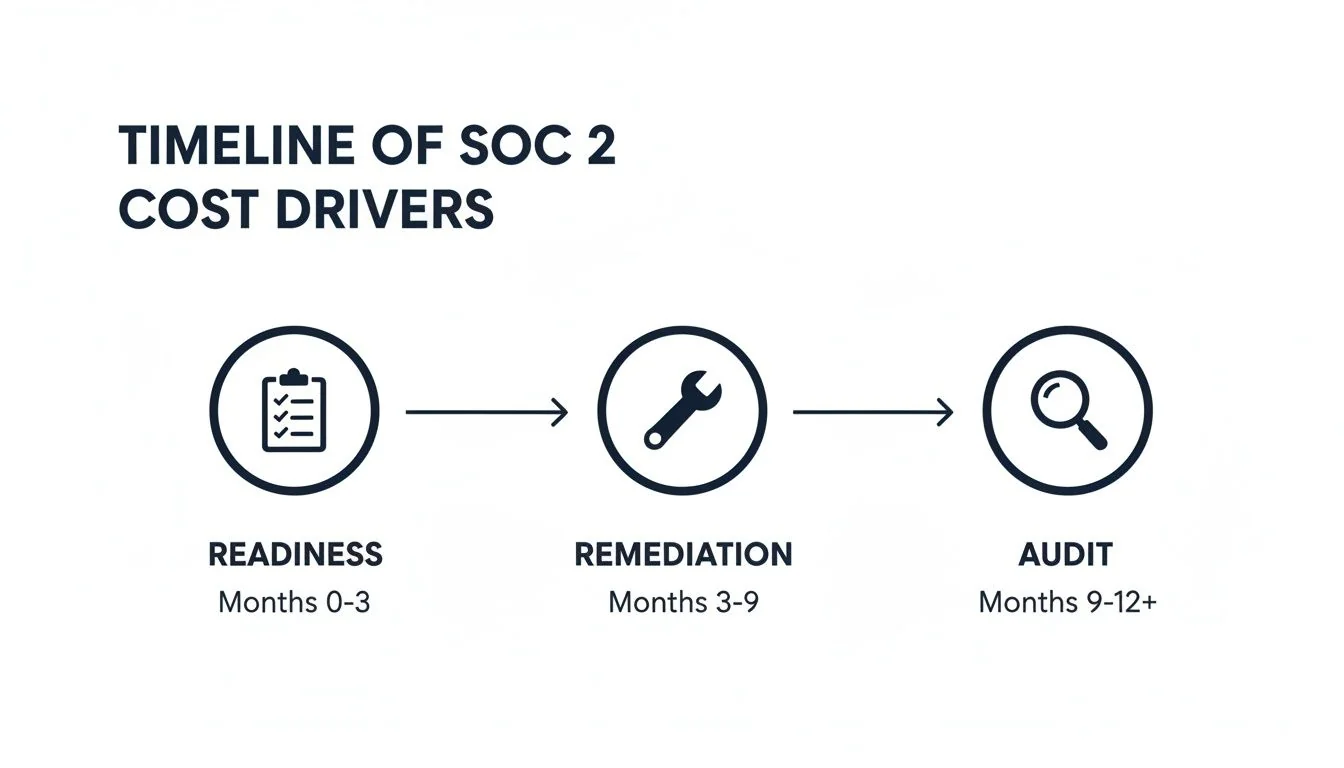
The heaviest lift—remediation—occurs at the beginning, well before the final audit fieldwork begins.
Turning the Plan Into Action
A structured plan is essential for any startup pursuing SOC 2. The first and most critical action is the readiness assessment. This engagement provides a detailed roadmap, pinpointing the exact gaps between your current state and the requirements of the AICPA criteria, such as the monitoring controls specified under CC7.1 (“To meet its objectives, the entity uses detection and monitoring procedures to identify… changes to infrastructure or data…”).
You can learn more about this initial step in our guide on the cost of a SOC 2 readiness assessment.
By mapping costs to a multi-month timeline, you create an operational playbook that ensures financial predictability and aligns your entire organization. This structured approach directly contributes to your SOC 2 audit readiness by ensuring that every dollar and every hour is spent on building a provably secure and compliant environment, transforming the audit from an expense into a strategic investment.
Choosing the Right Auditor and Avoiding Overpayment
Selecting an audit firm is one of the most critical decisions a startup will make when pursuing SOC 2. The choice directly impacts the total cost, the audit timeline, and the credibility of the final report. An auditor must be a CPA firm licensed by the AICPA to perform attestation engagements. Their role is to independently test your controls against the Trust Services Criteria and issue a formal opinion. For a startup, the right auditor acts as a partner who understands your technology and business context, leading to a more efficient and valuable audit.
Comparing Auditor Types
Audit firms vary significantly in their approach, expertise, and pricing. For a startup pursuing SOC 2, the goal is to find a firm that provides the necessary credibility and expertise at a price point that is sustainable for your business.
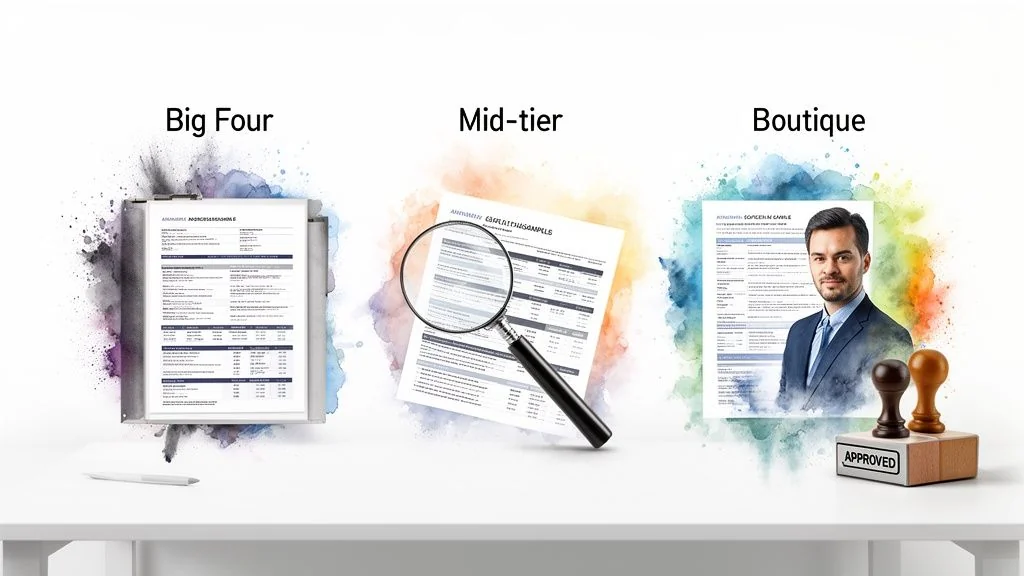
There are three main categories of audit firms:
- Big Four Firms (e.g., Deloitte, PwC, EY, KPMG): These firms offer unmatched brand recognition, which can be beneficial when selling to large, risk-averse enterprises. However, this prestige comes at a premium, with audit fees often 50-100% higher than other firms.
- Mid-Tier National Firms: These firms offer a balance of brand recognition and cost-effectiveness. They have substantial SOC 2 experience and are a solid choice for growth-stage startups that need a credible report without the Big Four price tag.
- Boutique Specialist Firms: These smaller firms specialize in IT audits like SOC 2. They are often the most agile and cost-effective, providing deep technical expertise and a hands-on approach that is well-suited for early-stage startups undergoing their first audit.
The right auditor for a startup is often one with direct experience auditing companies with a similar technology stack and business model, as they can conduct a more efficient audit and provide more relevant insights.
A Framework for Evaluating Auditors
To manage your SOC 2 audit cost for startups and ensure a successful outcome, you must use a structured evaluation process. It is crucial to compare at least three firms based on a consistent set of criteria.
Here are the key questions to ask every potential auditor:
- Verify Credentials: Confirm that the engagement team members are licensed CPAs and hold relevant security certifications like the CISA (Certified Information Systems Auditor). This is a non-negotiable requirement for a valid SOC 2 engagement.
- Check Tech Stack Experience: Ask if they have experience auditing companies with your cloud infrastructure (AWS, GCP, Azure) and key SaaS vendors. An auditor familiar with your environment will be significantly more efficient.
- Request Anonymized Sample Reports: Review a redacted SOC 2 report they have issued for a similar company. Is the report clear and well-structured? A confusing report will create friction with your customers.
- Understand Their Process: How do they manage evidence collection? Do they integrate with compliance automation platforms like Vanta or Drata, or do they rely on manual uploads to a portal? An inefficient process creates more work for your team and increases indirect costs.
This methodical selection process is a foundational component of SOC 2 audit readiness. By vetting an auditor for technical fit, clear communication, and process efficiency, you are not just purchasing an audit; you are securing a partnership that strengthens your security program and delivers a report that accelerates sales and builds customer trust.
Beyond the Bill: The Real Value of Your SOC 2 Investment
For a startup pursuing SOC 2, viewing the process as a mere cost is a strategic error. It is a foundational investment in operational maturity, security posture, and sales enablement. The entire budget—for the auditor, for compliance tools, and for remediation—is the capital required to build and validate a security program that meets the specific, rigorous demands of enterprise customers.
When viewed through a compliance lens, every dollar spent directly maps to strengthening the controls required by the AICPA Trust Services Criteria. That $15,000 subscription for a compliance automation platform is not just an expense; it is an investment in efficiency that automates the continuous monitoring and evidence collection necessary to prove the effectiveness of your controls over time. Similarly, a vulnerability management tool is not just a line item; it is the mechanism that enables you to meet the requirements of AICPA criterion CC7.1, which mandates monitoring for “anomalies that are indicative of malicious acts…and errors.”
From Cost Center to Competitive Differentiator
Proactively budgeting for the full scope of SOC 2 costs demonstrates a commitment to security that resonates with auditors, customers, and investors. This strategic financial planning transforms the compliance initiative from a perceived cost center into a tangible competitive advantage. The process of preparing for and undergoing a SOC 2 audit forces a startup to mature in critical operational areas.
- Formalized Onboarding and Offboarding: You will implement and document strict access control processes to satisfy criteria like CC6.1 (Logical Access) and CC6.6 (Termination of Access).
- Structured Risk Management: You will establish a formal risk assessment process to identify, analyze, and mitigate threats to the security of your system and customer data.
- Change Management Discipline: You will implement formal procedures for authorizing, testing, and approving changes to production systems, creating an auditable trail.
This investment lays the groundwork for continuous compliance, making subsequent annual audits significantly faster and more cost-effective. Ultimately, the funds allocated for a SOC 2 audit are an investment in building a culture of security and achieving a state of continuous SOC 2 audit readiness. This readiness is not about passing a single test; it’s about embedding security so deeply into your company’s operations that it becomes a cornerstone of customer trust and a key driver of long-term growth.
Finding the right auditor at the right price is crucial for managing your total SOC 2 cost. SOC2Auditors helps you compare verified pricing, timelines, and satisfaction scores from over 90 firms to find your perfect match without the sales calls. Get three tailored auditor quotes in 24 hours at https://soc2auditors.org.