 Menu
Menu
SOC 2 change management controls are the formal policies, procedures, and technical configurations an organization implements to authorize, test, approve, and deploy all modifications to its production systems. This scope includes changes to infrastructure, applications, software configurations, databases, and other critical IT components. The objective of these controls is to ensure that all system changes are managed in a controlled manner to maintain the security, availability, and integrity of the services provided to customers.
These controls are a direct response to the AICPA’s Trust Services Criteria (TSC), specifically the Common Criteria CC8.1, which states, “The entity authorizes, designs, develops or acquires, configures, documents, tests, approves, and implements changes to infrastructure, data, software, and procedures to meet its objectives.” For a company pursuing a SOC 2 report, implementing and evidencing these controls is mandatory to demonstrate operational maturity and a commitment to protecting customer data.
The Foundation of Change Management in SOC 2
Change management in a SOC 2 context is the documented, repeatable process that governs how a system alteration moves from concept to production. The core purpose is to prevent unauthorized, untested, or insecure changes from being introduced into the live environment, thereby mitigating risks of service disruption, security breaches, or data integrity issues.
For your SOC 2 audit, these controls are non-negotiable. They directly map to CC8.1 of the Trust Services Criteria, which mandates a structured lifecycle for all system changes: authorization, design, testing, and approval before implementation.
Why It Matters for SOC 2
A company pursuing SOC 2 needs a structured change management process to provide auditors with objective evidence that its IT environment is managed securely and predictably. Without it, there is no verifiable proof that changes are intentional and reviewed for risk. An auditor needs to see a clear, repeatable workflow to conclude that the controls related to CC8.1 are operating effectively.
This process provides auditors with concrete evidence that:
- Unauthorized changes are prevented: Strong controls, such as enforced peer reviews and restricted deployment permissions, demonstrate that only formally approved modifications can reach production. This directly addresses the risk of malicious or accidental unauthorized activity.
- System stability is maintained: Documented testing in a non-production environment (e.g., staging, QA) proves that changes are validated before deployment, reducing the risk of outages or performance degradation that could impact service availability.
- Accountability is enforced: A complete audit trail, from the initial change request ticket to the final deployment log, clearly identifies who requested, approved, and implemented every change, ensuring individual accountability.
Auditors are increasingly scrutinizing operational controls like change management. A recent CBIZ benchmark study revealed that SOC 2 reports with more than 150 security controls jumped from 16% to 23% in just one year. This trend indicates auditors are expanding their testing procedures with a particular focus on areas like CC8.1.
For a SOC 2 audit, a disciplined change process provides the necessary traceability and rollback capabilities, converting potentially chaotic deployments into a predictable and secure workflow. It is the auditable proof that differentiates controlled engineering from hopeful guesswork.
To meet SOC 2 requirements, a change management process must include several distinct stages, each generating its own trail of evidence.
Key Components of a SOC 2 Compliant Change Management Process
This table outlines the essential stages of a change management lifecycle as required by SOC 2, explaining the purpose of each stage and why it is critical for a successful audit.
| Stage | Purpose | Why It Matters for SOC 2 |
|---|---|---|
| Request & Authorization | To formally document a proposed change and secure approval from the designated owner. | Evidence for Audit: Provides a formal record (e.g., a Jira ticket) proving changes are initiated through an authorized channel, satisfying the “authorization” requirement of CC8.1. |
| Design & Review | To ensure the proposed change is well-designed, secure, and peer-reviewed for potential issues. | Evidence for Audit: Demonstrates due diligence through code reviews and design documents, showing that security and operational impacts are considered before deployment. |
| Testing & QA | To validate that the change works as intended and does not introduce bugs or security vulnerabilities. | Evidence for Audit: Generates test logs and QA sign-offs that prove changes are validated in a non-production environment, preventing failures in the live system and supporting the “testing” requirement. |
| Final Approval | To obtain a final sign-off from management or a Change Advisory Board (CAB) before deployment. | Evidence for Audit: Creates a clear point of accountability and a timestamped record confirming the change is ready for production, fulfilling the “approval” requirement of CC8.1. |
| Implementation | To deploy the approved change into the live environment according to a documented plan. | Evidence for Audit: Produces deployment logs showing a controlled, predictable process, often including rollback plans, which demonstrates operational control. |
| Post-Implementation Review | To confirm the change was successful and did not cause unintended negative consequences. | Evidence for Audit: Closes the loop on the change ticket, providing evidence that the change met its objectives and the system remains stable and secure post-deployment. |
Each step creates a mandatory piece of evidence your auditor will sample. A missing stage represents a gap in your control process and will likely result in a finding in your SOC 2 report. You can learn more about how this fits into the bigger picture in our detailed guide to SOC 2 controls.
Cracking the Code on CC8.1 Change Management
The AICPA Trust Services Criterion CC8.1 requires that changes to infrastructure, data, and software are authorized, designed, tested, approved, and implemented to meet the entity’s objectives. From a SOC 2 compliance perspective, this means establishing a formal process that prevents unauthorized or untested code from reaching production. The control’s purpose is to build a structured, predictable, and secure pipeline for system modifications, ensuring that no single individual can unilaterally make potentially disruptive changes.
Understanding this core objective is crucial for anyone pursuing SOC 2. It allows you to design internal controls that not only enhance security but also systematically generate the exact evidence an auditor needs to verify the operating effectiveness of your change management process.
Turning CC8.1 Into Real-World Actions
The language of the AICPA criteria must be translated into specific, actionable controls within your daily operations. For a successful SOC 2 audit, you must demonstrate that the principles of CC8.1 are consistently applied.
- Authorization and Approval: Every change must originate from a formal request (e.g., a ticket) and receive approval from an authorized individual or group, such as a Change Advisory Board (CAB). Why this matters for SOC 2: This creates a non-repudiable audit trail proving that every change is intentional and aligned with business objectives.
- Segregation of Duties: The individual who develops the code must not be the same individual who deploys it to production. Why this matters for SOC 2: This critical control prevents a single person from introducing unreviewed or malicious code into the live environment, reducing the risk of fraud and error.
- Testing and Validation: All changes must be tested in a non-production environment (e.g., staging, QA) to identify bugs, security vulnerabilities, or performance issues before deployment. Why this matters for SOC 2: Evidence of testing (e.g., QA sign-offs, automated test logs) is a cornerstone of CC8.1, proving to auditors that you take proactive steps to maintain system stability and security.
- Implementation and Review: The deployment process must be controlled and documented. A post-implementation review should confirm that the change was successful and did not cause unintended side effects. Why this matters for SOC 2: This demonstrates a complete, closed-loop process, assuring auditors that changes are monitored for success and that any negative impacts are addressed.
To bridge the gap between the formal criteria and practical application, reviewing essential policy and procedure examples can provide actionable templates for documenting your own controls.
What Auditors Are Really Looking For
For a SOC 2 Type 2 audit, an auditor will select a sample of changes made during the audit period and test the operating effectiveness of your controls. They will trace each sampled change from its initial request through to its final deployment.
The auditor’s primary goal is to verify that your documented process was followed without exception for every change in their sample. A single deviation can lead to an audit exception, highlighting a failure in your control environment.
They will request specific evidence for each control activity. Here is a breakdown of what to prepare:
| Control Area | Evidence Auditors Will Request |
|---|---|
| Change Initiation | Change request tickets (e.g., in Jira) with clear descriptions and business justifications. |
| Peer Review | Pull/merge requests in a version control system (e.g., GitHub, GitLab) showing comments and approvals from at least one other engineer, demonstrating segregation of duties. |
| Testing | Screenshots or logs from CI/CD pipeline tools (e.g., Jenkins, GitLab CI) showing that automated tests passed in a pre-production environment. |
| Deployment Approval | A documented sign-off within the ticket or version control system from a manager or designated approver confirming the change is ready for production. |
| Implementation | Deployment logs showing the date, time, and individual who executed the deployment, along with evidence that access to deploy is restricted. |
Automating this workflow is critical for SOC 2 readiness. It transforms routine development activities into a consistent evidence-generation machine. A well-defined SOC 2 change management control system doesn’t just satisfy CC8.1; it proves you have a mature and disciplined security posture.
Turning Theory Into Audit-Ready Evidence
For a SOC 2 audit, a change management policy is insufficient on its own; you must provide tangible evidence that the policy is consistently followed. Your daily development workflow must be configured to automatically generate a complete, auditable record for every change, proving your controls are effective.
An auditor needs to see verifiable proof of your controls in action, not just read about them in a policy document. The following steps outline how to create the specific evidence an auditor will sample to test your change management process against the requirements of CC8.1.
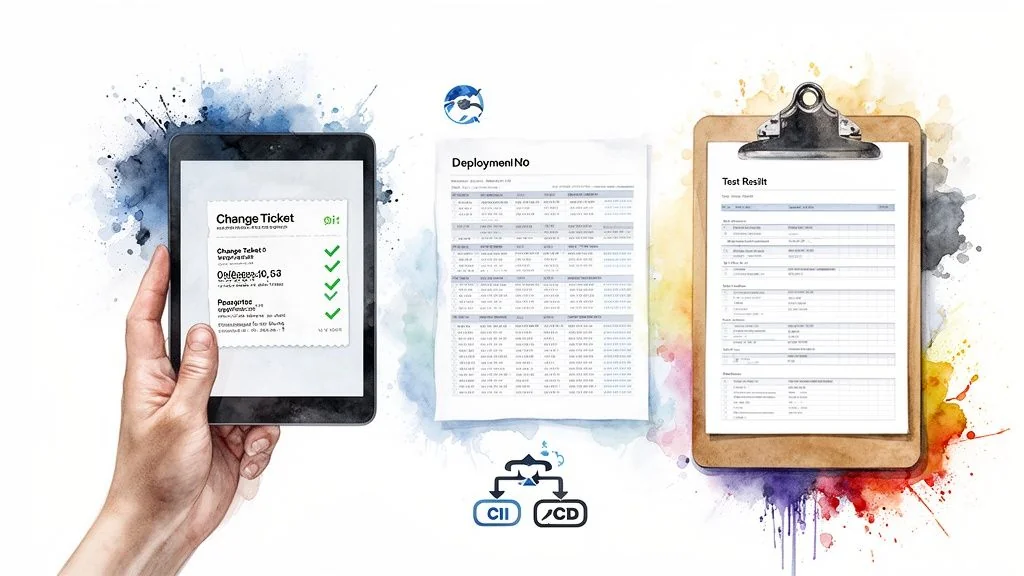
From Control Language to Concrete Proof
Your change management controls must be described in specific, testable language. Vague statements like “Changes are approved” are not auditable. You need precise control descriptions that point directly to the evidence you will provide.
Here is an example of a well-defined, auditable control statement:
“All changes to production systems are initiated via a ticket in Jira, which requires peer review via a GitHub pull request and formal approval from a designated change manager before deployment through our CI/CD pipeline.”
Why this matters for SOC 2: This single sentence provides the auditor with a test plan. It identifies the systems to inspect ([Jira], [GitHub], CI/CD pipeline) and the control activities to verify (ticketing, peer review, formal approval), making the audit process efficient and predictable.
Configuring Tools for Automated Evidence Collection
The most effective way to ensure consistent evidence generation is to embed compliance requirements directly into the tools your engineering team uses daily. This approach makes evidence collection an automated byproduct of the development process rather than a manual, error-prone task.
Here are specific, actionable configurations for common tools:
- Jira/Ticketing System: Configure workflows with mandatory fields for “Business Justification,” “Risk Assessment,” and “Testing Plan.” Use status gates to programmatically prevent a ticket from advancing to the “Ready for Deployment” stage until all required approvals are logged.
- GitHub/Version Control: This is a primary source of evidence for SOC 2. Implement branch protection rules to enforce peer review. Configure the rule to require at least one approval from a designated code owner before a branch can be merged into production. This creates an immutable, timestamped record of every code review.
- CI/CD Pipeline (e.g., Jenkins, GitLab CI): Automate testing and deployment. Configure the pipeline to execute unit tests, integration tests, and security scans for every commit. The logs from these pipeline runs serve as powerful evidence that every change was rigorously tested before deployment.
This tool-driven approach directly addresses CC8.1. Industry data shows that a formal process built around automated requests, risk evaluation, and timestamped logs can reduce audit discrepancies by 35-50%. By automating evidence generation, you can also cut deployment misses by 40%.
Evidence Requirements for Type 1 vs. Type 2 Audits
The evidence required depends on whether you are undergoing a SOC 2 Type 1 or Type 2 audit. A Type 1 report assesses the design of your controls at a single point in time. A Type 2 report tests their operating effectiveness over a period (typically 6-12 months), requiring far more extensive evidence.
This table breaks down the specific evidence auditors will request for each type of report.
| Evidence Type | Type 1 Requirement (Design) | Type 2 Requirement (Operating Effectiveness) |
|---|---|---|
| Change Management Policy | A formally approved policy document outlining your entire change management process. | The policy document, plus evidence that it was consistently followed throughout the entire audit period. |
| Change Tickets | One or two well-documented example tickets showing the complete workflow from request to deployment. | A population of all changes from the audit period, from which the auditor will select a sample of 25-50 tickets to test. |
| Approval Records | Screenshots of approval configurations in tools like GitHub or Jira. | The actual approval records (e.g., comments, timestamps, digital signatures) for every change in the auditor’s sample. |
| Test Results | A sample test plan and evidence from one successful test run to show the process is designed correctly. | The complete test logs and QA sign-offs for every change selected in the auditor’s sample. No exceptions are permitted. |
For a SOC 2 Type 2 audit, consistency is paramount. If an auditor finds even one change in their sample that did not follow your documented process precisely, it will likely result in an audit exception. The strength of your SOC 2 change management controls is measured by your ability to produce this evidence repeatedly and without fail. Assembling this information is a crucial part of compiling your complete set of SOC 2 documentation.
Common Change Management Failures and How to Fix Them
During a SOC 2 audit, change management is one of the most common areas for control failures. Most audit exceptions in this domain stem from undocumented processes, informal approvals, and inadequate testing—all direct violations of the principles outlined in the AICPA’s Trust Services Criteria. For a company pursuing SOC 2, addressing these common pitfalls is non-negotiable.
The friction often arises when a fast-paced development culture conflicts with the structured requirements of an audit. An informal approval in a messaging app, for instance, lacks the permanence and formality required for audit evidence. An auditor sees this as a control gap, leading to an immediate exception. Data from audit firms suggests unauthorized changes are found in up to 35% of environments, and inadequate documentation affects 40% of initial SOC 2 attempts. These are not minor issues; they are fundamental control deficiencies.
Informal or ‘Tap-on-the-Shoulder’ Approvals
Relying on verbal agreements or ephemeral messages (e.g., in Slack) for change approvals is a direct path to an audit failure. While seemingly efficient, these methods leave no auditable trail. When an auditor requests proof of authorization, a lost chat message is not acceptable evidence.
Why it matters for SOC 2: This is a direct failure to meet the “authorization” and “approval” requirements of CC8.1. Without a formal, persistent record, you cannot prove that your documented policy was followed. This will be flagged as an audit exception.
The Fix: Implement programmatic enforcement of approvals within your version control system. In GitHub or GitLab, configure branch protection rules that mandate at least one formal peer review and approval before a pull request can be merged into a production branch. This action creates an immutable, timestamped record for every approval, providing precisely the evidence an auditor requires.
Inadequate Testing for Emergency Changes
When a critical production issue occurs, the immediate impulse is to deploy a fix as quickly as possible, often bypassing the standard testing cycle. While the urgency is understandable, deploying an untested “emergency” change is a significant control violation and a major risk.
Why it matters for SOC 2: CC8.1 requires that all changes are tested; there is no exception for emergencies. Rushing untested code to production, even with good intentions, can introduce new vulnerabilities or cause further system instability, directly contravening the control objective.
The Fix: Establish a formal, documented “break-glass” procedure for emergency changes. This procedure does not skip controls but rather defines an alternate, audited control path.
- Documented Approval: The emergency change must still be documented in a ticket and receive explicit approval from a senior manager.
- Post-Mortem Review: After the incident is resolved, conduct a formal review of the root cause and the emergency fix.
- Retroactive Documentation: Update the ticket with a detailed record of what was changed, the justification for the emergency procedure, who approved it, and the results of post-deployment monitoring. This creates the necessary audit trail.
Poor Documentation and Traceability
This is a subtle but critical failure. An auditor examines a Jira ticket describing a new feature but finds no direct link to the specific pull request containing the code or the deployment log confirming its release. Without this traceability, the auditor cannot verify that the change that was approved is the same one that was deployed.
Why it matters for SOC 2: An auditor must be able to trace a change through its entire lifecycle. If they cannot connect the request (the “why”) to the code (the “what”) and the deployment (the “how”), they cannot validate the integrity of your process.
The Fix: Enforce a strict naming convention that links all artifacts together. Mandate that all pull request titles must include the corresponding ticket number (e.g., “FEAT: Implement user authentication [PROJ-123]”). This simple, enforceable rule creates a searchable and unbreakable link between the business justification in the ticket and the technical implementation in the codebase, satisfying the auditor’s need for end-to-end traceability.
Building Your Audit-Ready Change Management Program
Building a SOC 2-compliant change management program involves translating policy into practice. The goal is to define the rules, integrate them into your tools, and ensure every team member understands and follows the established procedures. This operational discipline is essential not only for passing the audit but also for preventing production outages and security incidents.
For any organization navigating how to get SOC 2 certification, a robust change management program transforms a high-risk audit area into a demonstrable strength, providing auditors with a clear, defensible narrative of how changes are managed securely.
Define Your Change Management Policy
The first step is to create a formal change management policy document. This document is the single source of truth that your auditor will review on day one. It must be clear, comprehensive, and formally approved by management.
Why it matters for SOC 2: The policy document is the foundation upon which your controls are built. It defines the “what” and “why” of your process, and the auditor will test your operational activities against this document. Your policy must explicitly define:
- Scope: Specify which systems are covered (e.g., production infrastructure, source code repositories, critical databases).
- Roles and Responsibilities: Clearly outline who can request, approve, and implement changes. Use defined titles like “Change Owner,” “Peer Reviewer,” and “Change Manager.”
- Change Categories: Define categories such as Standard, Emergency, and Minor, and detail the specific approval workflow required for each.
Configure Your Ticketing and Version Control Systems
Next, configure your tools to enforce the policy rules automatically. This shifts the burden of compliance from human memory to system enforcement, making it difficult to deviate from the required process.
Why it matters for SOC 2: This provides auditors with evidence that your controls are systematically enforced, not just followed on a best-effort basis. Actionable configurations include:
- Jira/Ticketing System: Create mandatory fields in change request tickets, such as “Business Justification,” “Risk Assessment,” and “Evidence of Testing.” Use workflow automation to prevent a ticket from being deployed until all required approvals are logged.
- GitHub/Version Control: This is critical for SOC 2. Implement branch protection rules on production branches. Configure these rules to require at least one peer review approval and successful status checks (i.e., passed automated tests) before a pull request can be merged.
Establish Clear Procedures and Train Your Team
A policy and configured tools are ineffective if the engineering team is not trained on how to use them. Develop clear, step-by-step procedures for each change type and conduct mandatory training sessions.
The objective is to make the compliant path the easiest path. When your team understands the process and the tools are set up to guide them, adherence becomes a natural part of their workflow, not an extra burden.
This visual illustrates the required transformation from an informal, high-risk process to a structured, audit-ready one.
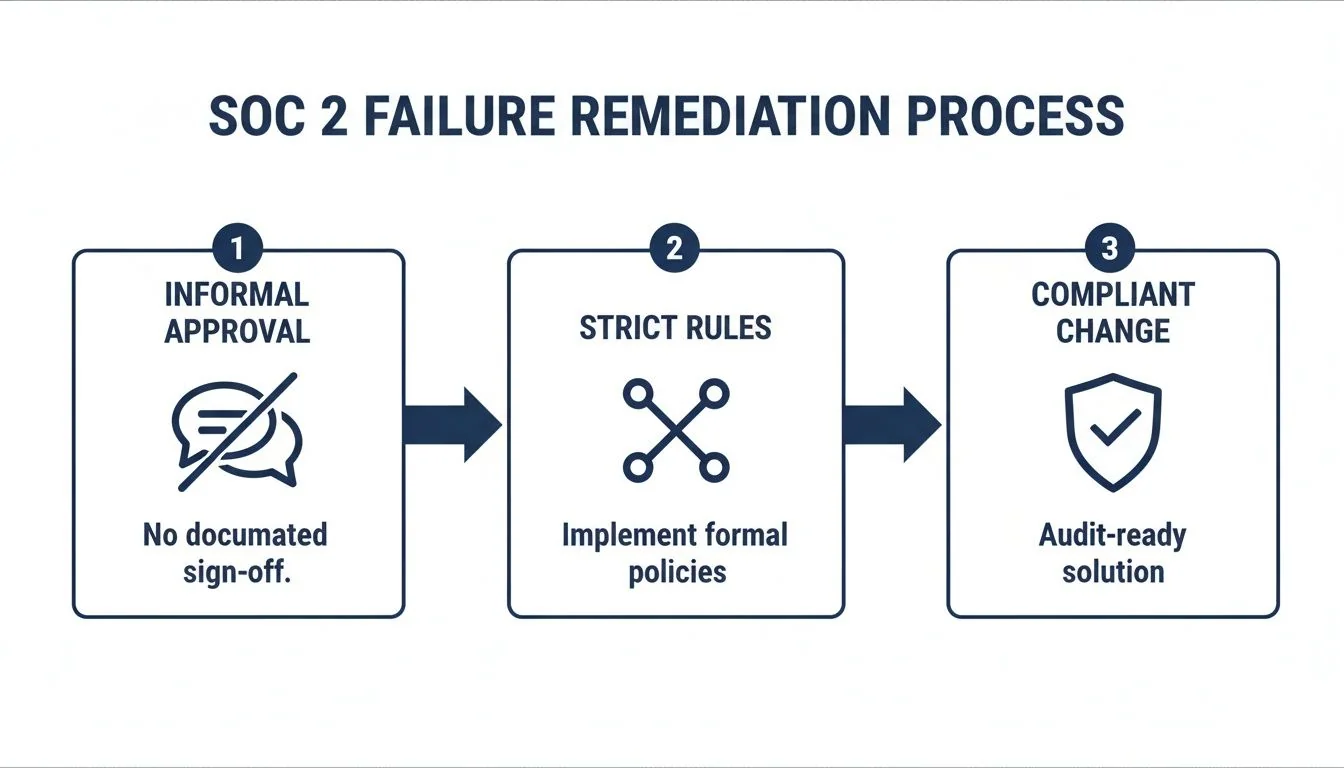
This flow demonstrates the move from ad-hoc approvals to an enforced, systematic process that generates a complete audit trail for every change.
Perform Periodic Self-Audits
Do not wait for your external auditor to identify control weaknesses. Conduct quarterly self-audits by randomly selecting a sample of recent changes and inspecting them against your policy.
Why it matters for SOC 2: This proactive testing demonstrates to your auditor that you are actively monitoring the effectiveness of your own controls—a key principle of a mature control environment. Ask these questions for each sampled change:
- Did the change have an approved ticket?
- Is there clear evidence of a peer review?
- Can you produce logs showing that testing was completed before deployment?
This continuous self-assessment is the essence of audit readiness. By identifying and remediating gaps before the official audit begins, you prove that your SOC 2 change management controls are not just well-designed but are operating effectively over time, which is the primary objective of a SOC 2 Type 2 report.
How Strong Change Controls Accelerate Your SOC 2 Audit
An organization’s change management program is a key indicator of its overall operational discipline. For a SOC 2 auditor, a well-documented and automated change control process signals a low-risk environment, while an inconsistent, manual process indicates high risk. Getting this right directly influences the speed, cost, and outcome of your SOC 2 engagement.
A robust system for managing change becomes a key differentiator that can lead to more favorable pricing and faster timelines from audit firms.

Reducing Audit Friction and Delays
Auditors base their testing strategy on risk assessment. Weak or manual change management is immediately flagged as a high-risk area, prompting a more extensive and time-consuming investigation. This can cause the auditor’s sample size to increase from the standard 25 changes to 50 or more. Each deviation discovered—such as a missing approval or an undocumented emergency fix—requires hours of follow-up, requests for additional evidence, and management interviews to explain the control failure. This is how audit timelines become significantly delayed.
Why this matters for SOC 2: A clean, consistent change management process builds auditor confidence. When an auditor pulls a sample and finds a complete, unbroken chain of evidence for every change—ticket, peer review, automated test results, deployment log—their confidence in the entire control environment increases.
An auditor’s goal is to verify that your documented process was followed without exception for every change in their sample. A single deviation can lead to an audit exception, highlighting a failure in your control environment.
A strong first impression in this critical area often convinces the auditor to reduce the scope of further testing, saving your team from countless hours of audit support and preventing project delays.
Lowering Audit Costs and Building Negotiating Power
The cost of a SOC 2 audit is directly proportional to the number of hours the audit firm anticipates spending. A company with weak change controls represents a significant time investment for auditors, who expect to spend extra time chasing down evidence and documenting exceptions. This anticipated effort inflates the price quoted for the engagement.
Why this matters for SOC 2: During scoping calls with audit firms, the maturity of your change management process is a key point of inquiry. By demonstrating a well-defined, automated, and consistently enforced program, you actively de-risk the engagement for the audit firm. This readiness is your most powerful negotiating tool. An audit firm is far more likely to offer a competitive price when they see you have a mature process that will lead to a predictable, efficient audit.
- Predictable Evidence: Strong controls ensure evidence is readily available, not something engineers must create retroactively.
- Fewer Exceptions: A disciplined process minimizes control failures, avoiding expensive remediation work and re-testing cycles.
- Efficient Fieldwork: Auditors can complete their testing more quickly, reducing the total billable hours.
The Strategic Advantage of Audit Readiness
Beyond passing the audit, a mature change management program provides a significant strategic advantage. It serves as tangible proof to enterprise customers and partners that your organization is reliable, secure, and operates professionally, which can be a deciding factor in closing major contracts. The difference in audit outcomes is stark:
| Audit Outcome | Impact of Weak Controls | Impact of Strong Controls |
|---|---|---|
| Audit Timeline | Delayed for months due to expanded testing and remediation cycles. | Accelerated as auditor confidence grows and evidence review is streamlined. |
| Audit Cost | Higher due to increased auditor hours and fees for re-testing failed controls. | Lower due to a predictable scope and reduced risk perception by the audit firm. |
| Report Quality | Higher risk of exceptions or a qualified opinion, which can deter potential customers. | A clean, unqualified report that builds immediate customer trust and confidence. |
| Team Disruption | Engineering teams are constantly diverted from product development to address audit inquiries. | Minimal disruption, as most evidence is captured automatically through standard workflows. |
Strong SOC 2 change management controls are fundamental to achieving audit readiness. By implementing the actionable guidance in this guide—defining clear policies, enforcing them with technology, and continuously monitoring your own performance—you build a resilient and secure engineering function. This proactive investment transforms a compliance requirement into a powerful business asset, ensuring your organization is prepared for a smooth, efficient, and successful SOC 2 audit.
Finding the right auditor is as critical as having the right controls. SOC2Auditors helps you compare 100+ verified audit firms based on price, speed, and real client feedback, ensuring you partner with a firm that understands your business and your timeline. Get your three tailored auditor matches in 24 hours.