 Menu
Menu

On this page
- Defining GCP SOC 2 Compliance and the Shared Responsibility Model
- Mapping Your Responsibilities on Google Cloud
- Configuring GCP Services for a Compliant Architecture
- Automating Evidence Collection for Type 2 Audits
- Planning Your Audit Timeline, Costs, and Scope
- Choosing the Right Auditor for Your GCP Environment
If you’re working toward a SOC 2 report on Google Cloud Platform, the hard part usually isn’t turning on security features. It’s proving, with clean evidence, that the right controls existed, were reviewed, and kept working throughout the audit period. That’s where most GCP SOC 2 compliance projects either become manageable or collapse into screenshot collection, late-night evidence hunts, and avoidable audit exceptions.
SOC 2 compliance on GCP means designing and operating your cloud environment so your system meets the AICPA Trust Services Criteria that apply to your audit scope, while clearly separating what Google controls from what your company controls. Your auditor evaluates your organization’s controls, not Google’s platform in the abstract. Google supports that effort by making its own SOC 2 assurance materials available, but your team still has to show how identity, change management, logging, incident response, vendor oversight, and data protection operate in your environment.
Defining GCP SOC 2 Compliance and the Shared Responsibility Model
GCP SOC 2 compliance is the process of aligning your company’s use of Google Cloud with the AICPA Trust Services Criteria, then producing evidence that your controls are suitably designed and, for Type II, operating effectively over time. For most SaaS companies, Security is the baseline criterion, with Availability, Confidentiality, Processing Integrity, or Privacy added only if the product and customer commitments justify them.
The first mistake teams make is assuming Google’s compliance status transfers to their application. It doesn’t. Google Cloud’s own SOC 2 reporting helps you evaluate the underlying platform, but your auditor still wants to see what your company configured, reviewed, approved, and monitored.
Google states that its core Google Cloud and Google Workspace SOC 2 Type II reports are issued quarterly, available through the Compliance Reports Manager, and that Google Cloud issues SOC 2 Type II reports only, not Type I. Google also explains that a Type II report typically evaluates control effectiveness over the past six months in its Google Cloud SOC 2 documentation. That matters because your vendor evidence for the cloud provider can stay current instead of relying on an old report from a prior audit cycle.
Practical rule: “GCP is SOC 2” is not a control. “We reviewed Google’s current report, documented inherited controls, and mapped remaining customer responsibilities” is a control activity.
A useful way to frame this is to compare cloud environments across providers. If you’ve dealt with managing AWS SOC 2 controls, the same core issue exists on GCP. The provider secures the underlying service, but your company owns the way identities, workloads, data flows, and production changes are handled inside that service boundary.
For someone pursuing SOC 2, this matters because every later decision depends on it. Scope too much, and you create unnecessary audit work. Scope too little, and you miss required controls. Get the boundary right first.
Mapping Your Responsibilities on Google Cloud
The cleanest GCP SOC 2 compliance projects start with a responsibility map, not a policy template. You need a written view of which controls are inherited from Google, which controls are shared, and which controls belong entirely to your company.
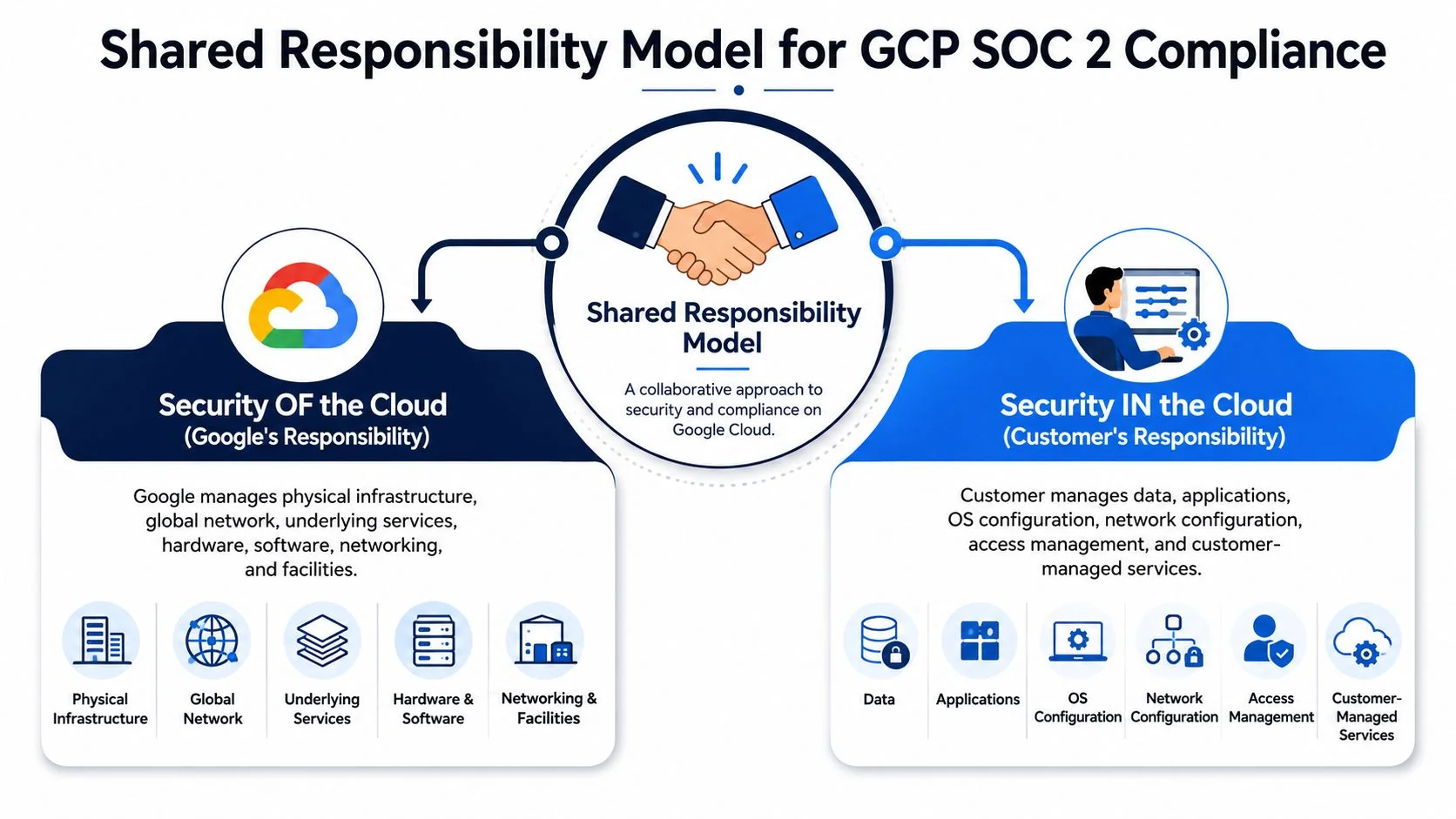
What Google owns and what you own
Google handles the security of the cloud. That includes the physical facilities, core infrastructure, underlying hardware, and managed service platform layers. Your company handles security in the cloud. That includes account structure, IAM design, network policy, workload configuration, secrets handling, logging choices, application security, and operational governance.
That division sounds obvious until the audit starts. Then teams discover they never documented who owns firewall rule review, who approves production IAM changes, or how they track exceptions for temporary admin access.
A practical starting point is to scope inherited controls before drafting internal controls. Google’s compliance materials help with that, and one published practitioner estimate says GCP-native services may cover “up to 30%” of control requirements before fieldwork begins, though the same guidance makes clear that this figure is anecdotal and highly dependent on architecture and shared-responsibility boundaries in the Compliance Reports Manager guidance.
A workable responsibility map
Use a simple matrix like this early in readiness work:
| Control area | Likely owner | What auditors usually expect |
|---|---|---|
| Physical data center security | Review of subservice evidence and vendor oversight records | |
| Hypervisor and underlying infrastructure | Documented inheritance and current provider report review | |
| IAM role design and access reviews | Customer | User listings, role definitions, review approvals, removal evidence |
| VPC rules and service exposure | Customer | Configuration evidence, approval trail, periodic review |
| Application logging and alert handling | Customer | Log retention setup, alert routing, ticket follow-up |
| Incident response for your product | Customer | Policy, incident records, post-incident actions |
| Encryption key administration where customer-managed | Customer | Key access restrictions, approvals, lifecycle evidence |
Auditors rarely struggle with the concept of shared responsibility. They struggle when the company hasn’t translated that concept into named control owners and recurring review activities.
Where teams usually get this wrong
Three patterns show up repeatedly:
- Over-inheritance. Teams assume managed services eliminate their need to document review controls.
- Over-scoping. They include test projects, abandoned workloads, or side systems that aren’t part of the in-scope service.
- Undefined shared controls. They note that Google covers part of the control, but never explain the customer side.
This matters for SOC 2 because scoping mistakes multiply quickly. Every in-scope project, service account, data path, and environment can create new evidence demands. If a system isn’t necessary for the report, leave it out.
Configuring GCP Services for a Compliant Architecture
A compliant GCP architecture isn’t the one with the most services enabled. It’s the one where each control objective has an enforceable configuration, a clear owner, and evidence an auditor can test.
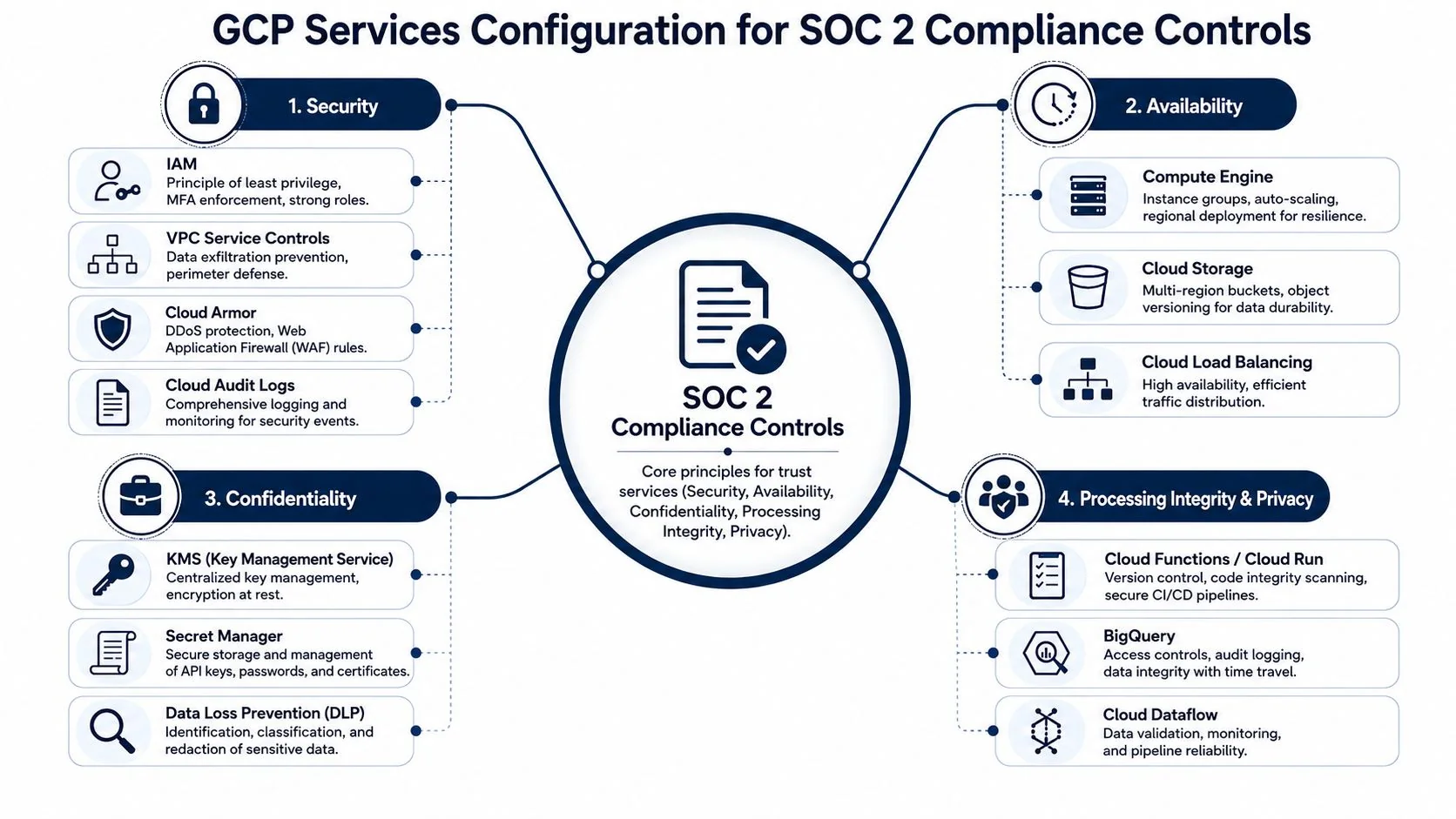
Start with the Trust Services Criteria
For most first audits, map technical controls against the criteria you selected. Security usually drives the bulk of the work. Availability and Confidentiality often add important system-level and data-handling expectations. Processing Integrity can matter if you make commitments about complete, valid, accurate, timely, or authorized processing.
Here’s a practical mapping model.
| Trust Services Criterion | Objective | Primary GCP Services | Key Configuration Goal |
|---|---|---|---|
| Security | Restrict unauthorized access | Cloud IAM, Organization Policy, Cloud Audit Logs | Enforce least privilege, approval-based changes, auditable admin activity |
| Availability | Support resilience and recovery | Compute Engine, Cloud Load Balancing, Cloud Monitoring, Cloud Storage | Define uptime-related controls, alerting, backups, and recovery procedures |
| Confidentiality | Protect sensitive data | Cloud KMS, Secret Manager, Cloud Storage, VPC Service Controls | Limit exposure, control secrets, manage encryption decisions |
| Processing Integrity | Support accurate and authorized processing | Cloud Logging, deployment pipelines, managed databases | Trace production changes and validate critical workflows |
| Privacy | Govern personal data where in scope | Logging controls, data stores, access controls, lifecycle procedures | Restrict data use and document handling aligned to commitments |
IAM and administrative control
Least privilege in GCP means more than avoiding basic roles. Auditors want to see that access is intentionally granted, reviewed, and removed. In Cloud IAM, keep production permissions narrow, separate human and machine identities, and avoid broad standing admin access where a narrower role or temporary elevation process would work.
For Trust Services Criteria related to logical access, strong evidence usually includes:
- Role design tied to job function, not convenience
- Approval records for privileged access changes
- Periodic access reviews with documented reviewer sign-off
- Termination and transfer handling that removes or adjusts access promptly
- Service account governance so non-human identities are inventoried and justified
If you’re using Google Groups to manage access, auditors often prefer that over one-off direct assignments because it creates a cleaner review pattern. But only if someone reviews group membership.
Logging, monitoring, and traceability
Cloud Audit Logs should be enabled and retained in a way that supports investigation and testing. Cloud Logging should capture the events you rely on for control execution, especially admin activity, policy changes, security-relevant events, and production changes. Cloud Monitoring should route alerts to people who respond, not to a dead mailbox.
Many teams fail a practical audit test. They can show that logging is enabled, but they can’t prove anyone reviews alerts, investigates exceptions, or preserves records long enough for fieldwork.
If a control says engineers review privileged changes, the auditor will eventually ask for the changes, the review record, and the dates. Logging alone isn’t enough.
Network and data protection controls
On GCP, network control evidence often comes from VPC design, firewall rule governance, ingress restriction, and segmentation between environments. If your architecture uses public endpoints, document why they’re required and how access is constrained. If you rely on VPC Service Controls, make sure the perimeter design is understandable to a reviewer who didn’t build it.
For confidentiality-related controls, focus on decisions rather than slogans:
- Encryption approach. Document where Google-managed encryption is sufficient and where customer-managed keys through Cloud KMS are necessary.
- Secrets handling. Use Secret Manager instead of hardcoded credentials or ad hoc secret files.
- Data storage boundaries. Define which buckets, datasets, and services may hold sensitive data.
- Sensitive data discovery. If you use DLP workflows, tie them to an operational process rather than treating scans as a one-off exercise.
What auditors actually test
Auditors usually care less about whether you adopted a fashionable architecture pattern and more about whether they can trace a control from policy to implementation to evidence. For GCP SOC 2 compliance, that means your configuration choices need to be stable, reviewable, and linked to operating procedures.
A secure GCP design helps. An auditable GCP design passes fieldwork.
Automating Evidence Collection for Type 2 Audits
Type II audits reward teams that treat evidence as a system, not a scramble. The most valuable technical work in GCP SOC 2 compliance is often the automation that preserves proof over time. Field guidance also emphasizes maintaining continuous access and vendor-review evidence throughout the audit period because Type II testing examines operating effectiveness over time, not just one-time setup, as noted in Google Workspace security materials covering security and third-party assurance.
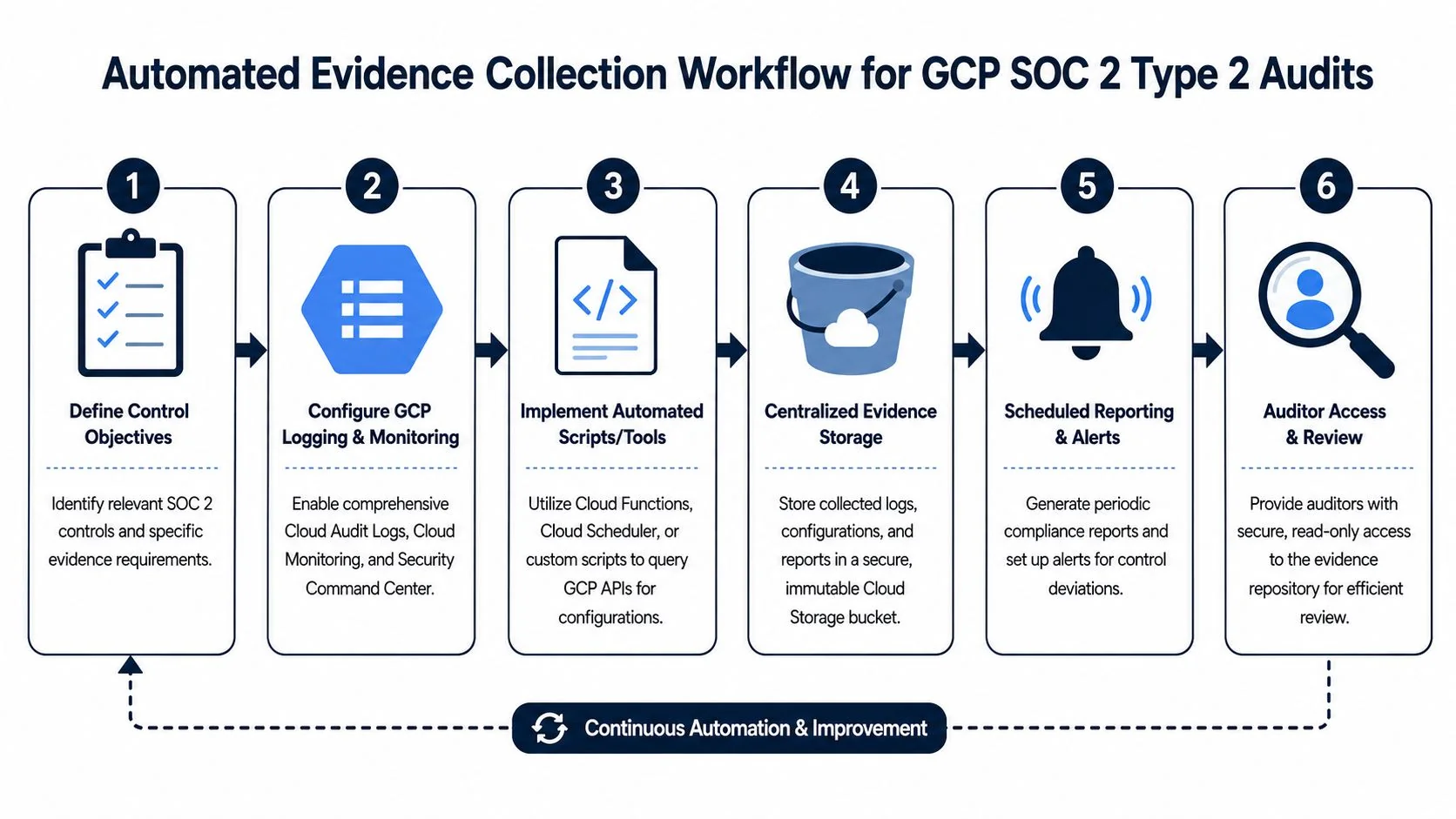
Build evidence around timestamps and approvals
The best evidence answers four questions quickly:
- What control operated
- When it operated
- Who performed or approved it
- Whether exceptions were handled
That pushes teams toward immutable logs, version-controlled infrastructure, ticket-linked approvals, and recurring exports. If you rely on screenshots in a shared folder, you’ll lose context and dates.
A strong GCP evidence pattern often includes Cloud Audit Logs exported to a locked-down repository, scheduled configuration snapshots, and Infrastructure as Code histories that show exactly when a production change was proposed, reviewed, and applied.
Evidence sources that hold up in audits
The evidence set should come from systems of record, not from manually assembled summaries.
- Cloud Audit Logs for admin activity, policy updates, and service usage tied to control actions
- Cloud Storage or BigQuery repositories for centralized, preserved evidence exports
- Terraform or other IaC repositories for change history, peer review, and rollback visibility
- Security Command Center findings for continuous monitoring and exception management
- Ticketing systems for approvals, incident records, and remediation follow-through
- HR or identity provider records for access lifecycle events connected to IAM changes
The easiest evidence to defend is evidence your team didn’t manually curate after the fact.
What to automate first
Not every control needs heavy automation. Start where evidence decays fastest.
| Control area | Manual approach that breaks | Better approach |
|---|---|---|
| Access reviews | Export a spreadsheet at quarter end | Scheduled membership pulls plus reviewer sign-off records |
| Change management | Collect screenshots of merged pull requests | Use version history, approval records, and deployment logs |
| Vendor oversight | Save a report once and forget it | Calendar-based review workflow with stored current reports |
| Logging controls | Confirm logging is enabled during readiness | Recurring validation and preserved export destinations |
| Exception handling | Keep notes in chat | Ticketed exception register with owner and expiry date |
This matters for SOC 2 because Type II isn’t about whether the control exists today. It’s about whether the control kept operating during the audit period. If you can’t show historical state, approval history, and exception handling, the environment may be secure but still hard to audit.
Planning Your Audit Timeline, Costs, and Scope
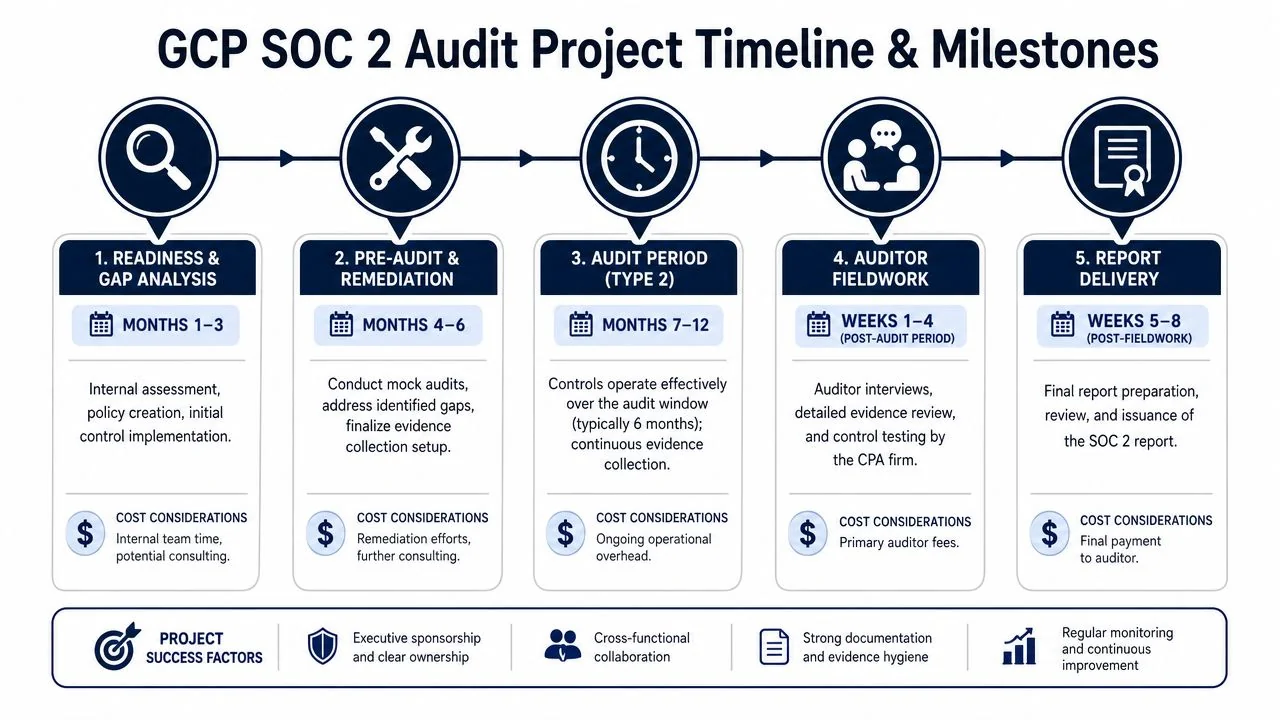
Most GCP SOC 2 compliance delays aren’t caused by hard technical blockers. They’re caused by poor scoping, weak ownership, and evidence processes that begin too late.
A realistic project shape
Independent guidance notes that teams can often reach SOC 2 cloud compliance on GCP in about 4 to 5 months when they follow a structured approach, and that work commonly uses the carve-out method so the customer report includes customer-responsibility controls while Google’s controls are referenced as subservice organization controls in Linford & Co’s GCP SOC 2 discussion. That timeline can be workable for readiness and early audit motion, but only if the scope is disciplined and evidence collection begins early.
The teams that move fastest usually make three decisions early:
- They define the in-scope system clearly. Product, production environment, supporting people, and critical vendors.
- They limit criteria to what customers require. Security first, then add others only when warranted.
- They assign control owners before tool selection. A platform won’t fix unclear accountability.
Scope decisions that affect effort
A small scope saves time only if it still reflects the actual service customers buy. If your production app depends on a background processing environment, a support admin path, and a deployment pipeline, those elements usually need consideration. Leaving out an important path creates more problems than it solves.
A useful scoping review asks:
- Which GCP projects are in production
- Which data stores hold customer or sensitive data
- Which admin interfaces can materially affect the service
- Which vendors support security, availability, or processing
- Which teams touch the in-scope system
One of the better ways to tighten that work is to run a readiness exercise before signing an audit engagement. If you need a structured path, you can transform your SOC 2 readiness with a formal readiness assessment and use that output to lock scope before fieldwork.
Where cost pressure usually comes from
I won’t invent a budget number because cost varies too much by architecture, scope, and auditor model. In practice, spend usually rises when companies:
- include too many systems,
- add criteria without customer demand,
- postpone remediation until fieldwork,
- rely on manual evidence gathering,
- or choose an auditor that isn’t comfortable with a GCP-native environment.
For SOC 2, this matters because timing and scope are audit readiness issues, not just project management issues. If the system boundary, control owners, and evidence plan aren’t stable, your audit timeline becomes guesswork.
Choosing the Right Auditor for Your GCP Environment
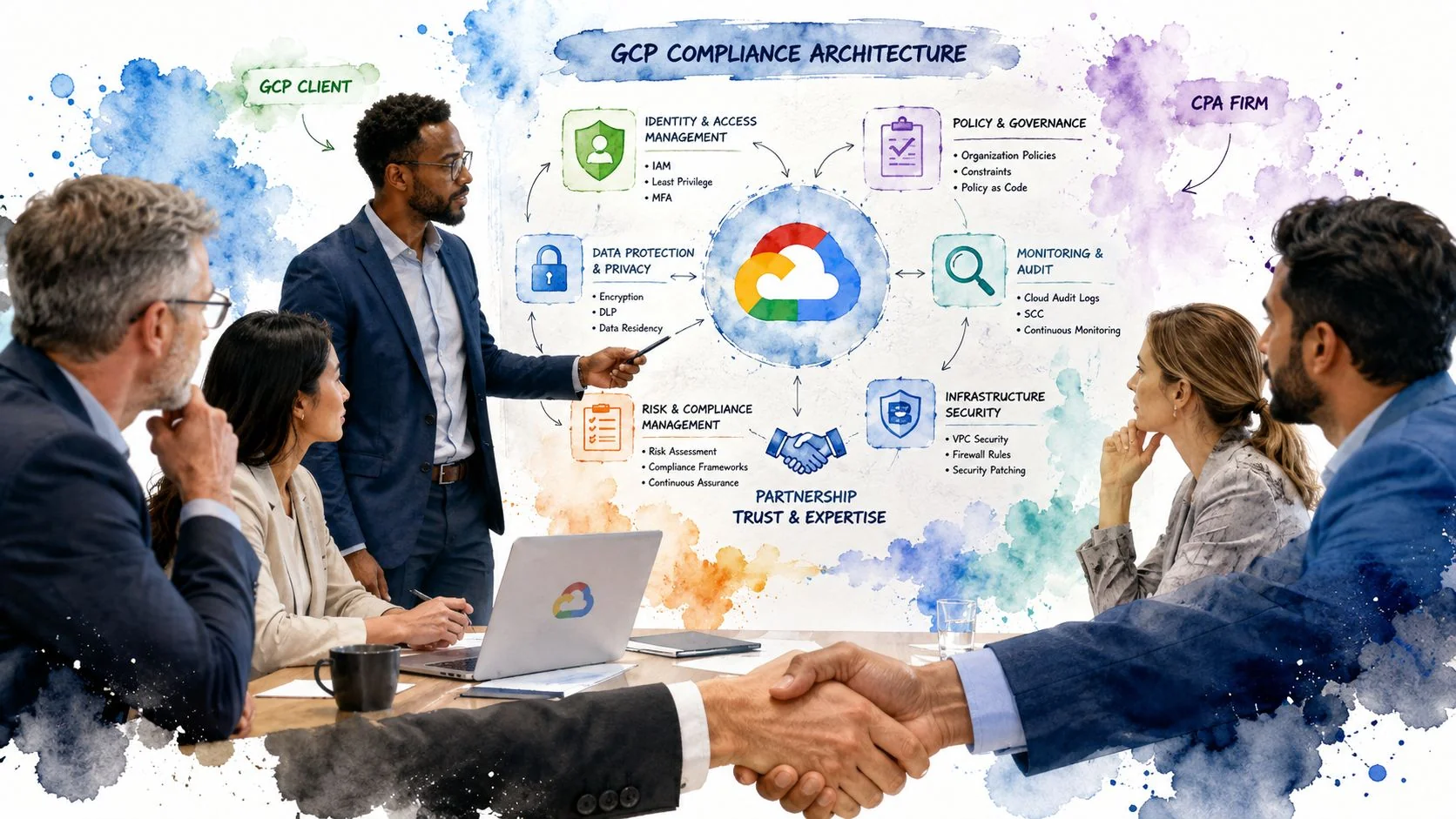
A GCP environment doesn’t require a niche auditor. It does require an auditor who can evaluate cloud-native evidence without forcing your team into a legacy, screenshot-heavy process.
What to screen for in auditor conversations
Ask direct questions. Have they audited companies running primarily on GCP? Are they comfortable testing controls through exported logs, ticket histories, and Infrastructure as Code records? How do they handle carve-out reporting for cloud providers? What evidence do they typically request for IAM reviews, logging, and change control in a managed-cloud environment?
Recent practitioner guidance on GCP Type II preparation emphasizes starting evidence collection early and focusing on how to maintain evidence over time, not just how to enable controls, in this GCP Type II audit preparation write-up. That point matters in auditor selection. Some firms understand ongoing evidence operations. Others still work as if every control should be proven by static documents created near the end of the period.
Good fit versus bad fit
A good auditor fit usually looks like this:
- They understand cloud inheritance and won’t ask you to prove Google’s physical controls from scratch.
- They accept system evidence from logs, repositories, and workflow tools when it is complete and reliable.
- They communicate sampling expectations early so control owners know what records to preserve.
- They challenge weak controls without expanding scope casually.
A weak fit often shows up in subtler ways. The firm may be technically competent but inexperienced with GCP-specific operating models, or it may default to generic requests that create rework for engineering and GRC.
“We need an auditor who understands our evidence model” is usually a better buying criterion than “we need the biggest firm we can afford.”
If you’re comparing firms, tools, and timelines, one option is SOC2Auditors, which provides side-by-side auditor comparisons and matching based on factors like industry, budget, and deadlines. Used properly, that kind of comparison helps narrow the list before you spend time in partner calls.
The practical endpoint is simple. Strong GCP SOC 2 compliance comes from a clean shared-responsibility map, tightly scoped controls, auditable GCP configurations, and evidence that survives the full review period. Pair that with an auditor who understands cloud-native testing, and you put your team in a far better position for SOC 2 audit readiness instead of last-minute remediation.
More in Audit Preparation