 Menu
Menu

On this page
- Is Vanta the Right Tool for Your SOC 2?
- How Vanta Automates Compliance (What’s Actually New in 2026)
- Onboarding and Ongoing Effort
- How Should Vanta’s Commercial Terms Affect Fit?
- Where alternatives change the decision
- Real User Sentiment (G2 and Reddit, 2026)
- How Vanta Works With Your Auditor
- Decision Framework: Should You Pick Vanta?
- Vanta FAQ
- Final Verdict
Vanta is a strong candidate for cloud-native companies that need to organize a first SOC 2 or multi-framework program quickly. Its value falls when much of the environment is custom or on-premises, when the team already has mature compliance operations, or when renewal terms create budget risk. Compare it with Drata, Secureframe, and Comp AI against your actual integrations, support needs, identity lifecycle, and commercial scope.
Best alternatives: Drata, Secureframe, Comp AI.
How we reviewed this: vendor documentation, G2 and Reddit buyer reports, and third-party procurement data (Vendr), cross-checked against our dated, sourced Vanta record.
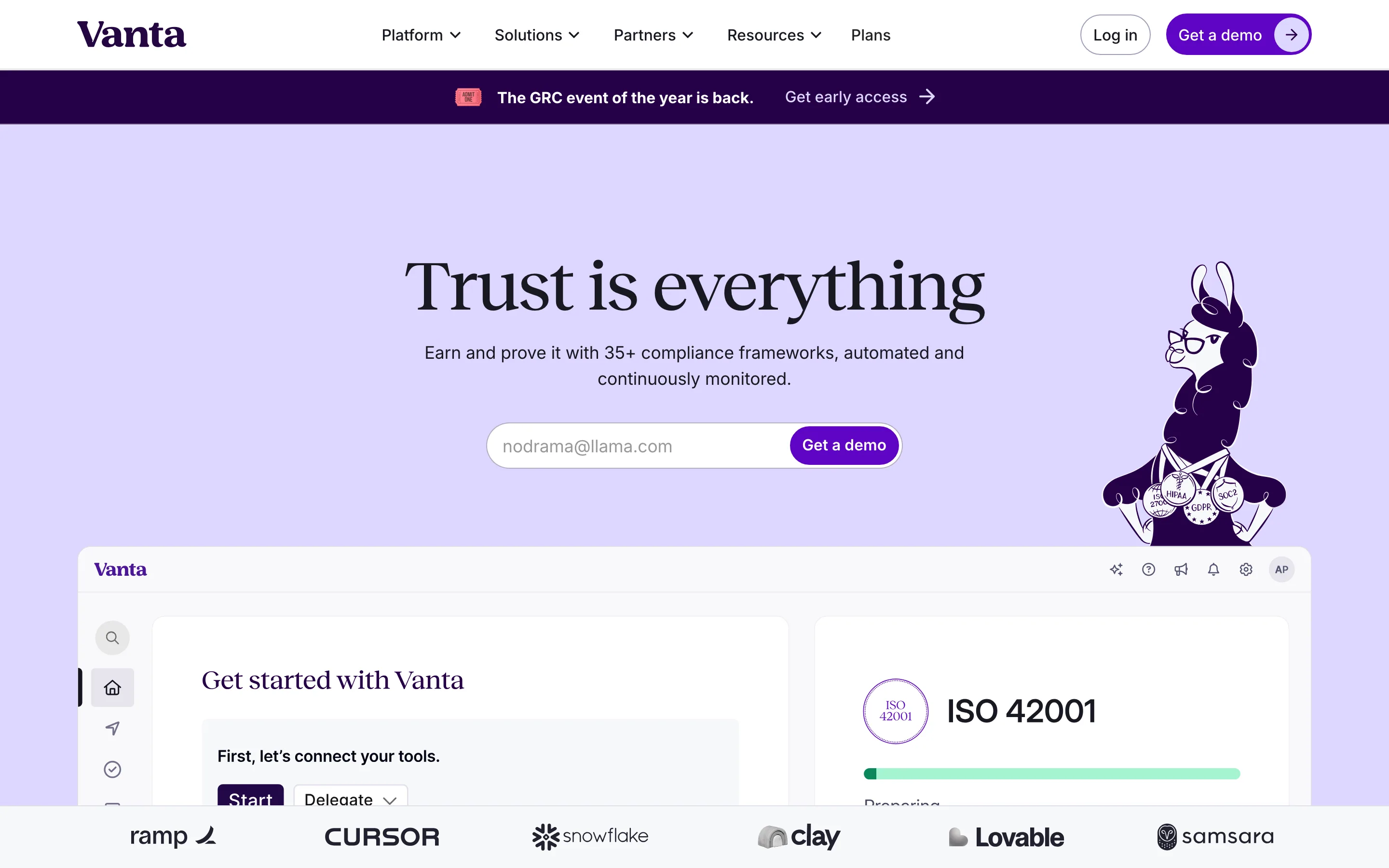
Vanta reports 16,000+ customers and crossed $300M ARR by April 2026 (Fortune). That scale makes it a common shortlist choice, but it does not settle fit. Vanta can organize readiness work and evidence collection; it cannot remove remediation, the Type 2 observation period, or the CPA firm’s examination. The decision turns on integration coverage, internal ownership, support, and the terms in your written quote.
Is Vanta the Right Tool for Your SOC 2?
Vanta is a compliance automation platform founded in 2018 in San Francisco. It connects to cloud infrastructure, identity providers, HR systems, and code repositories, then runs automated tests, collects timestamped evidence, and shows control status in one workspace.
For a standard cloud-native stack, we estimate that APIs can package roughly 70–80% of evidence; this is our estimate, not a vendor guarantee, and actual coverage depends on scope. Vanta was named a Leader in The Forrester Wave: GRC Platforms, Q2 2026 — its first appearance in that report.
Not every one of those 35+ frameworks ships with its own independently authored control set. Vanta documents crosswalking overlapping requirements — for example, mapping ISO 27001 controls onto evidence already collected for SOC 2 — so the same evidence satisfies more than one framework rather than always running a fully separate native test suite (vanta.com). SOC 2 is Vanta’s most independently substantiated framework claim; the rest are vendor-stated.
Vanta does not fix anything. Every failing control still requires your engineering or IT team to remediate. The platform does not include an auditor — you engage and pay a licensed CPA firm separately. This review covers what Vanta automates, how its auditor workflow and enterprise controls affect fit, how the Agentic Trust Platform changes the equation, and when you should pick a competitor instead.
The Vanta platform record is the source for dated identity, capability, framework, integration, pricing-evidence, and review-platform facts. This review uses that record as its evidence base and focuses on the buyer question it can answer: whether Vanta’s automation, administration, support, and auditor workflow fit your environment.
Identity lifecycle is the enterprise-admin question Vanta actually answers in public documentation, and the one most shortlisted alternatives still leave open. Comp AI is on the alternatives list because it changes a different constraint — inspectable code and self-hosting — not because it matches Vanta’s SCIM evidence.
| Identity / admin fact | Vanta | Drata | Secureframe | Sprinto | Comp AI |
|---|---|---|---|---|---|
| Native SCIM | Confirmed; may require an upgrade or add-on | Unknown (group-to-role sync documented; full account lifecycle is not) | Yes, Complete and above | Unknown | Unknown |
| SSO | Documented | Documented | Complete and above | Foundation and Growth | Unconfirmed |
| Onboarding model | Guided | Guided; a dedicated implementation specialist is not standard | Guided | Bundled expert (vendor-stated) | Guided |
| Open-core / self-host | No | No | No | No | Yes (AGPLv3 core; /ee is commercial) |
Capability values from our sourced directory records. Unknown means the current public evidence does not establish the feature, not that it is proven absent. Ask for the gate in writing before you sign.
Vanta fit by company profile
| Company Profile | Fit | Why |
|---|---|---|
| Early-Stage Startup (Seed–Series A) | Strong fit | Pre-built templates and automated tests accelerate first audit; unblocks enterprise sales. |
| Growth-Stage Company (Series B–C) | Good fit | Strong value across multiple frameworks, though customization needs grow. |
| Mid-Market / Enterprise | Conditional fit | Good for centralized visibility; automation gap widens with complex or custom controls. |
| Heavily Regulated (FinTech, HealthTech) | Conditional fit | Solid starting point for HIPAA + SOC 2 overlap, but requires significant internal compliance expertise. |
| Bootstrapped / Low Budget | Weak fit | Personalized direct proposals, scoped marketplace packages, and a separate CPA engagement make the full budget difficult to establish before sales discovery. |
Vanta Pros and Cons
✅ Vanta Pros
- 400+ vendor-reported integrations — broad coverage across AWS, GCP, Azure, GitHub, Okta, Rippling, and more.
- Established auditor workflow — Vanta supports scoped auditor access and Information Request List imports; confirm that your selected CPA firm uses the workflow.
- Agentic Trust Platform — the Nov 2025 platform (the Vanta AI Agent, Organizations Center, Risk Graph, Customer Commitments) drafts policies, answers questionnaires, and runs vendor-risk reviews with human sign-off.
- Time savings — an IDC study Vanta commissioned found teams spend up to 82% less time on framework and attestation audits.
- Continuous monitoring — Vanta reports 1,400+ pre-built tests running hourly.
❌ Vanta Cons
- Renewal uncertainty — sampled buyer discussions include price increases, especially after headcount or framework growth; Vanta publishes no renewal schedule.
- Doesn’t include the audit — the CPA firm’s examination is a separate engagement and budget line.
- Generic for custom stacks — mid-market teams with on-prem or heavily custom controls hit the “automation gap” (~50–60% coverage vs 70–80% on cloud-native).
- Self-service support at base tier — white-glove only starts at higher plans.
- SCIM gated, tier unnamed — SSO and role-based access are available broadly, and Vanta’s own help centre documents full SCIM push provisioning, but the same article says SCIM may require an upgrade or add-on without naming which tier or what it costs. Ask for the gate in writing before you sign.
- Mixed pricing transparency — direct proposals are personalized, while AWS Marketplace publishes scoped starting prices for selected plans and modules. The Vanta pricing guide owns the amounts, conditions, and source dates.
How Vanta Automates Compliance (What’s Actually New in 2026)
Vanta’s automation model has three layers: continuous controls monitoring that runs 24/7, automated evidence collection that packages data for auditors, and a policy and vendor risk module for everything that doesn’t plug into an API. In November 2025, a fourth layer arrived: the Agentic Trust Platform.
Continuous Controls Monitoring
Vanta runs 1,400+ automated tests against your connected systems, checking hourly. Examples of what these tests catch: an S3 bucket that became public, an employee who hasn’t enabled MFA, a production system without encryption at rest, a GitHub repo missing branch protection. Each test maps to a specific SOC 2 Trust Services Criterion (for instance, CC6.1 for logical access controls).
When a test fails, Vanta surfaces it in the dashboard with the affected resource, the control it maps to, and a suggested remediation. Your team remediates; Vanta re-checks. This continuous loop converts audit prep from a once-a-year sprint into a rolling process — which is why auditors familiar with Vanta complete fieldwork faster.
Automated Evidence Collection
Vanta pulls evidence directly from connected systems via API instead of your team taking hundreds of screenshots and exporting CSV files. It grabs user access lists from Okta, configuration states from AWS, training completion records from your HR platform, and packages everything with timestamps into an auditor-ready format.
For a CC6.1 (logical access) test as a concrete example: Vanta connects to Okta and AWS IAM, pulls all user access grants and MFA status, flags exceptions, and stores the result as a timestamped export the auditor can pull directly. The auditor doesn’t need to request a manual report — it’s already there. That alone reduces fieldwork time and makes audits less disruptive to your engineering team.
The Vanta AI Agent and the Agentic Trust Platform (Nov 2025)
Vanta launched the base Vanta AI Agent in June 2025 (general availability that July), then unified it into the Agentic Trust Platform in November 2025 (vanta.com/resources/introducing-vantas-agentic-trust-platform). The platform ships on four pillars:
- Vanta AI Agent — the autonomous worker that drafts policies mapped to your specific control gaps, remediates flagged tests, and answers incoming security questionnaires from your own evidence library, rather than handing you generic templates to fill in. Vanta states a 95% acceptance rate on its AI-drafted questionnaire answers (vanta.com/products/ai) — a vendor claim, not independently verified.
- Organizations Center — a control tower for companies running compliance across multiple entities, business units, or subsidiaries from one workspace.
- Risk Graph — a visualization layer that maps dependencies and control relationships across the organization, so you can see how a change in one system ripples into downstream controls.
- Customer Commitments — a way to track and prove the security promises you have made to customers (in contracts, DPAs, and trust pages) against your live control posture.
On 2 June 2026, Vanta launched the Vanta Agent for Risk for internal risk work: it recommends controls and owners and can send stakeholder notifications with a human in the loop. The surrounding mapping features did not all launch at the same status (Vanta launch page).
| Capability | Status at 2 June 2026 launch | Access noted by Vanta |
|---|---|---|
| Agent for Risk | Generally available | All Vanta customers |
| Risk-to-Asset Mapping | Generally available | Advanced Risk Management |
| Risk-to-Control Mapping | Preview | Advanced Risk |
| Risk-to-Vendor Mapping | Coming soon | Planned for Advanced Risk Management |
Vanta’s broader platform vision connects internal and third-party risk, but that is not the same as every mapping feature being generally available. Vanta branded the main agent “AI Agent 2.0” at the November 2025 launch; its current product pages call it the Vanta AI Agent. Policy drafts still need human review, and questionnaire automation works best when a question maps to evidence you already hold. Test the exact features and entitlements in your proposed plan.
Policy, Vendor Risk, and Training Modules
Vanta also includes a policy template library for SOC 2, ISO 27001, and other frameworks that your team customizes and approves within the platform. The vendor risk module lets you inventory third-party vendors, issue security questionnaires, and track their responses. Employee security training completion and policy acknowledgment are tracked automatically, giving auditors the evidence they need for personnel-related controls. These modules have been part of Vanta for several years and are stable.
Vanta also ships a standalone Trust Center — a public-facing page showing your compliance status and documentation to prospects, sold as its own product or as an add-on, with live customer instances at trust.vanta.com.
The Automation Gap: What Vanta Covers vs What You Still Do by Hand
The single most useful question when sizing Vanta is how much of your environment it can actually reach through an API. On a standard cloud-native stack (AWS or GCP, an off-the-shelf identity provider, a modern HR system), Vanta automates roughly three-quarters of evidence collection. The more your environment leans on on-prem infrastructure, proprietary systems, or bespoke controls that fall outside the 400+ integration library, the more that share drops — and the residual is manual work no platform removes.
Onboarding and Ongoing Effort
Vanta organizes onboarding around integrations, policies, automated tests, and an assigned remediation queue, but Vanta does not publish a general SOC 2 readiness band that applies across customers. The dated directory record therefore keeps Vanta’s time-to-readiness value unknown instead of turning selected customer stories into a typical timeline.
Your team still connects in-scope systems, adapts policies to actual practice, assigns every failed test, supplies evidence for controls outside the integration catalog, and resolves exceptions. After the first examination, an internal owner must keep access reviews, policy reviews, vendor checks, and new control failures moving. Vanta re-tests configurations; it does not perform the remediation or approve management decisions.
How Should Vanta’s Commercial Terms Affect Fit?
Vanta’s direct proposal is personalized, while its AWS Marketplace listing publishes scoped 12-month starting prices for selected plans and modules at the 1–20 employee band. This review uses that commercial state only to assess fit: whether the written proposal covers the integrations, frameworks, support, and enterprise administration your team needs. SCIM is confirmed, but Vanta says it may require an upgrade or add-on and does not publish the gate or price. Use the dedicated Vanta pricing evidence and quote-normalization guide for amounts, source dates, unknowns, and the fields to compare across proposals. Keep the CPA firm’s examination as a separate engagement.
Where alternatives change the decision
Vanta is strongest when integration breadth and a standard cloud stack matter most. Drata is the closer fit when multi-framework workflow and support weigh more heavily; Secureframe is worth testing for a more guided implementation; and Comp AI changes the operating model for teams that require inspectable code or self-hosting. Use the Vanta alternatives page for the scenario shortlist and Vanta vs Drata for the named head-to-head decision. The Vanta record holds the dated capability and evidence facts behind this review.
Real User Sentiment (G2 and Reddit, 2026)
Vanta G2 Reviews
Vanta holds a 4.6 out of 5 across roughly 2,665 reviews, per our sourced Vanta record — G2’s own review count fluctuates by cache and category filter, so treat the count as approximate rather than exact. Consistent praise centers on three things: the breadth of integrations (particularly AWS, Okta, and GitHub), the clarity of the compliance dashboard, and the familiarity auditors already have with Vanta evidence exports. Critical themes include price uncertainty and support responsiveness. Treat those as proposal questions because Vanta does not publish a renewal schedule or plan-level response commitments on this page.
Vanta Reddit Reviews
The sampled Reddit discussions are mixed on price relative to Drata: one buyer reports a materially higher Vanta quote, while another small SaaS team reports near-identical proposals. The useful conclusion is not a market-wide renewal percentage. Compare written proposals on the same scope and term.
One Incident Worth Knowing (June 2025)
A compliance vendor is only as credible as its own security, so this belongs in an honest review. In June 2025, a Vanta software bug briefly exposed some customers’ data — including employee names, roles, and MFA status — to other Vanta customers. Vanta disclosed the issue publicly, said it affected fewer than 4% of its customers, and shipped a fix (TechCrunch). No evidence of external exploitation was reported. It is a data point, not a verdict: enterprise SaaS vendors have incidents, and the signal to weigh is the disclosure and response, both of which were prompt here. If your buyers are security-sensitive, it is a fair question to raise with Vanta’s team directly.
How Vanta Works With Your Auditor
Vanta is not a CPA firm and does not issue the SOC 2 report. An independent licensed CPA firm performs the examination and signs it. Vanta can give the auditor scoped workspace access and let the firm import its Information Request List (IRL) instead of coordinating every request over email (vanta.com/partners/auditors). The auditor can review collected evidence, test results, and policy acknowledgments in that workspace, but still decides scope, sampling, and whether the evidence is sufficient.
The AICPA’s March 2026 FAQ on SOC 2 software tools describes tools like Vanta as an efficiency aid. The tool does not reduce the CPA firm’s professional responsibilities or replace independent judgment. Ask the firm how it validates Vanta-generated information and how it handles any commercial relationship with a tool provider.
The practical tip: when selecting an audit firm, ask directly whether their team has conducted audits using Vanta exports. Firms without that experience may ask for supplemental evidence in formats Vanta doesn’t natively produce, adding friction. Our guide on how to choose a SOC 2 auditor covers this selection criteria in detail. You can also browse vetted auditors who work with Vanta on our directory.
Decision Framework: Should You Pick Vanta?
1. How fast do you need your SOC 2 report?
If enterprise sales are blocked because you lack a SOC 2 report, Vanta’s templates, automated tests, and auditor workspace can shorten readiness work for a standard cloud stack. Compare that speed with the remediation you still own and the Type 2 observation period, which the platform cannot compress. If you already have internal compliance expertise, a lighter or lower-cost tool may deliver similar value.
2. What is your team’s existing compliance expertise?
Teams without a dedicated compliance function benefit most from Vanta’s prescriptive structure. The platform translates abstract AICPA criteria into a concrete engineering to-do list, which removes most of the uncertainty from a first audit. If your organization has an experienced CISO or a compliance team that has built custom controls before, Vanta’s standardized test set can feel too rigid — and you may pay for automation that doesn’t map to your actual control design.
3. Does the proposal expose the full commercial scope?
Require the proposal to name included frameworks, integration limits, support commitments, implementation work, SCIM entitlement, renewal terms, and every add-on. The Vanta pricing guide owns the dated price evidence and comparison worksheet; this review uses the proposal only to decide whether Vanta’s automation is worth the quoted terms for your environment.
4. How much of your environment uses custom or on-prem controls?
Our estimate puts automated evidence coverage around 70–80% for a standard AWS/GCP/Azure stack with off-the-shelf identity and HR tools, and around 50–60% for a custom or on-prem-heavy environment. Those are planning ranges, not measured product benchmarks. Inventory your in-scope systems and ask Vanta to demonstrate each integration; the uncovered share still requires manual evidence and documentation. If that share is large, compare Secureframe and other Vanta alternatives against the same inventory.
Vanta FAQ
Is Vanta worth it?
For cloud-native SaaS companies pursuing their first SOC 2 or ISO 27001 — particularly those with enterprise sales pressure — Vanta is widely considered worth the cost. An IDC study Vanta commissioned found teams spend up to 82% less time on framework and attestation audits (vanta.com/compare/drata). For teams with heavy custom or on-prem controls, or teams on a tight budget where the platform cost is a major line item, alternatives like Sprinto or a more manual approach with a consulting firm may deliver better value.
What’s new in Vanta in 2026?
In November 2025, Vanta launched the Agentic Trust Platform, building on the Vanta AI Agent. In June 2026 it released Agent for Risk for internal risk work. At that launch, the agent and Risk-to-Asset Mapping were generally available, Risk-to-Control Mapping was in preview, and Risk-to-Vendor Mapping was coming soon. See Vanta’s Agentic Trust Platform announcement and dated Agent for Risk status page.
How does Vanta compare to Drata?
Vanta generally suits cloud-native teams prioritizing connector breadth, while Drata is a closer fit when multi-framework workflow and support weigh more heavily. For the dated head-to-head evidence, see our Vanta vs Drata comparison.
Can Vanta replace a compliance consultant?
Vanta replaces a significant portion of evidence-gathering and continuous monitoring work. It does not replace strategic compliance judgment: control design decisions, auditor relationship management, interpreting ambiguous framework requirements, and managing audit exceptions still require human expertise. Most organizations — particularly those on a first audit — benefit from at least light consulting support alongside the platform.
Final Verdict
Vanta deserves a shortlist spot for early-to-growth SaaS companies on standard cloud stacks, especially when a missing SOC 2 report is blocking sales. Its reported customer scale, broad integration catalog, and established auditor workspace reduce adoption risk, but they do not prove fit for your controls. Budget for platform, audit, and labor together, test the integrations that matter, and negotiate renewal terms before signing.
Vanta is a weaker fit when much of the environment sits outside its integrations or when renewal terms in a personalized proposal create unacceptable budget risk. Vanta documents SCIM as potentially requiring an upgrade or add-on but does not name the tier or price publicly. In these cases, compare Drata, Secureframe, and Comp AI using the same integration list, support requirements, identity-lifecycle needs, and contract term.
One caveat that applies regardless: Vanta accelerates audit prep, but it does not make you compliant. Your team still owns remediation, access review decisions, policy accuracy, and vendor due diligence. The platform surfaces what needs fixing — your people have to fix it. Going in with that expectation produces better outcomes than expecting the dashboard to turn green on its own.
Browse Vanta alternatives if you want to compare additional options, or see our full Vanta SOC 2 guide for a deeper look at how the platform maps to specific Trust Services Criteria. If you’re already working through an automation-assisted SOC 2 audit checklist, our SOC 2 automation overview covers where platforms like Vanta fit in the broader process.
Ready to find the right audit partner for your Vanta-prepped program? At SOC2Auditors, we match you with vetted firms fluent in Vanta exports, with real pricing and timelines. Get three tailored matches in 24 hours.
Comparing SOC 2 software? See our side-by-side breakdown of every compliance platform we track — pricing, best-for, and what each one gets wrong, plus the sourced Vanta record behind this review.
Vanta buyer guides
Start with the product record, then compare Vanta's review, pricing, SOC 2 coverage, and alternatives before you shortlist.
More in Compliance Tools