 Menu
Menu
Getting SOC 2 certified means defining your audit scope, closing security gaps, and working with a licensed CPA firm to validate your controls. The result is a SOC 2 Type 1 or Type 2 report that proves your security posture to customers and partners.
To understand the complete audit process from planning to final report, see our SOC 2 Timeline Guide.
Why Does SOC 2 Certification Matter More Than Ever?
SOC 2 has shifted from a nice-to-have to a hard requirement in enterprise procurement. Without a current report, a single vendor security checklist can stall — or kill — a deal that is otherwise ready to close.

Many tech companies treat SOC 2 as a checkbox — the project that gets pushed to next quarter until an enterprise prospect demands it to close a deal. That delay is costly.
A common scenario: your SaaS company is close to signing a Fortune 500 client. Then procurement flags one line item on their vendor security checklist: “Provide current SOC 2 Type 2 report.” A process you assumed was optional becomes the only thing blocking the deal. This happens regularly.
A SOC 2 program is a proactive investment in operational maturity. It signals to the market that you take data security seriously — and it speeds up the deals where security is a gate.
A SOC 2 report is a narrative about your company’s commitment to security. It tells prospective customers that you have not only designed strong security controls but have also proven they work effectively over time.
What Is the Roadmap to SOC 2 Certification?
Earning a SOC 2 report follows five sequential phases: scoping your audit, running a readiness assessment to close control gaps, selecting a licensed CPA firm, collecting evidence during the observation period, and receiving the auditor’s final opinion.
For service organizations in SaaS, FinTech, and HealthTech, SOC 2 has become a standard requirement for enterprise sales. Customer trust depends on it.
The process breaks down into a few core phases.
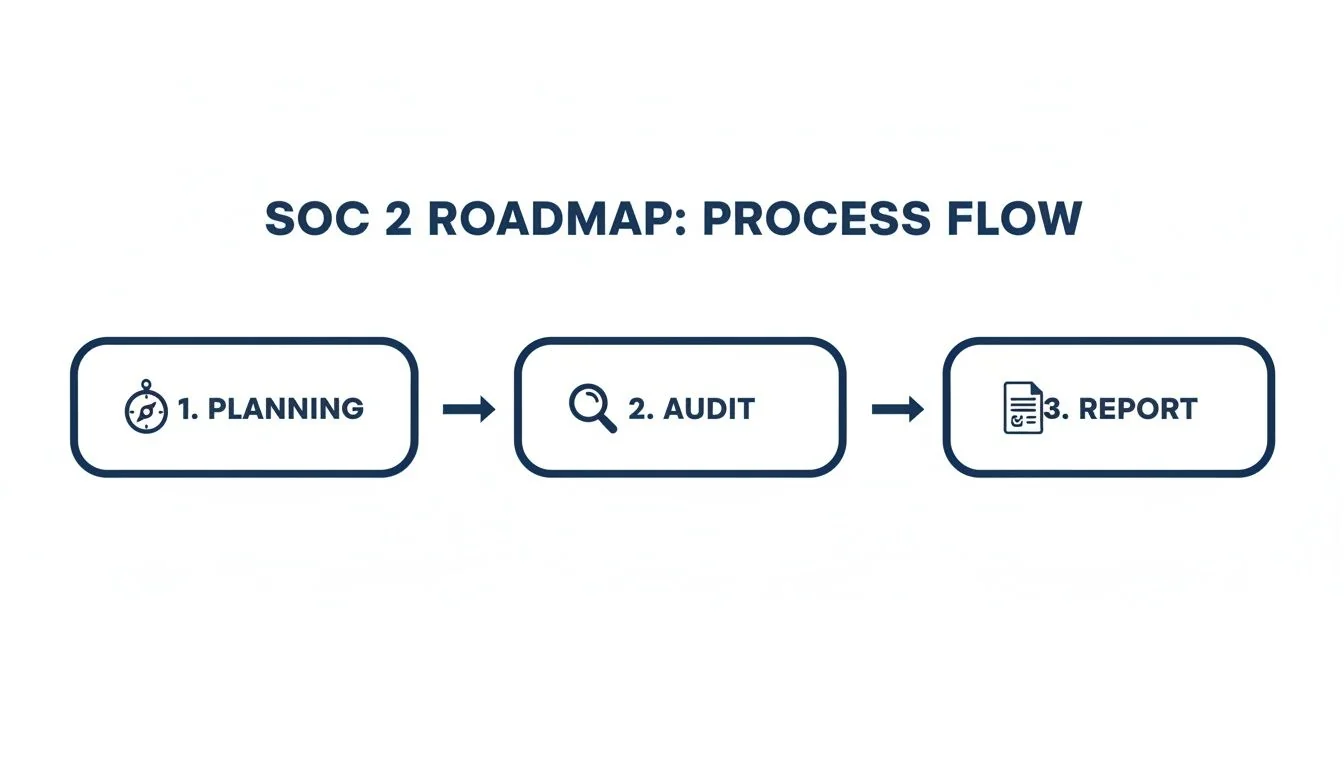
Planning and prep work feed into the formal audit and the final report. Weak preparation makes the rest significantly harder.
Understanding the Trust Services Criteria
At the very heart of SOC 2 are the Trust Services Criteria (TSC), a set of principles from the AICPA. These are the standards your controls will be judged against. For a deeper dive, check out our guide on what is SOC 2 compliance.
Your first real task is figuring out which of these criteria actually apply to the services you sell and the promises you make to customers.
- Security (Common Criteria): Required in every SOC 2 audit. Covers protecting systems and data from unauthorized access.
- Availability: Applies if customers rely on guaranteed uptime or your contracts include SLAs.
- Processing Integrity: Applies if your service processes transactions or calculations where completeness and accuracy matter.
- Confidentiality: Covers sensitive non-public information, such as trade secrets or business plans.
- Privacy: Covers personal information (PII) — how you collect, use, retain, and dispose of it, in line with frameworks like GDPR and CCPA.
Expert Tip: Choosing your TSCs is a strategic call. Don’t include all five just to look thorough. An auditor will scrutinize every criterion you include, so pick only what’s truly relevant to your service commitments.
Type 1 vs Type 2 Reports
You also need to decide between a Type 1 and a Type 2 report. The choice affects your timeline and budget significantly.
A Type 1 report is basically a snapshot. It assesses if your controls are designed properly at a single point in time. A Type 2 report, on the other hand, is more like a movie. It evaluates both the design and the operating effectiveness of your controls over a period of time, usually 6 to 12 months.
Need a quick way to compare? This table breaks it down.
SOC 2 Type 1 vs Type 2 At a Glance
| Attribute | SOC 2 Type 1 | SOC 2 Type 2 |
|---|---|---|
| Focus | Design of controls at a point in time | Design & operating effectiveness over time |
| Timeline | Faster (weeks to a few months) | Slower (requires a 3-12 month observation period) |
| Effort | Lower | Higher (ongoing evidence collection) |
| Customer Value | Good (shows intent) | Gold Standard (proves effectiveness) |
| Best For | Early-stage startups needing a quick win | Enterprise sales, mature security programs |
A Type 1 is a reasonable starting point, but enterprise customers and security-conscious buyers almost always require a Type 2. It is a strong trust signal that demonstrably strengthens market position. For a more detailed breakdown of the entire process, check out this complete guide to SOC 2 certification.
This decision tree can help you visualize the path from identifying the need for SOC 2 to kicking off the readiness and audit process.
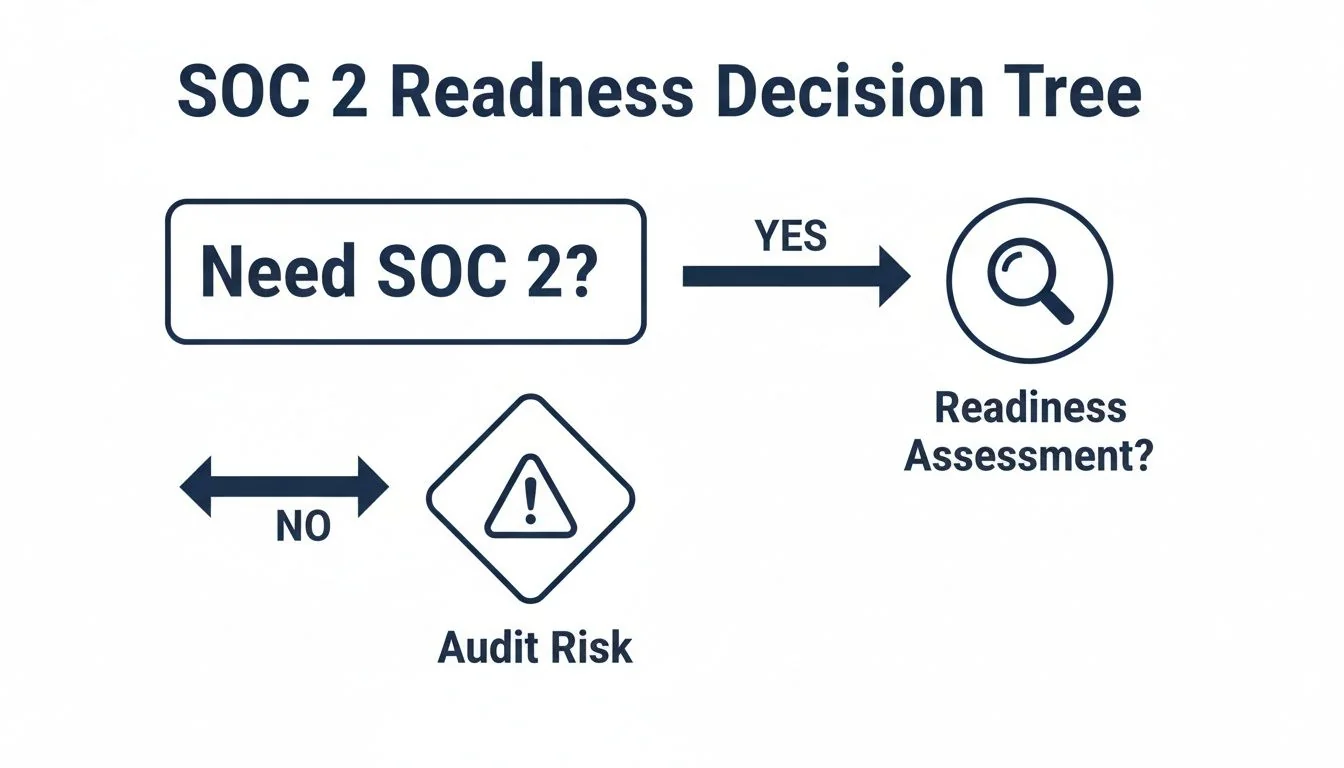
As the chart shows, a readiness assessment is the smartest first move for any company serious about compliance. It helps you avoid the significant risk—and cost—of walking into a formal audit unprepared.
A Practical Strategy for Startups
A fast-growing startup gets an urgent request from a potential client that requires a SOC 2 report to sign. Waiting 6-12 months for a Type 2 is not viable.
The practical approach: hire an auditor immediately and pursue a Type 1 report. This can often be completed in a few months, satisfying the client’s requirement and unblocking the deal.
At the same time, start the observation period for the Type 2 report. By the next annual audit cycle, the required 6-month window will be complete. The company can then move to Type 2, ready for larger enterprise clients. This approach addresses the short-term requirement without sacrificing long-term compliance progress.
How Do You Prepare for a SOC 2 Audit With a Readiness Assessment?
A SOC 2 readiness assessment maps your existing controls against the AICPA Trust Services Criteria, surfaces every gap before an auditor does, and produces a prioritized remediation plan. Companies that complete one are far more likely to pass cleanly on the first attempt than those that skip it.
Jumping into a formal SOC 2 audit without preparation is expensive. The most successful audits are won before the auditor ever logs into Zoom. This phase is about meticulous planning.

This work starts with a readiness assessment, often called a gap analysis. It lets you find and fix vulnerabilities on your own timeline before an auditor does it in the report.
The SOC 2 process can be intimidating — many smaller companies struggle just to understand the requirements. Companies that invest in a proper readiness assessment are far more likely to pass cleanly on the first attempt.
Defining Your Audit Scope
Draw a clear boundary around what the audit will cover. This is your audit scope — the specific systems, data, processes, and people involved in delivering your services to customers.
Think through the full lifecycle of customer data in your organization. A complete scope covers five dimensions:
- Infrastructure: Cloud environments (AWS, Azure, GCP) and data centers hosting your application and customer data.
- Software: Applications, databases, and internal tools that process, transmit, or store customer information.
- People: Employees and contractors with privileged access — engineers, DevOps, customer support staff.
- Data: The specific types of customer data your system handles. This directly determines which Trust Service Criteria apply.
- Procedures: Documented operational processes governing change management, incident response, and similar functions.
Getting scope wrong is costly. Too narrow, and the report won’t give customers the assurance they need. Too broad, and you’ll waste time and money gathering evidence for systems that don’t matter.
Conducting The Gap Analysis
Once your scope is set, run the gap analysis. Compare your current security controls against the requirements of your chosen Trust Services Criteria to identify every gap between what you do and what SOC 2 requires.
To get a deeper understanding of this crucial first step, check out this detailed guide on the SOC 2 readiness assessment.
Most readiness assessments surface gaps that need one to three months of remediation work. Budget time and resources for it.
A readiness assessment forces you to be brutally honest with yourself. It’s far better to discover a weak password policy or an inconsistent employee offboarding process now, where you can fix it quietly, than to have an auditor flag it as an official exception in your final report.
To help you get started, this comprehensive Cybersecurity Audit Checklist can guide you through the essential areas and make sure nothing critical gets missed.
Here are some of the key areas you’ll want to dig into during your analysis.
Key Focus Areas for Your Readiness Assessment
| Control Category | Example Control to Verify | Common Gap to Address |
|---|---|---|
| Access Control | Are terminated employees removed from all systems within 24 hours? | Offboarding process is manual and inconsistent, leaving old accounts active. |
| Change Management | Does all code go through a peer review and testing before deployment? | Developers sometimes push “hotfixes” directly to production without review. |
| Risk Assessment | Is there a formal risk assessment conducted and reviewed annually? | No documented risk assessment exists, or it’s several years out of date. |
| Security Monitoring | Are logs from critical systems collected and reviewed for anomalies? | Logging is enabled but no one is actively monitoring or alerting on the logs. |
| Vendor Management | Do you perform security reviews on critical third-party vendors? | No formal process for vetting the security posture of new software vendors. |
This is a starting point, but it shows the questions you need to answer before the auditor asks them.
Mapping Controls and Documenting Everything
Map each existing control directly to the relevant SOC 2 criteria. Your documented process for quarterly user access reviews, for example, directly supports the Security criterion for logical access. This mapping becomes a foundational part of your evidence package.
Auditors need to see proof, not assertions. Document everything — from high-level information security policies to the operational procedures your teams follow day-to-day.
Your readiness assessment will produce a prioritized remediation plan. The goal is to close every gap found, whether that means writing new policies, deploying a new security tool, or training staff on updated procedures.
How Do You Choose the Right SOC 2 Auditor for Your Business?
The right SOC 2 auditor is a licensed CPA firm with current AICPA peer-review status, direct experience in your industry, and a defined evidence-collection process. Get quotes from at least three firms and evaluate timeline, communication, and team seniority — not just price.
Picking the right audit firm is one of the most consequential decisions in the SOC 2 process. This is not just about finding the lowest price — it is about choosing a firm whose final report will hold up in front of your largest customers.

The choice affects your costs, your timeline, and how much your team has to suffer through the process. The right auditor is a clear-eyed guide. The wrong one makes everything harder.
Big Four Firms vs. Boutique Specialists
Your first big choice is whether to go with a massive, well-known firm (like the “Big Four”) or a smaller, specialized CPA firm. There are real pros and cons to each, and the right answer depends entirely on where your company is at.
A Big Four firm brings brand recognition. For some enterprise clients, a familiar logo on the report adds credibility — but the prestige comes with higher fees and a less flexible process.
Boutique firms typically focus on companies of a certain size or sector, such as SaaS or FinTech. They tend to be faster and more affordable, and offer closer attention throughout the engagement. For most startups and mid-market companies, that focus is more valuable than a big brand name. You can compare different types of firms to find the right SOC 2 audit firm for your situation.
Choosing an auditor is like hiring a key team member for a critical project. You need to evaluate their experience, communication style, and cultural fit—not just their price. A cheaper audit that produces a low-quality report is a waste of money.
Key Questions to Ask Potential Auditors
Once you have a shortlist, dig into how they work, not just what they offer. The quality of their answers tells you what the engagement will actually be like.
- Industry Experience: “How many SaaS/FinTech/HealthTech companies our size have you audited in the last year?” You need to know they understand your business model and its risks.
- Audit Team: “Who will be our day-to-day contact? What’s their experience level?” Being handed off to a junior associate after signing is a common frustration.
- Process and Tools: “What does your evidence collection process look like?” A firm still relying on email threads and spreadsheets will create unnecessary overhead for your team.
- Communication: “What’s your communication cadence? How do you handle disagreements during the audit?” This sets expectations before you’re mid-engagement.
These questions push past price comparison into an evaluation of what working together will actually be like.
Decoding Cost and Timeline Benchmarks
Understanding the time and cost involved is essential for planning. Both vary based on your audit scope, company size, and the firm you choose.
Timeline directly affects startup sales plans. A Type 1 report typically takes 3-6 months from start to finish. A Type 2 report, which requires a 6-12 month observation period, can push the total timeline to 6-15 months.
With budgets that can range from $15K for a lean startup to over $400K for a complex audit with a Big Four firm, it pays to do your homework. Using a platform to compare auditors based on real client feedback and responsiveness can save you from a costly mismatch.
Here’s a general breakdown of what a mid-sized SaaS company can expect:
| Factor | SOC 2 Type 1 | SOC 2 Type 2 (First Year) |
|---|---|---|
| Typical Cost Range | $15,000 - $35,000 | $25,000 - $60,000+ |
| Typical Timeline | 3 - 6 months | 9 - 15 months (including observation) |
| Team Effort | Moderate (focused sprint) | High (sustained effort) |
These are benchmarks. Adding multiple Trust Services Criteria or auditing a complex system pushes costs toward the higher end. The only way to get an accurate number is to collect multiple detailed quotes.
Here is how the total first-year investment typically breaks down across company stages. These figures reflect the total cost, not just the auditor fee.
| Expense Category | Startup (Seed/Series A) | Mid-Market (Series B/C) | Enterprise (Large Scale) |
|---|---|---|---|
| Readiness Assessment | $5,000 - $15,000 | $10,000 - $25,000 | $25,000 - $75,000+ |
| Auditor Fees | $15,000 - $30,000 | $25,000 - $60,000 | $60,000 - $150,000+ |
| Automation Software | $8,000 - $20,000 | $15,000 - $40,000 | $40,000 - $100,000+ |
| Total Estimated Cost | $28,000 - $65,000 | $50,000 - $125,000 | $125,000 - $325,000+ |
The single biggest factor in controlling your SOC 2 budget is your level of preparation. A thorough readiness assessment and a well-organized remediation effort will always result in a smoother, more cost-effective audit.
How Do You Navigate the SOC 2 Audit and Evidence Collection?
During SOC 2 fieldwork, auditors request three categories of proof: written policies and procedures, live system configuration exports, and walkthrough demonstrations with key staff. Organizing these in advance — and using a compliance platform to automate collection — is the difference between a smooth audit and a chaotic one.
The readiness assessment is complete, gaps are closed, and you have an auditor. Now comes fieldwork — where preparation converts into a structured, manageable project.
The fieldwork phase centers on one thing: evidence. Your auditor’s job is to verify that the controls you described on paper are working in practice. They need tangible proof for every claim.

What Auditors Really Want to See
Auditors look for three types of proof. Understanding these categories lets you anticipate requests and organize documentation ahead of time.
- Documentation: Information security policies, onboarding and offboarding procedures, your incident response plan, and system architecture diagrams.
- System Configurations: Screenshots or configuration exports from live systems — your AWS security group settings, the password policy in Okta, or branch protection rules in GitHub.
- Demonstrations and Interviews: The auditor schedules walkthroughs where a team member shares their screen and demonstrates a key process, like deploying code or deprovisioning a user. They also interview staff to confirm that written policies match what people actually do.
An auditor’s primary goal is to gain reasonable assurance that your controls are effective. They aren’t trying to trick you. If you are organized, transparent, and can provide clear evidence that connects your policies to your practices, the process will be far more collaborative than confrontational.
Managing a SOC 2 audit through email threads and shared folders is painful at scale. Compliance automation platforms like Vanta or Drata connect directly to your tech stack — AWS, GitHub, HR systems — and gather most of this evidence automatically, saving significant manual effort.
Preparing Your Team for Audit Interviews
Auditors will talk to engineers, HR staff, and managers to verify that written procedures match what people actually do. Prepare your team for these conversations.
- Set Expectations: Explain why the audit is happening and what the auditor’s role is. It is a verification process, not an interrogation, and it is standard practice at this stage of a company.
- Review Key Processes: Before an interview, do a quick refresher on the relevant policy with that team member — change management for an engineer, onboarding procedures for HR.
- Encourage Honesty: Tell your team to answer questions directly. “I’m not sure, but I can find out” is a perfectly acceptable answer. Guessing or overstating what exists is the worst outcome.
Auditors work with dozens of companies a year. They can tell when someone is unprepared or concealing something. Straightforward answers leave a better impression.
Confidence in these conversations comes from being organized. When an auditor asks for proof of your last security awareness training, you should be able to pull a report immediately showing who completed it and when. That readiness signals a mature security program and builds credibility with the auditor.
So You Got Your SOC 2 Report. Now What?
Once your SOC 2 report is issued, the immediate priorities are reading the auditor’s opinion, remediating any exceptions with documented plans, sharing the report with customers and prospects, and scheduling the next observation period before the current report ages out.
Passing the audit is the beginning, not the end. The goal is a durable, year-round security culture that protects your customers and makes every future audit routine.

SOC 2 is now a continuous business function, not a one-time project. Most companies run two or more compliance audits a year, and many juggle several simultaneously. Treating it as a periodic scramble rather than an ongoing program makes each cycle harder. For more on this shift, check out this beginner’s guide to the SOC 2 landscape.
Understanding Your Audit Opinion
Your first job is to sit down and actually read the final report. The auditor’s opinion is the single paragraph that every customer, prospect, and partner will zoom in on—it completely dictates how the report lands in the market.
There are a few ways this can go, and each tells a very different story about your security posture.
-
Unqualified Opinion: A clean report. The auditor reviewed your controls and found no significant issues. Your team can share it proactively as proof of your security commitment.
-
Qualified Opinion: The audit was largely successful, but the auditor found a significant problem with one or more controls. It is not a universal deal-breaker, but you will need to explain the exceptions to security-conscious customers. The documented findings tell you exactly where to focus remediation.
-
Adverse Opinion: The auditor found widespread, material problems with your security controls. An adverse opinion will stop deals.
Exceptions from your auditor are a third-party validated list of where your security needs work. Tackle them transparently and methodically.
Building a Culture of “Always-On” Compliance
Embed compliance into day-to-day operations so you are not scrambling a month before the auditors arrive. The goal is systems where controls are always working.
This breaks down into a few key activities:
- Automate Evidence Collection: Use tools that pull evidence continuously from your cloud provider, code repos, and HR systems. This eliminates the last-minute scramble for screenshots and log files.
- Run Internal Reviews: Do not wait for the auditor to find problems. Quarterly reviews of user access, security configurations, and vendor security surface issues before they become findings.
- Keep Security Training Current: Controls are only as strong as the people operating them. Regular training on phishing, data handling, and incident response keeps defenses effective.
Building Your Continuous Compliance Program
With a report in hand, the ongoing work begins. A SOC 2 report is a snapshot in time. Continuous compliance is the year-round effort that makes your next audit a routine check rather than an emergency project.
Your ongoing program should lock in a few key habits:
-
Annual Risk Assessments: At least once a year, formally re-evaluate the threat landscape. What’s new? Did you launch a new product? Enter a new market? This process should directly inform your security roadmap for the next 12 months and should be documented and reviewed by leadership.
-
Ongoing Control Monitoring: Run quarterly user access reviews, set up automated alerts for cloud misconfigurations, and perform regular vulnerability scans. The goal is to catch drift before it becomes an audit finding.
-
Security Awareness and Training: Your team is always your first line of defense. A continuous program makes sure security isn’t a one-and-done onboarding video but an ongoing conversation—through phishing simulations, monthly security reminders, and targeted training for high-risk roles like engineers and customer support staff.
Treating SOC 2 as a cycle rather than an event builds a genuinely resilient security culture — and earns more durable customer trust.
Your Post-Audit Checklist for Continuous Compliance
Once the dust settles, use this simple checklist to build a rhythm of continuous compliance. These steps will not only keep you secure but will also make your next audit feel less like a major disruption and more like a routine check-up.
- Fix Every Finding: Your auditor will check how you addressed this year’s exceptions next year. Create a plan for each one — assign owners, set deadlines, and document the remediation.
- Schedule Annual Tasks Now: While it is fresh, lock in next year’s risk assessment, penetration test, and policy reviews on the calendar.
- Review Vendors Annually: Your security is only as strong as your vendors’. Review new vendors before signing contracts and re-evaluate critical vendors each year.
- Share the Report: Distribute your successful SOC 2 report to customers, prospects, and your team. It is a concrete proof point, not just an internal milestone.
Done consistently, this ongoing work converts SOC 2 from a periodic burden into a genuine security asset that also helps win business.
Common SOC 2 Questions Answered
The terms are confusing, the stakes are high, and everyone seems to have a slightly different take. Here are the questions that come up most often, especially for companies going through this for the first time.
Is SOC 2 a Certification or an Attestation?
This trips up many people because even auditors casually say “SOC 2 certified.” Technically, that is not accurate. SOC 2 is an attestation report, not a certification.
A certification is typically pass/fail against a fixed checklist. An attestation is a formal opinion from a licensed CPA firm — they are affirming that your description of your security controls is fair and accurate. An independent expert is validating your claims.
“SOC 2 certified” is the common shorthand, but what you actually receive is a detailed report with an auditor’s professional opinion.
Do I Need to Cover All Five Trust Services Criteria?
No. Trying to cover all five is one of the most expensive mistakes you can make.
The only mandatory criterion is Security, also known as the Common Criteria. It is the foundation of every SOC 2 audit. The remaining criteria — Availability, Processing Integrity, Confidentiality, and Privacy — are optional and should only be added when they map directly to commitments you make to customers.
A good rule of thumb:
- Availability: Add this only if your contracts have specific uptime SLAs (e.g., 99.9% uptime).
- Confidentiality: Include this if you handle highly sensitive, non-public data like trade secrets or M&A information.
- Processing Integrity: This is for you if your system does critical financial calculations or transaction processing where accuracy is paramount.
- Privacy: This one’s for when you manage your customers’ Personally Identifiable Information (PII).
Don’t over-scope your audit “just in case.” Each criterion you add brings more controls, more evidence, and a higher price tag. Be strategic and stick to what’s truly relevant to your service commitments.
How Long Does This Actually Take?
For a first-time audit, budget 6 to 12 months from start to finish. It cannot be compressed into a single quarter.
Here is how that time typically breaks down:
- 1-3 months for scoping and the readiness assessment.
- 2-3 months for remediation — fixing the gaps the assessment surfaced. Most assessments find gaps that need this kind of focused attention.
- 3-6 months for the observation period, the minimum window an auditor needs to see your controls operating for a Type 2 report.
- 4-6 weeks at the end for fieldwork, testing, and the final report.
Rushing any of these phases is one of the most common causes of a qualified opinion or outright failure.
What Are the Biggest Hidden Costs?
The auditor’s invoice is not the whole picture. The number that surprises most companies is internal cost.
The largest hidden cost is almost always your own team’s time. Expect key people from engineering, ops, and HR to put in hundreds of hours on readiness, evidence gathering, and auditor interviews.
Beyond your team’s time, other significant costs include:
- Compliance Automation Software: Platforms like Drata or Vanta run $7,000-$20,000+ per year. The hours they save on evidence collection typically justify the cost.
- Remediation Tools: The readiness assessment may surface gaps that require new tooling — endpoint detection and response (EDR) software, vulnerability scanners, or similar.
What Happens If the Auditor Finds an Issue?
Exceptions are common, especially on a first audit. Finding one does not mean you have failed. An exception is a documented case where a control did not operate as designed during the audit period.
A real-world example: Your policy says all terminated employee access is revoked within 24 hours, but the auditor finds one instance where it took 48 hours. That’s an exception.
A few minor exceptions will be noted but are unlikely to change the overall opinion. A pattern of significant failures can lead to a qualified opinion, which signals material weaknesses to customers. Respond to any findings promptly, document the fix, and demonstrate a plan to prevent recurrence.
Can We Do This Without a Dedicated Compliance Person?
Yes. Most startups and smaller tech companies do not have a full-time compliance hire.
Responsibility typically splits between a technical leader (the CTO or a lead engineer) and someone on the operations side. The key is naming a single SOC 2 project owner — someone who coordinates with the auditor, tracks tasks, and keeps deadlines from slipping.
If you take this approach, a compliance automation platform is not optional. It provides the structure and workflow your team will need to stay on track.
How Often Do I Need to Get a SOC 2 Report?
A SOC 2 report has a shelf life. Customers and prospects want to see a current report, which means auditing is a recurring commitment.
The industry standard is annual renewal for a SOC 2 Type 2 report. Each year brings a new observation period (typically the last 12 months) followed by a new audit. This cycle proves ongoing commitment to security controls, not just a one-time effort — which is why continuous compliance monitoring matters.
Why is SOC 2 So Important for Business Growth?
SOC 2 is a commercial tool as much as a security one, especially for B2B companies. It lets you skip lengthy security questionnaire back-and-forth and give enterprise buyers concrete proof that you handle their data responsibly.
According to A-LIGN, SOC 2 consistently ranks as one of the top three most requested frameworks across tech, healthcare, and finance. You can read more about the widespread demand for SOC 2 on scrut.io. That prevalence makes it a standard requirement for vendors selling to serious buyers.
A SOC 2 report helps you:
- Speed up sales cycles by answering security questions before they are asked.
- Unlock enterprise deals gated by vendor security policies.
- Differentiate from competitors who have not made the investment.
- Build customer trust through proof, not assertions.
The investment pays back through access to larger deals and more security-conscious customers.
Finding the right auditor is the most critical step in your SOC 2 journey. SOC2Auditors makes it simple by providing verified data across our auditor directory, so you can compare real costs and timelines. Stop the endless sales calls and get three data-driven auditor matches tailored to your business in just 24 hours at https://soc2auditors.org.