 Menu
Menu

On this page
- What will TrustCloud cost for this program?
- Can TrustCloud carry a failed control through the customer and CPA handoffs?
- What did TrustCloud users report about the day-to-day work?
- How should TrustCloud handle a stale questionnaire answer?
- Can public TrustCloud feedback verify the control-to-answer handoff?
- What can a CPA do in TrustCloud’s AuditLens?
- Which TrustCloud handoffs should the paid-edition demo prove?
- When is TrustCloud’s three-module route worth the quote?
TrustCloud belongs on a SOC 2 shortlist when the same team runs control tests, answers frequent security questionnaires, and needs to give its CPA controlled evidence access. AWS Marketplace lists separate $0 startup offers for one TrustOps framework and 10 TrustShare questionnaires; neither is a free full-suite or CPA audit quote. Test whether a failed control changes the answer a prospect sees and whether the CPA can obtain the history it needs. A team buying only basic SOC 2 evidence collection may have less use for the wider suite.
Compare with: our Vanta review for an evidence-collection-led program, or our Drata review when the auditor workflow is the primary buying task.
Pros
- Control tests with configurable evaluation frequency
- TrustShare questionnaire and access workflows
- Documented AuditLens auditor access
- Documented SSO and SCIM paths
Cons
- Questionnaire answers need human approval
- Bulk evidence export requires support
- Startup offers have different headcount caps
- Website pricing requires a proposal
TrustCloud is the company formerly called Kintent. TrustOps handles controls and testing, TrustShare handles trust material and questionnaire responses, and AuditLens is the documented auditor workspace. TrustLens is a separate third-party assurance product; its current homepage prominence does not establish that AuditLens has been retired. Buying the TrustCloud suite does not by itself establish that these three workflows share the source, permissions, or history your program needs. The dated TrustCloud record holds the product facts. Our SOC 2 software guide compares TrustCloud with other platforms.
What will TrustCloud cost for this program?
TrustCloud’s own site publishes no price: its pricing page is a proposal form (checked October 20, 2026). The AWS Marketplace listing, checked the same day, shows eight 12-month SKUs in two employee bands. Four “for Startups” SKUs for organizations under 50 employees cost $0: TrustOps with one framework, TrustRegister for the first 25 risks, TrustShare for 10 questionnaires, and TrustLens for the first 10 vendors. For 51 to 500 employees, the paid SKUs are TrustOps at $5,000 with one framework, TrustRegister at $5,000 with unlimited risks, TrustShare at $150 per questionnaire, and TrustLens at $150 per vendor. The listing asks for custom pricing above 500 employees.
The bands leave gaps. A company with exactly 50 employees fits neither listed band. TrustCloud’s separate startup form offers its free path only to companies with 20 or fewer employees, so a 30-person company can see $0 on AWS and still not qualify there. A $0 listing is a SKU in one channel, not a general free plan, and none of it covers the CPA fee. At the listed prices, TrustOps for one framework plus 20 questionnaires comes to $8,000 for 12 months (our arithmetic, not a quote). Confirm how a second framework is priced.
Ask for an itemized order that names the buying channel, products, questionnaire allowance, frameworks, employee band, implementation, support, export service, term, and renewal. The AWS listing’s refund policy reads “No Refunds”, so settle cancellation and renewal terms before buying there. Price the independent CPA examination separately. TrustCloud’s SOC 2 launchpad lists auditor fees of $8,000 to $28,000 in a page updated April 7, 2026; that vendor-stated range is not a quote from your chosen CPA. If the sales case relies on access to multiple modules, require those modules and their limits in the order form.
Can TrustCloud carry a failed control through the customer and CPA handoffs?
TrustCloud documents each part of the route, but the cross-module result needs a demonstration with your data. Use one control failure that could change a customer questionnaire answer and require an auditor follow-up.
| Handoff | Who acts | Proof to keep |
|---|---|---|
| TrustOps source → control test | The control owner investigates a failed automated test or overdue manual attestation and records remediation. | Source record, test frequency, failure time, owner notification, decision, rerun, and retained result. |
| Control state → TrustShare answer | The security or sales-assurance owner checks the suggested answer against the changed control and approves what a prospect may receive. | Answer source, version, human approval, any condition or exception, and access-request decision. |
| Control history → AuditLens CPA review | The buyer invites the CPA; the CPA requests samples and decides whether the view and export satisfy its procedures. | Auditor role, viewed history, request and response, access revocation, and the support-mediated bulk export if needed. |
Sources: TrustCloud's control-testing guide, TrustShare page, and AuditLens guide (updated March 17, 2026). This table maps a buyer test. The public sources do not prove automatic propagation across modules, package inclusion, or that a suggested answer stays correct.
TrustOps says automated tests run at each control’s configured evaluation frequency, while manual attestations need a user to test and attach evidence. It publishes no universal default interval. Start with one failed test and one late manual item; ask what changes in status, who hears about it, and which result remains available after a rerun. A green summary without the earlier failure would be a poor audit record.
What did TrustCloud users report about the day-to-day work?
SOC2Auditors.org historical interviews with then-current TrustCloud users, published September 11, 2026. Fifteen role-labeled accounts, selected rather than representative; individual collection dates were not retained. Scores are self-reported, not a SOC2Auditors.org rating, and we do not average them.
The 15 selected interviews speak mostly to the TrustOps side. Small-team buyers scored it highest: a startup CTO, a founder, and a startup CEO each gave a 5 for the task list, templates, and support. The lowest scores came from people who contribute to one part of the program rather than run it. An IT admin (3) said, “It looks simpler than it actually is,” and a risk manager (3.5) wanted custom scoring and workflows in the risk register.
Only one interviewee, a sales and security lead, discussed TrustShare, and none described AuditLens or the accuracy of suggested answers. The interviews cannot confirm the control-to-answer-to-CPA handoff above, so the paid-edition demo has to.
| Buyer context | Interview evidence | What to prove before signing |
|---|---|---|
| Small team, first SOC 2, no compliance hire | A startup CTO said TrustCloud turned SOC 2 into “a clear list of what to do”; a founder relied on the templates and a startup CEO on the support team. A GRC consultant called it good value for smaller companies. | Name the support contact and service scope in the order; ask that person to explain one failed control with your owner. |
| Engineers and occasional evidence contributors | An engineering lead was not always sure “why a particular test was failing or exactly what it wanted.” An IT admin needed more guidance as a contributor, and a compliance analyst reported extra clicks and evidence-upload issues. | Have someone who logs in occasionally fix a failed test and replace an evidence file without a walkthrough. |
| Integrations in a real stack | A security engineer said the checks save time but some integrations still require setup or workarounds: “I wouldn't call everything plug-and-play.” | Connect the in-scope sources and list each one that needs a workaround or manual evidence. |
| Risk register and reporting beyond the first audit | A mid-market CISO said it works for maintaining compliance after the first audit. A risk manager wanted custom scoring and fields; a power user wanted better reporting and fewer cases needing support. | Rebuild your risk-scoring model and one management report in the demo tenant. |
Same interview scope as the interview note. Each row describes named respondents, not a measured segment average. The full role-labeled interviews appear below.
Read all 15 historical, selected user interviews; this is not a representative sample
| Role | What they said | Self-reported score |
|---|---|---|
| Startup CTO | It took something that felt terrifying—SOC 2—and gave us a clear list of what to do. We got audit-ready much faster than if we'd managed it ourselves. | 5 |
| Security Lead | Having controls, policies, evidence and automated tests in one place is the main value. Renewals are much less painful. | 4.5 |
| Founder | For a small company without a dedicated compliance team, it's a huge help. The templates mean you don't have to invent everything from scratch. | 5 |
| CISO | The ability to reuse controls across SOC 2, ISO 27001 and other frameworks saves a surprising amount of work. | 5 |
| Compliance Manager | Automation is good. Evidence collection and reminders mean I spend less time chasing people in Slack and spreadsheets. | 4.5 |
| Engineering Lead | Once you understand it, it's straightforward. Initially, though, I wasn't always sure why a particular test was failing or exactly what it wanted from me. | 4 |
| IT Admin | It looks simpler than it actually is. As someone contributing evidence rather than running the compliance program, I needed more guidance. | 3 |
| Startup CEO | The support team is probably the best part. When we didn't understand a requirement, we could actually get someone knowledgeable to help us. | 5 |
| GRC Consultant | It's good value for smaller companies. It doesn't have every bell and whistle of Vanta or Drata, but you're also not necessarily paying Vanta or Drata money. | 4 |
| Risk Manager | I'd like much more flexibility in the risk register—custom scoring, fields, calculations and workflows rather than fitting our process into theirs. | 3.5 |
| Compliance Analyst | The product works, but there are little workflow annoyances: extra clicks, awkward lists, evidence-upload issues and places where navigation isn't obvious. | 4 |
| Security Engineer | The integrations and automated checks save us time, but some integrations still require setup or workarounds. I wouldn't call everything plug-and-play. | 4 |
| Sales/Security Lead | The TrustShare side is useful commercially. Prospects can see our security posture, policies and controls without us rebuilding the same answer every time. | 4 |
| Mid-market CISO | It works well for maintaining compliance after the initial audit too. It's not just a one-time SOC 2 checklist. | 5 |
| Power user | My main request would be polish: better reporting, more customization, clearer tagging/classification and fewer places where you need support to understand how the system thinks. | 4 |
Same interview scope as the interview note.
How should TrustCloud handle a stale questionnaire answer?
TrustShare markets answer assistance, a trust portal, and approval of information requests. Its suggested response still needs a person to decide whether a changed control makes the old wording inaccurate. Ask for a conditional answer such as a control that applies only to one environment. Trace the cited policy or control, edit the answer, approve it, and check what a prospect with existing portal access can see. Public marketing does not establish answer accuracy or freshness in a buyer’s tenant.
The TrustShare product-page image captured September 11, 2026 shows an application-logging question beside a suggested answer about backup and disaster recovery. That mismatch in a vendor illustration is a useful relevance test: give TrustShare a recent questionnaire containing similar terms, then inspect the cited source and the answer a reviewer approves. It does not establish that a live customer’s answers are wrong.
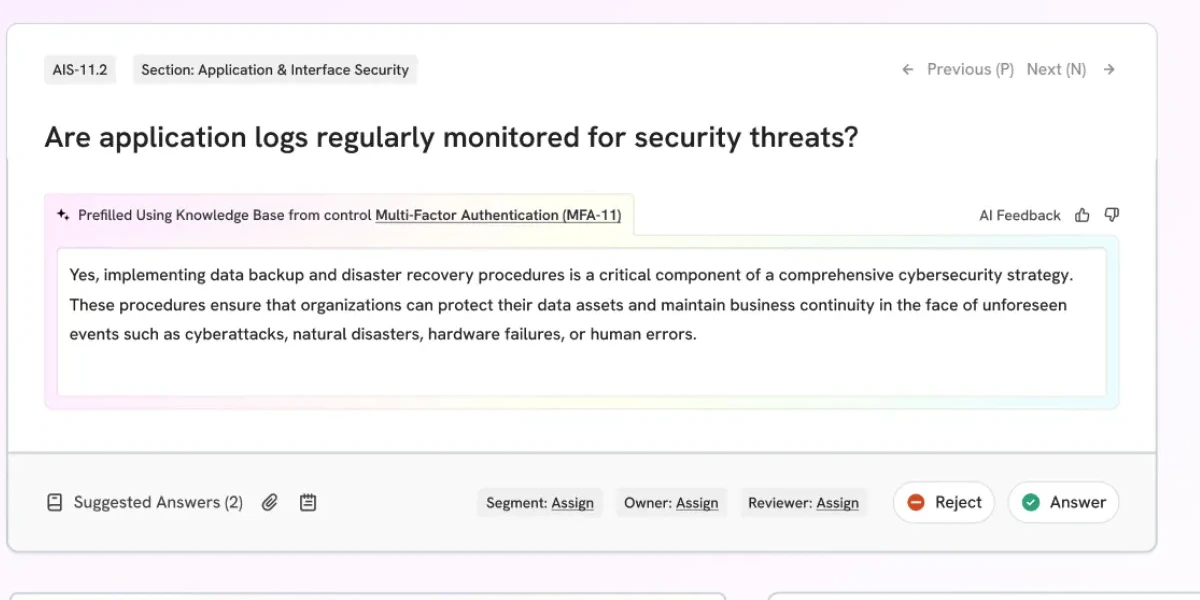
The same check should cover sensitive material. Request a document through TrustShare, have an authorized person approve access, and retain the access decision. If the proposed order does not include TrustShare or the necessary approval workflow, the TrustOps control record alone will not complete this customer-facing task.
Can public TrustCloud feedback verify the control-to-answer handoff?
The G2 product-review page showed 4.6/5 across 49 product reviews on September 11, 2026. That is a dated aggregate, not a current rating, a TrustShare score, or evidence that the control-to-answer handoff works. It is a separate population from the selected interviews above. Glassdoor results for “TrustCloud review” rate the company as an employer and should not be read as product feedback.
The r/grc thread (August 2025, archived) is small and self-selected. A commenter who ran a questionnaire comparison says their team chose Vanta. Another, who says they have not used TrustCloud, relays G2 themes. A third says TrustCloud saves every question-answer pair, so a library of 500 entries became 8,000. Treat these as test prompts, not findings: run two or three recent questionnaires through TrustShare, and ask how duplicate saved answers are found and merged.
What can a CPA do in TrustCloud’s AuditLens?
TrustCloud’s AuditLens documentation says a customer invites auditors into a program to review controls, evidence, and policies; a Compliance Admin can track what they reviewed. It also directs customers to support for a bulk evidence export. Ask the intended CPA to test its actual access, a historical artifact, a clarification request, and the exported files before the observation period is underway. Confirm how the engagement access is removed afterward.
AuditLens is software access, not a SOC 2 examination. Your team owns scope, evidence, and remediation. The independent CPA chooses procedures, tests controls, evaluates exceptions, and issues the report. The CPA decides whether AuditLens access and the support-mediated export meet its working-paper needs.
2 attestation-capable CPA firms in our directory list TrustCloud among the platforms they work with. The auditor directory can help you find a candidate, but a listing is not a formal TrustCloud partnership and does not mean the firm accepts your control evidence.
Which TrustCloud handoffs should the paid-edition demo prove?
Bring a real control, a recent questionnaire, and your CPA’s evidence request. Ask the seller to run these five checks in the edition it will quote:
- Failed control and recovery: Disconnect a test source and let one manual attestation go overdue. Assign both, record the fix, and rerun. The failed and passing results should both survive with timestamps, next to the configured evaluation frequency.
- Stale questionnaire answer: Change a control, then run a recent questionnaire through TrustShare and correct a conditional answer as described above. Compare the cited source with the wording a reviewer approved, and confirm what a prospect with portal access can open.
- CPA sample in AuditLens: Have your intended CPA find a historical failed result, a policy version, and the source artifact, and send one clarification request.
- Support-mediated bulk export: Ask support for the full evidence export the CPA would need. Note the request, the turnaround, whether the files are usable, and how engagement access is removed afterward.
- Order match: Reconcile TrustOps, TrustShare, AuditLens access, SSO and SCIM, support, frameworks, employee band, and export terms against the written proposal and its renewal basis.
Run these before signing. A sales demonstration of separate screens does not establish the handoffs or retained history in your scope.
TrustCloud documents SSO, named-role mapping, and SCIM deactivation in its SSO and SCIM guides. Public docs do not establish which quoted edition includes these features.
When is TrustCloud’s three-module route worth the quote?
Shortlist TrustCloud when questionnaire volume makes TrustShare useful alongside control work, and when your CPA accepts the AuditLens evidence route. Run the five demo checks before choosing it.
| Buying situation | Shortlist direction | Reason to test |
|---|---|---|
| Frequent questionnaires and controlled customer access to assurance material | TrustCloud | Trace a changed TrustOps control through a human-approved TrustShare answer and portal permission. |
| Primarily collecting SOC 2 evidence from existing systems | Vanta or Drata | Compare collection, failure history, CPA access, and the full order against the wider TrustCloud quote. |
| Implementation help matters more than questionnaire throughput | Secureframe or a separately scoped service | Check the named delivery work and who remediates controls; software access alone does not supply a compliance operator. |
These are buying-model comparisons, not a claim that every edition includes the same tools or services. The SOC 2 software guide covers the broader category; the TrustCloud profile holds the dated capability record.
Put other platforms through the same checks; compare SOC 2 compliance software to build the list.
More in Compliance Tools