 Menu
Menu
On this page
- Understanding Your Access Control Policy’s Role in SOC 2
- Copy-Usable Policy Skeleton
- Building Your Core Policy Components
- Putting Your Access Control Policy into Practice
- How to Generate Evidence for Your SOC 2 Auditor
- Avoiding Common Access Control Pitfalls
- Maintaining Your Policy for Continuous Audit Readiness
An access control policy is a formal, documented set of rules that defines how access to an organization’s information systems, data, and physical facilities is requested, authorized, granted, and revoked. This policy is a foundational component of information security, designed to ensure that users are granted the minimum level of access — or “least privilege” — necessary to perform their job functions. For the purposes of a SOC 2 audit, this policy serves as the primary evidence for the design of controls related to logical and physical access.
This policy supports the Security (Common Criteria) Trust Services Criterion, primarily the logical and physical access controls in CC6.1 through CC6.8. Those criteria come from the AICPA’s 2017 Trust Services Criteria (still current, with revised points of focus issued in 2022) and require entities to use logical access security software, infrastructure, and architectures to restrict access, and to authorize, modify, and remove access in line with documented security policies. At its core, the policy is the formal declaration of how the organization enforces least privilege.
Want the short version? Jump to the copy-usable policy template below. The rest of this page explains what each section needs to satisfy an auditor.
Understanding Your Access Control Policy’s Role in SOC 2
From a SOC 2 auditor’s perspective, an access control policy is the foundational evidence demonstrating a deliberate and management-approved strategy for securing information assets. It is not merely a procedural document; it is the primary artifact auditors request to assess the design of an organization’s security framework. A well-constructed policy answers the critical question: “How has the entity formally defined its rules for granting, managing, and revoking access to systems and data?”
For someone pursuing SOC 2, this policy is non-negotiable because it translates high-level security objectives into concrete, auditable rules. It provides the necessary context for all other access-related evidence, such as user lists, configuration screenshots, and system logs. The policy must be comprehensive, covering the entire user lifecycle from onboarding and role-based access assignment to managing privileged access and conducting periodic access reviews, thereby providing a clear framework for all access control activities.
Why This Policy Is Non-Negotiable for Auditors
Auditors treat this policy as the rulebook for your access control program. Without it, technical controls like Role-Based Access Control (RBAC) and Multi-Factor Authentication (MFA) have no documented intent or management approval behind them. SOC 2 evaluates both the design of controls (is the policy adequate?) and their operating effectiveness (does the organization follow it?), and the policy is the primary evidence for the design side.
The importance of robust access controls has grown as audits become more rigorous. CBIZ’s 2024 SOC Benchmark Study, which analyzed 193 SOC reports, found that SOC 2 reports containing more than 150 security controls rose from 16% to 23% year over year. The same study identified user access review failures as the single most common source of qualified opinions, overtaking business approval exceptions for the first time. For a company pursuing SOC 2, a weak or non-existent access control policy immediately signals a significant deficiency in the control environment to an auditor.
Connecting Policy Sections to SOC 2 Criteria
To achieve SOC 2 compliance, an access control policy must be explicitly mapped to the relevant Trust Services Criteria. This mapping provides auditors with a clear roadmap, demonstrating precisely how the policy’s clauses satisfy each specific AICPA requirement. This direct linkage is essential for an efficient audit, as it allows the auditor to quickly understand the control design and proceed to testing its effectiveness.
Auditor’s Perspective: An auditor’s primary objective is to verify that the policy directly addresses the risks and requirements outlined in the Common Criteria (CC) series, particularly CC6. A policy that explicitly references these criteria demonstrates a mature understanding of SOC 2 requirements.
Each section of the policy serves as a direct response to a SOC 2 control objective:
- User Provisioning/Deprovisioning: This directly addresses CC6.2, which requires procedures to authorize, modify, and remove access to data and systems based on changes in roles or employment status.
- Access Reviews: A policy mandating quarterly or semi-annual access reviews is the primary control for CC6.3, which requires periodic review of user access rights to ensure they remain appropriate.
- Least Privilege: A clear policy statement on the principle of least privilege forms the basis for meeting CC6.1, which focuses on restricting access to authorized users and devices.
Mapping Policy Sections to SOC 2 Common Criteria
This table directly connects the essential clauses of an access control policy to the specific SOC 2 Common Criteria they help satisfy, providing a clear roadmap for auditors.
| Policy Section | Relevant SOC 2 Common Criteria | Why It Matters for Your Audit |
|---|---|---|
| Least Privilege & Authentication (MFA) | CC6.1 | Fulfills the requirement to restrict logical access to authorized users and devices and to authenticate them before granting access to protected systems. |
| User Access Provisioning | CC6.1, CC6.2 | Demonstrates a formal, repeatable process for registering and authorizing users before issuing credentials, based on their defined job function. |
| User Access Deprovisioning | CC6.2, CC6.3 | Proves you have a time-bound mechanism to revoke access on termination or role change, preventing orphaned accounts. |
| Periodic Access Reviews | CC6.3 | Provides auditable evidence that you regularly verify access rights and remediate excessive permissions. |
| Physical Access | CC6.4 | Covers badge access, visitor logs, and data-center entry for in-scope facilities. |
| Data Disposal & Media Handling | CC6.5 | Requires that access credentials and stored data are securely removed when no longer needed. |
| Privileged Access & Boundary Protection | CC6.1, CC6.6 | Shows stricter controls for administrative accounts and protection against access from outside system boundaries. |
| Secure Data Transmission | CC6.7 | Covers encryption and access restrictions for data moving across and beyond your network. |
| Malware & Unauthorized Software | CC6.8 | Requires controls that prevent or detect unauthorized or malicious software, which is part of the access-control family. |
For an organization pursuing a SOC 2 report, the access control policy ties the rest of the audit evidence together. System logs, user-permission screenshots, and termination checklists all reference back to it. A detailed, maintained policy is the first step toward showing that access controls are designed well and enforced consistently.
Copy-Usable Policy Skeleton
Use the structure below as a starting outline, then replace the bracketed values with your own systems, owners, and timeframes. A SOC 2 auditor expects every one of these sections; missing sections are the most common gap in early-stage policies. Do not ship it with the brackets still in place. Generic, untailored language is itself a finding.
ACCESS CONTROL POLICY

1. Purpose
   Define how access to [Company] information systems, data, and facilities is
   requested, approved, granted, modified, reviewed, and revoked, in line with
   SOC 2 Common Criteria CC6.1-CC6.8.

2. Scope
   List every in-scope system, application, environment, and physical location.
   Example: production AWS accounts [IDs], [Okta], [GitHub], [BambooHR],
   data center at [address]. Avoid "all company systems."

3. Roles & Responsibilities
   - System Owners: approve access to the systems they own.
   - Data Owners: classify data and approve access to sensitive data sets.
   - Access Administrators (IT/Security): execute provisioning and deprovisioning.
   - Managers: request access and attest to it during reviews.

4. Least Privilege
   All access is granted at the minimum level required for the role. Standing
   privileged access is prohibited; elevation is time-bound and approved.

5. Authentication
   - MFA required for all users on all in-scope systems.
   - Minimum password length [12+] characters; SSO via [Okta/Entra ID] where supported.
   - Privileged accounts require phishing-resistant MFA (e.g., hardware keys/passkeys).

6. Provisioning (Onboarding)
   Access is assigned from predefined role templates, triggered by [HRIS] on hire,
   and approved by the relevant System or Data Owner before credentials are issued.

7. Modification (Role Change)
   On a role change, prior permissions are revoked before new ones are granted, to
   prevent privilege creep.

8. Deprovisioning (Offboarding)
   All access is revoked within [4 hours / same business day] of termination,
   triggered automatically by a status change in [HRIS]. Includes standalone apps
   and vendor portals not behind SSO.

9. Periodic Access Reviews
   User access is reviewed [quarterly]; privileged access [quarterly or monthly].
   Reviews are attested by the user's manager and retained as evidence.

10. Privileged & Administrative Access
    Admin access requires named accounts (no shared logins), separate approval,
    and session logging.

11. Remote & Third-Party Access
    Remote access requires VPN/Zero-Trust access plus MFA. Vendor and contractor
    access is time-bound, least-privilege, and reviewed on the same cadence.

12. Logging & Monitoring
    Capture successful/failed logins, permission changes, and account
    creation/deletion across in-scope systems (supports CC7.2).

13. Enforcement & Exceptions
    Violations are subject to [disciplinary process]. Exceptions require documented
    risk acceptance and a defined expiry, approved by [CISO/Security lead].

14. Review & Ownership
    Policy owner: [role]. Reviewed at least annually and after material changes.
    Version, approval date, and approver recorded.
Treat this as a framework, not a fill-in-the-blank document. The sections below explain what each one needs to satisfy an auditor.
Building Your Core Policy Components
Each component below needs to reflect your actual technology stack, data classifications, and workflows. A policy copied verbatim from a template fails on two counts: auditors spot the generic language, and it does not protect your real systems. For how these controls fit alongside the rest of your program, see our SOC 2 security controls overview and the full Trust Services Criteria reference.
The first component is the policy’s scope. This section must explicitly enumerate every system, application, database, network device, and physical location it covers. Vague language like “all company systems” is a red flag for auditors, as it suggests a lack of asset inventory and control. A SOC 2-ready scope statement must be specific, as properly documenting business processes is key to clarity.
An auditor-ready scope definition looks like this:
- Production Environment: All AWS resources within VPCs tagged ‘Production’, including EC2 instances, RDS databases, and S3 buckets containing customer data.
- Corporate Systems: The organization’s instances of Salesforce (Org ID: XYZ), Okta, and the internal HRIS platform, BambooHR.
- Physical Locations: The primary data center at [Address, Cage Number] and the corporate headquarters at [Address].
This level of detail proves to an auditor that a complete inventory of critical assets has been established and that the boundaries of the control environment are clearly understood. This directly supports the audit process by defining what is in-scope for testing.
Defining Roles and Responsibilities
For SOC 2 compliance, clear accountability is paramount. This section of the policy must assign ownership for every aspect of the access management lifecycle, addressing the SOC 2 emphasis on a formal organizational structure. The policy should define specific roles — not named individuals — responsible for authorizing, administering, and reviewing access.
Key roles to define for SOC 2 purposes include:
- System Owners: Individuals or teams accountable for a specific system or application (e.g., Head of Engineering for the production platform). They are the final approvers for access requests to their designated systems.
- Data Owners: Business leaders (e.g., CFO for financial data) responsible for classifying data and approving access to sensitive information sets under their purview.
- Access Administrators: IT or security personnel responsible for the technical implementation of access changes, such as provisioning and deprovisioning accounts based on authorized requests.
Without these clearly defined roles, access management becomes ad-hoc, increasing the risk of inconsistent approvals and unauthorized access — a significant concern for auditors. More details on structuring these responsibilities can be found in our overview of essential SOC 2 controls.
Implementing Least Privilege Access
The principle of least privilege is a fundamental concept in SOC 2 and must be the bedrock of the access control policy. The document must not only state this principle but also define the specific mechanisms for its enforcement. For someone undergoing a SOC 2 audit, this section is critical because it connects a high-level security principle to tangible, testable controls.
For example, a specific policy clause could state:
“Access to production AWS environments for developers is restricted to read-only permissions by default. Elevated privileges, such as write access to specific services, require a time-bound request via a JIRA ticket, must be approved by the designated System Owner, and are automatically revoked after 8 hours.”
This language provides a clear, auditable trail. An auditor can then request a sample of JIRA tickets and corresponding system logs to verify that this control is operating effectively, thus testing the implementation of least privilege.
Managing The Full User Lifecycle
A SOC 2-compliant policy must detail the entire user access lifecycle, from onboarding to offboarding. This is essential for satisfying SOC 2 criterion CC6.2, which focuses on the authorization, modification, and removal of access.
Onboarding: The policy must mandate that access is granted based on pre-defined role templates. For example, a “Support Engineer” role in an identity provider like Okta would automatically provision access to Zendesk and JIRA, but not to production databases. This demonstrates a systematic approach to granting initial access.
Modifications: When an employee changes roles, the policy must require a formal process to revoke old permissions before granting new ones. This prevents “privilege creep,” where users accumulate unnecessary access over time, a common audit finding.
Offboarding: This is one of the most scrutinized areas in a SOC 2 audit. The policy must mandate the immediate revocation of all system access upon employee termination. A strong policy links this process directly to the HR system (e.g., Workday or BambooHR), triggering an automated deprovisioning workflow.
Document each component in enough detail that it can guide technical implementation and stand as direct evidence for an auditor. A good policy turns abstract principles like least privilege into specific, enforceable rules.
Putting Your Access Control Policy into Practice
An access control policy remains a theoretical document until it is translated into operational technical controls. For a SOC 2 auditor, a policy that is not enforced is equivalent to no policy at all. They must see evidence that the rules defined in the policy are actively restricting access, monitoring activity, and protecting customer data. This implementation phase is where high-level statements about “least privilege” become concrete configurations in identity providers and cloud infrastructure.
This is a critical stage for any organization pursuing SOC 2, as access control gaps are a leading cause of audit failures. Common issues, such as shared administrative accounts or overly permissive roles, directly contradict the policy’s intent. According to Tenable’s 2025 Cloud Security Risk Report, 83% of AWS organizations use an identity provider to manage cloud identities, yet overly permissive defaults and standing excessive permissions continue to expose them to identity-based threats. Separately, Wiz Research found that 72% of cloud environments have publicly exposed PaaS databases lacking sufficient access controls. Auditors are well aware of these patterns and test for them directly.
From Policy to Identity Provider Configuration
Your Identity and Access Management (IAM) tool or identity provider (IdP) — such as Okta or Azure AD — is the primary mechanism for enforcing your policy. This is where you configure Role-Based Access Control (RBAC) to mirror the roles defined in your policy document. Instead of granting permissions on an ad-hoc basis, you create profiles like “Developer,” “Sales Ops,” or “Customer Support” with pre-defined, approved access levels.
For example, a “Developer” role in Okta should automatically grant access to Jira, GitHub, and a specific read-only role in your AWS staging environment. This is a direct implementation of the principle of least privilege. For your SOC 2 audit, you will need to provide screenshots of these role configurations as evidence that your policy is being technically enforced.
Automating User Provisioning and Deprovisioning
Manual user account management is prone to error and inconsistency, which are significant red flags for auditors. A mature, SOC 2-ready access control program integrates the IdP with a Human Resources Information System (HRIS), like Workday or BambooHR, to automate workflows.
When HR onboards a new hire in the HRIS, an automated trigger provisions their account in the IdP and assigns the correct role based on their job title. This eliminates manual intervention and creates a consistent, auditable trail.
Auditor Insight: The most scrutinized process in an access control audit is offboarding. An automated deprovisioning workflow that instantly deactivates all accounts when an employee is marked as “terminated” in the HRIS is considered a gold-standard control. It provides irrefutable evidence of timely access revocation, directly satisfying CC6.2.
To ensure these processes are followed, providing effective training in compliance is essential. All employees must understand their responsibilities under the access control policy.
This entire process is cyclical, not a one-time configuration. You scope access needs, onboard the user, and then conduct regular reviews to ensure ongoing alignment.
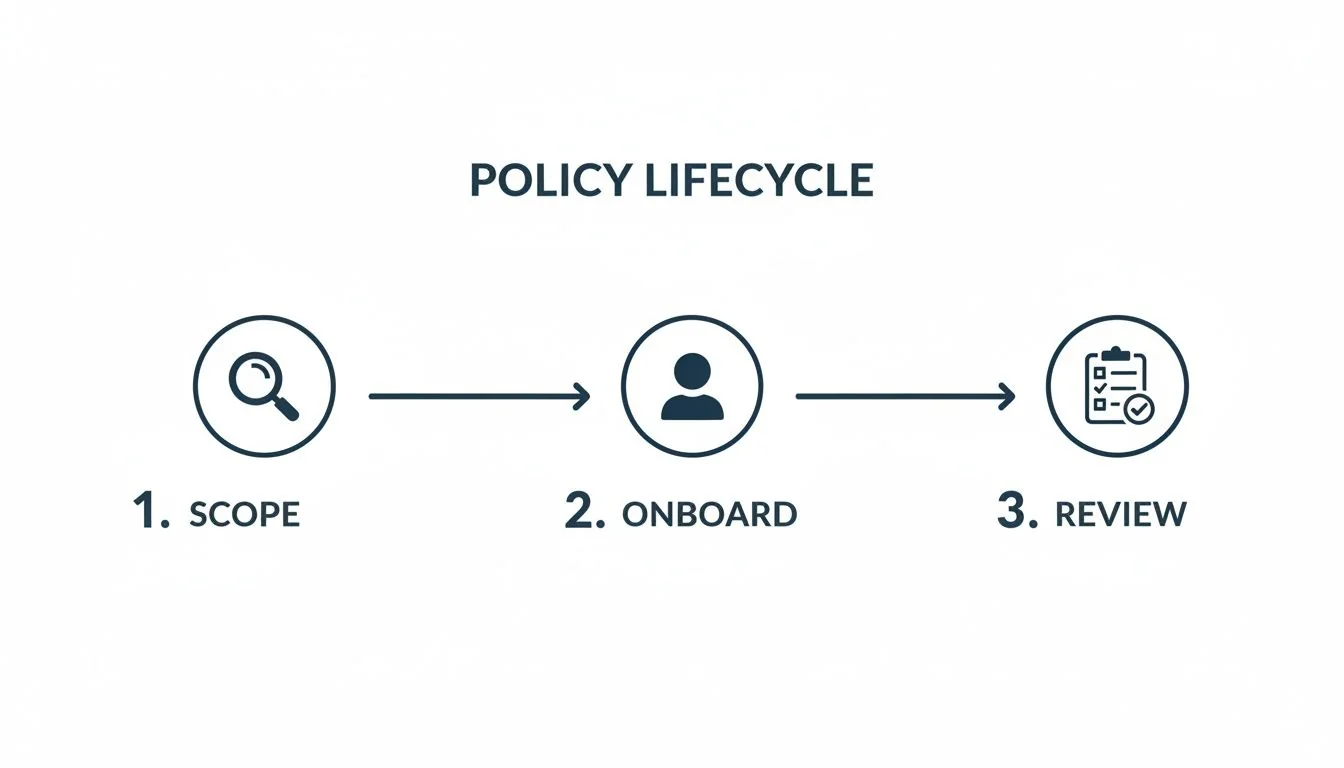
This workflow demonstrates that access management is a continuous process of scoping, provisioning, and reviewing, a key concept for maintaining SOC 2 compliance.
Configuring an Undeniable Audit Trail
Your policy must mandate comprehensive logging and monitoring, and your technical infrastructure must deliver it. This is how you prove that your controls are operating effectively over time — a mandatory requirement for a SOC 2 Type 2 report. You must configure systems to capture all significant access events.
For your SOC 2 audit, you will need to provide evidence of:
- Successful and failed login attempts across all in-scope systems.
- Changes to user permissions, especially escalations of privilege.
- Creation and deletion of user accounts, with a particular focus on administrative accounts.
Tools like Splunk, Datadog, or native cloud services like AWS CloudTrail must be configured to centralize these logs. This audit trail is the exact evidence required to demonstrate compliance with criteria like CC7.2, which covers the monitoring of systems to detect security events.
Translating the written policy into automated configurations reduces human error and gives your auditor the verifiable evidence they need for a clean report.
How to Generate Evidence for Your SOC 2 Auditor
For a SOC 2 audit, an access control policy is meaningless without verifiable evidence of its implementation. Evidence generation is the process of collecting tangible artifacts that prove your documented controls are operating effectively. This process is central to the audit, as it bridges the gap between policy statements and real-world security practices.
For anyone pursuing SOC 2, it is crucial to understand that auditors operate on a principle of “verify, then trust.” They require specific, objective artifacts — such as system configurations, logs, reports, and signed attestations — that directly substantiate the claims made in your policy. The goal is to provide undeniable proof that your access controls were consistently enforced throughout the entire audit period, which is the core requirement for a SOC 2 Type 2 report.
Key Evidence Categories for Access Controls
A successful SOC 2 audit requires a well-organized evidence package where each artifact is clearly mapped to a specific control. Auditors expect a combination of evidence types to form a comprehensive view of your control environment. For someone preparing for an audit, understanding these categories is the first step toward efficient evidence collection.
The primary categories an auditor will request include:
-
Configuration Screenshots: These are point-in-time snapshots showing how systems are configured to enforce policy rules.
- SOC 2 Example: A screenshot from your identity provider (e.g., Okta or Azure AD) displaying the permission set for a “Junior Developer” role, demonstrating the principle of least privilege.
- SOC 2 Example: A screenshot from AWS IAM showing the policy that enforces MFA for all administrative accounts, providing direct evidence for an authentication control.
-
System-Generated Logs and Reports: This is the most compelling form of evidence as it is objective, timestamped, and difficult to dispute.
- SOC 2 Example: An export from your HRIS listing employee termination dates. The auditor will cross-reference this with access revocation logs from your IdP to verify timely deprovisioning as required by CC6.2.
- SOC 2 Example: SIEM logs showing successful and failed login attempts, which demonstrates active monitoring as mandated by CC7.2.
-
Process Documentation and Records: This category provides evidence of human-led processes, showing that documented procedures are being followed consistently.
- SOC 2 Example: A completed access review spreadsheet or a report from a GRC tool, signed and dated by department heads. This is concrete proof that the periodic review required by CC6.3 occurred.
- SOC 2 Example: A sample access request ticket from a system like Jira or ServiceNow, showing the full approval workflow from request to manager sign-off to IT fulfillment.
Organizing Your Evidence for a Smooth Audit
The presentation of evidence is nearly as important as its content. A disorganized collection of files will lead to a longer, more frustrating audit with excessive follow-up requests. The objective is to make the auditor’s verification process as straightforward as possible.
A best-practice approach is to create a logical folder structure in a secure repository (e.g., Google Drive, SharePoint) or a GRC platform, mapping directly to the SOC 2 criteria:
- CC6.1 - Access Control
RBAC_Configuration_Okta.pngMFA_Enrollment_Report_Q3.csv
- CC6.2 - User Onboarding & Offboarding
Q3_New_Hire_Access_Grants.pdfQ3_Terminations_Access_Revocation_Logs.csv
- CC6.3 - Periodic Access Reviews
Finance_Dept_Access_Review_Q3_Signed.pdfEngineering_Dept_Access_Review_Q3_Signed.pdf
Auditor Tip: Use descriptive file names. A file named
AWS_MFA_Enforcement_Rule_CC6.1_evidence.pngis far more useful to an auditor thanscreenshot123.png. This level of organization signals a mature and well-managed compliance program.
For a deeper understanding of the complete evidence requirements, our guide on SOC 2 documentation provides a comprehensive overview.
Well-organized evidence is what shows an auditor that your written rules are actually operating controls. It is the difference between a policy that exists and one that is followed.
Avoiding Common Access Control Pitfalls
A well-written SOC 2 access control policy is insufficient if its implementation is flawed. For organizations pursuing SOC 2, understanding common failure points is critical to building a control environment that can withstand auditor scrutiny. These pitfalls represent not only compliance gaps but also significant security vulnerabilities that auditors are specifically trained to identify. They typically arise from a gradual divergence between policy requirements and day-to-day operational practices.
These issues matter for someone pursuing SOC 2 because they often lead directly to audit findings or qualifications in the final report. An auditor’s job is to test whether controls are operating effectively in practice, not just on paper.
The Silent Danger of Privilege Creep
A frequent finding in SOC 2 audits is privilege creep, the gradual accumulation of excessive access rights by users over time. This occurs when an employee changes roles or is granted temporary permissions that are never revoked. This directly violates the principle of least privilege, a cornerstone of CC6.1.
For a SOC 2 audit, an auditor will test for this by sampling employees who have been with the organization for an extended period. They will compare the user’s current access permissions against their documented job description. Any discrepancies, such as a developer retaining permissions from a previous support role, constitute an immediate control failure.
To mitigate this risk, the policy must mandate and enforce rigorous periodic access reviews. For these reviews to be effective for a SOC 2 audit:
- Make Managers Accountable: The review must be conducted and attested to by the employee’s direct manager, who is best positioned to validate access needs.
- Automate Evidence Collection: Utilize a GRC platform or identity management tool to automate the review process, creating a clean, undeniable audit trail of every approval and revocation.
- Enforce Zero-Trust: Treat all permissions as temporary and require recertification, especially for privileged accounts, on a quarterly basis.
The Chaos of Incomplete Offboarding
Another critical pitfall is incomplete user deprovisioning. Revoking Single Sign-On (SSO) access is not sufficient. SOC 2 auditors are aware that access to standalone applications, third-party vendor portals, or legacy systems not integrated with the primary identity provider is often overlooked. This directly violates CC6.2, which requires the timely removal of access upon termination.
An auditor will test this control by taking the list of terminated employees from the audit period and actively searching for any remaining active accounts. Discovering even one active account constitutes a clear control failure.
Auditor Reality Check: For SOC 2, “timely” is not measured in days. For high-risk employees, auditors expect access to be revoked within hours, if not minutes, of their departure. Any evidence of delay will be documented as a significant finding.
The offboarding checklist must be comprehensive, covering all systems from cloud infrastructure to marketing’s social media scheduler. The gold-standard control, from an audit perspective, is an automated process linked directly to the HR system.
Mismanaging Third-Party and Shared Accounts
Granting access to third-party vendors and contractors creates significant risk if not managed correctly. These users are often given overly broad permissions with insufficient oversight. Even more problematic are shared or generic accounts like admin@company.com or dev-team@. These accounts destroy individual accountability, making it impossible for an auditor to determine who performed a specific action. This is an immediate red flag and a direct violation of principles of traceability and accountability inherent in SOC 2.
Access control is hard to get right because you have to enforce one policy across many different systems. CBIZ’s 2024 SOC Benchmark Study found that security control counts in SOC 2 reports ranged from 34 to over 150, with the most common range between 34 and 74 controls (45.2% of reports). The same study noted that 54.9% of reports contained at least one control exception, and user access review failures were the leading driver of qualified opinions. For the broader set of controls these policies map to, see our SOC 2 controls list.
These are the high-impact issues auditors are tasked with finding. Address them before the audit by enforcing the policy through automated, auditable controls rather than manual effort.
Maintaining Your Policy for Continuous Audit Readiness
Achieving a SOC 2 report is the beginning, not the end, of a continuous compliance journey. The SOC 2 access control policy is a living document that must evolve with the organization to maintain audit readiness. For someone pursuing SOC 2, it is critical to understand that an outdated policy is a significant red flag for auditors, as it suggests that the compliance program is not being actively maintained. The policy must be treated as an operational component of the security strategy, subject to regular review and updates to reflect the current state of the organization.
This matters for SOC 2 because auditors expect to see evidence of a mature, ongoing compliance program. A policy that has not been updated in over a year signals that controls may no longer align with the business’s technology, personnel, or risk landscape.
Establishing a Formal Review Cadence
To ensure the policy remains relevant and effective, a formal, scheduled review process must be established. This process prevents the policy from becoming obsolete and demonstrates to auditors a commitment to continuous improvement. Best practice for SOC 2 readiness is to conduct a comprehensive policy review at least annually. This review must be a cross-functional effort involving stakeholders from security, IT, HR, and legal to ensure all aspects are considered.
The objectives for this annual review, from a SOC 2 perspective, are:
- Validate Scope: Confirm that the policy covers all current in-scope systems, applications, and data. If new critical SaaS tools have been adopted, they must be added.
- Update Roles: Revise role definitions and responsibilities to reflect any organizational changes, ensuring that designated “System Owners” are still appropriate.
- Incorporate New Technologies: Adjust policy language to address new authentication methods or technologies that have been implemented.
- Address Past Findings: The policy must be updated to explicitly address any findings or observations from the previous audit, demonstrating remediation and control improvement.
Integrating the Policy into Company Culture
A policy is only effective if it is understood and followed by employees. For SOC 2, demonstrating that the policy is integrated into the company culture is key to proving control effectiveness. Ongoing training and communication transform documented rules into ingrained organizational behavior, making compliance a shared responsibility.
An auditor can distinguish between a company that merely has a policy and one that operates by its policy. Evidence of ongoing training and employee attestations demonstrates a mature control environment where security is an integral part of operations.
To embed the access control policy into the employee lifecycle, organizations pursuing SOC 2 should:
- New Hire Onboarding: Require every new employee to review and formally acknowledge the policy as part of their initial training. This creates an auditable record of awareness.
- Annual Security Training: Include a refresher on the access control policy in the mandatory annual security awareness program.
- Manager Training: Ensure managers are trained on their specific responsibilities for enforcing the policy, particularly in approving access requests and conducting periodic reviews for their teams.
A documented history of policy updates, completed access reviews, and employee training is concrete evidence that your controls work over time, not just on paper. That record is what makes each annual audit faster, and it strengthens your security against real attacks at the same time.
Finding the right SOC 2 auditor is just as critical as having a strong access control policy. At SOC2Auditors, we connect you with verified audit firms that match your budget, timeline, and industry needs, turning a complex search into a data-driven decision. Get your tailored auditor matches today.