 Menu

On this page
- Vanta vs Delve at a glance
- Who does the readiness work in Vanta and Delve?
- How do Vanta and Delve hand evidence to the CPA?
- Is Vanta or Delve cheaper for the same SOC 2 scope?
- Does Vanta or Delve meet your identity-administration requirements?
- Which fits startups, enterprise, and Type 2: Vanta or Delve?
- How should you test Vanta and Delve before signing?
- Choose Vanta, Delve, or neither
Vanta and Delve both help prepare SOC 2 evidence. Vanta gives your team a guided roadmap and expert access; Delve says its customer-success team owns readiness communication, timelines and deliverables. Choose Vanta when your team will run the compliance work, and Delve only when its written scope takes named tasks off your team. Neither is proven cheaper for the same scope.
- Platform · VantaCollects connected evidence and runs tests.
Offers a guided roadmap and expert access. - Buyer teamApproves policies and shared evidence.
Implements fixes and operates controls. - CPA firmSets scope and tests controls independently.
Issues the SOC 2 report.
- Platform · DelveMarkets connected evidence collection.
Claims readiness coordination by its team. - Buyer teamApproves policies and shared evidence.
Implements fixes and operates controls. - CPA firmSets scope and tests controls independently.
Issues the SOC 2 report.
Buying Vanta or Delve does not transfer your security controls to the software vendor. The useful distinction is what help you purchase and which independent CPA examines the evidence. Read the Vanta review and Delve review if either shortlist choice is still open; the Vanta profile and Delve profile summarize each product. SOC 2 compliance software compared by buyer fit puts both in the wider field.
Vanta vs Delve at a glance
| Criterion | Vanta | Delve | Evidence class |
|---|---|---|---|
| Human help | Guided roadmap and access to compliance experts | Customer-success team claims ownership of readiness communication, timeline, and deliverables | Vendor descriptions. Contracted tasks and workload savings not publicly documented |
| Evidence and auditor workflow | Documents scoped auditor access, requests, review, and tracking | Markets audit management; announced an audit-workflow automation halt on April 3 | Vendor documentation and statement. Tenant behavior needs proof |
| Published starting price | $14,000 Essentials; 1–20 employees, 12 months | $12,000 Foundation Package; 1–20 employees, 12 months | AWS Marketplace listings. Different packages |
| Identity administration | Documented SCIM account provisioning, deactivation, roles, and teams; upgrade or add-on may apply | SSO, SCIM, and RBAC support not publicly documented | Vanta help documentation. Unknown does not mean absent |
| Required-source coverage | Connected tests; unsupported fields may need manual evidence | Markets AI evidence collection; coverage of your required fields is not publicly documented | Vendor claims; no measured coverage comparison |
| SOC 2 and ISO 27001 | Supports both; documents reuse through overlapping-control mapping | Markets both; cross-framework evidence reuse not publicly documented | Vendor claims |
| CPA firms listing the platform in our directory | 40 | No listed firm; confirm your CPA’s Delve experience directly | Directory; not a partnership, preference, or audit-quality measure |
Sources: each vendor's public pages and documentation, read between July 24 and October 15, 2026 (Vanta's SCIM documentation is dated August 11). Directory counts show firms that list a platform among those they work with; they do not establish current capacity or that every listed firm has audited that platform.
Who does the readiness work in Vanta and Delve?
Vanta describes expert access; Delve describes readiness coordination. Vanta describes a roadmap, customer-success support, and audit specialists. Delve says its customer-success team owns communication, timelines, and deliverables through readiness and coordinates with a CPA partner. Neither description establishes the hours your team saves.
Attach this responsibility schedule to each proposal:
| Work to assign | Vanta proposal | Delve proposal |
|---|---|---|
| Policy drafting and approval | Name who adapts templates or generated drafts to your actual practices, and who approves them. | Name which drafting and review tasks its team performs. Match each proposed policy to your actual practices before approval. |
| Failed control and remediation | Name the internal owner who fixes the system and the expert help included in the plan. | Separate gap identification and coordination from implementing the fix. Require an owner for both. |
| Manual evidence and exceptions | Identify missing connector fields, manual uploads, reviewers, and approval dates. | Identify original-source references, collection logs, human validation, and who rejects incorrect or incomplete evidence. |
| CPA requests and follow-up | Name who responds through the auditor workspace and supplies items outside it. | Name the coordinator and the direct CPA contact. Coordination must preserve your access to the firm's questions and answers. |
A schedule to complete with both vendors, not a finding about either tenant or a claim that these services are included. Vendor help can produce drafts and coordinate work; your company still approves its policies and operates its controls.
Any expert help beyond Vanta’s guided flows needs a written scope, and Delve’s coordination is worth only the tasks its order commits to. Require the same deliverable, named owner, acceptance criterion, and support duration from both.
How do Vanta and Delve hand evidence to the CPA?
Vanta documents an in-platform request and review path; Delve’s currently enabled audit-facing automation is not publicly documented. Vanta’s auditor page describes scoped access, evidence requests, tracking, and an Auditor API. Delve’s April 3, 2026 statement says it was halting automation that interacts with audit workflows. That wording does not establish that evidence collection or questionnaire automation stopped.
Neither Vanta nor Delve issues the SOC 2 opinion; the independent CPA firm performs the examination. Have the intended CPA request one original record, challenge an exception, and inspect the resulting export in each product. Ask where the firm keeps its own workpapers and what it needs outside the platform.
The Delve review sets out the allegations about Delve’s audit relationships, the responses from Delve and Accorp, and the report-authorship checks. The allegations remain unresolved in the public record, and they are not a finding about your proposed auditor or any specific report. Ask the CPA directly who will write its opinion and test results, and obtain the firm’s own engagement letter before you sign the software order.
40 attestation-capable CPA firms in our directory list Vanta among the platforms they work with. Use the Vanta auditor list to find candidates, then confirm experience and capacity. For Delve, the directory lists no firm: find a CPA through the auditor directory and ask it to assess the Delve handoff. That absence does not mean no CPA works with Delve.
Is Vanta or Delve cheaper for the same SOC 2 scope?
Neither Vanta nor Delve is proven cheaper for a matched project. The AWS Marketplace listings show a $14,000 Vanta Essentials starting price and a $12,000 Delve Foundation Package starting price. Both apply to 1–20 employees and a 12-month contract; they do not establish equal services, modules, or CPA fees.
| Price channel | Vanta | Delve |
|---|---|---|
| AWS Marketplace starting offer | Essentials $14,000; Plus $21,500; Professional $23,000 | Foundation Package $12,000 |
| Observed contracts | Vendr median $20,000 (Vanta pricing guide) | No comparable figure |
| Direct purchase | Personalized quote; no universal public price | The order controls fees, scope, and term; no universal public price |
Sources: Vanta's listing checked October 20, 2026; Delve's listing checked September 29. The screenshots below are September 29 captures. The Vendr median is from reported transactions, not quotes, and the two sides are different evidence types.
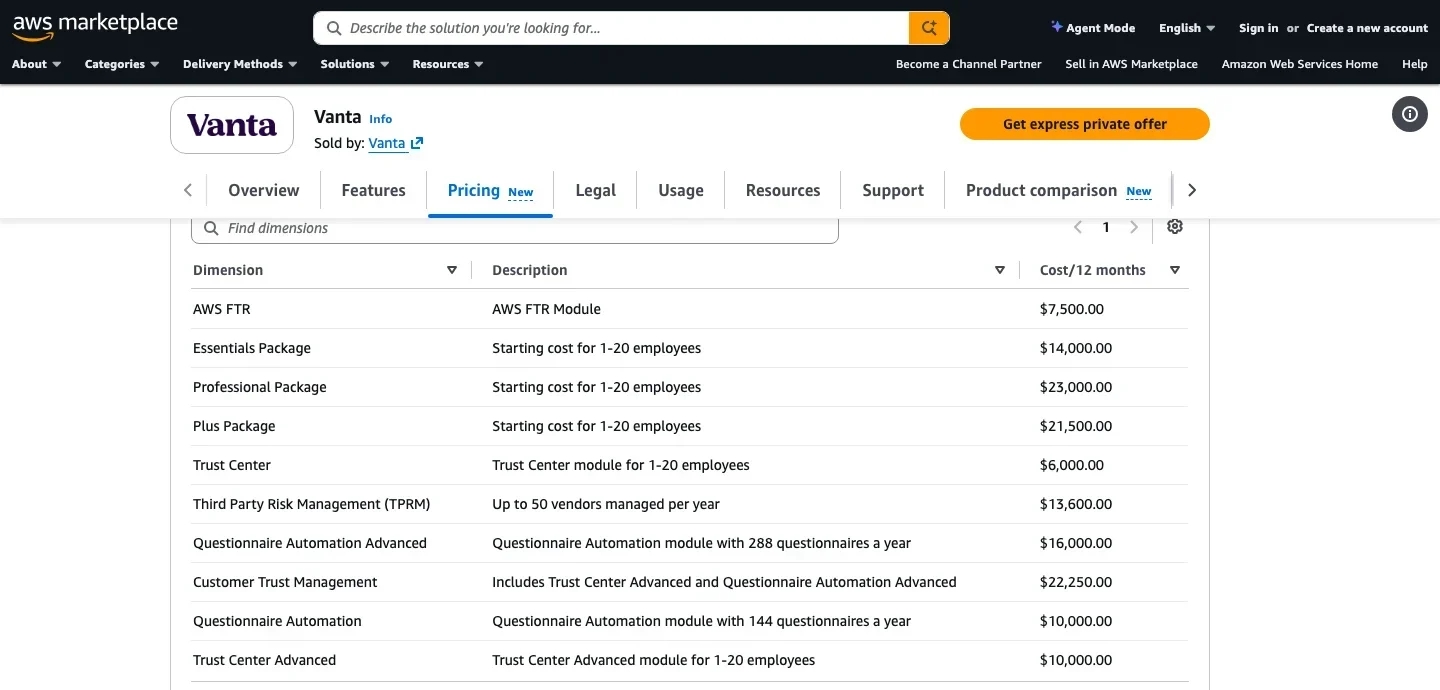
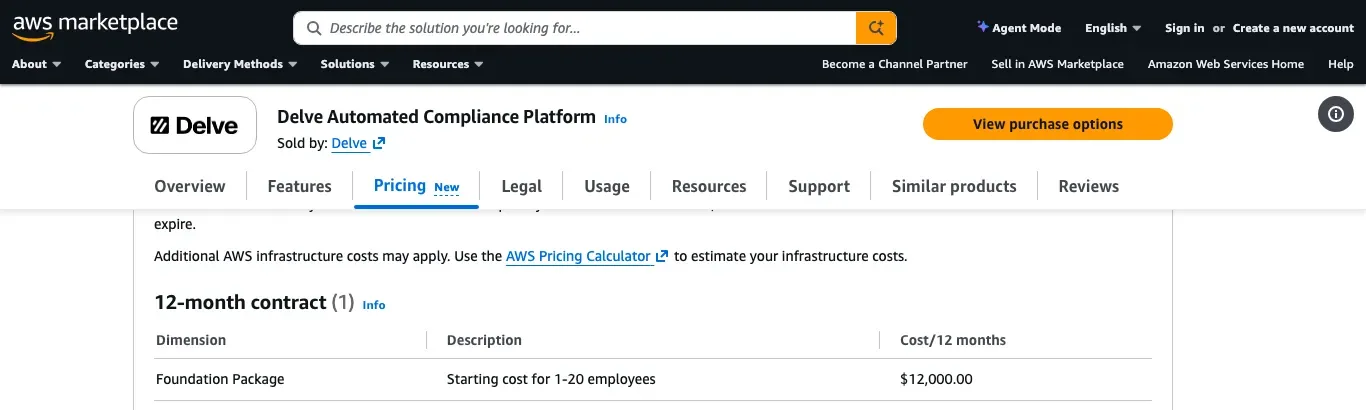
Do not turn the $2,000 starting-price difference into a savings claim. Request the same entities, employee band, systems, frameworks, modules, expert tasks, support duration, CPA scope, term, renewal cap, and export rights, and keep implementation, penetration testing, and the CPA examination itemized even if one proposal bundles them. The Delve review covers the listed Delve price and the budget lines to request.
Does Vanta or Delve meet your identity-administration requirements?
Vanta documents SCIM account lifecycle; equivalent public Delve SSO, SCIM, and RBAC support is unknown. Vanta’s SCIM documentation covers provisioning, deactivation, roles, and teams, with a possible upgrade or add-on. Delve does not publicly document SSO or SCIM for its own platform.
Test two paths with the same joiner or leaver. In Vanta, SCIM controls access to Vanta user accounts; a separate IdP or HR integration maintains the People roster and employment records used for compliance evidence. Removing platform access does not, by itself, prove an employee-offboarding control. Ask Delve to show both its platform-access path and the personnel evidence path.
If automated deprovisioning is mandatory, Vanta has a documented capability to evaluate, and Delve must demonstrate it and confirm the entitlement in writing.
Which fits startups, enterprise, and Type 2: Vanta or Delve?
Company stage alone does not decide between Vanta and Delve. The work owner, required access controls, and CPA-accepted evidence do.
- Startup or first SOC 2: Vanta is a reasonable candidate when a founder or security lead can own implementation and follow-up. Delve is a conditional candidate when its contracted coordination removes specific tasks and your CPA accepts the evidence handoff. A small team still needs an internal approver and people who implement fixes.
- Enterprise or multiple entities: Vanta’s documented administration gives a starting point; Delve’s public administration support is not documented and requires direct proof. With either, demonstrate entity separation, reviewer permissions, retention, and the quoted tier.
- SOC 2 Type 2: Both must preserve dated records, changes, and exceptions across the CPA’s agreed observation period, and neither removes that period. For an in-progress switch, get the intended CPA’s written acceptance of the historical evidence and examination period first.
- SOC 2 plus ISO 27001: Vanta documents overlapping-control cross-mapping; Delve markets both frameworks but publishes no comparable reuse detail. Ask each to show one reused artifact and one requirement that needs fresh work.
- Healthcare or FinTech: Both market adjacent frameworks such as HIPAA and PCI DSS. A framework label does not settle your PHI boundary, payment scope, or customer commitments; give both the same scoped requirements and intended examiner.
G2 showed Vanta at 4.6/5 across 2,728 reviews and Delve at 4.7/5 across 136 reviews in late September 2026. The samples are different buyers and do not measure audit quality, so the 0.1-point gap does not decide this purchase.
How should you test Vanta and Delve before signing?
Give both vendors the same systems, control, and failure, in a safe test workspace. Do not disrupt a production control to create the demonstration. Run three steps:
- Name the readiness deliverables in the order. Have each vendor complete the responsibility schedule above. Keep the named deliverables, owners, acceptance criteria, service duration, and itemized quote.
- Trace one original record end to end. Pick a required control for a system you cannot replace, plus a manual artifact. Open the original record, find its fields and timestamp in each product, then introduce a failed control and show the alert, owner, exception, fix, and rerun. Have the intended CPA request that record and challenge the exception, and keep the exports.
- Get the written boundary of audit-facing automation. Ask Delve to state in writing which collection, questionnaire, and audit-facing automations are enabled for your tenant after its April announcement, and where a human reviews them. Ask Vanta for the same boundary on its auditor workspace and Auditor API.
Finish all three before contract signature. Decline a proposal that cannot produce the evidence these steps ask for.
Choose Vanta, Delve, or neither
Choose Vanta when
- your team has an owner for policy approval, remediation, manual evidence, and CPA follow-up; and
- the quoted plan names the services and add-ons your program needs.
Next, use the Vanta pricing guide to normalize the offer and ask a firm from the Vanta auditor list to review the handoff.
Consider Delve when
- its written scope assigns useful work to named people for a defined duration; and
- you vet the CPA yourself and get direct answers on independence, report authorship, and the currently enabled audit workflow.
Next, read the Delve review and select a CPA through the auditor directory to assess the proposed workflow.
Choose neither when
- You need more expert implementation work than either proposal commits to: compare the service tasks and duration in the Scytale review.
- You can run a narrow program internally: start with choosing a SOC 2 auditor and agree a manual evidence plan with the firm. You still carry internal work and a separately quoted examination.
- A mandatory source, access, or export requirement fails in both: use Vanta alternatives or the software directory.
Vanta buyer guides
Start with the product record, then compare the review, pricing, alternatives, pair guides, and auditor listings before you shortlist.
More in Compliance Tools