 Menu
Menu

On this page
Secureframe and Vanta both help you prepare for SOC 2. Secureframe’s cheapest plan includes one automated check tailored to your business; Vanta requires an upgrade. Choose Secureframe if that covers your needs, or Vanta if its higher plan saves more work. Compare setup, support and audit fees before deciding.
- 01Two controlsPick two tests your standard connectors cannot supply.
- 02Plan gatesSecureframe: check Complete. Vanta: check Professional.
- 03Named ownerIdentify who builds each test and repairs a failed collection.
- 04CPA sampleKeep a dated result and have your CPA retrieve it.
- 05Written scopePrice both controls, support and evidence retention in the order.
The common mistake is buying “automation” or “expert guidance” without naming the control, package and person doing the work. Secureframe and Vanta both provide evidence software and routes to expert help; neither vendor signs your SOC 2 opinion. For the separate buy-or-skip decisions, read the Secureframe review and Vanta review. The Secureframe software profile and Vanta software profile hold the dated product records; the SOC 2 software guide covers a wider shortlist.
| Criterion | Secureframe | Vanta | Evidence class |
|---|---|---|---|
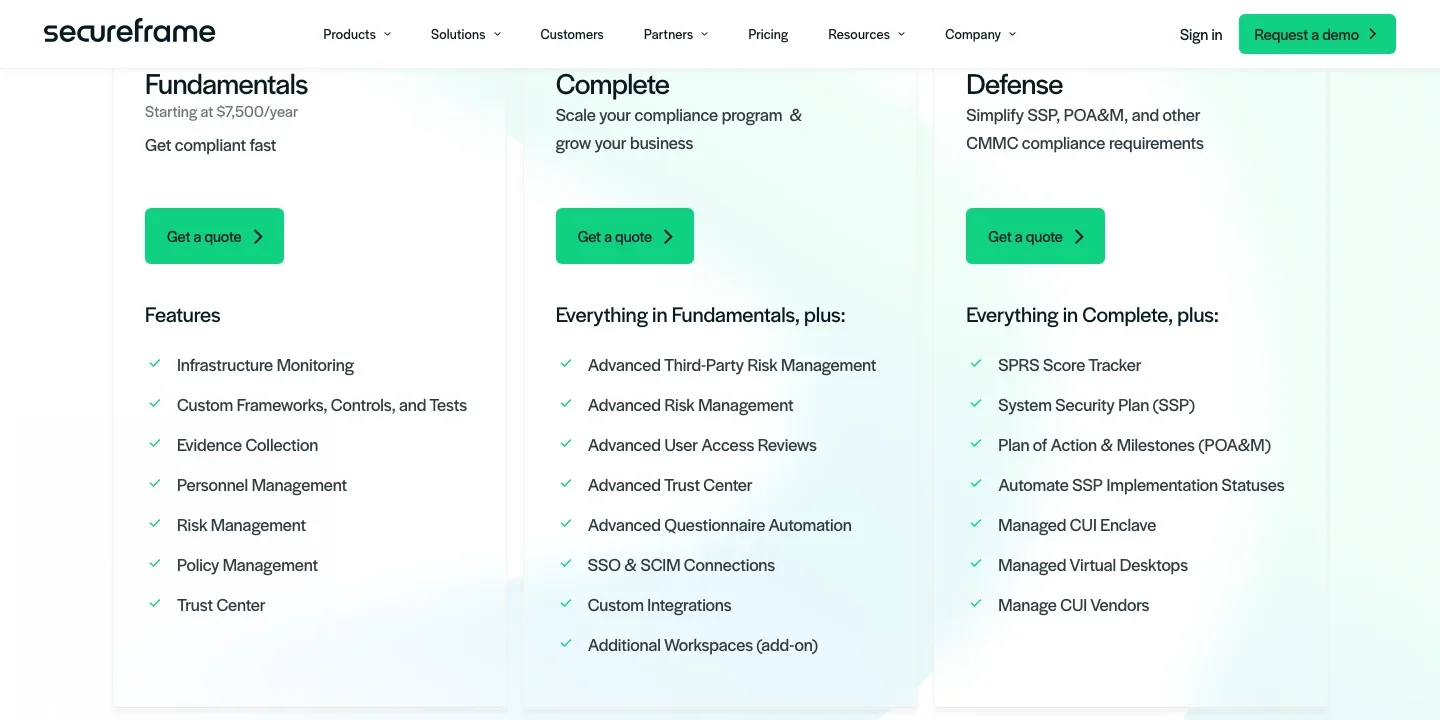
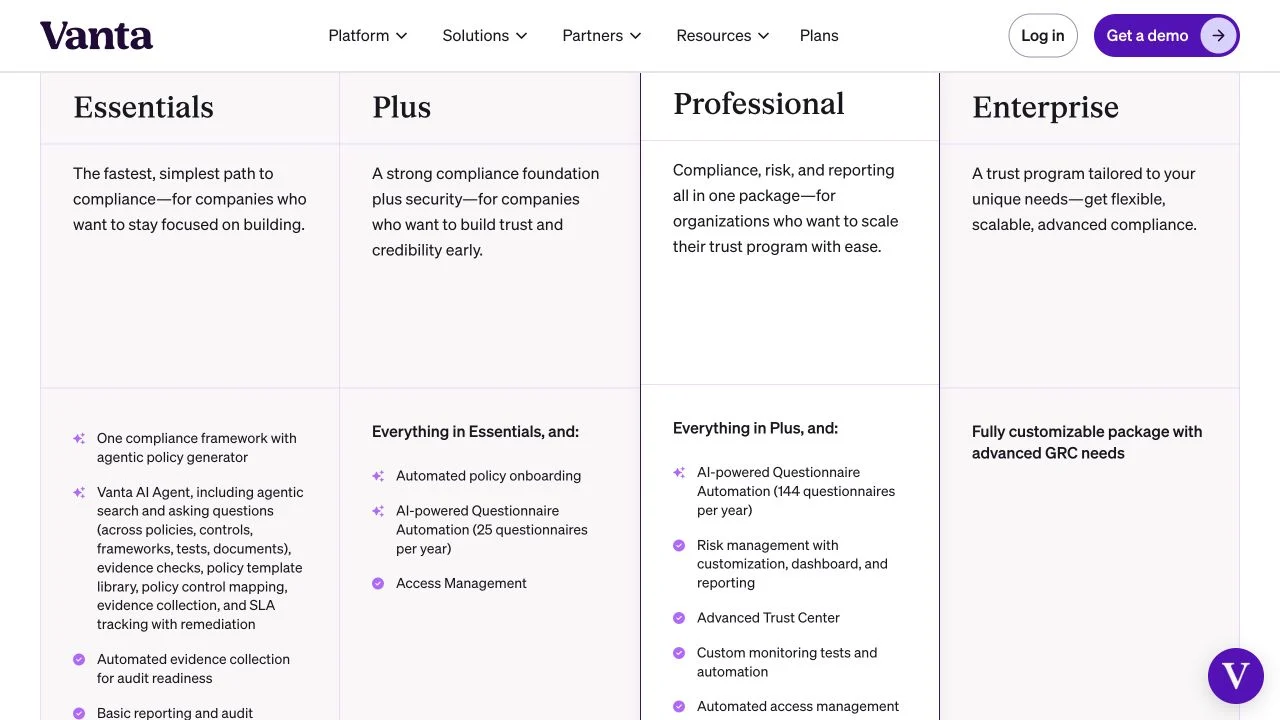
| Custom monitoring | Fundamentals: one custom automated test. Complete: unlimited; custom integrations listed. | Professional lists custom monitoring tests and automation. Quote the exact source and test limits. | Vendor package pages, September 30, 2026; not connector tests. |
| Platform identity | SSO and SCIM connections begin on Complete. | SSO listed; SCIM documentation says an upgrade or add-on may apply. | Vendor pricing and SCIM docs, September 30, 2026. |
| Expert work | Guided route; name the expert's deliverables in the order. | Guided route; expert partners offer additional services. | Vendor descriptions; implementation ownership requires a written scope. |
| CPA workspace | Audits Module; evidence visibility depends on the configured observation window. | In-product requests and review; Auditor API can sync evidence and control status. | Each vendor's auditor documentation, September 30, 2026. |
| Firms listing the platform | 13 attestation-capable firms | 41 attestation-capable firms | Our directory; listings establish neither audit quality nor your firm's experience. |
| Direct-site price | Fundamentals starts at $7,500/year; Complete and Defense require quotes. | Essentials, Plus, Professional and Enterprise require quotes. | Vendor sites, September 30, 2026; no matched public price for custom-work scope. |
Sources: Secureframe packages, Vanta plans, Vanta SCIM, and the auditor sources below. The two vendors' package names do not establish equivalent entitlements.
When do Secureframe and Vanta need a higher plan?
Secureframe lists one custom automated test on Fundamentals and unlimited custom automated tests on Complete; Vanta lists custom monitoring tests and automation on Professional. These are the vendors’ public package boundaries checked September 30, 2026. A demo using a higher plan does not establish what an entry-plan order includes.
Secureframe’s Complete package also lists custom integrations, advanced user access reviews and SSO/SCIM connections. Vanta’s Professional card lists automated access management and advanced control management; Vanta’s SCIM help separately warns that an upgrade or add-on may be needed. Ask each vendor to put the demonstrated identity path and custom-source work in the order. Provisioning access to the compliance platform is separate from collecting employee offboarding evidence from your HR or identity system.
The practical test is two nonstandard controls, such as an access review for an internal admin tool and an approval check from a self-hosted change system. Make Secureframe and Vanta show the exact collected field, test logic, owner, failed result and retained history. A manual upload can be adequate evidence; it also means somebody must gather and review it. Price that responsibility rather than assuming the connector eliminates it.
Secureframe advertises 300+ native integrations on its pricing page; Vanta advertises 400+ integrations on its product page, both checked September 30, 2026. Those vendor totals do not establish coverage of either example. Secureframe’s December 2022 office-hours explanation, still available on September 30, describes daily, weekly and monthly checks; Vanta’s current automation page advertises hourly tests. We have not measured either product’s intervals. Inspect the last two runs of your required control instead of treating “continuous” as one schedule.
What do Secureframe, Vanta and your CPA actually do?
Secureframe and Vanta organize evidence and support audit collaboration; your team operates the controls and an independent CPA examines them. September 30, 2026 documentation gives concrete handoff paths for both products, but neither path establishes how much implementation work your seller will perform.
Secureframe’s Audits Module guide says evidence is visible in Audit Mode only when its completion date falls inside the selected observation window. Evidence outside that period appears “Out of Audit.” The module also supports auditor requests, shared comments and module-level read access. Have your CPA check a correctly dated sample and an out-of-window sample. Agree how late uploads are handled; changing a completion date is not a substitute for proving when the control operated.
Vanta’s auditor page documents evidence requests, review, comments and information request lists, plus an Auditor API for synchronizing evidence and control statuses with auditor tools. Have the intended firm use its actual access path to request, inspect and retain the same two samples. An API listing does not establish that your CPA’s audit tools use it.
Our directory contains 13 attestation-capable firms listing Secureframe and 41 listing Vanta. Compare CPA firms that list Secureframe and CPA firms that list Vanta. The counts identify candidates; a larger count does not prove a smoother examination, partner certification or audit quality. Confirm the firm’s platform experience and engagement terms directly.
For expert help, ask Secureframe and Vanta to name who connects systems, adapts policies, resolves a failed collection and prepares the CPA handoff. Access to a compliance expert does not establish delegated execution. If a proposal bundles an audit fee, identify the independent issuer and examination scope separately.
The September 30, 2024 Reddit comparison contains a Secureframe user’s praise for automatic testing, auditor access and responsive support alongside a recommendation to run a proof of concept for larger environments. A Vanta user describes a simpler environment working well. The thread also includes disclosed Secureframe and Vanta representatives. The June 2023 three-platform discussion still ranks prominently, but includes commercial participants and predates today’s packages. Treat those old, self-selected accounts as questions to investigate, not a support-quality ranking.
Is Secureframe or Vanta cheaper for the same work?
Secureframe’s $7,500/year Fundamentals floor cannot be compared directly with a Vanta Professional quote. On September 30, 2026, Secureframe’s Complete and Defense prices and all four Vanta direct-site plan prices required quotes. Neither vendor publishes a complete, matched public price for the custom-work scope above.
Vanta’s direct package cards give no dollar amount. Separately, its seller-controlled AWS Marketplace listing showed 12-month starting prices for 1–20 employees on September 30, 2026: Essentials $14,000, Plus $21,500 and Professional $23,000. That channel offer has an explicit employee band; Secureframe’s public floor does not disclose the same band. The two surfaces cannot establish a savings percentage.
Same-source transaction evidence gives a different comparison. On September 30, 2026, Vendr’s Secureframe page showed an annual USD range of $7,733–$32,575, with a $20,000 median; Vendr’s Vanta page showed $7,500–$57,221, also with a $20,000 median, across 373 purchases. Secureframe’s purchase count was not shown in the retrieved price panel. These are different buyer pools with varying scope, not matched quotes. The overlapping ranges and equal medians do not prove price parity or that either vendor is cheaper for your program.
For the actual comparison, price the same employee band, frameworks, entities, workspaces, two custom controls, SSO/SCIM, implementation, support deliverables, contract term and renewal cap. Keep the CPA engagement on its own line even if one transaction bundles it. The Secureframe pricing guide and Vanta pricing guide cover the separate commercial evidence in more detail.
How do Secureframe and Vanta fit different SOC 2 programs?
Secureframe and Vanta can both enter a startup or enterprise shortlist; the evidence routes and quoted work decide the fit. Company stage alone does not establish which product is faster or which support package your team needs.
- First SOC 2 at a startup: Secureframe Fundamentals and Vanta Essentials warrant evaluation when the normal connectors cover your controls. Secureframe’s one-custom-test limit and Vanta’s higher-plan custom-monitoring gate matter as soon as that assumption fails. Assign an internal owner and demonstrate the required evidence before paying for an upgrade.
- Enterprise or multiple entities: Secureframe Complete and Vanta Professional/Enterprise deserve a test with the actual IdP, roles, business units and custom sources. In September 2026, Secureframe lists Additional Workspaces as an add-on; Vanta’s plan table also distinguishes workspace entitlements. Quote each required workspace and access boundary.
- SOC 2 Type II: Secureframe’s configured observation window and Vanta’s auditor-request workflow must preserve evidence your CPA can examine for the intended period. A passing dashboard is not a report. If switching between Secureframe and Vanta, export historical artifacts, mappings, exceptions and comments, and get the CPA’s decision on continuity before ending the old contract. A software switch alone does not determine whether the observation period must restart.
- SOC 2 plus ISO 27001: Secureframe and Vanta both list framework support, but reuse is a control-level question. Demonstrate one shared control and one ISO-specific requirement; identify the additional work and framework fee in each order.
- Defense or another regulated sector: Secureframe’s September 2026 Defense package explicitly lists SSP, POA&M and SPRS workflows plus managed CUI infrastructure. Vanta also markets CMMC support; that is not evidence of an equivalent managed enclave. Ask both vendors to document the exact assessment and infrastructure scope. For healthcare or financial services, establish data handling, residency and contractual terms separately; a framework logo does not answer them.
What should you ask Secureframe and Vanta to prove?
Run the same five steps in Secureframe and Vanta, using the plans actually quoted. Keep the outputs and give your intended CPA the evidence sample; this is an evaluation you can run, not a claim that either product has passed it.
- Map two hard controls. Bring the same internal-tool access review and nonstandard change-approval requirement to both trials. Keep each source-to-control map, collected fields, custom-test entitlement and manual fallback.
- Break and restore collection safely. Use a nonproduction source or safe test credential. Show the failed result, stale-evidence state, assigned owner, expert response and restored collection. Keep timestamps and the response commitment, with the person doing remediation named.
- Trace one employee’s two identity paths. Provision and remove a test platform user, then inspect the separate HR/IdP employment record used for offboarding evidence. Keep the access history, roster record and written SSO/SCIM entitlement.
- Make the CPA retrieve history. Have the firm request a sample, inspect one artifact inside and one outside the proposed observation window, comment and retain an export. Keep the CPA’s assessment of permissions, dates, file formats and access after cancellation.
- Reconcile the order. Match the demonstrated tests and services to package, headcount, frameworks, workspaces, implementation, independent audit fee, renewal terms and exit rights. Keep both itemized proposals and the list of work your team still owns.
Complete the same five checks in both products before signature.
Choose Secureframe, Vanta or neither
Choose from the control sample, named work and written price you can verify. Secureframe and Vanta each remain conditional choices until the intended CPA accepts the handoff.
Choose Secureframe when
- Your team wants its guided workflow and the proposed expert’s deliverables are named.
- Complete covers the required custom integrations, tests and identity connections at an acceptable total cost.
- Defense’s documented CMMC scope addresses a separate requirement you actually have.
Take that scope to the Secureframe pricing guide and shortlist auditors who list Secureframe.
Choose Vanta when
- Its connectors or custom monitoring produce the evidence your actual stack needs.
- The Professional or negotiated package includes the tested functions and support work.
- Your intended CPA can use Vanta’s request workflow or Auditor API and retain usable evidence.
Use the Vanta pricing guide and compare auditors who list Vanta.
Choose neither when
- Neither product can produce the control history your CPA needs.
- Your team needs someone to perform implementation and neither proposal names that work.
- The total software, services and audit cost exceeds the value of the work saved.
Compare separately scoped readiness help with a direct CPA engagement, or broaden the software shortlist through Secureframe alternatives and Vanta alternatives.
Vanta buyer guides
Start with the product record, then compare the review, pricing, alternatives, pair guides, and auditor listings before you shortlist.
Secureframe buyer guides
Start with the product record, then compare the review, pricing, alternatives, pair guides, and auditor listings before you shortlist.
More in Compliance Tools