 Menu
Menu

On this page
- Vanta vs Drata at a glance
- How do Vanta and Drata work with auditors?
- Does Vanta or Drata support SCIM?
- Is Vanta or Drata cheaper?
- Does Vanta or Drata have more integrations?
- Does Vanta or Drata test controls more often?
- How do Vanta and Drata fit startups, enterprise and Type II?
- How should you test Vanta and Drata before signing?
- Choose Vanta, Drata, or neither
Vanta and Drata automate SOC 2 evidence collection; account lifecycle and CPA handoff decide. Vanta documents SCIM lifecycle; Drata documents role sync and Audit Portal (September 2026). Choose Vanta for required account automation, Drata for proven CPA workflow savings. Neither is proven cheaper for matched scope.
Vanta and Drata organize evidence; an independent licensed CPA firm examines the controls and issues the SOC 2 report. A connected system or passing dashboard test does not establish that the CPA has enough evidence. For whether either belongs on your shortlist, read the Vanta review and Drata review; their Vanta and Drata profiles hold the dated product records.
Vanta vs Drata at a glance
Vanta has the clearer published app-account lifecycle. Drata documents an audit-specific portal. Your CPA’s acceptance of the resulting evidence decides the SOC 2 handoff.
| Criterion | Vanta | Drata | Evidence class |
|---|---|---|---|
| CPA evidence workflow | In-product requests, comments, information request lists and Auditor API | Assigned audits, request lists, audit resources and evidence packages in Audit Portal | Vendor docs |
| SCIM account lifecycle | Create, update, deactivate and reactivate Vanta accounts; upgrade or add-on may apply | IdP group-to-role sync documented; full Drata account lifecycle remains unknown | Vendor help docs |
| Published integrations | 400+ | 300+ | Vendor-reported totals |
| Automated test cadence | Hourly | Daily at 19:00 PST; manual reruns available | Vendor-reported schedules |
| Direct plans | Essentials, Plus, Professional, Enterprise; quote required | Foundation, Advanced, Enterprise; quote required | Vendor pricing pages |
| Observed annual contracts | $7,500–$57,221; $20,000 median | $9,415–$68,250; $25,000 median | Vendr transaction pools; unmatched scopes |
| CPA firms listing the platform in our directory | 41 | 50 | Directory records; not partnership or quality ratings |
Product and price sources were checked September 30, 2026. Directory counts cover attestation-capable firms that list the platform, not official partnerships, current capacity or platform preference.
How do Vanta and Drata work with auditors?
Vanta lets auditors request, review and comment on evidence inside the platform; Drata gives assigned auditors an audit-specific view through Audit Portal. The Vanta auditor page and Drata Audit Portal documentation, checked September 30, 2026, describe these workflows. A portal name does not establish that one is faster.
| CPA task | Vanta’s documented path | Drata’s documented path |
|---|---|---|
| Request a sample | Information request lists with upload windows and due dates; evidence comments | Audit request lists and audit resources; the customer sets the period and auditor assignment |
| Review the submitted evidence | Request, review and track evidence in the platform | Auditor and customer use the same underlying audit data and packages; access depends on configuration |
| Move evidence into the firm’s tools | Auditor API syncs evidence and control statuses | Downloadable evidence and audit packages; confirm the New or Classic Experience in the proposed tenant |
Vanta’s public auditor page and Drata’s Audit Hub page illustrate different entry points into audit coordination. The CPA’s actual request, review and export in Vanta and Drata must establish which workflow removes duplicate handling.
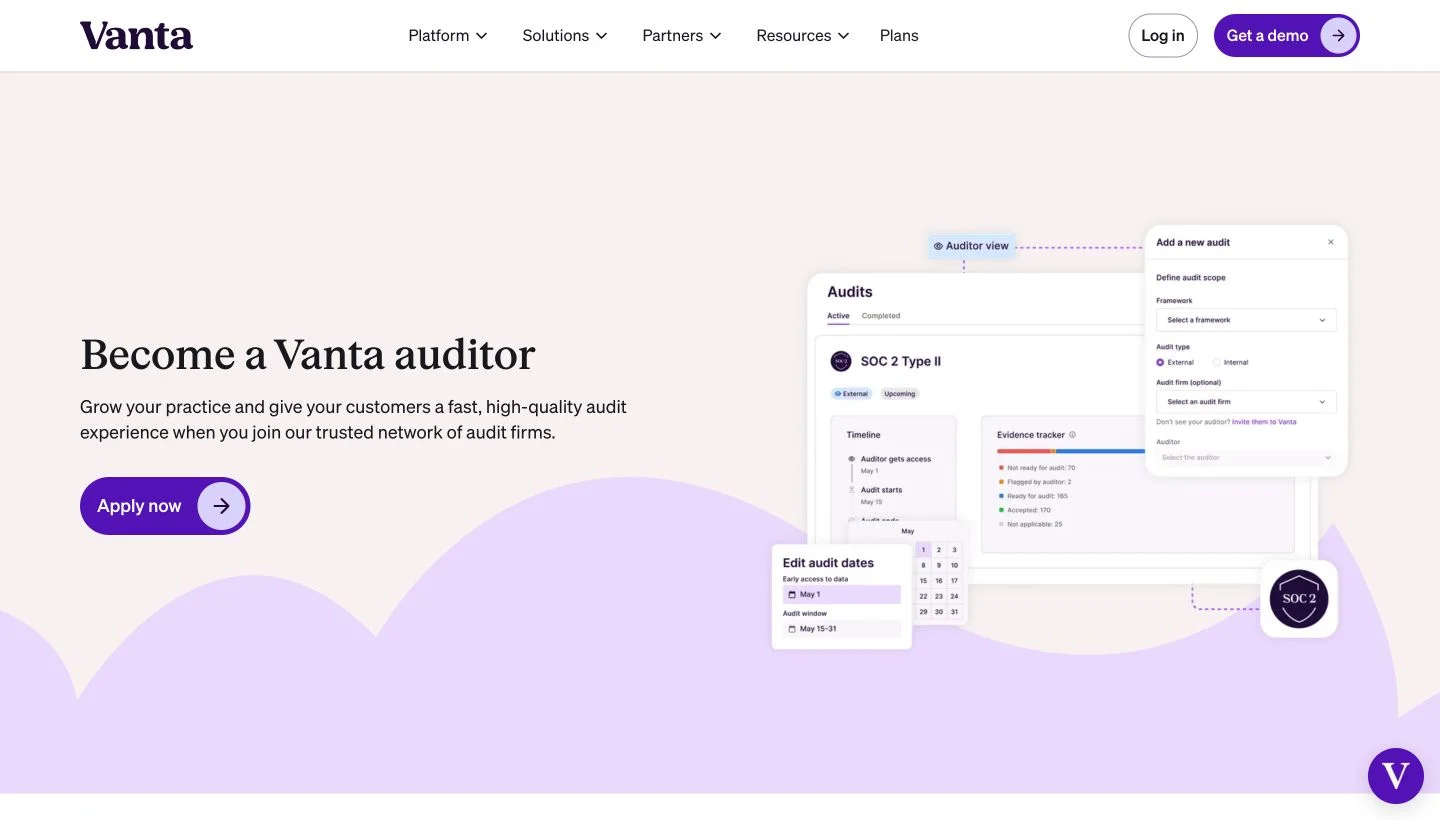
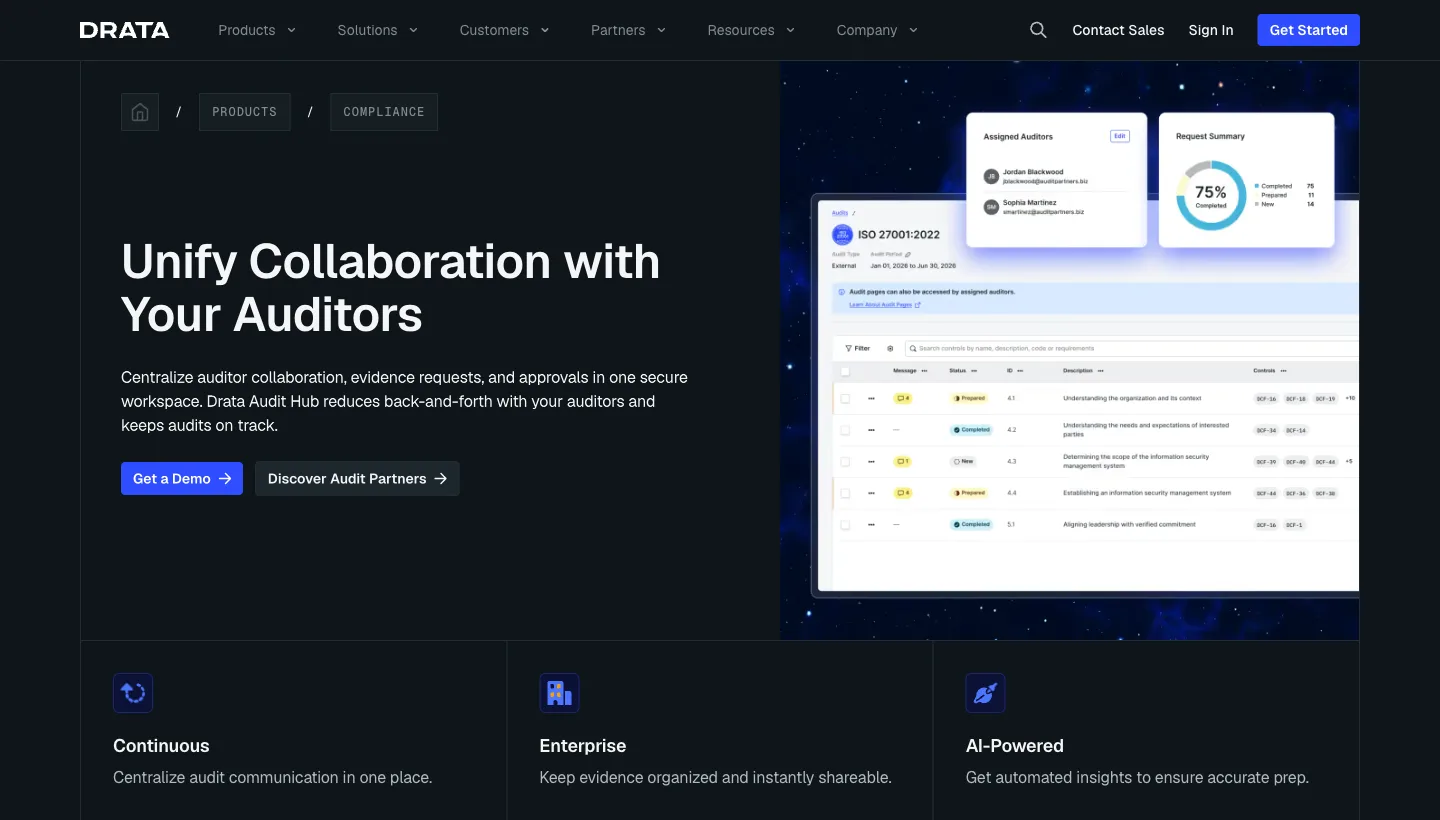
Our directory lists 41 attestation-capable firms for Vanta and 50 for Drata. Use the Vanta auditor list and Drata auditor list to find candidates; the counts do not establish audit quality or current platform experience.
Ask the intended CPA to request one sample, inspect an exception and export the record in both products. Keep its written acceptance and any extra evidence requests. Choose Drata if Audit Portal demonstrably reduces that firm’s coordination work; choose Vanta if its existing workflow or API removes more duplicate handling.
In a 2023 r/cybersecurity discussion, an auditor questioned Vanta’s evidence depth while other participants reported successful use of both tools. A Vanta employee and a Drata reseller disclosed affiliations. These conflicting, old accounts are reasons to test your CPA’s requirements, not a current product ranking.
Neither software vendor signs the SOC 2 opinion. Vanta says its Seamless Audit package can bundle an independent auditor’s cost. Identify the CPA firm, engagement letter and fee even when the purchase is one transaction.
Does Vanta or Drata support SCIM?
Vanta documents SCIM creation, updates, deactivation and reactivation of Vanta user accounts; Drata documents IdP group-to-role assignment, while full Drata account lifecycle remains unknown. These are the public boundaries in Vanta’s SCIM guide and Drata’s role-mapping guide, checked September 30, 2026.
Vanta SCIM controls login access to Vanta, not the employee roster or account removal across all your business systems. Vanta’s separate IdP and HRIS integrations manage the People roster and employment data. Its documentation also warns that unmatched existing accounts remain manually managed. Vanta says an upgrade or add-on may be required; the exact tier and price remain unestablished.
Drata can grant or revoke mapped roles as IdP group membership changes. Its documentation says manually assigned roles remain independent: removing a group-derived role does not establish that all access is gone. Do not infer account deactivation from role revocation.
For mandatory provisioning, make both vendors create, change, deactivate and restore an app login account, then inspect its remaining roles and sessions. Check personnel records separately. Vanta has the documentation advantage; a successful Drata demonstration and written tier commitment can resolve its unknown lifecycle boundary.
Is Vanta or Drata cheaper?
Neither Vanta nor Drata is proven cheaper for the same scope. Vendr’s Vanta and Drata pages, checked September 30, 2026, show a lower Vanta floor, median and ceiling, but substantially overlapping bands. The pools contain different buyers and contracts.
| Observed procurement field | Vanta | Drata |
|---|---|---|
| Annual range | $7,500–$57,221 | $9,415–$68,250 |
| Median | $20,000 | $25,000 |
| Purchases reported | 373 | 235 |
These are third-party procurement observations, not either vendor’s rate card or matched offers.
Both vendors also publish scoped AWS Marketplace offers, checked September 30, 2026:
| Marketplace field | Vanta listing | Drata listing |
|---|---|---|
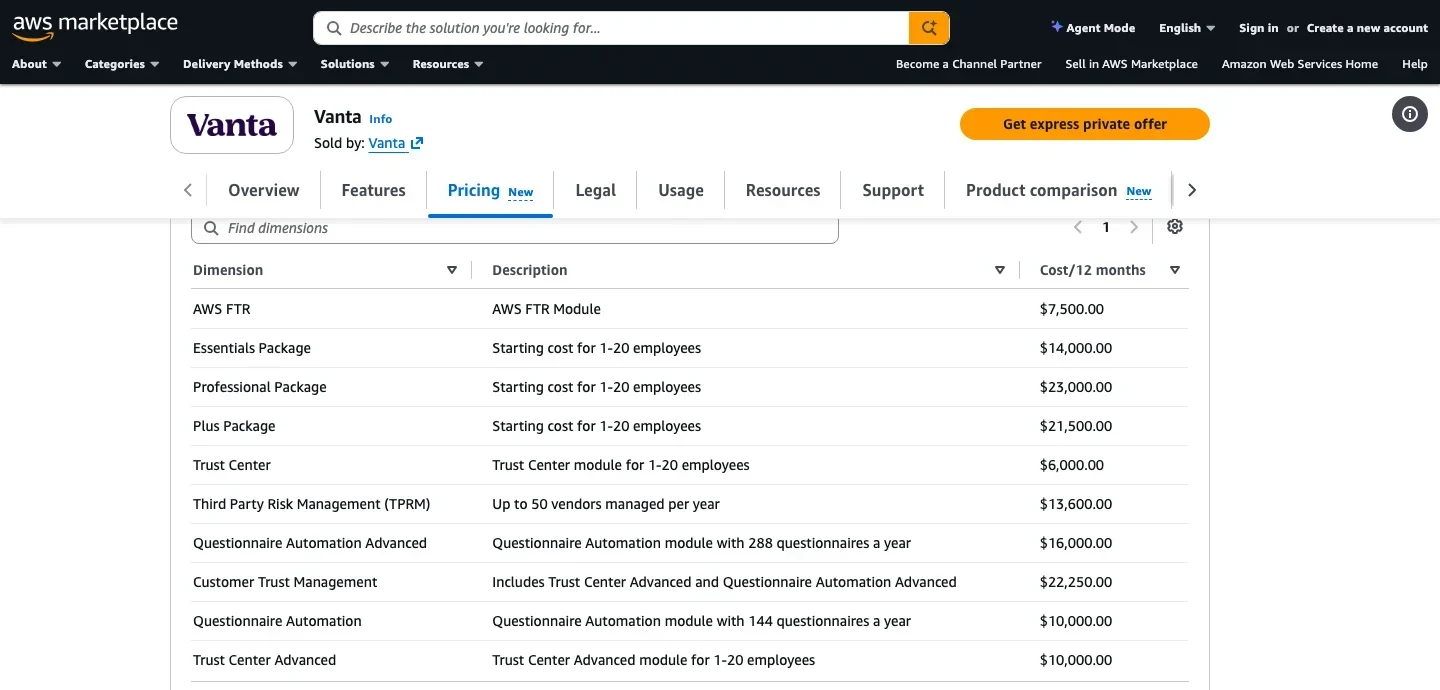
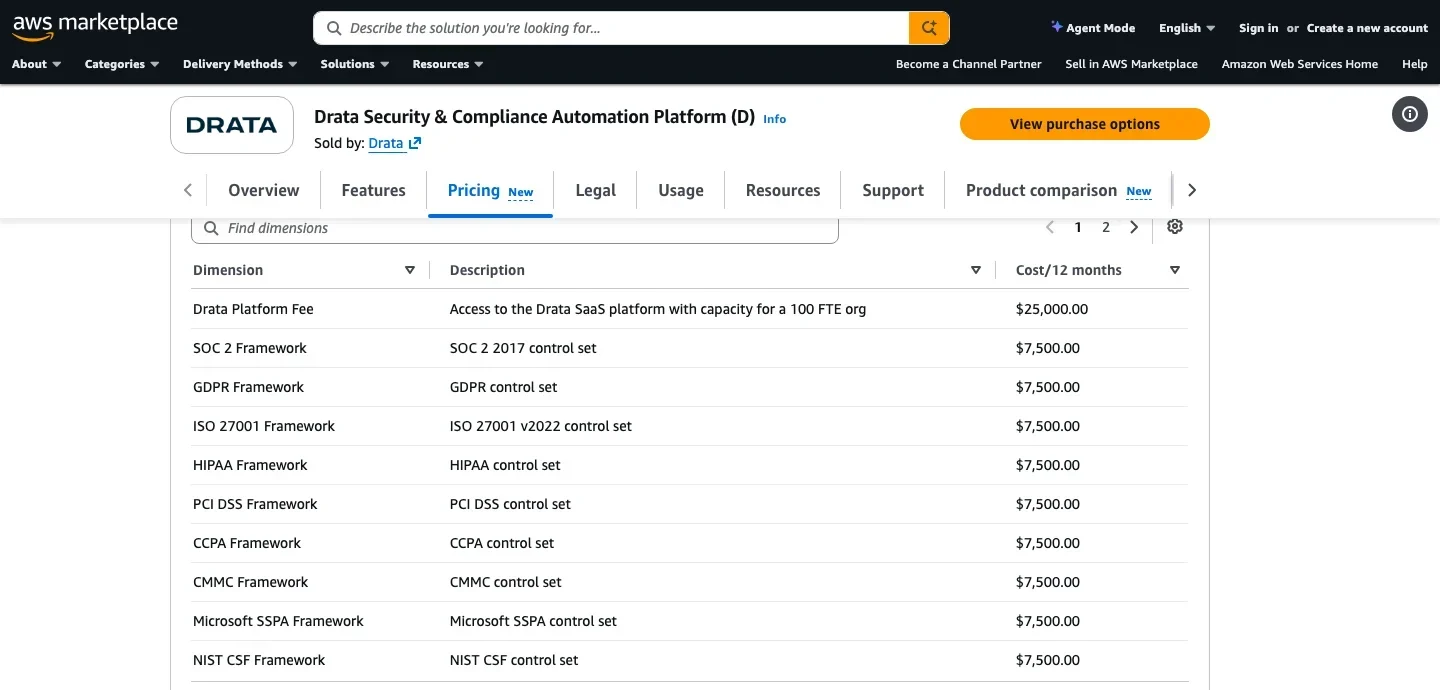
| Term and employee scope | 12 months; starting costs for 1–20 employees | 12 months; platform capacity for a 100 FTE organization |
| Listed dimensions | Essentials $14,000; Plus $21,500; Professional $23,000 | Platform $25,000 plus SOC 2 framework $7,500: $32,500 subtotal |
| What remains separate | Additional modules and independent CPA scope; confirm package inclusions | Other frameworks, modules and independent CPA examination |
The $14,000 and $32,500 figures are not equivalent quotes. Vanta names small-team packages; Drata names separately priced dimensions for a different employee scope. Drata’s AWS listing does not price its direct Foundation, Advanced or Enterprise plans. Private offers may differ for either product.
Drata’s listing instead separates platform capacity for a 100 FTE organization from the SOC 2 framework. Adding those two dimensions gives $32,500; it does not make Drata more expensive than Vanta for the same company.
The Vanta direct pricing page and Drata plans page require quotes. Drata Foundation allows up to 50 FTEs and one named pre-mapped framework. Normalize employees, frameworks, modules, implementation, support, CPA fee, term and renewal before comparing totals. The Vanta pricing guide and Drata pricing guide hold the full quote checklists.
A 2025 r/soc2 pricing thread mixes platform-only prices, audit bundles and multi-framework programs; some participants disclose selling these tools or competing products. Its useful theme is scope and renewal risk. Its anecdotes cannot establish your price or a representative discount.
Does Vanta or Drata have more integrations?
Vanta reports 400+ integrations; Drata reports 300+. The totals come from Vanta’s automation page and Drata’s compliance page, checked September 30, 2026. Vanta has the larger published catalog; neither total proves evidence depth for your required systems.
Give both vendors the same in-scope inventory. For each irreplaceable cloud, identity, source-control, endpoint and HR system, trace one control from the source record to the CPA’s sample. Ask what needs manual collection and what fails when a sync breaks. Choose the product that leaves less unsupported evidence work, rather than counting connector logos.
Does Vanta or Drata test controls more often?
Vanta publishes hourly automated tests; Drata publishes daily tests at 19:00 PST, with manual reruns available. Vanta’s product page and Drata’s help guide were checked September 30, 2026. These are vendor-reported schedules, not measured tenant performance.
Vanta’s more frequent default matters when the control changes often and somebody acts on the result. Fail the same access control in both products and record the source-change time, test-result time and owner notification. More frequent polling alone does not prove faster remediation or complete Type II evidence.
How do Vanta and Drata fit startups, enterprise and Type II?
Company stage does not decide Vanta vs Drata. Both sell small-team and larger-program offers. The system coverage, CPA handoff and commercial entitlements decide whether either fits.
- First SOC 2 or startup: Vanta’s AWS packages start with a 1–20 employee scope; Drata Foundation allows up to 50 FTEs and one pre-mapped framework. These are different packages, not proof of cheaper or faster readiness. Make both proposals name who implements policies, repairs failed controls and answers the CPA.
- Enterprise or multiple entities: Vanta documents app-account lifecycle; Drata documents group-derived roles and workspace-specific role behavior. Test a group-wide admin, an entity owner and an auditor against two entities. Record what each can view, change and export, including an attempted action outside its entity. Get workspace limits and extra charges in writing.
- SOC 2 Type II: Neither Vanta nor Drata shortens the agreed observation period. Choose the product that preserves source dates, repeated control performance, exceptions and remediation for the CPA’s selected period. A passing current test is not a historical sample. If switching, have the CPA approve continuity and any evidence gaps before cancelling the incumbent; a platform change alone does not determine whether the period must restart.
- SOC 2 plus ISO 27001 or other frameworks: Vanta describes cross-mapped controls; Drata Advanced allows any available framework. Give both the same requirement set and inspect native, mapped and manual controls. Reusing evidence does not remove framework-specific operating work or the separate examination or certification process.
- Healthcare or fintech: Vanta and Drata’s general SOC 2 workflows do not settle the buyer’s sector scope. Ask both to map the actual healthcare or payment requirements, identify manual work and confirm where sensitive evidence may be stored and shared. Use the healthcare or fintech shortlist when those requirements change the buying task.
On September 30, 2026, G2’s seller pages listed Vanta at 4.6/5 from 2,728 reviews and Drata at 4.7/5 from 1,397. Each listed one product profile, but the pools are different buyers, not matched SOC 2 tests. Use review themes for reference-call questions about evidence friction, onboarding, support and renewal; the averages do not decide this pair.
How should you test Vanta and Drata before signing?
Run the same five tests in both products and keep the outputs. Use a vendor-assisted trial or proof of concept with the intended CPA. If a vendor cannot demonstrate a required step, mark it unresolved in the proposal.
- Connect the required systems. For one high-risk control per irreplaceable cloud, identity, source-control, endpoint and HR system, save the source record, result, timestamp and remediation trail. Break one sync and record recovery. Map one shared control to a second framework if needed.
- Prove app access and separation. Create, change, deactivate and restore an app login through your IdP, then change its groups and roles. Check remaining manual privileges and personnel records separately. For multiple entities, attempt an unauthorized cross-entity action. Record the required plan and add-on charge.
- Run the CPA’s request. Have the intended firm request a sample, inspect an exception and export evidence in each product. For Type II, use a historical sample from the agreed period. Keep the firm’s written acceptance and any additional evidence it requires.
- Test the exit. Obtain a bulk export of controls, policies, dated evidence history and auditor requests. Keep the files and confirm format, retention and access after cancellation. Ask the CPA what must remain available if you migrate during its observation period.
- Compare one written scope. Put employees, entities, frameworks, modules, implementation deliverables, support, CPA scope and fee, term, renewal and cancellation in both proposals. Mark each item included, extra or unknown. Compare totals only after the scopes match.
Do this before contract signature. If both pass, choose the proposal with less remaining manual work and a lower complete cost for that same scope.
Choose Vanta, Drata, or neither
Choose Vanta when
- a required integration produces CPA-accepted evidence that Drata’s does not;
- documented Vanta-account provisioning meets a mandatory requirement and its commercial gate is acceptable;
- hourly testing changes your team’s response to a high-risk control; or
- your CPA proves its Vanta workflow or Auditor API avoids duplicate handling.
Next, normalize the offer with the Vanta pricing guide and select candidates from the Vanta auditor listing.
Choose Drata when
- its output produces better evidence on your critical systems;
- your CPA proves a lower-friction request and export through Audit Portal;
- its tested roles and workspaces fit your organization better; or
- its written implementation, support and renewal scope removes more work at an acceptable total cost.
Next, use the Drata pricing guide and have a candidate from the Drata auditor listing assess the demonstrated handoff.
Choose neither when
- both fail a required integration, access boundary or historical evidence export;
- your procurement policy requires a complete public price that neither scoped listing establishes; or
- your team needs more implementation work than either proposal includes. Use the end-to-end platform comparison to compare service scope and identify the independent CPA issuer.
Comp AI is another path when code inspection or self-hosting is required; confirm its open-core licence, commercial feature boundary and operating duties. For a wider shortlist, use Vanta alternatives, Drata alternatives or the software directory.
Vanta buyer guides
Start with the product record, then compare the review, pricing, alternatives, pair guides, and auditor listings before you shortlist.
Drata buyer guides
Start with the product record, then compare the review, pricing, alternatives, pair guides, and auditor listings before you shortlist.
More in Compliance Tools