 Menu
Menu

On this page
- Which enterprise GRC platforms should you shortlist?
- Compare the products behind the platform names
- Best fits by enterprise workflow
- Enterprise GRC or enterprise SOC 2 automation?
- Implementation: who does the work after the demo?
- Compare enterprise GRC quotes on the same scope
- Enterprise GRC demo worksheet
- How we selected and checked these platforms
The best enterprise GRC software depends on the program you need to run. Start with ServiceNow IRM for GRC connected to an existing ServiceNow environment; Optro for an internal-audit and SOX-led program; and LogicGate for workflows your GRC team wants to configure. Add Riskonnect for enterprise risk and controls, MetricStream for regulated groups with complex organizational reporting, and Archer when an existing Archer deployment shapes the decision.
Choose the workflow before the brand. A risk register, a SOX testing cycle and a SOC 2 evidence request are different jobs. A platform may support all three through different products, permissions and services. An enterprise GRC suite runs risk and assurance work across the business; if a SOC 2 report is the immediate job, the automation platforms in our SOC 2 compliance software comparison are the narrower fit. A small team without a GRC function is better served by our best compliance software for small businesses.
The comparison below identifies documented scope and the questions that can change a purchase. It does not assume that every demonstrated module is included in one licence. Go straight to the demo worksheet if you already have a shortlist.
Which enterprise GRC platforms should you shortlist?
Enterprise GRC software connects risks, controls, accountable owners and management reporting across an organization. For this shortlist, each platform must have documented risk assessments, compliance or control-owner workflows, enterprise reporting, and organizational and administrative scope. A large customer base or SSO alone does not establish that fit.
| Platform | Best-fit workflow | Resolve before purchase |
|---|---|---|
| ServiceNow Integrated Risk Management Product source | Connecting enterprise risk and controls to an existing ServiceNow operating model. | Entity design, application entitlements and implementation ownership need scoping; an IRM label does not settle them. |
| Optro Product source | Internal audit and SOX teams connecting assurance work to enterprise risk and compliance. | Confirm how the proposed audit, SOX, controls and risk products share records, permissions and licence scope. |
| LogicGate Product source | GRC teams configuring their own risk, controls and assurance workflows. | Applications, Power Users and implementation scope must match the program; record access needs careful configuration. |
| Riskonnect Product source | Enterprise risk teams joining risk registers, compliance and internal controls in one program. | A broad portfolio still needs a defined module combination, access model and implementation statement of work. |
| MetricStream Product source | Regulated groups needing legal-entity and business-unit roll-up across risk, compliance and SOX. | Specify organization structure, regulatory-content coverage and the products/services included before comparing proposals. |
| Archer Product source | Existing Archer programs evaluating their next risk or regulatory-compliance deployment. | Separate versioned Archer GRC use cases from current Evolv products; deployment and dependent-use-case licences change the scope. |
These are recommendations by workflow, rather than a ranking from first to last. Internal audit, SOX and third-party risk are comparison dimensions; you do not need all three to justify an enterprise GRC purchase.
If your immediate requirement is collecting evidence for SOC 2 and managing security compliance, start with our enterprise SOC 2 compliance software comparison. Use this page when risk, assurance or regulatory work across the business is the buying task.
Compare the products behind the platform names
A product family is not a bill of materials. Ask each vendor to identify the product, edition and entitlement behind every requirement. “Integrated” may describe how records connect; it does not tell you what the proposal includes.
Keep local control failures visible in the group report
| Platform | Risk, controls and reporting | Internal audit / SOX | Third-party risk |
|---|---|---|---|
| ServiceNow Integrated Risk Management | Risk: Risk Management Controls: Policy and Compliance Management Reporting: Risk Management | Audit: Audit Management SOX: Policy and Compliance Management | Third-party risk: Third-party Risk Management |
| Optro | Risk: Enterprise & Operational Risk Management Controls: Controls Management; Compliance Management Reporting: Reporting and dashboards | Audit: Audit Management / OpsAudit SOX: SOX Management | Third-party risk: Third-Party Risk Management |
| LogicGate | Risk: Enterprise Risk Management Controls: Controls Compliance Reporting: Enterprise Risk Management | Audit: Internal Audit Management SOX: SOX Compliance | Third-party risk: Third-Party Risk Management |
| Riskonnect | Risk: Enterprise Risk Management Controls: Compliance Reporting: Enterprise Risk Management | Audit: Internal Audit SOX: Internal Controls Management | Third-party risk: Third-party Risk Management |
| MetricStream | Risk: Enterprise Risk Management Controls: Regulatory Compliance Management Reporting: Enterprise Risk Management | Audit: Internal Audit Management SOX: SOX Compliance Management | Third-party risk: Third-Party Risk Management |
| Archer | Risk: Archer Evolv Risk Controls: IT & Security Policy Program Management Reporting: Archer GRC Enterprise Catalog | Audit: Audit Planning & Quality SOX: Not established. | Third-party risk: Third-Party Risk Management |
“Not established” means the reviewed evidence did not settle that scope. It is not a claim that the vendor lacks the capability. The linked documentation describes functionality; the demo must establish whether it works with your data, roles and proposed licence.
Best fits by enterprise workflow
ServiceNow IRM: connect GRC to an existing ServiceNow environment
Shortlist ServiceNow IRM when your risk and compliance program needs to connect to processes and records your organization already maintains in ServiceNow. Its documented entity model and differentiated risk roles give the evaluation a concrete starting point: what is the entity, who owns it, and who can assess or change it?
Make the first demonstration about one shared service supporting two business units. Change its owner, assess its risk, test a linked control and show the management report. That exposes whether the proposed design preserves ownership and produces the roll-up you need.
The procurement issue is application and delivery scope. Risk Management, Policy and Compliance Management, Audit Management and Third-party Risk Management have distinct documented workflows. Confirm the edition and entitlements, advanced reporting rights, integrations and implementation responsibility. The public pages reviewed did not establish a current all-inclusive IRM package or a numeric price.
Decision to resolve: does connecting GRC to your existing operating model justify the entity design, configuration and ongoing administration? Our ServiceNow IRM profile covers its SOC 2 operating role in more detail.
Optro: connect internal audit and SOX to enterprise risk
Optro, formerly AuditBoard, is a strong shortlist for an audit or SOX team that wants to connect its assurance work to risk, controls and compliance. Current products document the audit lifecycle, a SOX risk-control matrix, risk registers by entity and compliance programs that share controls and evidence.
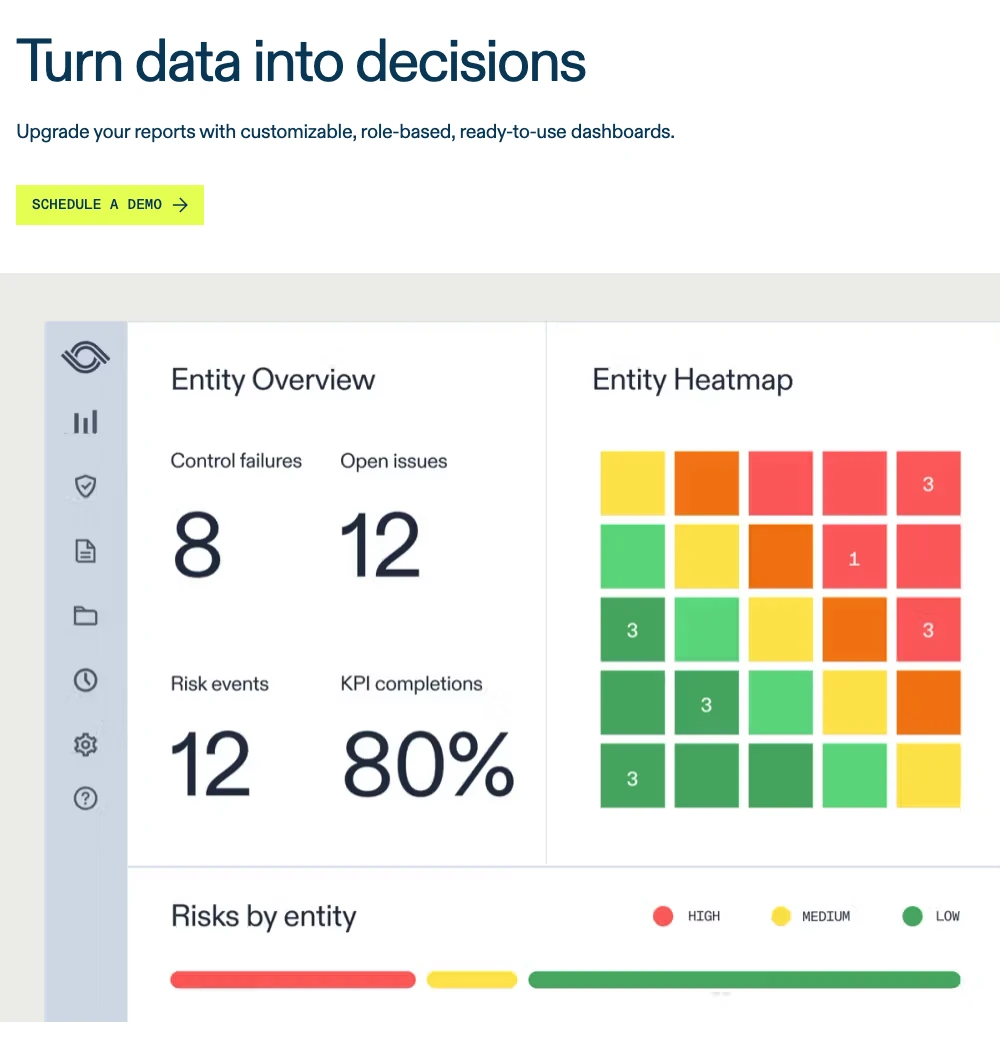
Use one finding to test the proposed product combination. Trace it from an audit workpaper to the control owner, remediation action and enterprise risk report. Then change a business-unit user’s permissions and inspect both the dashboard and the exported data.
Optro documents row-level reporting security and custom roles. Your proposal still needs to specify the product combination, which user categories can work across it, and who configures that access. The names SOX Management and Controls Management do not prove either separate mandatory purchases or one bundled licence.
Decision to resolve: can the quoted products preserve one set of owners, controls and issues across your audit, finance and risk teams? See the Optro profile for its current identity and broader software comparison.
LogicGate: configure workflows your GRC team will maintain
LogicGate Risk Cloud belongs on the shortlist when your team needs to adapt risk, controls and assurance workflows to its own processes. Its Application model makes the operating question explicit: which workflows will you configure, and which Power Users will maintain them?
Have the proposed administrator change an assessment field, approval step and report during the demo. Then test record-level access using existing records as well as newly created ones. LogicGate’s User Group documentation warns that existing records need group assignment before access enforcement; unassigned records can become invisible. That is a migration and configuration task to plan before launch.
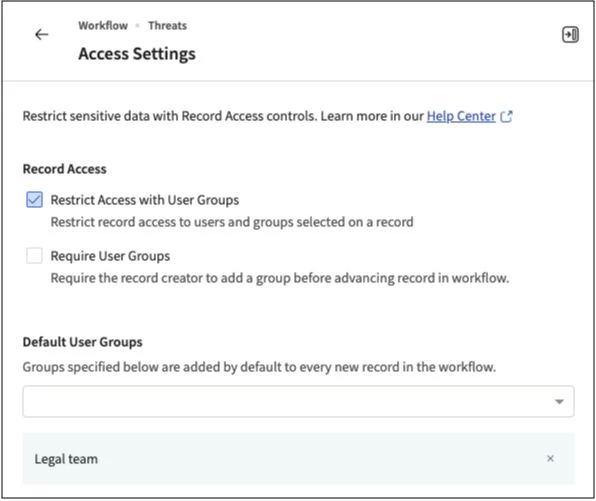
Its published pricing model is unusually specific about purchase dimensions: Applications and Power Users are paid, while Standard and External user licences are included at no additional cost. Those user types have different rights. Additional solution components remain commercial scope, and no numeric rate was established.
Decision to resolve: do you have an administrator who can own the configured program after implementation? LogicGate’s services description states that each published implementation option covers one Application. Price the full Application combination, migration and training rather than extrapolating one deployment package to the entire program.
Riskonnect: join enterprise risk, compliance and internal controls
Riskonnect is a useful candidate when enterprise risk oversight leads the purchase and compliance or internal controls need to use the same program data. Its ERM page describes risk hierarchies by business unit, location or category; its controls product connects risk-control-process mappings with testing, evidence, reviews and sign-off.
Choose one risk that appears in two parts of the organization. Show the local assessments, enterprise report and linked control failure without silently treating both assessments as independent risks. Follow the issue into remediation and demonstrate who can see or change each record.
Riskonnect’s current platform page describes configurable workflows, forms, dashboards and data access controls. Test the actual permission model, including exports and integrations, rather than accepting a dashboard filter as proof of data isolation.
Decision to resolve: which modules and implementation option cover your program? The ERM FAQ says buyers can purchase needed modules and expand later, and describes three implementation options. It does not settle your included services, migration effort or future module price. Get those terms in the proposal.
MetricStream: report across a regulated group's organizational structure
MetricStream is a strong shortlist when the organization itself is a difficult part of the GRC model: multiple legal entities, business units, jurisdictions and control-owner groups. Its enterprise risk documentation describes a federated, centralized data model, while its SOX documentation describes multi-dimensional organization structures and enterprise roll-up.
Define the hierarchy before viewing dashboards. Bring two legal entities, one shared process and a control with different local owners. Ask the vendor to preserve local accountability while consolidating management reporting. Include a local exception so the demonstration cannot rely on every subsidiary following an identical template.
MetricStream names regulatory compliance, regulatory change, internal audit and SOX products. Name the jurisdictions and obligations your program must cover, and distinguish the workflow from regulatory-content subscriptions. A portfolio diagram does not establish what content, products or services are included.
Decision to resolve: can the proposed model represent your actual group and remain maintainable when an entity, control owner or reporting requirement changes? Require a written delivery plan with the data, configuration, testing and post-launch responsibilities assigned. This review did not establish a specific implementation package.
Archer: evaluate the next step for an existing Archer program
Archer is most relevant here when an existing Archer deployment shapes the purchase. The current site markets Evolv risk and regulatory-compliance offerings alongside the Archer system of record. Evaluate the precise proposed combination rather than treating legacy Archer GRC use cases and current Evolv products as interchangeable.
The versioned documentation offers a useful procurement check. In the Archer 6.9 policy-program design, company, division and business-unit applications belong to Enterprise Catalog. Certain reports depend on Issues Management, Key Indicator Management or a use case containing the Risks application. Documentation names those dependencies explicitly.
That does not establish current Evolv licence inclusion. Ask the vendor to reproduce the required report in the proposed deployment and identify its product and use-case dependencies in writing. For an existing customer, include migration, custom applications and integrations in that demonstration.
Decision to resolve: what is retained, replaced or added in this proposal, and which version and deployment support each requirement? Internal audit is documented in the 2024.03 Audit Planning & Quality use case; a current SOX-specific purchase boundary was not established in this review.
Enterprise GRC or enterprise SOC 2 automation?
Choose enterprise GRC when the core job is organizing business risks, control ownership, regulatory obligations and assurance work across the organization. Choose SOC 2 automation when the core job is collecting security evidence, monitoring mapped controls and managing the audit preparation process.
Company size does not settle that choice. A large software company can have a focused SOC 2 requirement; a smaller regulated group can need complex risk and legal-entity reporting. Specify the records, people and decisions the system must support.
You may need both. In that case, designate the owner of each risk, control, test result and issue, and demonstrate how updates move between systems. Compare a joined workflow with the cost of maintaining the connection. Our enterprise SOC 2 software comparison covers the security-compliance buying task; it should not replace a business-wide risk evaluation. To see the full set of SOC 2 platforms, compare SOC 2 compliance software.
Implementation: who does the work after the demo?
A working sales demonstration does not establish who will import your data, configure permissions or maintain the program. The operating scope below gives you a starting point for the statement of work.
| Platform | Organization / administration | Implementation | Licensing |
|---|---|---|---|
| ServiceNow Integrated Risk Management | Scope: GRC entities Administration: Risk Management roles | Implementation: Expert Services | Licensing: IRM applications |
| Optro | Scope: Compliance Management Administration: Platform security | Implementation: Optro Success and Services | Licensing: Audit, controls, risk and compliance products |
| LogicGate | Scope: Internal Audit Management Administration: Permission Sets; User Groups | Implementation: Implementation services | Licensing: Applications; Power Users |
| Riskonnect | Scope: Enterprise Risk Management Administration: Platform Technology | Implementation: Implementation options | Licensing: Selected Riskonnect modules |
| MetricStream | Scope: SOX Compliance Management Administration: SOX Compliance Management | Implementation: Not established. | Licensing: Connected GRC products |
| Archer | Scope: Enterprise Catalog Administration: Policy Program Management access roles | Implementation: Not established. | Licensing: Policy Program Management; Issues Management; Enterprise Catalog |
Assign an accountable owner for the risk taxonomy and organizational model; the control library and framework mappings; permissions and external access; migration and integrations; and ongoing workflow changes. Identify the buyer, vendor or partner responsible for each deliverable, plus the evidence that makes it accepted.
For migration, use a sample containing duplicates, obsolete controls, missing owners and a closed issue with history. Require reconciliation of record counts and relationships after import. A successful upload is not enough if the new system loses ownership or the audit trail.
For maintenance, ask your intended administrator to make the next business change. Add a subsidiary, change a control owner and adjust a report. Record the steps, permissions, training and vendor assistance required. That exercise helps you compare operating effort without relying on an unsupported “easy to use” score or a universal implementation timeline.
Compare enterprise GRC quotes on the same scope
No comparable numeric price was established for this shortlist. A generic annual range would hide differences in Applications, modules, users, entities, deployment, content and services. Use the public pricing model where one is documented, then request an equivalent-scope proposal from each finalist.
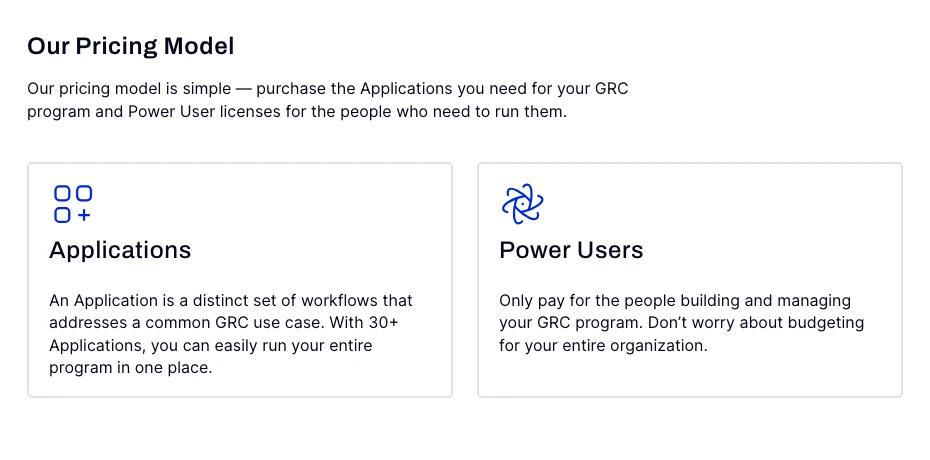
Ask each vendor to return the same schedule:
- Software: product and edition, modules or Applications, role-based user counts, entities or instances, environments, reporting and AI rights.
- Connections and content: integrations, API access, middleware, regulatory feeds and external risk-intelligence subscriptions.
- Delivery: configuration, migration, validation, training and any buyer or partner work excluded from the services fee.
- Three-year operation and exit: support, renewal basis, growth assumptions, recurring administration, exports, retention and termination assistance.
Calculate three-year cost from those items, using explicit assumptions for added entities, users and workflows. Separate one-time services from recurring charges and internal staff effort. Leave a missing quote item unresolved; do not enter zero and let the spreadsheet make an incomplete proposal look cheaper.
Enterprise GRC demo worksheet
Use the same scenarios with every finalist. Bring representative records and your intended roles; include an exception, a failed test and a restricted user. The goal is to retain evidence of the workflow and its commercial scope, rather than score a prepared presentation.
| Scenario / requirement | Demonstration and evidence | Quote, owner and cost questions |
|---|---|---|
| Group rollup and permissions Consolidate two subsidiaries while preserving local ownership and access boundaries. | Demonstrate: Create two business units with different risk scores. Roll them into a group report, then sign in as a local owner and a group reviewer to show who can see and change each record. Acceptable evidence: A saved group report, the underlying calculation, and a permission matrix tested with both roles. | Which product and edition cover entity hierarchies and reporting? Who configures the rollup and permissions, and do additional entities or reviewer roles change the quote? |
| Shared controls and local exceptions Reuse a shared control without hiding a subsidiary exception or overdue remediation. | Demonstrate: Map one control to two obligations and two business units. Fail the control in one unit, assign remediation, approve an exception, and show the effect on both local and group reporting. Acceptable evidence: Control mappings, an exception approval trail, and a remediation record with an owner and due date. | Are control mapping, exceptions, and remediation in the same quoted module? Who maintains mappings, and what services or content subscriptions cost extra? |
| Internal audit finding lifecycle Trace an audit finding from fieldwork through management action and independent closure. | Demonstrate: Open an audit workpaper, record a finding, assign a management action, reject an incomplete response, and have an auditor verify closure while retaining the original evidence. Acceptable evidence: A workpaper-to-finding link, version history, management response, and independent closure approval. | Which internal-audit product is required? Who owns templates and migration, and are auditor, manager, and occasional responder roles licensed differently? |
| SOX tester and reviewer separation Separate control testing from review and retain evidence for a repeat test. | Demonstrate: Assign a test to one user and review to another. Attempt self-approval, reject a test, retest the control, and export the evidence and sign-off history. Acceptable evidence: Role restrictions, retained test versions, a dated reviewer sign-off, and a usable evidence export. | Is SOX testing included or separately licensed? Who configures segregation of duties, and what do external reviewer access and recurring testing support add to cost? |
| Supplier risk to enterprise risk Connect a material supplier issue to an enterprise risk and its accountable owner. | Demonstrate: Record a critical supplier assessment, identify an issue, connect it to an enterprise risk, escalate it, and show how residual risk and management reporting change. Acceptable evidence: Linked supplier and risk records, escalation history, and the updated risk calculation and report. | Which supplier-risk and enterprise-risk modules or integrations are needed? Who owns the data connection, and are supplier counts, assessments, or external feeds charged separately? |
| Regulatory change trace Trace a changed obligation through affected policies, controls, and accountable approvals. | Demonstrate: Introduce a changed obligation, identify affected controls and policies, assign an impact review, approve the updates, and show which business units still need action. Acceptable evidence: The original and revised obligation, impact links, approval history, and an unresolved-action report. | Is regulatory content supplied, imported, or maintained by your team? Who validates the mapping, and which content feeds, workflow modules, and services sit outside the quote? |
| Administrator changes and imports Let the nominated administrator change a workflow and import records with controlled validation. | Demonstrate: Have your administrator rename a step to "Finance review", add an approval condition, and import records containing a duplicate and a missing owner. Show validation, change history, and recovery. Acceptable evidence: A recorded administrator session, rejected import rows with reasons, and a recoverable configuration version. | Can your team perform these changes in the quoted edition? Who owns configuration and support, and which changes require paid vendor or partner services? |
| Equivalent-scope three-year cost and exit Compare the same modules, roles, entities, services, and contract term, then prove a usable exit. | Demonstrate: Price a shared three-year scope for every shortlisted vendor. Itemize setup and recurring charges, then model one additional entity. Export related records, attachments, and history for reuse outside the platform. Acceptable evidence: An itemized three-year proposal with assumptions and renewal terms, plus sample exports that preserve record relationships and attachments. | Who owns implementation and data extraction? What are the license, integration, content, storage, services, renewal, and exit charges, and which costs remain unquoted? |
Download the editable CSV worksheet. Add one copy per vendor and record product, edition, configuration owner, demo result, services cost and license cost. Blank costs mean unquoted, not zero.
Mark each result as demonstrated, configuration required, additional purchase, not demonstrated or out of scope. Name the proposed product and edition, the person responsible for configuration, and any licence or services cost. Treat a promise of future availability as an unresolved requirement until you have an acceptable delivery commitment.
Start with the scenarios that could eliminate a candidate. If subsidiary permissions or SOX review boundaries are mandatory, establish those before spending time on dashboard styling. Then agree a proof-of-concept scope, acceptance evidence and implementation statement of work with the remaining finalists.
How we selected and checked these platforms
We reviewed current official product pages, documentation, pricing descriptions and services materials on October 1, 2026. The shortlist requires sourced risk assessment, control or compliance ownership, management reporting, organizational scope and administration. Recommendations reflect those documented workflows and the buying tasks above. We did not run hands-on product tests, obtain contract quotes or measure implementation performance.
Source links and check dates accompany the comparison. A named product establishes documented or marketed scope, not inclusion in a particular purchase. ServiceNow’s current package entitlements remained unverified; its cited entity model is documented for Zurich and needs confirmation against your proposed release. Archer’s cited use-case documents are versioned. Reconfirm LogicGate’s published September 2025 implementation terms in the proposal. Unknowns remain visible so buyers can resolve them in the demo and proposal.
This is a focused shortlist, not a complete market inventory. No paid placement determines these recommendations. Recheck product names, entitlements, content coverage and services terms before signing; those can change between a public page and your contract.
More in Compliance Tools