 Menu
Menu

On this page
Building a security operations center is the process of defining a centralized security function that monitors, detects, analyzes, and responds to threats across an organization’s environment, with people, process, and technology aligned to a documented operating model. For SOC 2 purposes, that function matters because auditors care about whether monitoring, incident handling, and escalation are designed and operated consistently, not whether you have a flashy room full of screens. The advice to start by buying tools or leasing a command center is backwards. Start with the evidence you need to produce under the AICPA Trust Services Criteria, then build the operating model that can support it.
Deciding Whether You Need a Physical SOC
A physical command center is optional more often than vendors admit. What matters for SOC 2 is not whether analysts sit under one roof, it’s whether your team can monitor, triage, escalate, and evidence response in a way that matches your system boundary and control design. MITRE’s guidance notes that, with the exception of a virtual SOC, a physical operations floor will be needed, but modern operating guidance puts much more weight on log collection, SIEM, orchestration, and continuous monitoring than on facility design. That gap is real, and it’s where a lot of buyers waste time.
Practical rule: choose the operating model that makes your evidence cleaner, not the one that looks more impressive in a sales deck.
Physical, virtual, and hybrid each solve different problems
A physical SOC helps when you need tight coordination, sensitive access controls, or a heavily staffed 24/7 environment. A virtual SOC fits distributed teams, cloud-first environments, and companies that can prove coverage through tooling and ticketed response rather than desks and wallboards. A hybrid SOC often lands in the middle, with a core on-site team and remote analysts filling coverage gaps.
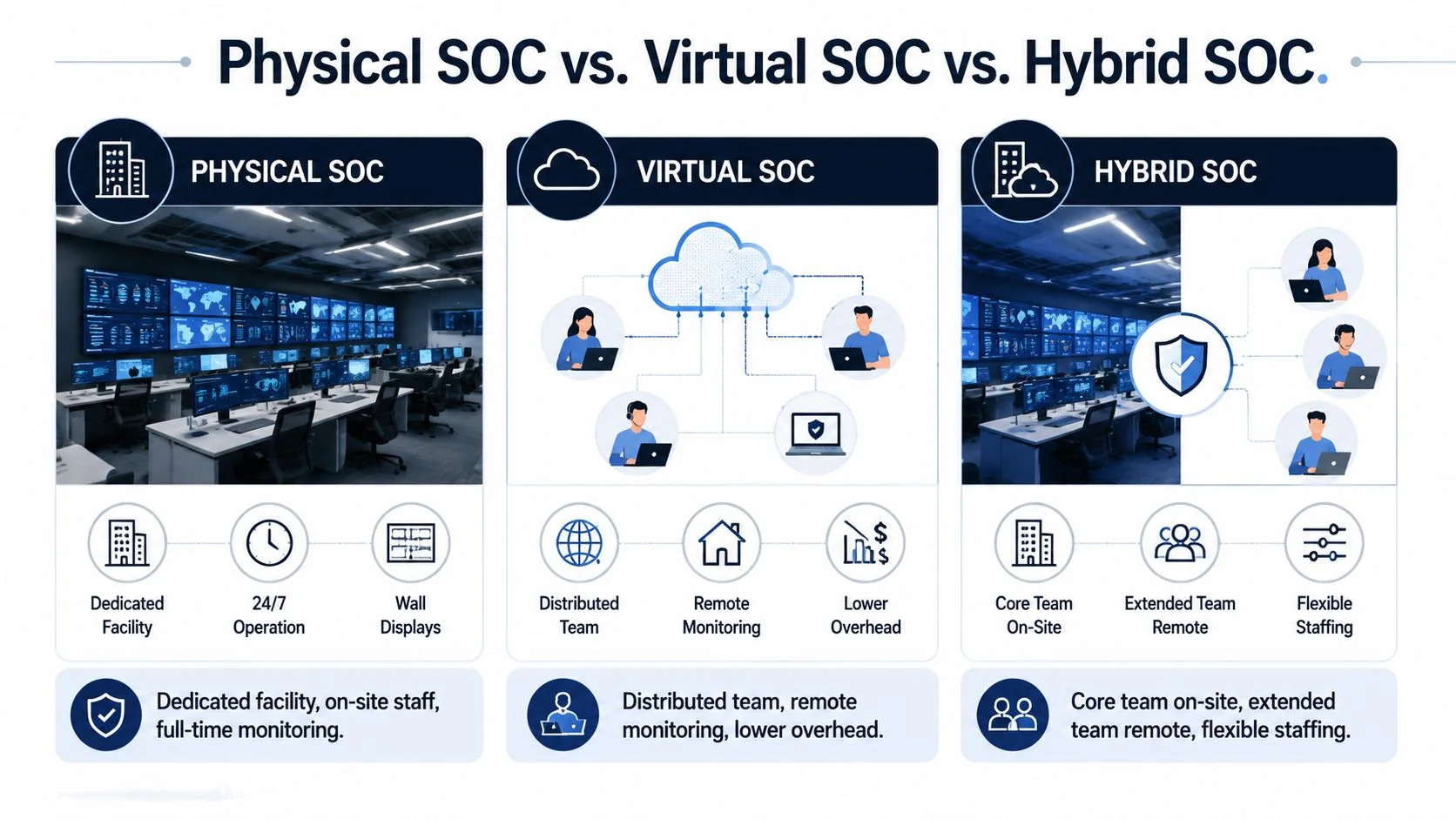
For SOC 2, the better model is usually the one that produces a clear audit trail. If your responders are remote, that’s fine, as long as your tooling shows who saw the alert, what they checked, when they escalated, and how the incident was closed. Auditors test process evidence, not floor plans.
A decision framework that avoids unnecessary overhead
Use three questions. First, does your environment require on-site access to systems or data that can’t be monitored remotely? Second, can your current staffing realistically support the hours you claim without creating single points of failure? Third, will a physical room improve evidence quality enough to justify the cost and operational drag?
Distributed SaaS teams usually get more value from remote collaboration, follow-the-sun coverage, and documented handoffs than from a fixed operations floor. If your environment is mostly cloud, the burden is on you to justify why a room adds control value rather than overhead. For a SOC 2 readiness timeline, that matters because you can move faster with a lean virtual model when your evidence path is simple and well documented.
Scoping the SOC to Your SOC 2 System Boundary
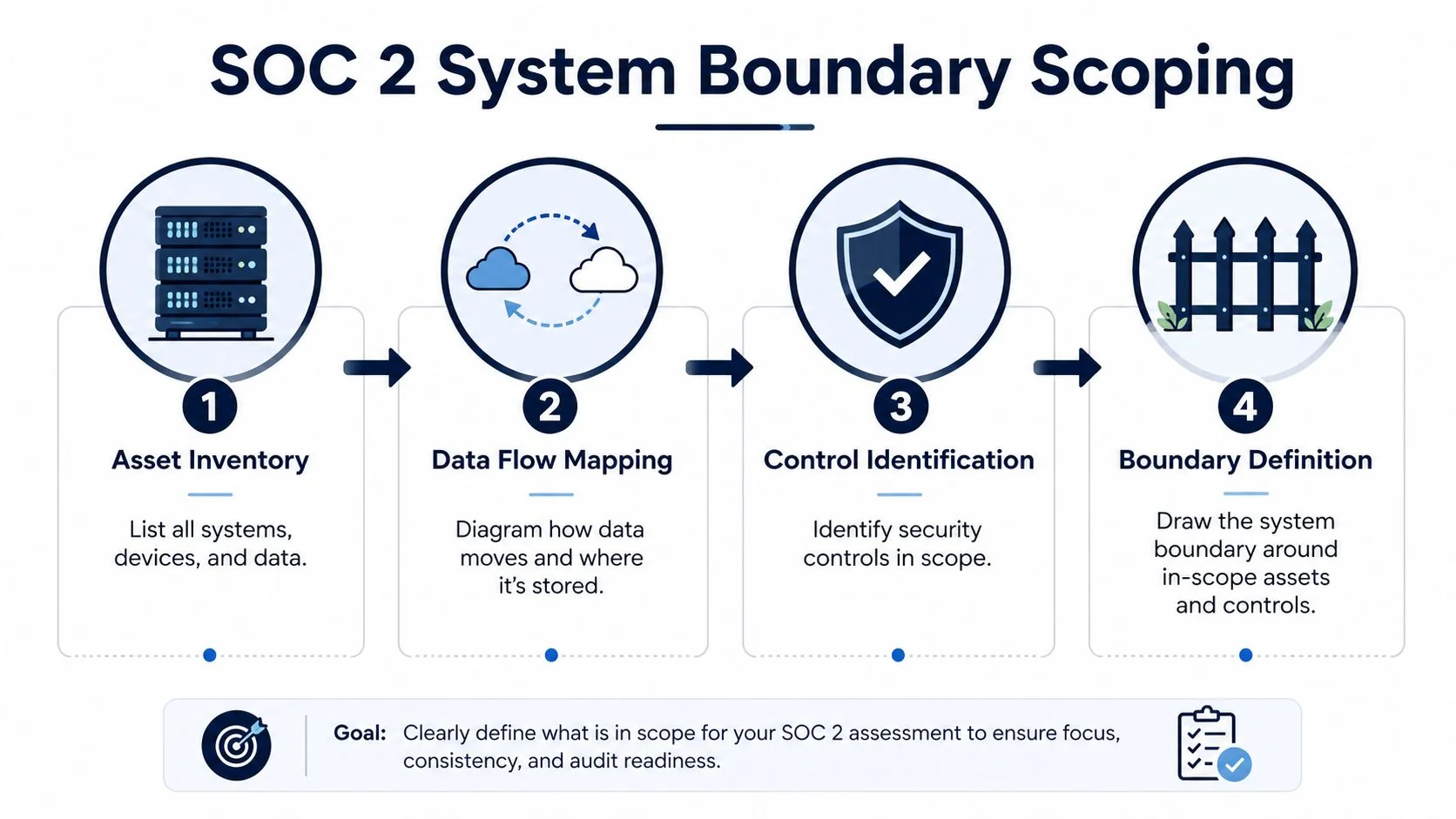
A SOC that tries to monitor everything produces noise, not evidence. The strongest SOC 2 scopes start with the company’s actual system boundary, then decide which assets, data flows, and tools belong in the monitoring program. Government and industry guidance says to identify the organizational assets, systems, and data that are most valuable or sensitive, then define what the SOC will and won’t monitor. That narrowness is a feature, not a weakness.
Start with inventory, not tooling
Inventory the assets first. Include production systems, identities, logging sources, cloud accounts, and the data stores that support customer-facing services. Then map data flows so you can see where logs originate, where they are stored, and which third parties touch them.
That order matters because SOC 2 evidence should match the boundary you operate. If an integration sits outside the trust-services scope, don’t let it pollute the core monitoring plan on day one. If a SaaS startup has cloud infrastructure, the minimum useful scope is usually production identity, application logs, cloud control-plane logs, and the systems that change or store customer data.
Decide what to exclude on purpose
Exclusion is where teams usually get nervous, but a defined exclusion list is stronger than an aspirational claim to monitor everything. Keep the initial log onboarding tight. Pick only the minimum critical data sources, then expand once the team can operate them without drowning in noise.
Audit reality: a narrow, documented boundary is easier to test than a vague promise that “everything is monitored.”
Current-state and target-state diagrams are useful here because they give auditors something concrete to review. Group-IB’s approach of mapping stakeholders and drawing current and future diagrams is especially practical.
Sizing Your Team Around Alert Volume and Automation
Staffing is where most SOC builds break. One SOC survey found that 27% of SOCs receive more than 1 million alerts per day, the average security analyst investigates 20 to 25 incidents daily, and a single case can take 13 to 18 minutes just to compare indicators of compromise against logs and threat intelligence, according to the source cited in the brief security operations center workload study. The same source says manual research can produce false-positive rates of 70% or higher, and 66% of cybersecurity professionals believe there are too few qualified analysts to handle the alert volume. In plain terms, headcount alone doesn’t fix the problem.
Design for coverage, not heroics
The first staffing mistake is assuming one analyst can do everything. The second is assuming a senior analyst can compensate for weak automation forever. SANS identified the biggest barriers to SOC excellence as lack of skilled staff (58%) and insufficient orchestration and automation (50%), which lines up with what happens on the floor. Analysts burn out when the team treats every alert as a manual investigation.
A workable model separates responsibilities:
- Tier 1 monitoring: watch queues, validate obvious noise, and escalate quickly.
- Tier 2 analysis: confirm incidents, correlate sources, and handle deeper investigation.
- Detection engineering: tune rules, reduce false positives, and improve visibility over time.
For SOC 2, this role separation matters because auditors want to see that continuous monitoring is not dependent on one person remembering how to handle a Friday-night alert. They test whether the process exists, whether the right people can follow it, and whether the evidence shows a consistent handoff from triage to response.
Hire for impact, not just coverage
If the budget is tight, put money into detection engineering and a clean Tier 1 process before expanding headcount. Outsourcing Tier 1 to an MSSP can make sense when your internal team is small, but only if escalation ownership is clear and the service boundary is written down. The point is not to buy labor in bulk. It is to create a repeatable triage path that feeds evidence into incident response and leaves an audit trail auditors can test.
If you are actively building the team, SOC engineer hiring has become a competitive market. The best candidates are not just alert readers. They understand tooling, escalation, and how to keep response actions auditable. That matters because SOC 2 reviewers look for people who can explain why an alert was closed, escalated, or contained, then point to the record that supports it.
The startup SOC 2 compliance tips guide is useful if you are still deciding how much logging you can support in year one versus year two. It gives a practical view of how logging and monitoring controls usually grow, and that helps you match staffing to the evidence you can sustain instead of promising a control set the team cannot operate.
Writing Playbooks That Auditors Actually Accept
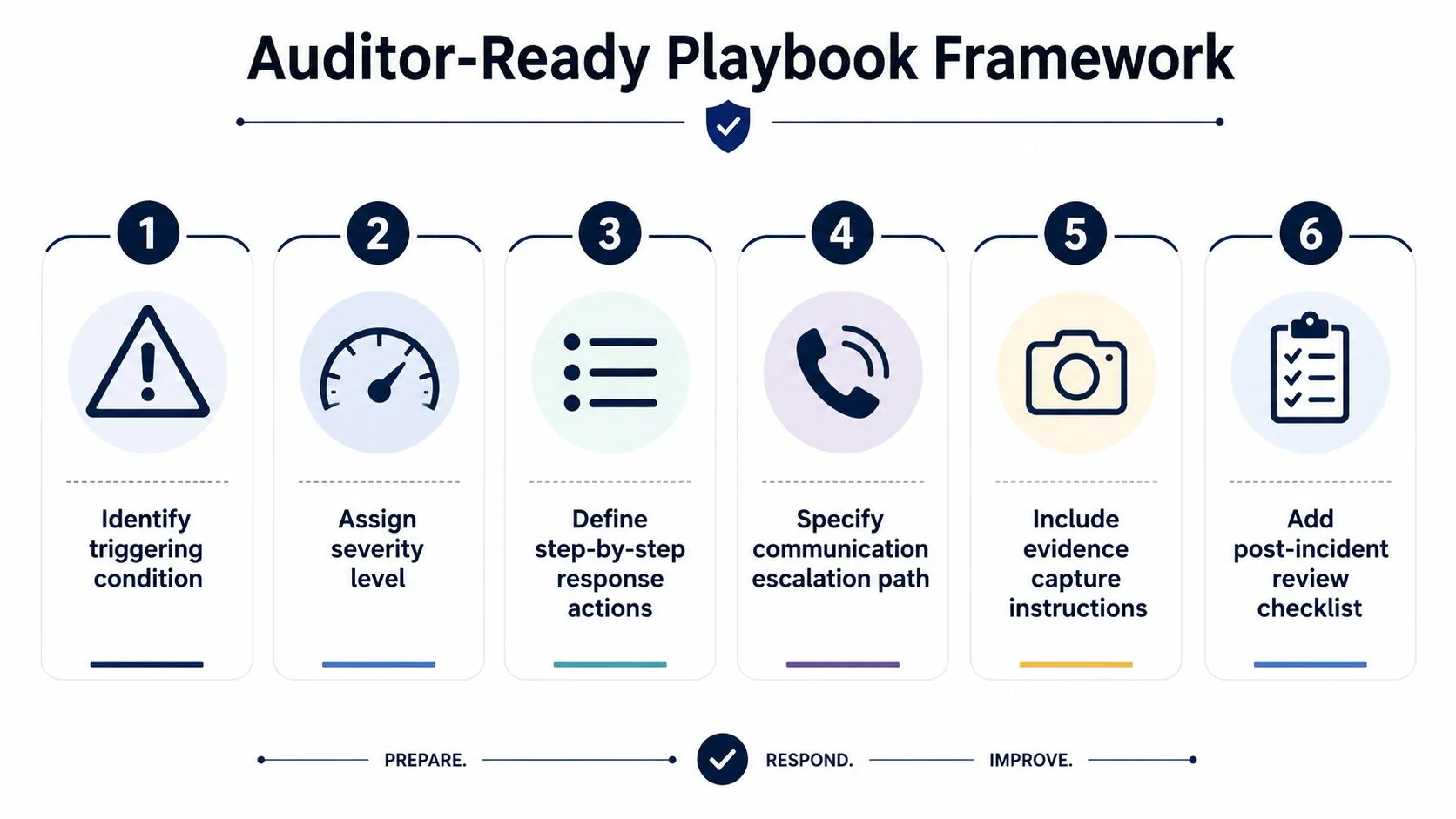
Auditors don’t give points for having an incident response document that no one uses. They test whether your team follows documented procedures consistently, and whether those procedures match the tools you operate. ISACA recommends building standard operating procedures around the implemented tools, and NordLayer’s guidance on a policy library aligns with that approach. The right playbook is short, specific, and easy to execute under pressure.
Use a trigger-check-decision-action structure
A good playbook starts with the alert condition, then forces the analyst through a predictable sequence. Group-IB recommends one-page workflows with trigger, analyst checks, decision point, and response action. That format is practical because it’s fast to follow and easy to test during an audit.
Build the first playbooks for the alert types that would most affect customer trust, for example:
- Phishing reports: identify trigger, verify sender and payload, isolate affected mailbox if needed, and log the evidence.
- Suspicious endpoint behavior: confirm device identity, review process history, decide whether to contain, then capture supporting artifacts.
- Privilege escalation events: validate whether the change was approved, check for out-of-band activity, and record escalation steps.
Each one should say who approves containment, who notifies leadership, and where evidence gets stored. That’s what turns an incident process into an auditable control.
Make the playbook library part of governance
A SOC 2 auditor will usually want to see more than the document. They’ll want version control, ownership, and proof that the team used the playbook during the audit period. Keep a policy library with incident response plans, secure communication protocols, and role duties written clearly. If a playbook is used once and then forgotten, it won’t carry much weight.
Selecting Tools That Produce Audit-Ready Evidence
Tool selection should be driven by evidence gaps, not by a vendor’s feature matrix. A SOC needs meaningful data from sensors and logs generated by applications, operating systems, networks, cloud platforms, and, where relevant, ICS or OT systems. ISACA also lists endpoint protection, firewalls, SIEM, malware protection, security monitoring tools, and patch management as core technologies that must tie back to procedures. The order matters. Central log collection comes before advanced analytics.
| Tool Category | SOC 2 Evidence Produced | Implementation Priority |
|---|---|---|
| Log collection and normalization | Shows what was captured, from where, and when | First |
| SIEM | Demonstrates correlation, alerting, and retention of security events | First |
| Endpoint protection | Shows endpoint monitoring, detection, and response actions | First |
| SOAR | Shows workflow automation, approvals, and response consistency | Second |
| Threat intelligence enrichment | Shows context used during investigation | Second |
| Advanced analytics | Shows maturity in detection and investigation | Later |
Pick tools that close specific gaps
If you lack visibility, start with log collection and SIEM. If response is slow or inconsistent, add SOAR after your playbooks are stable. If endpoint coverage is thin, endpoint protection should come before advanced analytics. The mistake is buying more tooling before deciding what evidence you want to produce.
A useful rule is to treat each tool as an evidence generator. SIEM creates searchable records. SOAR creates workflow history. Endpoint protection creates containment proof. If a tool doesn’t strengthen your audit trail, it’s not a priority.
Avoid overbuilding the stack too early
Independent guidance from UST and ISACA points to a sequence that starts with log collection, data management, KPI definition, and playbooks, then moves into tools and staffing structure. That sequence is boring, but it works. Over-investing in technology before defining outcomes usually gives you a larger, noisier environment and weaker proof of control operation.
If you’re comparing vendors, it helps to see how platforms behave in practice. You can find out how Vanta performs as one benchmark, but the key test is whether the platform helps your team show that monitoring and response were performed as required.
Proving Operational Effectiveness Through Metrics and SLAs
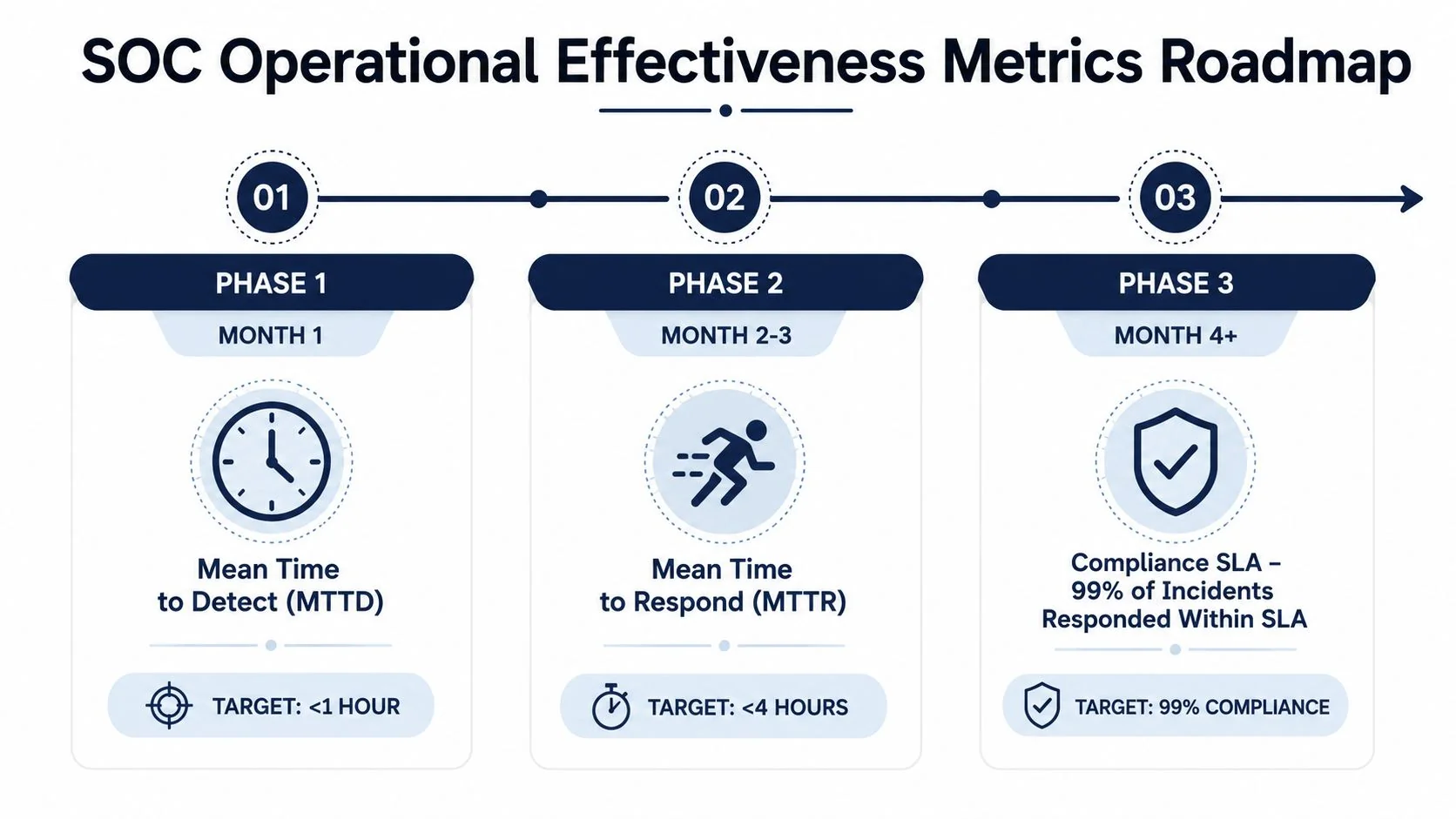
Type 2 readiness rises or falls on evidence over time. A SOC can look solid in a kickoff meeting and still fail an audit if it cannot show steady operation across the review period. The metrics that matter are the ones tied directly to incident handling, such as mean time to detect, mean time to respond, and alert-to-incident conversion. Vanity dashboards do not help. Neither does a wall of green checkmarks without context.
Set SLAs that match the team you have
Start with a small number of response commitments. The roadmap above gives a useful shape for maturity, but do not turn it into theater. Auditors want evidence that alerts were acknowledged, investigated, and resolved within the time you said they would be. Your SLA has to match staffing, tooling, and escalation paths, or the control will look neat on paper and weak in practice.
A good dashboard is simple. It shows alert volume, triage backlog, escalations, containment actions, and closed incidents. It also shows whether incidents were handled within policy, not just whether they were handled eventually. That matters because reviewers test consistency, not good intentions.
If the team cannot explain a missed SLA without opening three systems, the evidence design is too weak.
Tie metrics to budget and audit timing
A phased budget works better than a giant all-at-once purchase. Build logging and triage first, then add automation and more advanced correlation once the team proves it can sustain the basics. That approach lines up with maturity assessments that translate business goals into target operating models, which is the base for staffing and tooling decisions.
For a SOC 2 Type 2 audit, the question is simple. Can you prove that monitoring and response operated as designed throughout the review period? If the answer is yes, your metrics, SLAs, and playbooks did their job.
One more practical benchmark comes from the support world: operational metrics only matter when they show repeatable service quality over time, not just activity.
Building a security operations center for SOC 2 is less about buying a fortress and more about building proof. Define the boundary, pick the operating model, scope the logs, staff for reality, write playbooks people will use, and choose tools that generate evidence instead of noise. If you are preparing for a SOC 2 audit, use SOC2Auditors to compare firms, match your timeline to the right auditor, and make sure your SOC design can stand up to the controls, samples, and interviews that will follow.
More in Audit Preparation