 Menu
Menu

On this page
- Introduction to Red Team Assessment
- Objectives Scope and Threat Models
- Comparison with Penetration Testing and Team Operations
- Red Team Methodology and Phases
- Success Metrics and Reporting Practices
- Timelines Costs and Operational Considerations
- Buyer Preparation Checklist and Provider Selection
- Conclusion and SOC 2 Audit Readiness
The red teaming market reached USD 1.8 billion in 2025 and is projected to grow at a 14.2% CAGR through 2030, reaching an estimated USD 3.5 billion . For SOC 2 programs, that growth reflects a shift from occasional adversarial testing to routine validation of whether controls operate as intended under pressure.
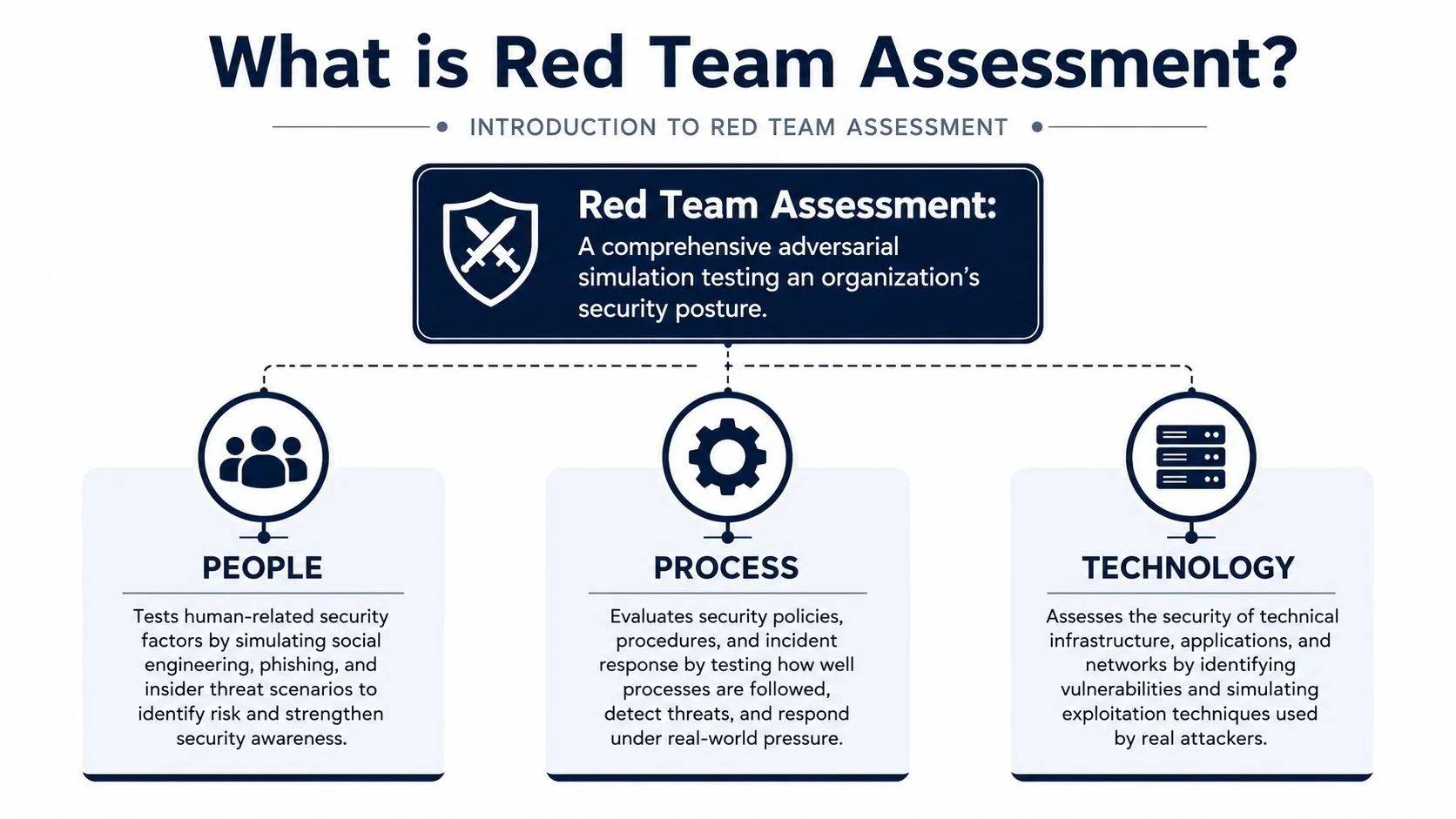
A red team assessment is an adversarial simulation that tests an organization’s security posture across people, processes, and technology. In a SOC 2 context, that matters because auditors care less about whether controls exist on paper and more about whether they operate effectively when someone actively tries to bypass them.
Introduction to Red Team Assessment
A red team assessment should produce evidence an auditor can use, not just a narrative about a failed attack path. For SOC 2, that matters because the Trust Services Criteria, especially CC7, look for how a company detects, responds to, and learns from security events in real operating conditions. A well-run assessment shows whether monitoring catches suspicious behavior, whether escalation works, and whether remediation closes the gap that was exposed.
A red team assessment is an adversarial simulation of network infrastructure, applications, procedures, and the human factor. It is useful in SOC 2 programs because it tests whether controls work under pressure, not just whether they are documented. The strongest evidence usually comes from artifacts such as alert logs, incident tickets, escalation records, after-action notes, and proof that remediation was validated after the exercise.
Practical rule: If the exercise cannot produce auditor-ready evidence, it is incomplete for SOC 2 purposes.
The value is practical. Red team findings show where detection, response, and escalation paths break down, which helps teams close gaps before fieldwork or a surveillance review. For Type 1 readiness, the assessment supports control design and implementation. For Type 2, it can also support operating effectiveness by showing that the team identified the issue, remediated it, and verified the fix held up in practice.
Objectives Scope and Threat Models
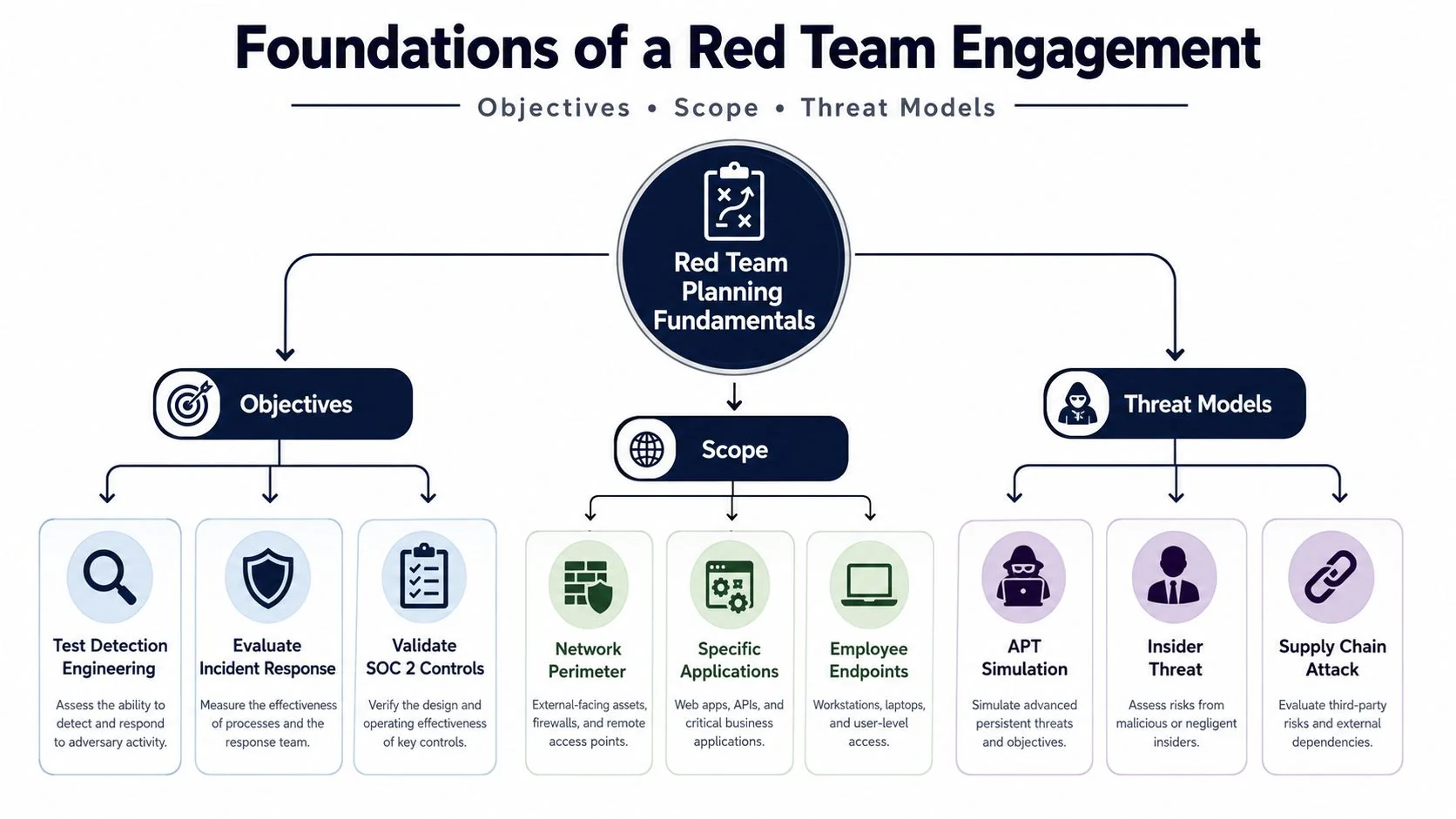
A useful red team assessment starts with a narrow question, not a broad wish list. For SOC 2, the cleanest objectives usually map to detection engineering, incident response, or control monitoring. If the goal is unclear, the exercise becomes hard to defend in an audit because the findings will not connect cleanly to the control environment.
Scope needs the same discipline. Red teaming should cover the parts of the environment that directly influence the outcome, including infrastructure, applications, procedures, and human factors. That can include cloud control planes, identity systems, third-party trust paths, and employee-facing workflows when they materially affect the Trust Services Criteria.
The threat model should match the business risk you care about. A commodity external attacker, a credential thief, a targeted intruder, or a supply-chain compromise each stresses different controls, so the test design should reflect the attacker profile, not a generic script. For SOC 2, that usually means tying the threat model to criteria in the Security category, then extending to Availability or Confidentiality when the system’s risk profile demands it. For teams that need a tighter testing boundary, understanding SOC 2 pentest scope helps separate what belongs in a penetration test from what belongs in a broader adversarial exercise.
A strong scope statement should say what is in bounds, what is out of bounds, what systems are protected from active exploitation, and what evidence must be retained. That boundary work matters to auditors because it shows the organization can authorize testing without undermining production stability or breaking change management controls. It also supports remediation validation, since the team can point to a defined test surface, confirm what changed, and retain proof that the fix held after retesting.
Comparison with Penetration Testing and Team Operations
A penetration test answers a different question from a red team assessment. Pen testing is usually vulnerability-focused, while a red team exercise is adversary-focused and tries to answer whether a skilled attacker could reach a business objective without being stopped. That distinction matters in SOC 2 because one report supports technical weakness remediation, while the other supports a higher-confidence view of detection and response.
Blue team work sits on the defensive side. Blue teams monitor, investigate, contain, and harden. Purple team work connects the two, because defenders and testers collaborate to tune detections and improve playbooks faster than they would through separate exercises alone. For SOC 2 programs, purple team activity often becomes the most efficient path to turning a red team finding into measurable improvement.
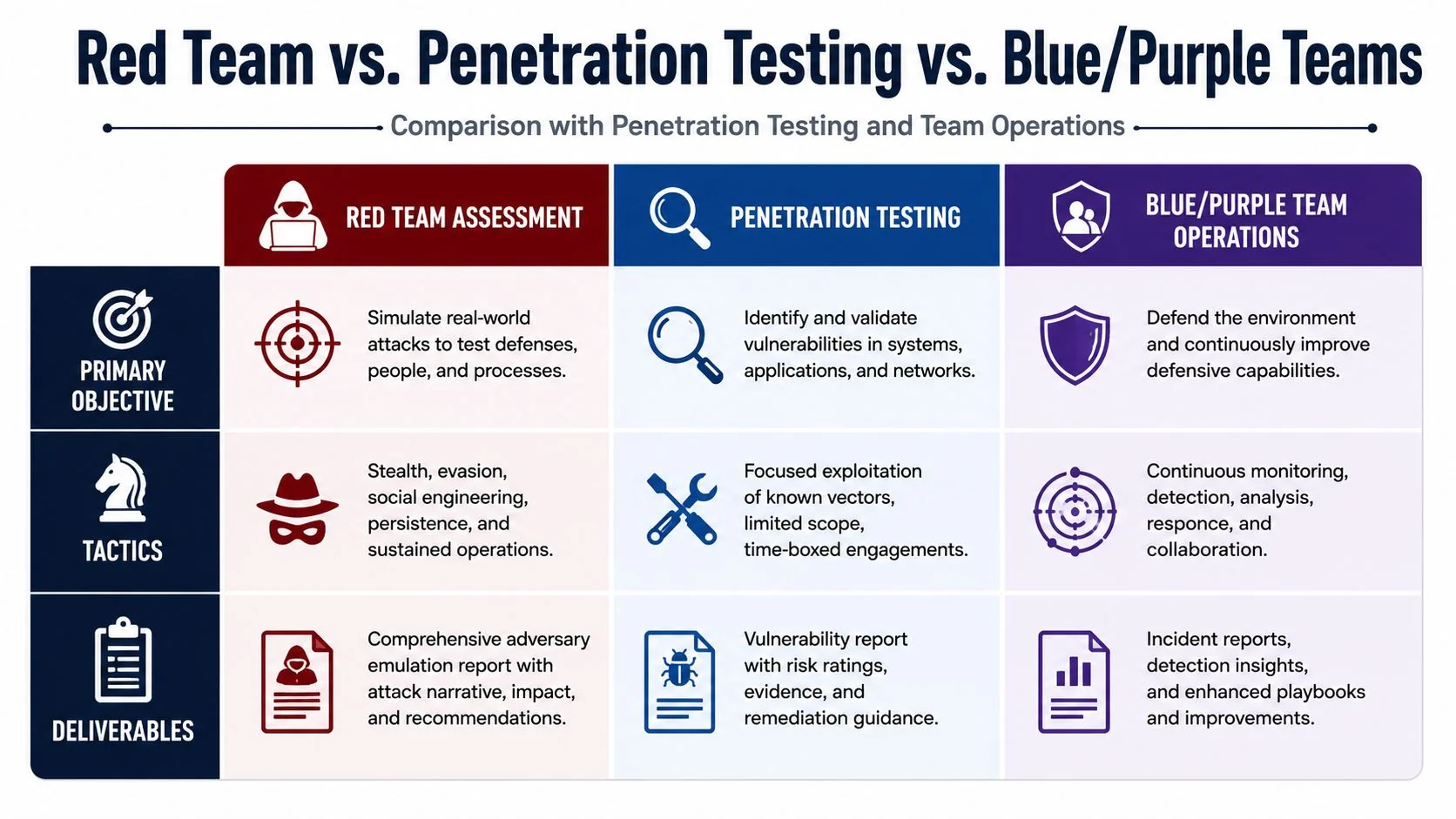
| Approach | Primary objective | Tactics | Deliverables |
|---|---|---|---|
| Red Team Assessment | Simulate real-world attacks to test defense | Stealth, evasion, sustained engagement | Adversary path, evidence, remediation backlog |
| Penetration Testing | Identify and exploit vulnerabilities | Focused exploitation | Vulnerability report, risk ranking, fixes |
| Blue or Purple Team Operations | Defend and improve detection | Monitoring, response, collaboration | Incident notes, tuned playbooks, detection updates |
For buyer due diligence, this also clarifies understanding SOC 2 pentest scope. If the objective is compliance evidence, the test should match the assurance need. A red team assessment gives stronger proof that monitoring and response operate under realistic attack pressure, while a standard pen test is better for validating exposed weaknesses and patch priorities.
Red Team Methodology and Phases
The red team lifecycle usually begins with defined scope and objectives, then moves through reconnaissance, vulnerability discovery, exploitation, maintaining presence, lateral movement, privilege escalation, and mission completion (SecureLayer7 red team assessment). For SOC 2, that sequence matters because each phase can produce evidence tied to control design, operating effectiveness, and remediation validation.
Planning and authorization
Planning isn’t paperwork overhead, it’s the audit trail that proves the test was authorized. The engagement should include the rules of engagement, escalation contacts, out-of-scope systems, production safety limits, and cleanup obligations. Those documents support the auditor’s expectation that the organization can test aggressively without losing control of its environment.
Execution and evidence
Reconnaissance usually starts with external intelligence gathering and attack surface review, then moves into test execution. The most useful evidence is not just that an attacker got in, but how they got in, what control failed, and which log source should have caught it sooner. I’ve seen teams produce far better audit evidence when they retain screenshots, timestamps, and log excerpts at each pivot point rather than waiting until the final report.
If the attack path can’t be reproduced from the evidence package, the remediation team will spend too much time guessing.
Reporting and validation
A technically strong report should map findings to MITRE ATT&CK and NIST control families, then turn each weakness into a concrete fix and a retest condition (red-team methodology planning guidance). That’s where SOC 2 value shows up. The report becomes a control-improvement artifact, not just a description of what went wrong.
A red team that stops at the debrief leaves the audit story incomplete. The better pattern is to validate the fix, document the retest, and preserve proof that the issue is closed in the remediation tracker.
Success Metrics and Reporting Practices
SOC 2 evidence is easier to defend when red team results are measurable and tied to control outcomes. A practical metric set includes time to detect, time to respond, and exploitation success rate. Those measures give auditors concrete evidence to review, and they give management a way to judge whether monitoring and response are improving over time.
A stronger scorecard goes a step further. A stealth metric can be defined as time undetected divided by total engagement time, while an objective coverage score can be measured as achieved objectives divided by planned objectives (CyberNX KPI templates). Those formulas separate a loud test that gets caught right away from a realistic engagement that stays active long enough to reveal a real detection gap.
| Metric | What it shows | Why SOC 2 teams care |
|---|---|---|
| Time to Detect | How quickly monitoring identified the activity | Evidence that alerting and escalation work |
| Time to Respond | How quickly the team contained the event | Evidence that incident response is functioning |
| Stealth / Evasion Success Rate | Whether the test behaved like a low-and-slow adversary | Evidence the simulation was realistic |
| Objective Coverage Score | Whether the exercise reached the intended attack paths | Evidence the test exercised meaningful risk |
For reporting, the useful standard is a report that can stand up in an audit file. Each finding should include a title or ID, risk rating, description, evidence, business impact, remediation recommendation, and references such as CVEs or MITRE ATT&CK technique IDs. Each finding should be traceable enough to be reviewed, challenged, and tracked to closure.
That format supports the SOC 2 evidence trail. It shows how a weakness was identified, how the team assessed its impact, what fix was assigned, and what proof confirmed the issue was closed in the remediation tracker.
Timelines Costs and Operational Considerations
A red team assessment has to fit the audit calendar and the budget, but the primary driver is usually scope discipline. Public benchmark ranges for this work vary, so the figures below should be treated as planning estimates, not fixed pricing. In practice, cost moves with scope breadth, environment complexity, and whether the team also handles remediation validation. A narrow engagement for one environment can usually be scheduled faster, while a broader cloud, identity, and supply-chain assessment needs more coordination and more legal review.
| Audit Type | Timeline Range | Cost Range |
|---|---|---|
| Type 1 readiness | Short planning window, then a focused exercise | Lower to mid-range engagement cost |
| Type 2 readiness | Longer cycle with testing plus retest | Mid-range to higher engagement cost |
| Expanded enterprise scope | Extended planning and execution | Higher-end engagement cost |
Note: Ranges are estimates based on market analysis and can vary significantly based on provider and engagement complexity.
A significant operational constraint is production risk. A red team should not create outages just to prove a point, so the rules of engagement need explicit safety language, especially for systems tied to customer data or core availability. In practice, that means writing down boundaries such as prohibiting denial-of-service (DoS) attacks or data exfiltration of sensitive customer PII, along with the authorization letters, liability coverage, and escalation paths that belong in the planning file rather than in an email thread.
Red team timing should line up with management review and audit fieldwork. If the exercise ends too late, remediation evidence will not be ready when the assessor asks for it. If it ends too early, the organization may have time to fix issues but not enough time to prove the fix held under retest. That timing matters for SOC 2 evidence because assessors usually want the finding, the ticket, the validation notes, and the retest result in the same control story. Teams preparing for that workflow often use a readiness process such as streamlining SOC 2 audit preparation to keep the evidence trail organized.
Buyer Preparation Checklist and Provider Selection
A buyer should treat provider selection as part of the control environment, not just procurement. Start by documenting the systems in scope, the security goals, the evidence retention plan, and the change management rules that govern how test activity is approved. If those basics aren’t clear, the engagement will drift, and the audit file will be harder to defend.
Use a practical checklist before signing anything:
- Scope Definition: Confirm which environments, identities, and third-party dependencies can be tested.
- Authorization Pack: Collect the written approvals, rules of engagement, and emergency contacts.
- Evidence Repository: Set up a place to store logs, screenshots, retest notes, and remediation tickets.
- Control Mapping: Ask how findings will be tied to the Trust Services Criteria and internal control IDs.
- Remediation Workflow: Require a path from finding to fix, then from fix to retest.
For vendor vetting, ask direct questions. Does the firm support evidence traceability? Do they provide report templates with individual finding IDs, business impact, and control references? Can they help with retesting after remediation? Are they comfortable working inside change windows and production constraints? If the answer to any of those is vague, the report probably won’t be audit-friendly.
The provider conversation should also fit broader readiness work. For teams that want a structured pre-audit motion, streamlining SOC 2 audit preparation depends on the same discipline, clean scope, mapped controls, and evidence that remediation was completed. One option in that workflow is SOC2Auditors, which helps companies compare auditor choices and readiness inputs, but the red team provider still has to deliver traceable security evidence.
Conclusion and SOC 2 Audit Readiness
A red team assessment strengthens SOC 2 readiness because it tests whether security controls work under realistic adversarial pressure, not just whether they exist in policy. The most valuable programs tie findings to Trust Services Criteria, map them to MITRE ATT&CK and NIST, and then prove remediation with a retest.
That evidence matters in both Type 1 and Type 2 audits. It shows control design, operational effectiveness, management review, and follow-through. It also reduces fieldwork delays because the assessor can review a complete trail, from authorization to attack path to closure.
Schedule red team work as a recurring control validation activity, not a one-off event. Track remediation deadlines, preserve the evidence package, and include the results in management review so the audit file tells a coherent story. If your team can show that a red team assessment drove better detection, tighter response, and closed gaps, you’re not just preparing for SOC 2, you’re building an audit-ready security program that can stand up to scrutiny.
More in Audit Preparation