 Menu
Menu

On this page
Treating network testing as solely an uptime exercise is too narrow for SOC 2. Network testing solutions are also evidence systems: they generate the records, reports, baselines, exception logs, and remediation trails auditors use to decide whether your controls operated over time. That framing matters because the market itself reflects how central this category has become. The global network performance testing market is projected to grow from $4.2 billion in 2025 to $7.8 billion by 2034 according to Market Intelo’s network performance testing market report.
A company pursuing SOC 2 doesn’t get much value from saying its network is “stable” or “secure.” Auditors want objective proof. They want to see whether management evaluated controls, whether issues were identified, whether findings were remediated, and whether performance and security controls held up across the observation period. That’s where disciplined network testing changes from an IT task into a compliance function.
Defining Network Testing for SOC 2 Compliance
Network testing solutions are the hardware, software, and service-based tools used to measure and validate network performance, security, and functionality across production and pre-production environments. In practice, that includes tools that test throughput, latency, packet handling, route behavior, protocol integrity, resilience under load, and exposure to security weaknesses.
For SOC 2, that definition needs one more layer. Network testing is a control validation activity. It gives you auditable evidence that your security and availability controls exist, operate as designed, and are reviewed when conditions change. If you’re preparing for a Type 2 report, this matters even more because you need evidence across the audit window, not just a clean point-in-time configuration.
What auditors care about
Auditors usually aren’t looking for a pile of screenshots from a monitoring dashboard. They’re looking for a coherent record that answers a few simple questions:
- Was the control defined: Did you establish what the network should do and how you test it?
- Was the control performed: Did the team run the test on the stated cadence?
- Were exceptions investigated: When results fell outside expected ranges, did someone review and respond?
- Was remediation documented: Can you show the fix, approval, and follow-up validation?
That’s why a basic “we use monitoring” statement rarely helps. Monitoring without retained evidence, ownership, and review history doesn’t satisfy much in an audit.
The compliance lens changes tool selection
A technically strong tool can still be weak for SOC 2 if it doesn’t preserve history, support repeatable testing, or make exports easy to archive. The right network testing solutions do more than surface incidents. They produce records you can map to the Trust Services Criteria, especially Security and Availability.
Practical rule: If a test result can’t be retained, dated, reviewed, and tied to remediation, it’s operationally useful but audit-poor.
For someone pursuing SOC 2, that’s the key shift. You’re not only validating the network. You’re proving that management has an active, documented process for evaluating whether critical controls are functioning.
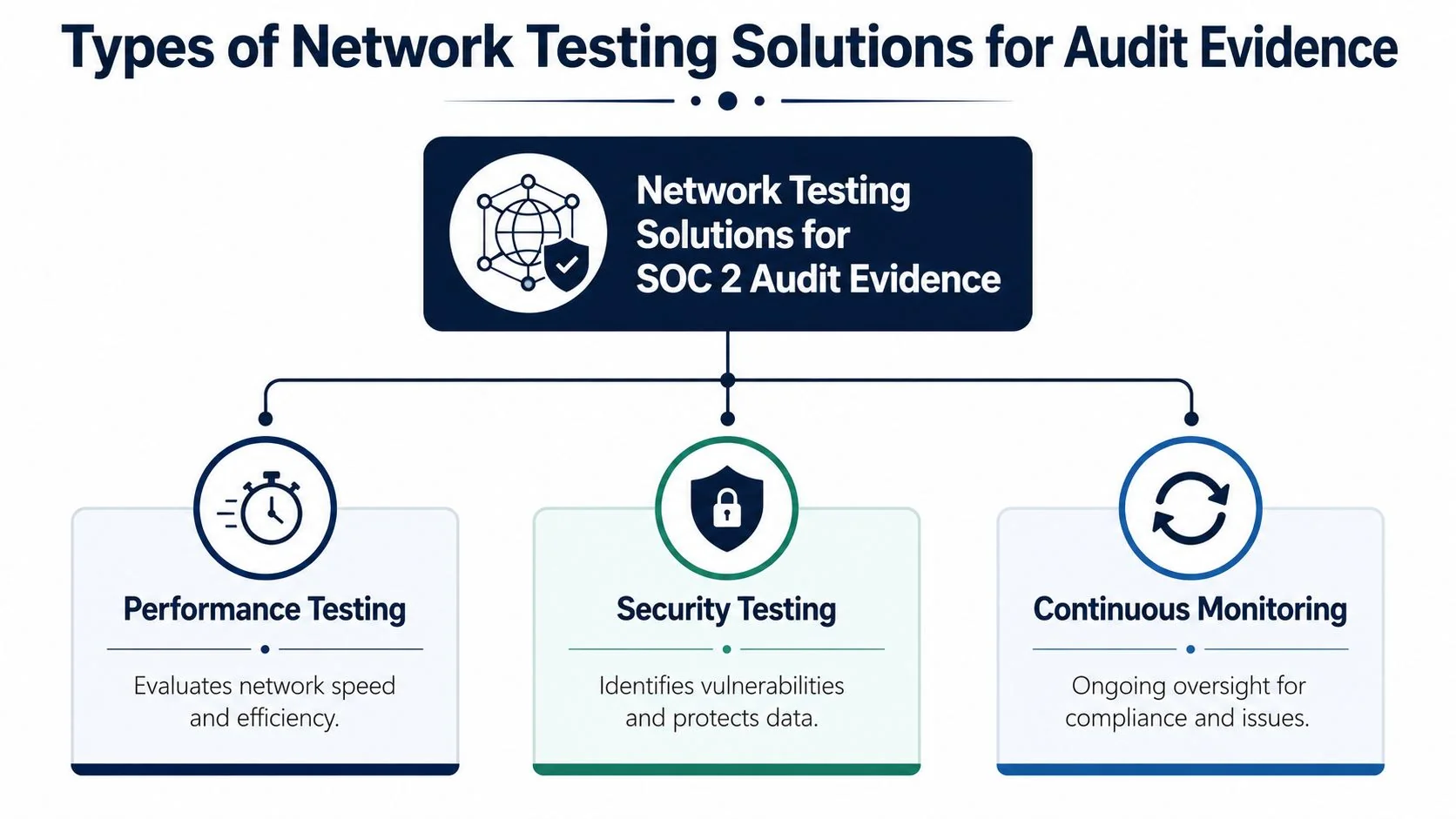
Types of Network Testing Solutions for Audit Evidence
The five Trust Services Criteria are Security, Availability, Processing Integrity, Confidentiality, and Privacy, and network testing provides direct evidence for the Security criterion through penetration testing and vulnerability scanning, and for Availability through performance testing and monitoring, as summarized in HIPAA Journal’s SOC 2 compliance checklist.
Performance testing
Performance testing supports the Availability criterion by showing whether the network can deliver the service levels your business depends on. This includes load testing, stress testing, throughput validation, latency checks, and path analysis.
Tools in this category often include iPerf3 for bandwidth measurement, PingPlotter for continuous latency and route tracing, and synthetic traffic platforms that mimic application behavior without touching production transactions. For audit purposes, the value isn’t the tool name. It’s the baseline and trend history those tools produce.
A useful performance evidence package usually includes:
| Evidence item | Why it matters for SOC 2 |
|---|---|
| Baseline throughput and latency results | Shows expected operating conditions were defined |
| Stress test records before changes | Demonstrates management evaluated availability risk before deployment |
| Exception logs and incident tickets | Proves degraded performance triggered review |
| Capacity trend reviews | Supports planning and control adjustment |
Performance testing tends to fail in audits when teams only test after complaints. That proves reactive troubleshooting, not control operation.
Security testing
Security testing maps to the Security criterion and is often the most scrutinized testing category in a SOC 2 review. This includes penetration testing, vulnerability scanning, configuration validation, and targeted validation of segmentation and exposed services.
Penetration testing gives you a separate evaluation of the environment. Vulnerability scanning gives you recurring visibility between deeper assessments. Together, they show that the organization isn’t waiting for an incident to discover weaknesses.
Security testing matters for SOC 2 because it converts a policy claim like “we protect systems from unauthorized access” into a testable record with findings, severity context, remediation, and retesting.
Continuous monitoring
Continuous monitoring is what turns isolated tests into an auditable system. It captures whether controls were observed over the period, not just on one date. This can include synthetic probes, recurring scans, alerting workflows, change-triggered checks, and periodic review by engineering or security owners.
What works well:
- Scheduled synthetic checks: Good for proving consistency over time.
- Automated scan outputs: Good for showing recurring evaluation.
- Review evidence: Meeting notes, ticket approvals, and sign-offs close the loop.
What doesn’t work well:
- Ephemeral dashboards: Useful in operations, weak in audits if history isn’t retained.
- Unowned alerts: If nobody is assigned to review and resolve them, auditors see noise, not control activity.
- Manual tests with no cadence: Hard to defend as a functioning control.
For SOC 2, the strongest programs combine all three categories. Performance proves service reliability. Security proves control evaluation. Continuous monitoring proves those activities didn’t happen once and disappear.
Essential Testing Metrics and Methods for SOC 2
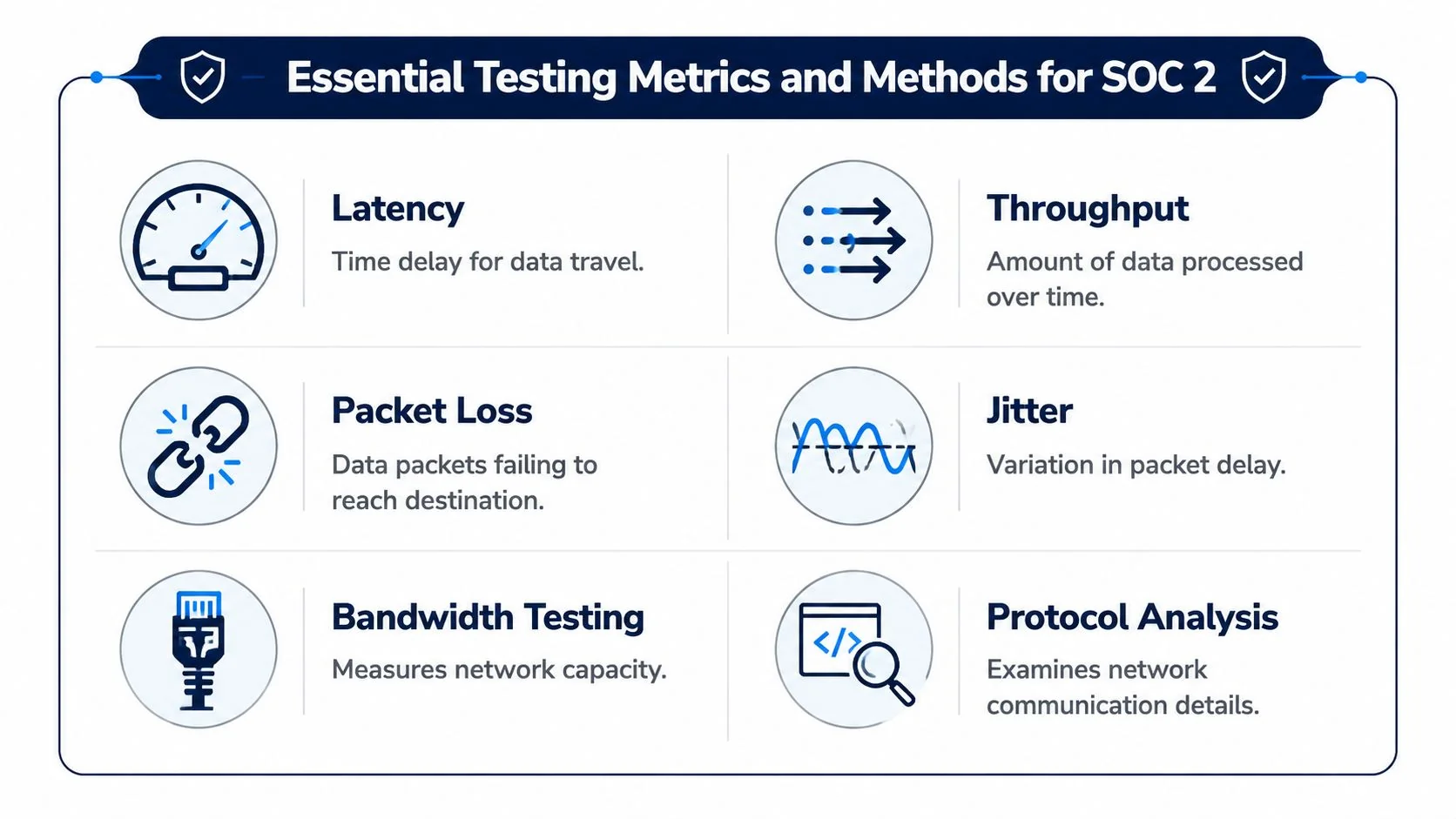
Modern network testing should measure latency, throughput, packet loss, jitter, and bandwidth utilization, and organizations are advised to use continuous synthetic monitoring every 500 milliseconds to 1 minute, run thorough throughput validation weekly, and perform stress testing before major infrastructure changes, according to VIAVI’s 2021 network test survey white paper. For SOC 2, those metrics matter because they turn vague availability claims into dated operational evidence.
The metrics that stand up in an audit
Not every metric deserves equal attention in your evidence file. The ones below usually tell the clearest story:
- Latency: Shows delay across critical paths. Useful for proving acceptable service responsiveness.
- Throughput: Shows whether the network can carry expected workload.
- Packet loss: Helps explain degraded application behavior and unstable sessions.
- Jitter: Important for real-time workloads and any service sensitive to timing variation.
- Bandwidth utilization: Useful for capacity planning and explaining why controls were adjusted.
These metrics become audit-grade when you document three things around them: the expected range, the collection cadence, and the owner who reviews exceptions.
Repeatability matters more than one good result
A single successful test doesn’t prove much. Auditors trust methods they can understand and results they can compare over time. That’s where standardized protocols help. Repeatable benchmarking methods such as RFC 2544 and RFC 9411 matter because they formalize how throughput, latency, and packet loss are measured under stable test conditions, as described in the IETF publication for RFC 9411.
Here’s the practical takeaway. If your testbed shifts every time someone runs a check, you can’t prove cause and effect. If your methodology stays stable, you can show that a configuration change, routing update, or infrastructure migration corresponded with a measurable change in behavior.
Document the method, not just the outcome. Auditors are more comfortable with a modest but consistent testing process than with a pile of high-volume results generated inconsistently.
How to package metrics as evidence
A good evidence set usually includes a concise test record with:
- Scope of the systems or paths tested
- Method used, including tool and test profile
- Date and owner for traceability
- Result summary against the baseline
- Exception ticket or approval note if the result fell outside range
Teams often collect the data but skip the interpretation. That’s a mistake for SOC 2. The auditor needs to see not only that the metric existed, but that management used it as part of control evaluation.
How to Meet SOC 2 Security Testing Criteria
Under SOC 2’s CC4.1 criterion, management must use separate evaluations to check controls, and penetration tests are explicitly recognized as an acceptable evaluation, making them practically required for a successful audit, especially during the Type 2 observation period, as explained in ComplyJet’s analysis of SOC 2 penetration testing.
What counts as credible security testing
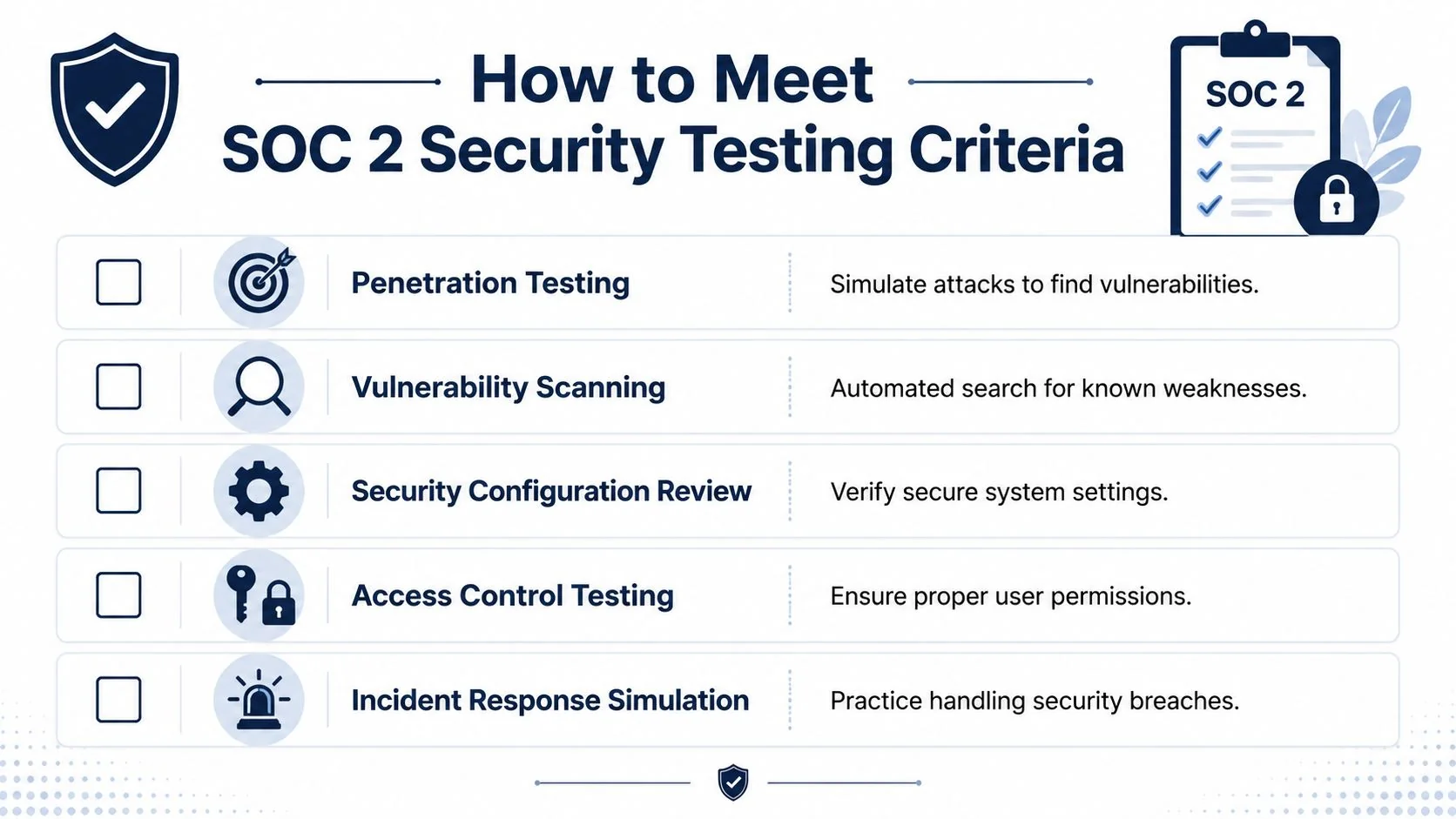
For SOC 2, the strongest network security evidence usually combines several layers:
- Penetration testing: A scoped exercise that validates whether exploitable weaknesses exist in the actual environment.
- Vulnerability scanning: Recurring detection of known weaknesses between formal assessments.
- Security configuration review: Validation that exposure, segmentation, and network-facing controls match policy.
- Access control testing: Confirmation that network access paths and permissions are restricted appropriately.
- Incident response simulation: Evidence that security teams can detect and handle network-related threats.
That combination matters because CC4.1 is about evaluation, not paperwork. A policy saying “we scan” doesn’t satisfy the criterion. A scheduled scanner, retained reports, findings triage, and remediation evidence gets much closer.
What auditors expect in the evidence package
The minimum useful penetration test file isn’t just the PDF from the testing firm. It should include the operating trail around the test.
A defensible package contains:
| Evidence component | Why the auditor cares |
|---|---|
| Defined scope | Confirms what was tested and what was excluded |
| Findings list | Shows weaknesses were identified and categorized |
| Management response | Proves the company reviewed the results |
| Remediation records | Shows action was taken |
| Retest evidence | Confirms fixes were validated |
This is why cheap, surface-level testing often creates more work than it saves. If the output isn’t specific enough to support remediation or mapping to controls, your team still has to reconstruct the evidence later.
Penetration testing and the CC7 series
The CC7 family focuses on identifying and responding to risks and security events. In practice, that means your testing program should connect to ongoing detection and response, not sit in a drawer after delivery. Scan outputs should feed triage. Findings should become tickets. Retests should close the loop.
For a more detailed breakdown of scope, timing, and evidence expectations, review SOC2Auditors’ guide to pen testing.
A penetration test helps in a SOC 2 audit only when the organization can show what it did next.
One more point matters for security-heavy environments. Standard terrestrial testing approaches often miss emerging architectures. Satellite-linked and other non-terrestrial networks can require hardware-in-the-loop testing to emulate orbital dynamics, Doppler shifts, and link variability across different orbit types, which LitePoint discusses in its overview of designing and testing non-terrestrial networks. If your production model depends on those paths, generic scans and basic latency simulation won’t create enough evidence for a serious control review.
Choosing and Implementing Your Network Testing Solution
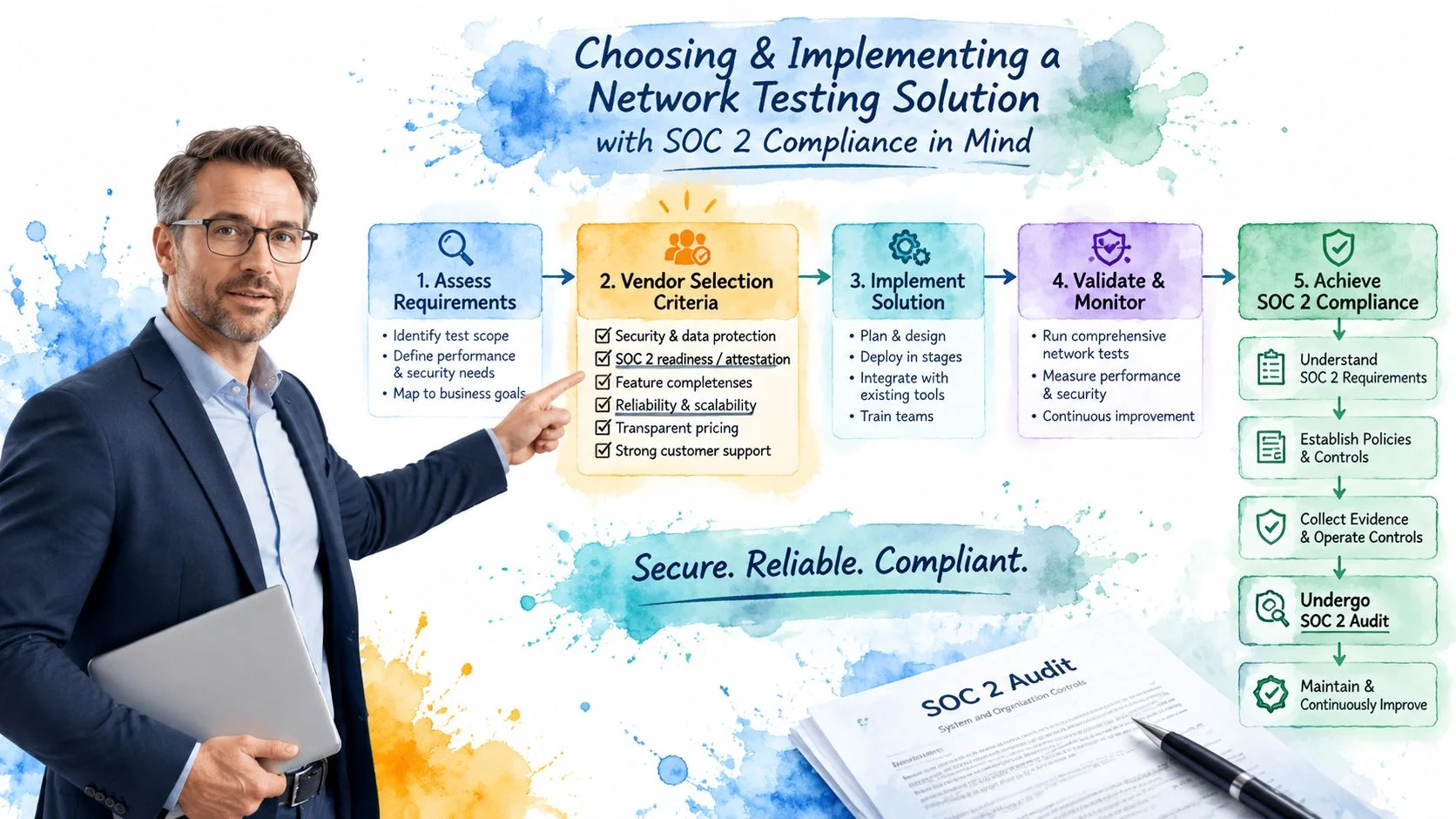
The best network testing solutions for SOC 2 are not always the most feature-rich. They’re the ones that make evidence collection routine, reviewable, and hard to lose.
What to prioritize in a tool decision
A network team may love a tool because it’s fast and flexible. A GRC team may hate it because exports are weak, access history is thin, and the results aren’t easy to archive. For SOC 2, choose platforms and workflows that support both groups.
Prioritize these capabilities:
- Retained reporting: You need durable exports, timestamps, and historical access to prior runs.
- Automation support: Scheduled jobs and recurring test runs reduce evidence gaps.
- Clear ownership: Results should route to named owners, not disappear into a shared inbox.
- Change alignment: Testing should trigger after network redesigns, migrations, and major launches.
- Repository compatibility: Reports should be easy to store in a secure, version-controlled evidence repository.
Open-source tools can work well here. iPerf3 is strong for bandwidth testing. Wireshark is strong for packet-level troubleshooting. PingPlotter is useful for continuous path visibility. FitGap’s overview of benchmark software for networks captures how these tools differ in scope. The trade-off is that open-source stacks often need more internal process design to make outputs audit-ready.
Implementation usually fails on process, not tooling
Most SOC 2 gaps come from weak operating discipline. Teams run the test but don’t define the review step. They fix the issue but don’t preserve the remediation evidence. They monitor the path but don’t connect it to a control owner.
A workable implementation model is simple:
- Set a formal cadence for recurring tests and reviews.
- Define owners for each testing domain and each escalation type.
- Use change-triggered testing after meaningful infrastructure updates.
- Archive every report, finding, and retest in a secure evidence location.
Build around cadence and retention
For SOC 2, a compliant testing cadence includes an annual full network penetration test, additional tests after major infrastructure changes, and continuous automated vulnerability scanning, and all reports and remediation evidence must be archived for the audit, according to Copla’s guidance on SOC 2 pentest requirements.
That requirement changes how you should implement the program. Don’t build around whichever engineer remembers to run the tool. Build around policy, schedule, workflow, and retention. The tool is only one component of the control.
Turning Network Tests into Audit Readiness
A mature testing program does more than find network issues. It shows that management has a structured way to evaluate controls, identify breakdowns, respond to findings, and preserve evidence. That’s why the strongest SOC 2 programs treat network testing solutions as part of governance, not just infrastructure operations.
What good evidence looks like in practice
Strong audit readiness usually comes from combining several layers of proof:
- Performance evidence that supports Availability through recurring baselines, trend reviews, and change validation.
- Security evidence that supports Security through penetration tests, scans, remediation logs, and retests.
- Monitoring evidence that shows controls operated over time rather than once before the auditor asked.
The pattern is straightforward. Define what you test. Run it on a documented cadence. Review exceptions. Fix what matters. Preserve the trail.
Good network testing doesn’t just reveal technical truth. It creates institutional memory that an auditor can inspect.
Common failure points
Teams usually struggle in the same places:
| Failure point | Audit consequence |
|---|---|
| No formal test cadence | Hard to prove consistent control operation |
| Reports stored ad hoc | Evidence goes missing during fieldwork |
| Findings fixed without retest | Auditors question whether remediation worked |
| Monitoring without documented review | Alerts exist, but control ownership is unclear |
If you want an external perspective before the audit starts, use a structured pre-audit assessment guide to find the evidence gaps early.
A company is audit-ready when its network testing program produces repeatable, reviewable evidence tied to the relevant Trust Services Criteria. For SOC 2, that means performance testing that supports Availability, security testing that satisfies expectations around separate evaluations and threat detection, and monitoring records that show control effectiveness over the observation period. A disciplined program shortens audit fieldwork, reduces follow-up requests, and gives your auditor a cleaner path to concluding that your controls were present and functioning. If you need help choosing the right audit firm once that evidence foundation is in place, SOC2Auditors can help you compare options and move toward SOC 2 audit readiness with more confidence.
Need help selecting an audit firm after your testing evidence is in shape? Compare SOC 2 auditors on SOC2Auditors.
More in Audit Preparation